"A much-needed monograph on the role of Sephardic Jews in Argentina, and . . . an important contribution to the study of Jews in Latin America overall" (
Choice).
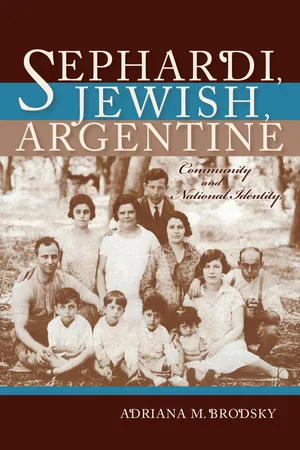
At the turn of the twentieth century, Jews from North Africa and the Middle East were called Turcos ("Turks"). Seen as distinct from Ashkenazim, Sephardi Jews weren't even identified as Jews. Yet the story of Sephardi Jewish identity has been deeply impactful on Jewish history across the world. Adriana M. Brodsky follows the history of Sephardim as they arrived in Argentina, created immigrant organizations, founded synagogues and cemeteries, and built strong ties with coreligionists around the country.
Brodsky demonstrates how fragmentation based on areas of origin gave way to the gradual construction of a single Sephardi identity. This unifying identity is predicated both on Zionist identification (with the State of Israel) and "national" feelings (for Argentina), and that Sephardi Jews assumed leadership roles in national Jewish organizations once they integrated into the much larger Askenazi community.
Rather than assume that Sephardi identity was fixed and unchanging, Brodsky highlights the strategic nature of this identity, constructed both from within the various Sephardi groups and from the outside, and reveals that Jewish identity must be understood as part of the process of becoming Argentine.
- 298 pages
- English
- ePUB (mobile friendly)
- Available on iOS & Android
eBook - ePub
About this book
Trusted by 375,005 students
Access to over 1.5 million titles for a fair monthly price.
Study more efficiently using our study tools.
Information
ONE
BURYING THE DEAD
Cemeteries, Walls, and Jewish Identity in Early Twentieth-Century Argentina
Jews bury themselves the way they live.
Nathan Englander, The Ministry of Special Cases
Only death requires that we be precise.
Yehuda Amichai, “The Clouds Are the First Fatalities”1
THERE LIES AN OLD WALLED-IN JEWISH CEMETERY IN AVELlaneda, a suburb to the south of Buenos Aires. The tombs, still bearing sepia pictures of the deceased and blurred Yiddish inscriptions, were once adorned with expensive marble monuments; now they are almost all destroyed by the passage of time, occasional vandalism, and a wish to forget. The cemetery abuts that of the Moroccan Jewish congregation, and the differences between the two graveyards could not be starker. In contrast to the unkempt grass and damaged tombs of the walled cemetery, that of the Moroccan Jews displays carefully maintained and finely decorated monuments.
The identity of those buried in the walled cemetery holds the key to understanding this vivid contrast. They were members of the Zwi Migdal, an infamous mutual aid association of Jewish pimps and madams involved in the international traffic of Jewish women known as “white slavery.”2 The embarrassing presence of large numbers of organized Jewish pimps and prostitutes threatened the broader Jewish community’s standing within Argentine society—precisely because these outlaws insisted on identifying themselves as Jews—in early twentieth-century Buenos Aires, which already had a reputation as “the capital of vice.” Shunned by the broader community, the traffickers nevertheless worked to create and sustain their own Jewish institutions, such as the cemetery, and a synagogue. The Zwi Migdal had originally requested burial space from the majority Ashkenazi community but was “informed that the separation between purity and impurity was extended even to the dead.”3 Its members were thus forced to establish their own cemetery, outside communal boundaries. Although the small Sephardi Moroccan community eventually shared a common wall with the Zwi Migdal, even they carefully walled the cemetery off, and left to neglect the burial ground of the “impure” when the organization was dismantled by the Argentine police in 1930.
Walls went up among “pure” Jews, as well. The four main Sephardi immigrant groups, as soon as they arrived in Buenos Aires, organized burial societies, raised money, and negotiated with Argentine authorities, among themselves, and with Ashkenazim to purchase lots to bury their dead. By 1957, Sephardi societies had founded six separate cemeteries close to the city of Buenos Aires, and had opened up five burial grounds (see figure 1.1 and table 1.1). Some of these groups shared land, but their dead lay separated by walls.
Outside Buenos Aires, however, Sephardim tended to be less divided by origin when founding their cemeteries. In towns across Argentina, Sephardim usually came together to bury their dead, even sharing these cemeteries with Ashkenazim, at first. Ashkenazim would eventually open up their own burial grounds, sometimes a single wall away from Sephardim. Yet in even smaller provincial towns the Jewish community, represented by a handful of members from differing origins, Ashkenazim and Sephardim, managed to achieve unity inside one cemetery wall.
The walls that Jews built around their dead are the focus of this chapter. Anthropologist Fredrik Barth argued that ethnic groups are defined by the boundaries that enclose them rather than by the “cultural stuff” encircled within. These social boundaries are, of course, not static; they are modified and validated through interaction with others, an ongoing process that makes it necessary to continually redefine the line that divides those inside from those outside. This theory places “difference” at the center, as ethnic boundaries delineate just that. In Barth’s words, the boundary “implies a recognition of limitations on shared understandings, differences in criteria for judgment of value and performance, and a restriction of interaction to sectors of assumed common understanding and mutual interest.”4 Such difference is not likely to disappear even though ethnic groups live in constant interaction with others. “The persistence of ethnic groups in contact,” contends Barth, “implies not only criteria and signals for identification, but also a structuring of interaction which allows the persistence of cultural difference.”5 Stuart Hall likewise favors a definition of cultural identity which incorporates “difference” as constitutive of that identity.6 In a discussion of diasporic communities, he claims that they do share a common element, yet that essential element is also necessarily modified by what the community becomes in each diasporic context. The idea of “difference” is stressed brilliantly by Daniel Boyarin and Jonathan Boyarin: “diasporic cultural identity teaches us that cultures are not preserved by being protected from ‘mixing’ but probably can only continue to exist as a product of such mixing.”7

Figure 1.1. Jewish cemeteries close to Buenos Aires. For key, see Table 1.1, p. 28.
Table 1.1. Jewish Cemeteries Close to Buenos Aires

Using Barth’s and Hall’s focus on difference as central to ethnic identity, I argue that the walls around the dead built by Sephardim and Ashkenazim in Argentina show how ethnic, subethnic, and diasporic identities were understood and experienced, and how these separations were informed by local realities. In this chapter, we see that what so outraged Ashkenazi Rabbi Joseph regarding Moroccan Jews in Buenos Aires “and their ridiculous [burial] practices,” which signaled to him the need for Ashkenazim to found a separate burial ground, did not bother Ashkenazim in Vera, in the Santa Fé province, when they came to be buried among Moroccan Jews. The issues that prompted the creation of six different Sephardi cemeteries close to the city of Buenos Aires were not apt in provincial settings, in which the Jewish population overall (and Sephardim in particular) was small. Cemetery walls underscored differences between many groups: Jews (Ashkenazim and Sephardim) from non-Jews in towns with a small Jewish population; Sephardim (regardless of origin) from Ashkenazim in larger provincial cities; and Sephardim from other Sephardim around Buenos Aires. But this chapter also shows that those differences could be overcome, even if for short periods, so that Jews in Argentina, Sephardim and Ashkenazim, Moroccan, Arabic, and Ladino speakers could negotiate common walls or shared burial grounds. The boundaries around these groups were thus not marking essential differences, but delineating strategic ones; they were malleable indeed.
Scholars have studied cemeteries for a variety of reasons. Latin American historians in particular have focused on cemeteries in order to understand the contested process of secularization that wrought control of cemeteries from the church to the state after the Wars of Independence.8 These studies have drawn connections between new cemeteries and modern discourses on medicine and health, as secularization was embedded in the larger project of Latin American modernization. Ethnic cemeteries and ethnic societies that provided burial in city cemeteries have also been the focus of several studies.9 These have stressed the persistence of ethnic identity in the new lands, and the role played by death in accentuating ethnic loyalties. Jewish cemeteries in particular have received much scholarly attention. In many cases, the focus of these works has been the historical recovery of Jewish presence in areas where Jews no longer live.10 My reading of Jewish/Sephardi cemeteries aims to uncover the contested nature of the walls that encircled and divided the dead, as well as the dialogues that death spurred and made possible among the living.
THE FIRST JEWISH ARGENTINE CEMETERIES IN SANTA FÉ
Jewish cemeteries were founded in JCA colonies as they were created. The first dates from 1891, founded in the colony of Moisesville in the province of Santa Fé.11 Like the schools, synagogues, and libraries built in the colonies, the cemeteries belonged to the JCA, and it was not until later that they were sold to each colony’s Ḥevra Kedusha (Burial Society).12 In any Jewish community, this organization’s main role is the preparation and care of the body for ritual interment, but besides its burial function, the Ḥevra Kedusha purchases a plot for the construction of the cemetery and then oversees its maintenance. This role usually involves dealing with secular authorities in obtaining licenses and passing inspections.
What would become the first Sephardi cemetery was founded in the city of Santa Fé in 1895. Unlike the many ethnic groups who came to the province to work the land, the Sephardim in the capital city were not colonists themselves, but rather lived off the increasing activity brought about by colonization. The population of the province exploded, as evidenced by the number of towns, which went from four in 1869 to sixty-two in 1895.13 It was in these small villages that Sephardim settled. In the city of Santa Fé, for example, in 1886 and 1887, a few Moroccan Jews bought permits (patentes) to sell goods out of humble “stores,” which were no more than movable trays on wheels. By 1895, several Jews had managed to buy their own, more permanent shops in key locations such as the city’s commercial area and around the train station, and had founded their first institutions.14
The cemetery was a Jewish, not exclusively Sephardi, burial ground when it opened. In fact, the first interment was the reburial of an Ashkenazi child who had died in 1892, and was probably originally buried in the municipal cemetery.15 The first burial was an Ashkenazi boy, as well. The only Jewish organization in town, the Ḥevra Kedusha that bought the cemetery, was founded by forty members, of whom seven were Ashkenazim.16 The cemetery became Sephardi in 1915, with the founding of an Ashkenazi Ḥevra Kedusha and the subsequent purchase of a plot in 1916 for their own dead.
It is unclear what prompted the Ashkenazim to invest in their own plot in this case. But Santa Fé’s Jewish cemeteries, the first in Argentina, confirm important contentions. First, that the history of Ashkenazi Jews in Argentina requires a careful look at Santa Fé, along with Entre Ríos, Buenos Aires, La Pampa, and Santiago del Estero, as these were the areas where the JCA founded their agricultural colonies. Yet the location of the first Sephardi cemetery reminds us that we should also look to the interior of the country to find the first vestiges of Sephardi life. The opening of the Sephardi cemetery on June 5, 1895, also shows that the provincial government had by then clearly recognized that religious minorities had the right to bury their dead in their own space and following their own traditions. In 1867, the province of Santa Fé had taken cemeteries away from the control of the church, and placed them under the jurisdiction of municipal governments. The city of Santa Fé, following this decree, reserved a part of the local cemetery for “Arabs, Jews, and Protestants.”17 But in 1871, the provincial government, through another decree, made it possible for the various religious communities to have their own cemeteries rather than share space in the municipal burial grounds. Taking advantage of this provision, the small Jewish community raised the money to buy a lot adjacent to the city cemetery. These acts—the creation of a Ḥevra Kedusha, the raising of funds, the purchase of the property—are also evidence of a commitment to maintain the cemetery rather than use the existing section in the municipal cemetery. The fact that there were no recorded burials in June 1895 indicates the purchase and creation of the cemetery had not been prompted by an individual’s death or an epidemic. Jews were in Santa Fé to stay. This story further suggests that (only) from 1895 to 1916, Ashkenazim and Sephardim had found ways to negotiate their differences in order to embark on a common project.
BUENOS AIRES: FROM NO JEWISH CEMETERY TO TWO JEWISH CEMETERIES
Before the two Jewish cemeteries opened in the first years of the twentieth century, Jews in Buenos Aires had solved their burial needs by using the (second) Dissidents’ Cemetery,18 a term given to burial grounds not consecrated by the Catholic Church, so both Jews and Protestants were allowed to follow their own burial traditions there. This cemetery, on the outskirts of Buenos Aires at its founding, was closed in 1892, as the expanding city encroached on its borders; the remains were disinterred and relocated to burial grounds farther outside city limits. The British and German communities obtained from the city government a parcel (Disidente Section) in the recently opened Cementerio del Oeste (Western Cemetery), later to be named Cementerio de la Chacarita (Chacarita Cemetery), and Jews continued to bury their coreligionists alongside the dead of these communities until 1900 (see table 1.2).19 But by 1898, it was clear that the British and German community section could not accommodate the growing Jewish community...
Table of contents
- Cover
- Title Page
- Copyright
- Contents
- · Note about Translation and Transliteration
- · Note on Previously Published Material
- · Acknowledgments
- Introduction
- 1 Burying the Dead: Cemeteries, Walls, and Jewish Identity in Early Twentieth-Century Argentina
- 2 Helping the Living: Philanthropy and the Boundaries of Sephardi Communities in Argentina
- 3 The Limits of Community: Unsuccessful Attempts at Creating Single Sephardi Organizations
- 4 Working for the Homeland: Zionism and the Creation of an “Argentine” Sephardi Community after 1920
- 5 Becoming Argentine, Becoming Jewish, Becoming and Remaining Sephardi: Jewish Women and Identity in Twentieth-Century Argentina
- 6 Marriages and Schools: Living within Multiple Borders
- · Postscript
- · Notes
- · Bibliography
- · Index
Frequently asked questions
Yes, you can cancel anytime from the Subscription tab in your account settings on the Perlego website. Your subscription will stay active until the end of your current billing period. Learn how to cancel your subscription
No, books cannot be downloaded as external files, such as PDFs, for use outside of Perlego. However, you can download books within the Perlego app for offline reading on mobile or tablet. Learn how to download books offline
Perlego offers two plans: Essential and Complete
- Essential is ideal for learners and professionals who enjoy exploring a wide range of subjects. Access the Essential Library with 800,000+ trusted titles and best-sellers across business, personal growth, and the humanities. Includes unlimited reading time and Standard Read Aloud voice.
- Complete: Perfect for advanced learners and researchers needing full, unrestricted access. Unlock 1.5M+ books across hundreds of subjects, including academic and specialized titles. The Complete Plan also includes advanced features like Premium Read Aloud and Research Assistant.
We are an online textbook subscription service, where you can get access to an entire online library for less than the price of a single book per month. With over 1.5 million books across 990+ topics, we’ve got you covered! Learn about our mission
Look out for the read-aloud symbol on your next book to see if you can listen to it. The read-aloud tool reads text aloud for you, highlighting the text as it is being read. You can pause it, speed it up and slow it down. Learn more about Read Aloud
Yes! You can use the Perlego app on both iOS and Android devices to read anytime, anywhere — even offline. Perfect for commutes or when you’re on the go.
Please note we cannot support devices running on iOS 13 and Android 7 or earlier. Learn more about using the app
Please note we cannot support devices running on iOS 13 and Android 7 or earlier. Learn more about using the app
Yes, you can access Sephardi, Jewish, Argentine by Adriana M. Brodsky in PDF and/or ePUB format, as well as other popular books in Social Sciences & Jewish History. We have over 1.5 million books available in our catalogue for you to explore.