Stories of the runaway slaves who left their spirits behind. "An easy read and an odd collection of tales of murders, mayhem, madness, and sadness." —
Folklore
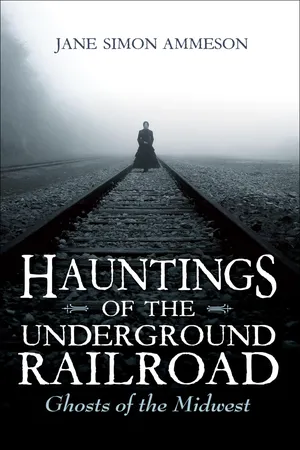
Before the Civil War, a network of secret routes and safe houses crisscrossed the Midwest to help African Americans travel north to escape slavery. Although many slaves were able to escape to the safety of Canada, others met untimely deaths on the treacherous journey—and some of these unfortunates still linger, unable to rest in peace. In
Hauntings of the Underground Railroad: Ghosts of the Midwest, Jane Simon Ammeson investigates unforgettable and chilling tales of these restless ghosts that still walk the night. This unique collection includes true and gruesome stories, like the story of a lost toddler who wanders the woods near the Story Inn, eternally searching for the mother torn from him by slave hunters, or the tale of the Hannah House, where an overturned oil lamp sparked a fire that trapped slaves hiding in the basement and burned them alive. Brave visitors who visit the house, which is now a bed and breakfast, claim they can still hear voices moaning and crying from the basement. Ammeson also includes incredible true stories of daring escapes and close calls on the Underground Railroad. A fascinating and spine-tingling glimpse into our past,
Hauntings of the Underground Railroad will keep you up all night.
- English
- ePUB (mobile friendly)
- Available on iOS & Android
eBook - ePub
About this book
ONE
Phantom of the Cellar
SLIPPERY NOODLE INN INDIANAPOLIS, INDIANA
A type of ghostly meet-and-greet place, the Slippery Noodle Inn on South Meridian Street in Indianapolis has attracted an assortment of spirit residents for more than 170 years. It’s a former stop on the Underground Railroad, and at least one of those haunting the place is a runaway slave.
“We’ve got a lot of ghosts,” says owner Hal Yeagy. “That’s because a lot has happened here since the place opened.”
Indeed, this is the oldest bar in the state, and there seems to be no end to the phantom-producing incidents, which Yeagy is more than happy to list.
“In 1912, one of the customers got into a fight with another customer over a girl and stabbed him, leaving the bloody knife on the bar,” says Yeagy, whose parents bought the business in 1963 when he was about six. “Of course, when the police came, no one had seen a thing.”
Add to that the suicide in the basement of a former owner, the death of a three-year-old who was playing with matches and caught on fire, and a customer who, after shooting another man, said in wonderment, “I don’t know why I did that.” During Prohibition, both the Brady and the Dillinger gangs used what had been a livery in the back of the saloon for target practice. Pigs and cattle were slaughtered in the basement (you can still see the meat hooks used to hang the carcasses), and liquor was distilled and beer brewed down there as well.

In its more than 160 years in business, the Slippery Noodle Inn, a stop on the Underground Railroad, has attracted its share of ghosts, including George, a relic from the Underground Railroad days who stays in the basement. Photo courtesy of Hal Yeagy.
And while we’re not saying he’s haunting the place, back in the day, James Whitcomb Riley tipped more than a few drinks in the bar—not an atypical occurrence for the famed Hoosier poet.
“There was a pumpkin patch between here and the train station just up the street and supposedly Riley, after drinking too much at the bar, fell asleep on his way home right in front of the pumpkins,” says general manager Marty Bacon, who has worked at the Slippery Noodle for a quarter of a century. “When he awoke amongst the pumpkins, he felt inspired and wrote his famous poem ‘When the Frost Is on the Punkin.’”
Ah … poetic inspiration comes from many sources.

Through the decades, staff at the Slippery Noodle Inn have learned to get along with the spirits, some of whom have been there longer than anyone else. Photo courtesy of Hal Yeagy.
Yeagy isn’t sure how old the building is—Indianapolis title records from 1920 and before were mostly destroyed when the city flooded, he says—but he’s been able to trace it back to 1850 when it was the Tremont House.
“They were trying to be fancy with the name,” he says, noting that it was a railroad hotel offering guests food, drink, and a place to stay.
Over the years, its name changed more than once. In the 1860s it became the Concordia House, named after the Concord, the first German Lutheran immigrant ship to land in the United States. The next name—the Germania House—continued to reflect the heritage both of the owners and of the patrons in this predominantly German section of Indianapolis. But when World War I started and being German wasn’t necessarily cool, the owner, whose last name was Beck, dropped Germania and changed the name to Beck’s Saloon. Before Prohibition, Walter Moore bought the business.
“It became Moore’s Saloon until Prohibition, so then they called it Moore’s Restaurant but you could still drink, and then Prohibition ended and it was called Moore’s Saloon again,” says Yeagy.
Whatever the name, for a long time it functioned as a hotel as well as an eatery.
Guests slept in the small rooms off the long hallway on the second floor, where at the end there was a communal bathroom with an old claw-foot tub. We’re not sure who was in charge of cleaning that tub; it’s a subject we don’t want to think about too much. By the mid-twentieth century some of these rooms were no longer used for sleeping but for working gals entertaining gentlemen in exchange for cash.
While UGRR sites are typically undocumented, the building itself yields clues as to its history as a stop on the Underground Railroad, says Yeagy.
“The basement floor was dug down deeper than it needed to be,” he says. “And there are all sorts of little rooms that you kind of have to half bend over to get into.”
There is even more proof. When Yeagy’s parents, Harold and Lorean, were still running the place, a family came in. They had an ancestor who was a fugitive slave and they wanted to see what the inn looked like.
“They said their relative had stayed here because it was a part of the Underground Railroad and they had these bits of a diary he’d written talking about it,” says Yeagy. “It makes sense. Indiana was a free state and at the time we were located on the southern end of the city, which would be a good location. And near the railroad station, there were always a lot of people coming and going.”
Though Yeagy has never actually seen an apparition, he’s had lots of strange experiences at the Slippery Noodle.
“When I took over in 1984 the place was literally just the front bar room where we had five or six bright orange booths and ice cream parlor stools,” he says. “The place was a mess. The ceiling upstairs was falling in. I was the only one working there and I still had my other job. I had people help and I was remodeling the back room. My girlfriend Carol at the time, now my wife, would help me. I had everything padlocked up, there were steel gates, which I would close. When we got back in the morning, the steel gates would be open and the two-by-fours I was using would be stacked up. It was scary the first few times but then I figured, what the heck.”
Yeagy’s felt the cold spots. When he’s working late at night in his office on the second floor, the only person in the buildings, he hears footsteps, doors closing, and someone calling his name. The ghosts also have some tech skills—all the music on Yeagy’s computer was deleted.
“We had everything backed up but still,” says Yeagy. “A lot of things get moved around. But most of what I experience is just the overall feel of the place. I talk to the ghosts all the time.”
When Yeagy’s son Brian began posting about ghostly incidents on the Slippery Noodle’s Twitter feed, the ghostly happenings increased to the point that Yeagy decided to delete the tweets.
“We were just getting too much activity,” he says. “It was just getting them too riled up.”
One time, things got a little strange—more than the usual activity and cold spots and things going bump in the night. No one knew exactly what was going on until they got a call from Carol Yeagy’s sister. She’s an empath, someone so in tune to other’s feeling that it’s painful for her to go out of the house.
“She called us up,” Yeagy says about his sister-in-law, “and told us that a new ghost had moved in and he’s scaring the other ghosts. She says I’ll get him out, and within a few days, it was like a black veil being lifted or a dark cloud being blown away. Bad things stopped happening and the employees were happier.”
As for Marty Bacon, well, he says he’s been around so long (he started as a bouncer in 1991), he thinks the ghosts have come to know him. He says he talks to them sometimes and also leaves a shot of whiskey on the bar in case one of the spooks is thirsty. He’s heard doors slamming and footsteps on the floorboards even when he was the only one in the building. Voices call his name, sometimes in a very demanding way.
The first time he was alone and something unusual happened, Bacon thought someone had hidden in the restaurant until everyone had left. So he searched, but no one was there. For the most part he’s okay with the ghosts, but there’s one he calls the shadow man, a shadowy apparition who “creeps him out.”
“Our big music room used to be the stable where people would keep their horses when they’d come in to get a drink or spend the night. Upstairs was the hayloft which are now offices and storage,” says Bacon. “One time I was leading a psychic and twenty people around and the psychic says there’s the Boss and I’m one of his employees.
“He owned the stable and keeps his lockbox up here—he’s a heavyset white guy with a pitted face,” says Bacon, recalling the description the psychic gave them.
Turns out that “the Boss” didn’t like Bacon—maybe he resented another “boss” being around.
“The psychics—this one was from New Orleans—said the other spirits respected me except for the one guy, the Boss, and she said he bumps into you.”
“It gave me cold goosebumps,” says Bacon. “My grandmother used to say when that happened it was like someone had stepped on your grave.”
The Boss needed a little help but was finally convinced to move on. But as one ghost leaves, more come, says Bacon.
“According to the psychic from New Orleans, we’ve been around so long, we’ve become like a spirit magnet,” he says. “When they tear down one of the old houses around here, then the spirits come here because they’re comfortable here and because we’re old.”
Though most of the people who work at the inn who’ve experienced the ghostly ambience say the basement is the most haunted, Bacon finds that most of his experiences happen on the main floor in the back bar area or upstairs in the office. There’s Sara, the apparition dressed in a long blue turn-of-the-last-century dress who is sad because one of her customers killed her. How do they know her name? Several staff members took an Ouija board to where the Lady in Blue hangs out—often upstairs where the hotel rooms were or on a balcony overlooking the stage. The planchette spelled out her name. The lady in blue was the madam of the bordello and she’s angry because the place isn’t the same anymore.
One employee heard pounding footsteps coming after him in the basement and started running for the stairs. The footsteps got louder and faster behind him, but once he got upstairs he was okay. The whole experience left him shaken. But, mostly, the ghosts are just part of the team working at the Noodle.
Bacon thinks he’s figured out which ghost hails back to the Underground Railroad.
“It’s probably George,” he says. “George is an older black man in denim overalls and is down in the basement. One of the psychics says that he did odd jobs and helped people who were on the Underground Railroad get out.”
George is a friendly spirit and doesn’t bother anyone. Whether he’s helping the same UGRR travelers as he did back then, Yeagy and Bacon don’t know. He’s just there. One of their beer distributors ran into George in the narrow hallway of the basement and when he went upstairs and asked about the other man, he was told there was no one down there but him.
“He refuses to come back and all the guys he works with make fun of him,” says Bacon.
A woman making deliveries also ran into George and she nodded at him and he nodded back. She found out later he was a ghost.
But George, Sara, and the other spirits don’t bother Yeagy or Bacon. As for the other ghosts, now that the Boss and the spirit who was scaring the other spirits are gone, the two men are rather philosophical about the remaining spooks.
“I figure they’re a lot better than some customers,” says Bacon. “A ghost isn’t going to drink my booze or take my money.”
BONAPARTE’S RETREAT NAPOLEON, INDIANA
Southeastern Indiana, with its scenic panoramas of the Ohio River, hillsides dotted with farms, and nineteenth-century towns, is a beautiful slice of Hoosier homeland, a seemingly placid and gentle place. But back in the mid-1800s, there were invisible trails through this pastoral prettiness, and it’s estimated that there were some three hundred sites in southeastern Indiana where people hid or helped runaway slaves. Because the Underground Railroad was a secret organization that survived only by stealth, much of the history of those who helped, those who traveled its routes, and even where they stayed has been lost. But there are still remnants—a home here, a historic marker there—that tell the story.

Once known as the Railroad Inn, Bonaparte’s Retreat in Napoleon, Indiana, was a stop on the Underground Railroad. Charlie, the ghost who lives in the basement, was a runaway slave who continued to help others make their way to freedom. Photo courtesy of Kendal Miller.

The Central House in Napoleon, Indiana, is said to be haunted by Underground Railroad ghosts. Photo courtesy of Kendal Miller.
And sometimes there’s even more than that. In the small hamlet of Napoleon, William Love and William Howe bought a brick tavern in 1852. Like many new owners, they modified the 1832 building’s design, adding a few special touches for their ultimate goal—becoming a station on the UGRR as it coursed through Ripley County.
Love renamed the tavern the Railroad House Hotel, a dig at slave seekers. The only railroad in the small town was the underground one. And even after all these years, both the physical and astral aspects of that time remain.
“There’s a dead space between two walls and then a hidden room and tunnel on the south side of the building that no one knew about,” says former county historian Helen Einhaus about what is now a busy restaurant called Bonaparte’s Retreat.
The room was only accessible by the trap door from inside the tavern—a drop of ten ...
Table of contents
- Cover
- Title Page
- Copyright
- Contents
- Preface
- 1 Phantom of the Cellar
- 2 Spirits of the Waters
- 3 Sold down the River: The Reverse Underground Railroad
- 4 Lincoln Walks at Midnight
- 5 Outwitting the Devil
- 6 Ghostly Overload
- 7 A Room with a Ghoul
- 8 John Hunt Morgan
- 9 The Last Trip Home
- 10 Michigan’s Haunted Underground Railroad
- 11 The Conductor and the Slave: The Story of Levi Coffin and William Bush
- 12 Restless Spirits
- 13 There Should Be Ghosts!
- Selected Bibliography
Trusted by 375,005 students
Access to over 1.5 million titles for a fair monthly price.
Study more efficiently using our study tools.
Information
Publisher
Quarry BooksYear
2017Topic
HistoryPrint ISBN
9781626195615
Subtopic
African American HistoryeBook ISBN
9780253031297
Index
HistoryFrequently asked questions
Yes, you can cancel anytime from the Subscription tab in your account settings on the Perlego website. Your subscription will stay active until the end of your current billing period. Learn how to cancel your subscription
No, books cannot be downloaded as external files, such as PDFs, for use outside of Perlego. However, you can download books within the Perlego app for offline reading on mobile or tablet. Learn how to download books offline
Perlego offers two plans: Essential and Complete
- Essential is ideal for learners and professionals who enjoy exploring a wide range of subjects. Access the Essential Library with 800,000+ trusted titles and best-sellers across business, personal growth, and the humanities. Includes unlimited reading time and Standard Read Aloud voice.
- Complete: Perfect for advanced learners and researchers needing full, unrestricted access. Unlock 1.5M+ books across hundreds of subjects, including academic and specialized titles. The Complete Plan also includes advanced features like Premium Read Aloud and Research Assistant.
We are an online textbook subscription service, where you can get access to an entire online library for less than the price of a single book per month. With over 1.5 million books across 990+ topics, we’ve got you covered! Learn about our mission
Look out for the read-aloud symbol on your next book to see if you can listen to it. The read-aloud tool reads text aloud for you, highlighting the text as it is being read. You can pause it, speed it up and slow it down. Learn more about Read Aloud
Yes! You can use the Perlego app on both iOS and Android devices to read anytime, anywhere — even offline. Perfect for commutes or when you’re on the go.
Please note we cannot support devices running on iOS 13 and Android 7 or earlier. Learn more about using the app
Please note we cannot support devices running on iOS 13 and Android 7 or earlier. Learn more about using the app
Yes, you can access Hauntings of the Underground Railroad by Jane Simon Ammeson in PDF and/or ePUB format, as well as other popular books in History & African American History. We have over 1.5 million books available in our catalogue for you to explore.