- 399 pages
- English
- ePUB (mobile friendly)
- Available on iOS & Android
eBook - ePub
About this book
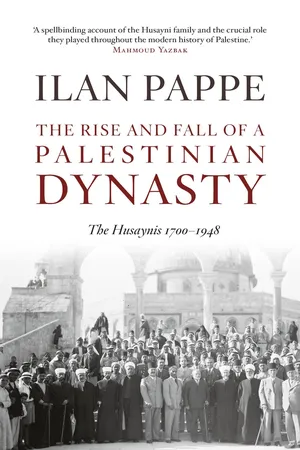
'Along with Edward Said, Ilan Pappe is the most eloquent writer of Palestinian history.' New Statesman The Husayni family of Jerusalem dominated Palestinian history for 250 years, from the Ottoman times through to the end of the British Mandate. At the height of the family's political influence, positions in Jerusalem could only be obtained through its power base.In this compelling political biography, Ilan Pappe traces the rise of the Husaynis from a provincial Ottoman elite clan into the leadership of the Palestinian national movement in the twentieth century. In telling their story, Pappe highlights the continuous urban history of Jerusalem and Palestine. Shedding new light on crucial events such as the invasion of Palestine by Napoleon, the decline of the Ottoman Empire, World War I and the advent of Zionism, this remarkable account provides an unforgettable picture of the Palestinian tragedy in its entirety.
Trusted by 375,005 students
Access to over 1.5 million titles for a fair monthly price.
Study more efficiently using our study tools.
Information
Print ISBN
9780863564604
Subtopic
Middle Eastern HistoryCHAPTER 1
The Making of a Family
From al-Ghudayya to al-Husayni
On the first day of the year 1765, Mehmet Aga, the chief eunuch in the harem of the sultan, was awakened by a strong but pleasant odor. It was the scent of soap, familiar to him ever since that ‘Arab Abd al-Latif’ (Abd al-Latif II) was appointed naqib al-ashraf in Jerusalem. The latter had a small soap manufactory in Jerusalem, and many in the palace had become partial to its soaps and vials of rose water. The chief eunuch was especially fond of soaking in a rose water bath, but his supply had recently run out. Now he got out of bed as briskly as his great bulk allowed and prepared to meet Abd al-Latif’s emissaries. He gave his sleeping servant, a young black eunuch recently arrived from Egypt, a little kick to wake him and sent him to the major–domo to help him sort out the presents intended for the various dignitaries who were regular recipients of Abd al-Latif’s largesse.1
The majordomo found the delegation from Jerusalem standing beside the guardhouse that had sprung up near the eunuchs’ quarters and watching open-mouthed as builders and masons completed the conversion of the harem from a traditional Ottoman structure into a baroque-rococo one.2
Abd al-Latif’s son Abdullah was the delegation’s leader. After the usual greetings, he addressed the chief eunuch as follows: ‘We urge our glorious son, Mehmet Aga, to do his utmost to distribute these gifts in accordance with our wishes, and may Allah prolong his days. To our benefactor, sheikh al-islam, a chest of soap, a jar of rose water and six head-coverings …’3
The list went on: former chief qadis, past and present naqibs al-ashraf of Istanbul, all received one or two fragrant chests and soft linen caps with the dignitaries’ names embroidered on them by daughters of the family. As on previous occasions, Mehmet was asked to obtain receipts showing that the gifts had reached their destinations. The list was usually made up of eighteen of the imperial capital’s dignitaries. Two chests were always assigned to the sheikh al-islam (who appointed local notables to the highest religious posts) to make sure he remembered Abd al-Latif’s four sons and would obtain plum positions for them in the city’s religious hierarchy.
Abdullah spent several days in the bustling capital and called on Zayn al-Abidin, Istanbul’s naqib al-ashraf, an exalted official empowered to appoint and discharge any naqib al-ashraf in the provincial capitals throughout the empire. Zayn al-Abidin assured Abdullah that the niqaba – the post of naqib al-ashraf of Jerusalem – would remain in the family, or, more precisely, remain his.4 The authorities also confirmed Abdullah in his post as supervisor of the sanctuary of Nabi Musa.
This time the mission was driven by some urgency: the governor of Damascus harassed the family by threatening to pass the niqaba to the Alami family. As noted before, ever since the appointment of Muhib al-Din al-Ghudayya to the post of mufti, the Alamis had coveted the post and had actually filled it for a while.
ABD AL-LATIF, FOUNDER OF THE NEW FAMILY
But all that was in the past, and in 1765 Abdullah was thinking about the future. Would he be able to repeat his father’s achievements?, he wondered.
Zayn al-Abidin clearly remembered Abdullah’s father. Al-Qudsi – ‘the Jerusalemite’ – was the nickname of the notable who sent him chests of fragrant soaps, sweet rose water and exquisite caps almost every year. The first such delivery arrived in 1740, accompanied by a letter begging for the post of naqib to be restored to the Ghudayyas. The letter vilified not only the Alamis but also their allies the Jarallahs, likewise one of the grandest families in the city. With amazing boldness, Abd al-Latif asked not only to have the post of naqib restored to him but also his father’s old post of sheikh al-haram, guardian of the city’s holy shrines. The letter was kept for several years in the Istanbul naqib’s office, until one day the loyalty of the Ghudayyas during the 1703 uprising was brought to mind and the decision was made to accede to Abd al-Latif’s request. Perhaps the sweet scents of the soaps and rose water helped.5
The letter of appointment arrived in the beginning of February 1745, and Abdullah could still quote it verbatim: ‘We hereby command that you be appointed naqib al-ashraf of the holy places in Jerusalem, Nablus, Gaza, Ramallah and Jenin. You are to treat respectfully all persons of high lineage. You are to preserve their legal rights …’ and so on and so forth. It was signed: ‘In all humility, the Honorable Ottoman naqib al-ashraf, Sayyid Zayn al-Abidin.’6
Once he held these two posts, Abd al-Latif’s sphere of influence stretched beyond Jerusalem. More importantly, the Alamis could not compete with his status and power. Khalil al-Muradi, the mufti of Damascus, who knew him personally, would write that Abd al-Latif controlled every aspect of life in Jerusalem, so powerful and dominant had he become.7 But it was not blind fortune that preserved Abd al-Latif’s exalted position – it was his tireless efforts to maintain good relations with the governor of Damascus and the authorities in Istanbul that ensured his standing and influence. He followed closely everything that took place at the sultan’s court, and every possible opponent of the sultan or the vizier received gifts from Abd al-Latif.
But times were changing. Abdullah complained to the high official in Istanbul that the source of the trouble lay in Damascus. In 1760 the sultan had appointed a new governor of Damascus, Othman Pasha, a harsh, tyrannical man who had been sent to the region in order to suppress the revolt of Dahir al-Umar, dubbed the ‘King of Galilee’ by the Franciscans in the country. Al-Umar was in fact much more attuned to the people and less ambitious as a king, but he did become a thorn in the empire’s side. This young Palestinian sheikh had sprung up and grown strong in the town of Saffuriya, and with his personal charm and well-placed bribes he persuaded the Ottoman authorities to make him governor of Galilee as well as its imperial tax collector. In 1735 he expanded his rule to Nazareth, Marj ibn Amr (the Jezreel Valley) and Nablus.8
When al-Umar expanded his sphere of influence, he threatened the valuable Hajj routes, which provided substantial revenues from levies on transit and encampment on the pilgrimage route to Mecca. (They also conferred honor and prestige on the person who protected the journey of the believers on their way to perform one of the five basic commandments of Islam.) Yet despite his grave infringement of Istanbul’s power, no one could defeat this man. In 1750 he expanded his rule to include Haifa and Tantura. His success encouraged other local potentates to encroach on Ottoman control of the Syrian districts. But it should be understood that what appeared to be the crumbling of imperial control was in reality a struggle for the representation of the empire and the collection of its taxes rather than attempts to displace it as the sovereign power. When a local potentate sought a larger share of the tax revenue, he was not actually challenging the empire. Istanbul’s decentralized, delegated power made such moves possible; only when the empire began to weaken would the rules of the game change, and then the central power would try to deter dominant figures in the provinces from embarking on independent courses.
Decades before, al-Umar had created enough uncertainty to allow relief from tax collection and other forms of annoying governing policies directed from Damascus. This was now over, and with the help of the new governor Damascus restored its position as the center of regional authority. At the time of Abdullah’s visit, the new governor in Damascus began to show satisfactory results in the attempt to contain Dahir al-Umar. He succeeded in strengthening Jerusalem’s attachment to Damascus, and hence to the empire.
But Abdullah complained in Istanbul that the new governor was more concerned with increasing his own wealth at the expense of the local notables than in suppressing the rebellious al-Umar. What Abdullah did not tell his host was that some months before going to Istanbul, he himself had sent emissaries to al-Umar in Acre, proposing cooperation against the tyrannical governor. However, the governor did hear about it, and forbade Abdullah’s father to leave his house – a punishment that was still in force for some time after Abdullah entered the imperial capital. So tyrannical did Damascus’ rule seem to Abdullah that he would have preferred to let his beloved city fall into Dahir al-Umar’s hands. Economic considerations combined with political ones prompted the family to support the Galilean ruler. Abdullah feared that more money would be taken by the governor in Damascus than by al-Umar. Moreover, the family’s fortunes were in decline due to the 1760 earthquake that shook Jerusalem and, although causing little loss of life, destroyed many of the family’s properties.9
Zayn al-Abidin reassured the young man, saying that his father’s connections in the capital would secure the family’s predominance in Jerusalem, even if they were at odds with Damascus. The Istanbul naqib, like other high imperial officials, habitually made such promises, not only to the Ghudayyas but to their rivals. The old imperial method of divide and rule enabled the central government to maintain control over its outlying provinces. Still, the family’s great wealth and generous gifts served to secure an advantage over its rivals. This was a ruthless competition for limited resources and properties capable of sustaining only a handful of aristocratic families in Jerusalem.
The power of these families derived from the income they received for managing the sanctuaries and for the religious services they provided to the populace, and they strove to pass these posts and their properties on to their heirs. Abd al-Latif succeeded in conferring a prime position on his offspring, and his son had to work to keep it. The fate of the family hung in the balance. Since the Ghudayyas’ income came indirectly from the sultan himself, their lavish gifts were a kind of quid pro quo. Since the reign of Suleiman the Magnificent, the sultans had invested greatly in the holy places in Jerusalem, a good deal of their investment being in the form of rewards to the people who looked after the shrines, such as the sheikh al-haram, the mufti and others. So far as we know, the Ghudayyas had no sources of income outside the city walls. Still, the management of holy places and clerical posts was sufficient to make them wealthy by both contemporary and modern standards.
Muslim notables such as the Ghudayyas also accrued economic power from the debts owed to them by the Jewish and Christian communities. All members of the family lent money, and the debts increased from one generation to the next, enriching the family’s capital. Abd al-Latif himself passed on this kind of financial asset – not unlike modern bonds or shares – to his son Hassan and his daughter Budriya. The creditors were also the benefactors and patrons of the non-Muslim communities in the city. For example, the creditors of the Jews had the right to veto the community’s chosen leaders.
But there was no satisfying the governor of Damascus: the accruement of debts meant that the accruement of debts meant that the Ghudayyas were richer than before, and the governor thus expected them to pay more taxes. Despite Zayn al-Abidin’s assurances, Abdullah returned to Jerusalem with a heavy heart and a premonition that his family could expect a difficult time. His worries were confirmed as soon as he returned. Before he had rested from the journey, his family informed him that the situation had worsened. The governor of Damascus had openly allied himself with the rival families to depose Abd al-Latif from his post.
The campaign against Abd al-Latif had begun before Abdullah’s journey to Istanbul. It was led by the Dajani family, who headed the Shafi’i school in the city. (Each of the four canonical Islamic schools of law had its own judiciary.) The rumor that was spread in the city would not seem defamatory to us today, but at the time it could seriously damage Abd al-Latif’s standing. It began with an undeniable act that was typical of the man. Not far from his house lived the Jewish rabbi Aharon, who used to beat his son Hayim mercilessly. Abd al-Latif could not bear to see this and demanded that the rabbi stop the beatings, and indeed they stopped. The grateful lad must have decided that only Islam could save him from his abusive father, and asked to be converted. But Abd al-Latif refused to convert him. It was here that the slander began. Some claimed that Abd al-Latif was not interested in protecting the boy but was motivated by greed, and that he had been paid handsomely by the leaders of the Jewish community. Abd al-Latif had no choice but to petition the court, which decided that he was ‘a religious man and a true believer’ and that the slander was groundless.10
But the campaign went on, and it was only thanks to the mufti of Damascus, Khalil al-Muradi, Abd al-Latif’s devoted old friend, that the rival families were unable to carry out their scheme. The family enterprises were now being run by Abdullah, since his father was still confined to his house for the crime of corresponding with the Galilean rebel Dahir al-Umar. In effect, Abdullah had become the city’s naqib al-ashraf. Counseled by his friends in Damascus and Istanbul, he hoped to be successful in the post, which he had wanted but had not expected to take on so soon.11
In fact, Dahir a...
Table of contents
- Cover
- Title
- Copyright
- Contents
- Foreword
- Introduction
- Prologue
- 1. The Making of a Family
- 2. In the Shadow of Acre and Cairo
- 3. Struggling with Reform, 1840–76
- 4. The Death of the Old World
- 5. Facing the Young Turks
- 6. In the Shadow of British Military Rule
- 7. British Betrayal and the Rise of the National Aristocracy
- 8. The Grand Mufti and His Family
- 9. The Great Revolt: The Family as Revolutionary Aristocracy
- 10. The Family in Exile
- 11. World War II and the Nakbah
- Epilogue
- Family Trees
- Endnotes
- Bibliography
- Photographs
- Index
Frequently asked questions
Yes, you can cancel anytime from the Subscription tab in your account settings on the Perlego website. Your subscription will stay active until the end of your current billing period. Learn how to cancel your subscription
No, books cannot be downloaded as external files, such as PDFs, for use outside of Perlego. However, you can download books within the Perlego app for offline reading on mobile or tablet. Learn how to download books offline
Perlego offers two plans: Essential and Complete
- Essential is ideal for learners and professionals who enjoy exploring a wide range of subjects. Access the Essential Library with 800,000+ trusted titles and best-sellers across business, personal growth, and the humanities. Includes unlimited reading time and Standard Read Aloud voice.
- Complete: Perfect for advanced learners and researchers needing full, unrestricted access. Unlock 1.5M+ books across hundreds of subjects, including academic and specialized titles. The Complete Plan also includes advanced features like Premium Read Aloud and Research Assistant.
We are an online textbook subscription service, where you can get access to an entire online library for less than the price of a single book per month. With over 1.5 million books across 990+ topics, we’ve got you covered! Learn about our mission
Look out for the read-aloud symbol on your next book to see if you can listen to it. The read-aloud tool reads text aloud for you, highlighting the text as it is being read. You can pause it, speed it up and slow it down. Learn more about Read Aloud
Yes! You can use the Perlego app on both iOS and Android devices to read anytime, anywhere — even offline. Perfect for commutes or when you’re on the go.
Please note we cannot support devices running on iOS 13 and Android 7 or earlier. Learn more about using the app
Please note we cannot support devices running on iOS 13 and Android 7 or earlier. Learn more about using the app
Yes, you can access The Rise and Fall of a Palestinian Dynasty by Ilan Pappe,Ilan Pape in PDF and/or ePUB format. We have over 1.5 million books available in our catalogue for you to explore.