eBook - ePub
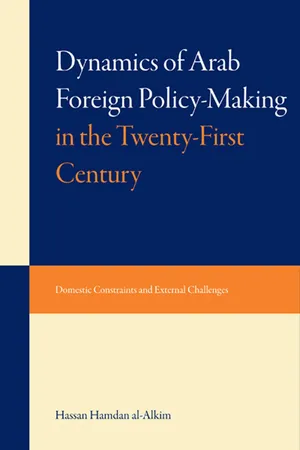
Dynamics of Arab Foreign Policy-Making in the Twenty-First Century
Domestic Constraints and External Challenges
- 392 pages
- English
- ePUB (mobile friendly)
- Available on iOS & Android
eBook - ePub
Dynamics of Arab Foreign Policy-Making in the Twenty-First Century
Domestic Constraints and External Challenges
About this book
The Arab world's strategic location and its considerable material and human potential should allow it to play a major role in world affairs. However, in addition to sharing language, culture and history, Arab states also face common challenges: authoritarian regimes, ethnic and social cleavages, economic underdevelopment, and the need for security from the West. Hassan Hamdan al-Alkim examines the dynamics of Arab foreign policy-making in the twenty-first century, taking account of the current political developments in the Arab world since January 2011. Through an insightful analysis of pivotal issues such as the Middle East Peace Process, the food and water crisis and Saudi Arabia's foreign policy, Alkim brings us closer to a nuanced understanding of contemporary Arab politics and its role in world affairs. This balanced and discerning study is essential reading for policy-makers, academics and students of Middle Eastern politics.
Information
Part One
THE INPUT PROCESS
CHAPTER 1
Political Aggregations and Political Articulations
1. Introduction
It is not easy to define political underdevelopment in the Arab world, though it is possible to recognize some of its manifestations. Analysts usually start by distinguishing between politically advanced countries and those to which the economic terms ‘developing countries’ or ‘in the process of development’ apply. In this context Talcott Parsons formulated a set of factors, comprising a generality of jobs, laws, achievements, specializations, public interests and emotional neutrality. What he means by ‘generality’ is that the yardsticks for political mobilization and the issuing of laws are general and concern an entire community rather than specific persons to the exclusion of others. The ‘achievement’ factor refers to the fact that these communities rely on performance and efficiency in their evaluation, and that social connections do not play an important role in their political choices. In addition, they are advanced scientifically, because they respect specialization and are not founded on superficiality. They are also public spirited and strive to advance the public interest without, however, neglecting personal interests. They rely on logic, reason and common sense, and emotions do not play a key role in their daily lives and political activities. Some thinkers have attempted to qualify political underdevelopment without specifying particular indicators or groups: for these, a society is ‘more or less modern depending on its use of new elements of power, and advanced tools, to maximize the outcome of its efforts’. They also believe that a modern society (i.e. one that is politically advanced) is the result of the historical adaptation process by institutions, with fast-changing jobs that reflect the unprecedented increase in man’s knowledge, and allow him to control his environment.1 Arab governments, Samuel Huntington argued, are overwhelmingly undemocratic: monarchies, one-party system, military junta, personal dictatorship or some combination of these, ‘usually resting on limited family, clan, or tribal base and in some cases highly dependent on foreign support’.2
My study is based on the hypothesis that the political regimes of the majority of Arab states lack political legitimacy, are undemocratic and that inter-Arab political dynamics are characterized by competition, distrust and power struggles. The political situation in both Tunisia and Egypt, though moving towards democratization, is still unstable and difficult to predict. In an attempt to analyse and assess Arab states’ foreign policy undertakings, this chapter will discuss the political process, and the analysis of political aggregations and political articulations includes political legitimacy, the democratic process and the inter-Arab political dynamics and their impacts on the dynamics of foreign policy-making. The importance of this stems from the fact that foreign policy-making is envisaged in the executive authority whereas the legislative and judicial powers are paralysed by their total dependence on the former for information and interpretations of policies.
2. Lost Political Legitimacy
Political legitimacy is linked to the degree of political development achieved by a given country. Politically advanced societies possess attributes such as diverse political (i.e. institutional) structures, democracy, a proper system of accessing power and the successive ability to achieve several objectives. On this basis, political underdevelopment might be identified as follows.
It is the weakness of a political regime’s ability to mobilize its members’ and institutions’ efforts for the pursuit of the higher objective. It could therefore be seen as the failure to formulate a new political value system that compels its constituent elements to acquire new constructive outlooks, and engage in participatory activities.3
In short, political underdevelopment is due to a political system’s lack of ‘row potential’, including the ability to maintain contact with intermediary agencies and non-governmental organizations (NGOs), not to mention the requisite economic resources to complement this potential. This limits both the possibility and the desire to bring up a new breed of individuals and institutions, or mobilize those already available, to achieve the country’s higher political objectives. Political underdevelopment also carries with it a certain lack of clarity as to what a political regime’s higher political objectives are, whether in the short or the long term. A politically underdeveloped society is therefore one that is unable to have an overview of the future because it is not yet able to ascertain the scope or full range of its current political manœuvrability. Arab governments lack any bases for justifying their rule in terms of Islamic, democratic or even nationalist values.4 It is argued that Arab states are an ‘artificial creation’. Their borders were drawn by the colonial powers and do not represent naturally ordained living spaces for homogeneous ethnic, linguistic and religious groups. Arab states’ borders ‘often appear contrived, enclosing diverse ethnic, religious and linguistic groups that were incorporated as minorities in the post colonial era’.5
The Arab regimes are corrupt and brutal. Corruption constitutes the main obstacle to the development process. A questionnaire responded to by 150 officials from 60 underdeveloped countries confirmed that corruption is the main obstacle facing development.6 Examples of corruption in the Arab world are many and cover almost all Arab countries from the Gulf States to Morocco. The Tunisian and Egyptian revolutions have unveiled this fact. The kings, presidents and emirs have enhanced their grip on the local business sector giving free rein to their associates and relatives; for example, Al-Walid Ibn Talal in Saudi Arabia, Alla’a Mubarak in Egypt, the Al-Trapolsi family in Tunisia, Al-Makhloof, Al-Shalish, Al-Asaad and Al-Akhrass in Syria or party members as in Iraq, Lebanon and Yemen. They give high priority to arms deals, not to be used, but to amass booty and plunder resources. Gulf ruling families have fleets of aircrafts that are private, but paid for with public funds.7 The war lords in Lebanon dragged the country into fifteen years of civil war and instability and threatened the country’s independence because of their foreign connections, reflecting that personal interests supersede loyalty to the state. Monopoly of power, censorship, banning political parties, outlawing trade unions, espionage, restrictions on the freedom of expression, bullying, discrimination on tribal, religious, ethnic and sectarian bases, imprisonment of oppositions, forcing opposition members into early retirement, and injustice are common to all Arab regimes, to differing degrees. Senior official posts in the foreign office, the interior and finance and the chief of staff of the armed forces are always assigned to either family members or senior personnel or close associates, regardless of their suitability for the post. Personal allegiance rather than to the state is the prerequisite. It was argued that as population increases in the Arab world, so governments become more complex, the ruling elites grow more distant from the ruled and the regimes’ legitimacy face an increasing danger of gradual erosion.8
The political, religious and cultural terrain of the Arab world has not been fertile ground for democracy. Salama argued that Arab governments are fragile, dependent and that the political systems are scared, insecure and believe that dependence on foreign powers represents the best insurance policy for their survival.9 The fact that contemporary Arab states are artificial and the by-product of colonial divisions has cost them legal legitimacy, and raised questions about their legitimate nature.10 Oil in some Arab countries has freed oppressive governments from the need to raise taxes and thereby expose themselves to those pressures that raising taxes brings, such as for accountability and political participation.11 Members of the ruling elites have become businessmen competing with the local bourgeoisie but also defending the business social strata’s interests in the form of political articulations. Therefore, the ruling elites have increasingly allied themselves to the oligopolistic business group that emerged in the 1990s. The private sector has not been politically active in the Arab world. Local bourgeoisie has always been weak and dependent on governments simply because, in reality, they are compradors, not real businessmen. They tend to support the ruling party or family. Arab entrepreneurs have not been prominent in the political reform process.12 In fact, they constitute the second social group for political recruitment to senior official posts. Arab governments followed the colonial legacy of greater dependence on minorities for political support for their unpopular policies. This is clearly manifested in the fact that minorities have always represented pools for political recruitment. The refusal of the ruling elites to share power has left Arab governments exposed to criticism, and threatens state security and stability.13
Reforms pursued in most Arab countries failed to confer political legitimacy or ease social unrest since they were cosmetic. Elections held in some of these countries could not ‘substitute for legitimacy based on consensual political participation within the framework of clear rules of the game’.14 Reforms adopted, despite their significance, have not changed the structural basis of power, where the executive branch still dominates, unchecked by any form of accountability.15 On the contrary, steps taken in the so-called Arab republics to maintain power through changing the succession procedures from a scrutinized closed selection to a hereditary approach similar to the other Arab monarchies and sheikhdoms mark the decay in those political systems. The Syrian constitution was amended to open the way for the appointment of Bashar Assad, the son of the late president Hafiz Assad. Egypt, Yemen and Libya are expected to follow suit. Colonel Gaddafi has held absolute power since 1 September 1969, calling himself the King of the Kings. The Libyan people are among few peoples all over the contemporary world that have not witnessed any elections or change in ruling power for four decades. Moreover, the Libyan people have suffered the absence of a free press and partisan life or real civic institutions. There are only those institutions established by Gaddafi as propaganda machines, to praise him and glorify his book ‘The Green Book’.16 The perceived absence of political legitimacy has made efforts at developing good and transparent governance very difficult.17 There is simply the absence of the rule of law, fuelling violent rebellions against the Gaddafi and Saleh regimes. Thus, dependency values foster negative trends that lead to isolationism and carelessness, so that political underdevelopment not only affects good political governance, but also has an impact on people, institutions, values and behaviour. ‘Increasing transparency will make it difficult for governments to continue the kind of policies they so routinely carried out in the past.’18 The global ...
Table of contents
- Cover
- Title
- Copyright
- Contents
- List of Tables
- List of Figures
- List of Maps
- Abbreviations
- Prelude
- Introduction
- Part One: The Input Process
- Part Two: The Output: Case Studies
- Epilogue
- Notes
- Bibliography
- Index
Trusted by 375,005 students
Access to over 1.5 million titles for a fair monthly price.
Study more efficiently using our study tools.
Frequently asked questions
Yes, you can cancel anytime from the Subscription tab in your account settings on the Perlego website. Your subscription will stay active until the end of your current billing period. Learn how to cancel your subscription
No, books cannot be downloaded as external files, such as PDFs, for use outside of Perlego. However, you can download books within the Perlego app for offline reading on mobile or tablet. Learn how to download books offline
Perlego offers two plans: Essential and Complete
- Essential is ideal for learners and professionals who enjoy exploring a wide range of subjects. Access the Essential Library with 800,000+ trusted titles and best-sellers across business, personal growth, and the humanities. Includes unlimited reading time and Standard Read Aloud voice.
- Complete: Perfect for advanced learners and researchers needing full, unrestricted access. Unlock 1.5M+ books across hundreds of subjects, including academic and specialized titles. The Complete Plan also includes advanced features like Premium Read Aloud and Research Assistant.
We are an online textbook subscription service, where you can get access to an entire online library for less than the price of a single book per month. With over 1.5 million books across 990+ topics, we’ve got you covered! Learn about our mission
Look out for the read-aloud symbol on your next book to see if you can listen to it. The read-aloud tool reads text aloud for you, highlighting the text as it is being read. You can pause it, speed it up and slow it down. Learn more about Read Aloud
Yes! You can use the Perlego app on both iOS and Android devices to read anytime, anywhere — even offline. Perfect for commutes or when you’re on the go.
Please note we cannot support devices running on iOS 13 and Android 7 or earlier. Learn more about using the app
Please note we cannot support devices running on iOS 13 and Android 7 or earlier. Learn more about using the app
Yes, you can access Dynamics of Arab Foreign Policy-Making in the Twenty-First Century by Hassan Hamdan Al-Alkim,Hassan Hamdan al-Alkim in PDF and/or ePUB format, as well as other popular books in Politics & International Relations & International Relations. We have over 1.5 million books available in our catalogue for you to explore.