There are times when those working on a major science project receive public accolades. Typically, it’s when the data from a live science run is released, and what has been an intense period of private work becomes public property, to be dissected by the researchers’ scientific peers and celebrated by the world’s press. But on 14 September 2015, the huge team working on LIGO – more formally, the Laser Interferometer Gravitational Wave Observatory – had no such expectations. No one realised that 50 years of fruitless work was about to be rewarded in an unexpected fashion.
The immense LIGO experiment, covering two sprawling sites in the US and supported by over 1,000 scientists working around the world, was undergoing an engineering run. This was routine technical testing before the gravitational wave observatory would go live a few days later. It was the eighth and final cycle of fine-tuning before things might get interesting. Yet around 7.00am Eastern Standard Time – midday in the UK – a first email was sent out to interested parties that signalled the beginning of the biggest change to astronomy since the introduction of telescopes.
On that day, our understanding of the universe took a leap forward.
The gravity detectives
To call LIGO an observatory appears to be a dramatic understatement, though that is exactly what it is. It comprises two vast sites over 3,000 kilometres (1,865 miles) apart. Each of the near-identical facilities, one based in Livingston, Louisiana and the other at Hanford, Washington state, is home to a pair of 4-kilometre (2.5-mile)-long tubes, 1.2 metres across, set at right angles to each other to form an L-shape. At each site, a laser passes along the pair of tubes to reflect off mirrors at the ends many times before the beams are brought together to form an optical interference pattern, a tiny set of fringes that gives a visible warning of incredibly small changes. The slightest variation in the length of the beams will produce a detectable effect, a change that was expected to happen in the presence of gravitational waves – ripples in the fabric of space and time that had been predicted by Albert Einstein back in 1916, but had never been detected.
The vast twin systems, including those 4-kilometre lengths of metal tubing, contain hardly any air. The presence of vibrating air molecules would scatter the laser beams, introducing ‘noise’ into the carefully monitored signal. Any sound vibrations and air currents buffeting the delicately suspended mirrors located at the ends of the tubes would equally destroy the detection process.
The pressure inside those tubes is a remarkable trillionth of the atmospheric level. This took 40 days of gradual pumping to achieve, during which time the tubes were heated to over 150°C to expel as much gas as possible from the metal surfaces.
Just getting the tubes ready for that evacuation took immense care. Establishing delicate equipment in remote areas of the United States was not without its problems. The tubes are big enough, and took long enough to construct, for the local wildlife to take up residence. When a member of the team walked through the near-completed tubes at Livingston, he discovered that wasps, black widow spiders, mice and snakes had all moved in. And that meant acid-bearing urine leaving stains on the pristine stainless steel that would release vapour when the air was removed, requiring a major cleaning effort before that vacuum could be established. (That word ‘stainless’ in ‘stainless steel’ doesn’t apply once acids are involved.)
Despite the intense vacuum within the operational tubes, their metal walls are just 3 millimetres thick – around the same as 50 sheets of standard A4 paper. Without the frequent reinforcing loops along the length of the tubes, the outside air pressure would crush them. The exterior of each tube is cased in concrete, not to resist the vacuum, but to cushion any outside impact. This is just as well, as a security truck collided with one of the tubes of the Hanford observatory at night. The driver suffered a broken arm, but the tube stayed intact. A damaged tube, allowing air at atmospheric pressure to pour in, would have been catastrophic. The resulting blast of air would have destroyed most of the detection system, causing many millions of dollars’ worth of damage.
Because the arms extend for such a distance, their supports have to gradually increase in height along their length to cope with the curvature of the Earth. From one end to the other, there is more than a metre difference in height, needed to keep the tube perfectly straight. And this was just a small consideration in ensuring that the detectors can function properly. A far bigger issue was vibration.
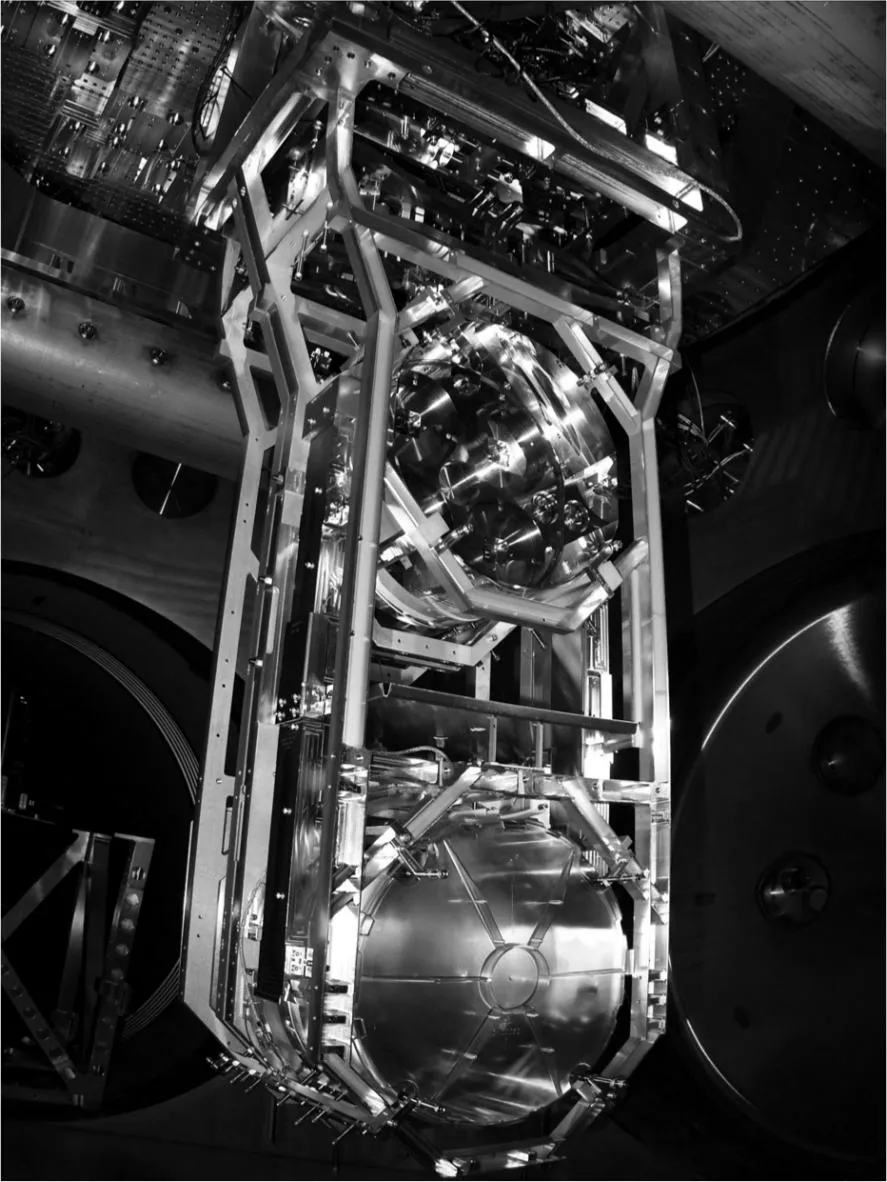
To deal with the inevitable environmental vibrations, LIGO has a whole host of feedback systems, which monitor position and make tiny movements of the arms and components to compensate for changes. Positions are monitored 983,000 times a minute – once every 0.000061 seconds. The ‘seismic isolation platforms’ deal with the larger vibrations down to around 1 million times larger than the waves that LIGO has to detect. The remaining reduction is achieved by the remarkable suspension systems used to keep LIGO’s mirrors from moving due to anything other than gravitational waves. These use four separate pendulum suspensions to dampen movement, dangling the mirrors from glass fibres just twice the thickness of a human hair, keeping the 40-kilogram ‘test mass’ mirrors as stable as possible.
Business as usual
During the engineering run in September 2015, all of LIGO’s detection systems were in play, bringing the light beams into alignment and testing their functionality, with no thought of capturing a breakthrough observation of a gravitational wave. For over 50 years, scientists had been looking for the tiny distortions in space and time caused by a distant cosmic event that would add a new, powerful approach to the astronomer’s armoury. They had never achieved a single result. Some even suggested that gravitational waves would be impossible to detect unless we could take the leap of building an observatory in space, as the tiniest local tremor was enough to confuse the incredibly delicate instruments. But for now, these worries were put to one side. No careers were at risk of yet another failed detection of these elusive waves on this run. It was simply a matter of ensuring that the technology behaved as it should.
However, just because this was an engineering run did not mean that the observatory was inactive. Unlike the dome of a traditional telescope, with shutters to prevent light coming in, there is nothing that can stop gravity getting through. Gravitational waves may be incredibly weak and difficult to detect, but nothing can hinder their progress across the universe. And the 14 September email told the members of the LIGO collaboration that an unexpected event had occurred.
We still tend to think of astronomers peering directly through telescopes – but even most traditional optical observatories are now automated, their observers located anywhere in the world. Detection in the case of gravitational wave observatories is not about seeing something in the sky, but about pinpointing subtle changes in a stream of data from the instruments. The origins of those first, few cautious emails on 14 September emphasise how far this kind of science has moved the work away from on-the-spot observers. There are people stationed at Hanford and Livingston, but they are mostly engineers, involved in the day-to-day running of the equipment. The earliest email comments from gravitational physicists originated in Hanover, Melbourne, Paris and Florida – the only one from the US (where most of the collaboration were still asleep), and that located far away from either detector.
There was a time when data like this would have to be searched by eye, giving a team of grad students sleepless nights as they worked through page after page of computer printouts, fighting their way along mind-numbing strings of numbers. Now, though, much of that initial sifting is done using computer algorithms. Some of these systems look for specific patterns that models predict will be produced by natural phenomena expected to generate gravitational waves. But the system that flagged up the event on 14 September, the cWB or ‘coherent wave burst’ pipeline, had no such preconceptions. It was merely looking for near-simultaneous bursts of activity recorded at the two facilities. And cWB flagged up that a strong wave pattern had been received at Livingston, followed by a remarkably similar burst of activity at Hanford, 7 milliseconds later.
Event alert
The first response to this alert was to check for hardware injections. During the engineering run, it is normal practice to produce artificial signals to test whether or not the detection systems at the two sites pick them up. But there were no known planned injections made in the period when the detection occurred.
That didn’t mean that the event was certainly a real sighting of a gravitational wave. All kinds of checks still had to be made. After all, this wasn’t supposed to be an observation run; many oddities could occur in the systems as they were being fine-tuned. For that matter, there was always the possibility that what was being recorded was a large-scale seismic vibration that had been picked up by both observatories – or even that two totally separate vibrations had just happened to occur at the same time. And the LIGO team were always aware of the unnerving possibility of a blind injection.
Although the scientists could confirm that there were no routine hardware injections planned, what was being detected could have been an artificial event that had been intentionally triggered without the scientists’ knowledge. Such ‘blind injections’ play an important role in the operation of a complex set of instruments like LIGO. They make sure that those involved aren’t allowing their own prejudices and desires to influence their interpretation of the results. After all, the observations they make are simply variations in an ever-changing data stream. How that data is interpreted is crucial, and because the scientists never know whether an event is artificial or real until they have fully analysed it, they can’t be biased by wishful thinking.
Blind injections had already been used in previous runs of LIGO, raising hopes on two occasions when it appeared more and more likely that an observation of gravitational waves had been made, only to have those expectations crushed when the secrecy was lifted to reveal a fake event. In theory, blind injections weren’t needed during an engineering run, as no one was intending to take the data seriously, so it seemed unlikely that this was the case on 14 September – but at this stage of the process, the scientists had no way of knowing for sure.
Over the next two days, excitement grew. The event seemed more and more likely not only to be a real one, but also to provide a very significant discovery. No one had expected gravitational waves to be obvious in the data stream, but these were clear, visible signals – so strong that, were this a real detection, they had both found gravitational waves and made the first-ever direct observation of black holes. In which case, the team was surely looking at a Nobel Prize. More than that, their work – which some still believed was pointless, because they thought that LIGO wasn’t sensitive ...