Peter Pugh presents his selection of – not the best, fastest, most successful or richest – but the 50 most influential British men and women of the modern world – for good or ill.
Pugh discusses and ranks the influence of scientists and inventors such as Francis Crick, John Logie Baird and Alan Turing; lawmakers and leaders like prime ministers Attlee, Churchill and Thatcher; entrepreneurs including James Dyson, Mary Quant and Terence Conran; and cultural icons like J.K. Rowling, who, in the words of Lisa Simpson no less, 'turned a generation of kids onto reading'.
One of the most influential Britons in Pugh's book achieved influence by saying nothing for over 60 years, and the top three places are held by an economist, a scientist and a civil servant …
In what amounts to a whistle-stop tour through recent British history, this undoubtedly contentious and wholly enjoyable book will spark countless debates across our sceptred isle.
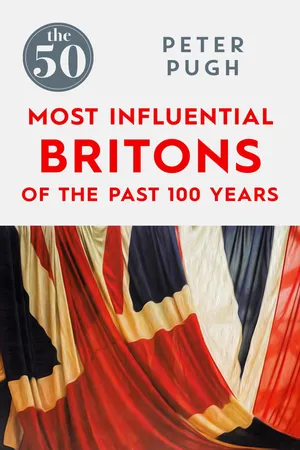
eBook - ePub
The 50 Most Influential Britons of the Past 100 Years The 50 Most Influential Britons of the Past 100 Years
- 304 pages
- English
- ePUB (mobile friendly)
- Available on iOS & Android
eBook - ePub
The 50 Most Influential Britons of the Past 100 Years The 50 Most Influential Britons of the Past 100 Years
About this book
Information
25. SIR FRANK WHITTLE
The jet engine transformed both peaceful air travel and war in the air and the man most responsible for its invention and development is Frank, later Sir Frank, Whittle.
Born in June 1907 in Coventry, Whittle grew up acquiring engineering skills from his father who was a practical engineer and mechanic. He was determined to join the newly formed Royal Air Force and passed the entrance exam with a high mark at the age of sixteen. However, he was rejected on medical grounds because he was only five feet tall and had a small chest measurement. He built up his chest and reapplied when he was taller but was rejected again. Undeterred, he tried once more under an assumed name and this time got into the School of Technical Training at RAF Cranwell.
In 1928 he produced a thesis, Future Developments in Aircraft Design. In it he showed that a high altitude aircraft could fly faster because of the reduced air resistance and that ‘the turbine is the most efficient prime mover known so it is possible it will be developed for aircraft, especially if some means of driving it by petrol could be devised’.
As Andrew Nahum pointed out in his book Frank Whittle, Invention of the Jet:
The gas turbine, in a heavy, industrial and relatively inefficient form, already existed and was employed in industrial plants where a cheap supply of combustible gas was available. For example, from 1914 the Thyssen company installed them at several steelworks in Germany where they ran on waste blast furnace gas.However, the jet propulsion idea made the Whittle gas turbine/jet engine conceptually different from the propeller turbine, in which as much energy as possible is extracted as rotary shaft horsepower from the exhaust by the turbine stages. Whittle’s idea instead left as much energy as possible in the gas stream to form a high velocity exhaust jet. This simplification of the gas turbine made Whittle’s jet proposal attractive for development at a time when the combined inefficiencies of the compressor, the turbine and the required reduction gearing and propeller drive seemed, in aggregate, too great to make a propeller turbine unit viable.
Whittle asked himself, ‘Why not substitute a turbine for the piston engine?’
He felt that, instead of using a piston engine to provide the compressed air for the burner, a turbine could be used to extract some power from the exhaust and drive a similar compressor to those used for superchargers. The remaining exhaust would power the aircraft.
In 1929 Whittle sent his concept to the Air Ministry but was turned down. However, a Flying Officer, formerly a patent examiner, suggested he patent the idea, which he did.
Not much further happened until 1935 when Whittle was introduced to two investment bankers at O.T. Falk & Partners, and one of them, Lancelot Law Whyte, said:
The impression he made was overwhelming. I have never been so quickly convinced, or so happy to find one’s highest standard met … This was genius, not talent. Whittle expressed his idea with superb conciseness: ‘Reciprocating engines are exhausted. They have hundreds of parts jerking to and fro, and they cannot be made more powerful without becoming complicated. The engine of the future must produce 2,000 hp with one moving part: a spinning turbine and compressor.

Falk & Partners financed a new company, Power Jets Ltd, which entered into an agreement with steam turbine specialists, British Thomson-Houston, to build an experimental engine facility at a BTH factory near Rugby.
Financial problems continued to delay progress and it was not until January 1940 (four months into the Second World War) that the Air Ministry finally placed a contract with the Gloster Aircraft Company for an aircraft to test the Whittle Supercharger W1.
Finally on 12 April 1941 a W1 powered aircraft took off at RAF Cranwell. It flew for seventeen minutes and reached a speed of 340 mph. At the end of this successful flight a colleague said to Whittle, ‘Frank, it flies,’ to which Whittle replied, ‘Well, that’s what it was bloody well designed to do, wasn’t it?’
In terms of mass production of Whittle’s engines he was involved with Rover for a time but then he was introduced to Rolls-Royce who were already mass-producing the Merlin engines that had been so successful powering the Spitfire and Hurricane in the Battle of Britain. Rolls-Royce gradually took over production of Whittle’s engine and Ernest, later Lord, Hives, Managing Director of Rolls-Royce, became convinced that the company’s future lay with the jet engine. He was quite correct.
24. DR BEECHING
Dr, later Baron, Beeching had a dramatic effect on the lives of the majority of Britons with his report The Reshaping of British Railways, published on 27 March 1963.
It called for the closure of no less than one-third of the country’s 7,000 railway stations, and the removal of passenger services from around 5,000 miles of existing routes.
The rail transport system had grown from zero to a complete coverage of the country in the nineteenth century, built by a number of private companies. However, it was nationalised in 1948 under the Labour Government’s nationalisation programme.
Prompting Beecham’s report was the fact that the existing railway system was highly complicated and inefficient and losing millions of pounds a year. In 1961 it was calculated to be losing £300,000 (nearly £1 million today) every day. Its traffic was also declining in terms of both passengers and goods due to the growth of motor traffic. For example, one third of the network was carrying one per cent of the traffic and, of 18,000 passenger coaches, 6,000 were only used 18 times a year or less. The system was costing £3 million to £4 million a year (£75 million to £100 million today) to maintain and earning only £0.5 million (£12.5 million today).
The closures were carried out from 1963 to 1970 and were heavily criticised, especially of course by those affected.
Another explosion of criticism was caused by the salary paid to Beeching as the First Chairman of the British Railways Board. He was paid £24,000 a year (about £600,000 today) which was the same as he had been receiving as a director of ICI (Imperial Chemical Industries). This was £14,000 more than the Prime Minister, Harold Macmillan, and two and a half times more than any head of a nationalised industry at the time.
Needless to say, the cuts meant loss of jobs and there was plenty of opposition from the trade unions. Beeching was unrepentant, saying, ‘I suppose I’ll be looked upon as the axe man, but it was surgery, not mad chopping.’

And, as well as cuts, there was also some modernisation carried out as a result of Beeching’s report. For example, there was a greater emphasis on block trains, a rail cargo shipping method whereby all the storage cars were shipped from the same point and arrived at the same destination, which did not require expensive and time-consuming shunting en route.
After all the drama of the first Beeching Report, he produced a second one in February 1965. This time he said that of the 7,500 miles of trunk railway throughout Britain only 3,000 miles ‘should be selected for future development’ and therefore have further investment.
The achievements and long-term influence of Richard Beeching were very well summarised in the biography written by R.H.N. Hardy, a railway manager himself. He wrote:
Richard Beeching became a remarkable, indeed an outstanding, Chairman of the Board and leader of the railway industry … his famous Reshaping Report was constructive and for us within the system, his work changed our thinking, our methods of doing things, our ideas on assessment of managers and our systems – such as they were – of financial control. He was a great believer in forward planning but, in the railway industry, he went further than that and his influence is felt to this day …… if it was by bringing to the attention of the country the critical situation facing the railways and the taxpayer, if it was to make the public face up to the question of striking a balance between the social need for public transport where it could not pay its way and the financial burden on the community if it were to be provided, if it was to create a basic internal organisation that stood the test of time for many years, then he succeeded and succeeded magnificently.
23. SIR HENRY ROYCE
Henry Royce, the partner of Charles Rolls in the foundation of Rolls-Royce Ltd, was influential not only for the development of the Rolls-Royce cars but, more importantly, for the development of Rolls-Royce aero engines.
Rolls-Royce Ltd was founded in 1904 to produce cars and, as is well known, the company was soon producing what became known by many as ‘the best car in the world’. However, the future of the company was thrown into jeopardy by the outbreak of the First World War on 4 August 1914. At the first board meeting after the outbreak of war, Claude Johnson, the Managing Director, was authorised ‘to reduce the works wages to about one fourth by discharging about half the hands and allowing the remainder to work only half time’. More surprisingly, the board decided that the company ‘would not avail itself of the opportunity, now possibly arising, of making or assembling aero engines for the British Government’.
This decision was soon reversed and Henry Royce began to develop his first aero engine. On the outbreak of the War not a single British aero engine was in production. The country was still totally dependent on France for them. Rapid progress was made and, by August 1915, Royce’s engine was being tested. Once proven, Government orders flowed in for the engine, named the Eagle, and Rolls-Royce engineers were sent to the USA to supervise an extra 1,500 engines that were being built there.
The Eagle was soon followed by the Hawk engine and then the Falcon which became the standard engine for the British Fighter F2B, Britain’s most effective fighter of the First World War. It could dive faster than any other fighter and it was often able to fly home even when severely damaged. With the Falcon it became a byword for reliability. Finally, before the end of the War, Rolls-Royce manufactured the Condor which was fitted into the Handley Page bombers as they wanted maximum horsepower in a twin-engine design.

The next exciting development once the First World War was over was the flight across the Atlantic by Alcock and Brown in their Vimy aircraft. The Vickers Vimy was powered by two of Rolls-Royce’s Eagle VIIIs.
The next triumph came with the Schneider Trophy which was an international award presented to the nation with the fastest seaplane over a pre-determined, measured course. There had been two contests before the First World War, none during the War and then the contests resumed in the 1920s with the Americans becoming dominant. Reg Mitchell, who went on to design the Spitfire, was busy designing aircraft to try and win the Schneider Trophy and he chose Rolls-Royce engines for the 1929 contest.
The engine they used was the Kestrel which Rolls-Royce had begun to develop in 1924. The Kestrel became the critical engine in re-establishing Rolls-Royce’s position as the premier supplier of aero engines to the RAF. The Kestrel proved to be a fine forerunner of the Merlin engine which made Rolls-Royce world famous.
The engine supplied for the three successive British victories in the Schneider Trophy contest in 1929, 1930 and 1931 was referred to as the ‘R’ engine. One of Sir Henry Royce’s last decisions was to authorise the development of a new engine bigger than the Kestrel incorporating as much ‘R’ technology as possible. This new engine was called the Merlin and as Gordon (son of Reginald) Mitchell said, ‘The decision to fit the Merlin engine into Mitchell’s type 300 fighter was a vital turning point in the development of the Spitfire.’
The Merlin powered not only the Supermarine Spitfire but also the Hawker Hurricane, the two magnificent fighter aircraft that enabled the RAF to defeat the German Luftwaffe in the Battle of Britain in 1940 and prevent a German invasion of Britain.
Initially, in the Battle of Britain which began in the summer of 1940, the Spitfires and Hurricanes were powered by Merlin IIIs. As the battle went into the autumn a number of Spitfires were fitted with the Merlin XII, which gave enhanced altitude performance. Later in the Hurricane II, the Merlin XX was fitted, with its improved supercharger intake design and two-speed supercharger. Production of the Merlin engine was increased from 2,000 in 1939 to 7,000 in 1940.
Royce’s Merlin engines may not have ultimately won the Second World War but they undoubtedly enabled Britain to escape losing it in 1940.
22. SIR DAVID ATTENBOROUGH
The fact that the President of the United States of America, Barack Obama, interviewed Sir David Attenborough in early 2015 shows how important Sir David’s influence has been in explaining the natural world, not only to Britons but to people in other countries as well.
He was born in 1926 in Isleworth, west London and grew up in Leicester where his father was principal of University College. He was interested in nature from an early age and collected fossils, stones and other natural specimens. He was educated at Wyggeston Grammar School for Boys in Leicester and won a scholarship to Clare College, Cambridge where he studied geology and zoology, leaving with a degree in natural sciences.
David joined the BBC in 1952 and was soon working on an animal programme with the naturalist Julian Huxley. His first television appearance was in Zoo Quest, and he began to travel the world with the second series of Zoo Quest filmed in South America where David could be seen in bushes and poking around anthills and armadillos’ burrows.
David was diverted from his nature exploration when he became Controller of BBC Two in 1965, although he insisted on having a clause in his contract th...
Table of contents
- Copyright Page
- About the Author
- Contents
- Introduction
- The 50 Most Influential Britons of the Last 100 Years
- 50. Sir Freddie Laker
- 25. Sir Frank Whittle
- Back Cover
Trusted by 375,005 students
Access to over 1.5 million titles for a fair monthly price.
Study more efficiently using our study tools.
Frequently asked questions
Yes, you can cancel anytime from the Subscription tab in your account settings on the Perlego website. Your subscription will stay active until the end of your current billing period. Learn how to cancel your subscription
No, books cannot be downloaded as external files, such as PDFs, for use outside of Perlego. However, you can download books within the Perlego app for offline reading on mobile or tablet. Learn how to download books offline
Perlego offers two plans: Essential and Complete
- Essential is ideal for learners and professionals who enjoy exploring a wide range of subjects. Access the Essential Library with 800,000+ trusted titles and best-sellers across business, personal growth, and the humanities. Includes unlimited reading time and Standard Read Aloud voice.
- Complete: Perfect for advanced learners and researchers needing full, unrestricted access. Unlock 1.5M+ books across hundreds of subjects, including academic and specialized titles. The Complete Plan also includes advanced features like Premium Read Aloud and Research Assistant.
We are an online textbook subscription service, where you can get access to an entire online library for less than the price of a single book per month. With over 1.5 million books across 990+ topics, we’ve got you covered! Learn about our mission
Look out for the read-aloud symbol on your next book to see if you can listen to it. The read-aloud tool reads text aloud for you, highlighting the text as it is being read. You can pause it, speed it up and slow it down. Learn more about Read Aloud
Yes! You can use the Perlego app on both iOS and Android devices to read anytime, anywhere — even offline. Perfect for commutes or when you’re on the go.
Please note we cannot support devices running on iOS 13 and Android 7 or earlier. Learn more about using the app
Please note we cannot support devices running on iOS 13 and Android 7 or earlier. Learn more about using the app
Yes, you can access The 50 Most Influential Britons of the Past 100 Years The 50 Most Influential Britons of the Past 100 Years by Peter Pugh in PDF and/or ePUB format, as well as other popular books in History & 20th Century History. We have over 1.5 million books available in our catalogue for you to explore.