![]()
Big numbers
Infinity, as no end of people will tell you, is a big subject. It will take you into history, philosophy and the physical world, but is best first approached through mathematics. It makes sense to ease into it via big numbers.
By giving a lengthy number a name you seem to demonstrate your power over it – and the bigger the number is, the more impressive your ability. This is reflected in the reported early life of Gautama Buddha. As part of his testing as a young man in an attempt to win the hand of Gopa, Gautama was required to name numbers up to a huge, totally worthless value. Not only did he succeed, but he carried on to bigger numbers still.
Googoled
It’s fine giving names to numbers we encounter every day, but how many of us will ever use this number?
As it happens, it does have a name, one that proved a problem for the unfortunate Major Charles Ingram when it was his million-pound question on TV show Who Wants to be a Millionaire? He was asked if the number – 1 with 100 noughts after it – was a “googol”, a “megatron”, a “gigabit” or a “nanomol”. Major Ingram favoured the last of these, until a cough from the audience prompted him towards googol. To be honest, who can blame him? “Googol” sounds childish.
Googol is childish – for a good reason. In 1938, according to legend, mathematician Ed Kasner was working on some numbers on his blackboard at home. His nephew, nine-year-old Milton Sirrota, was visiting. Young Milton spotted the biggest number and is supposed to have said: “That looks like a googol!”
This isn’t a very convincing story, though. There’s no reason why Kasner would bother to write such a number on a blackboard.
Symbols from India
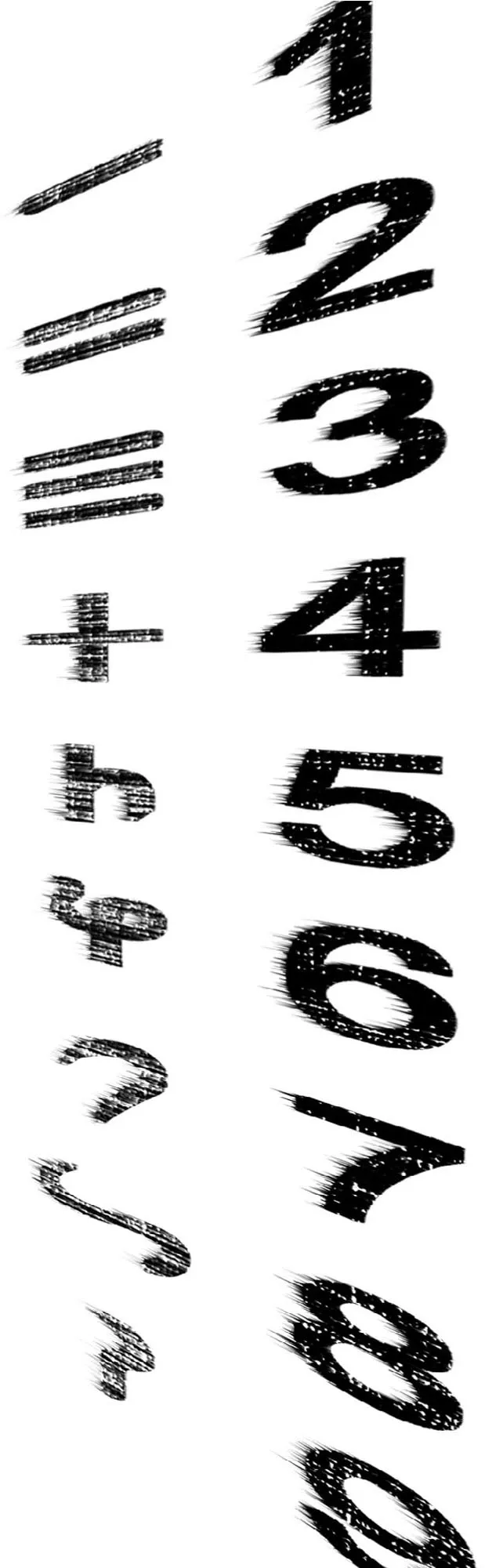
To deal with any number we need symbols that represent numerical values. The symbol equivalents of the words “one”, “two”, “three” and so on (1, 2, 3…) arrived in the West from India via the Arabic world. The oldest known ancestors of the modern system were found in caves and on coins around Bombay dating back to the 1st century AD.
The numbers 1 to 3 were based on a line, two lines and three lines, like horizontal Roman numerals, though they can still be seen with some imagination in the main strokes of our modern numbers. The markings for 4 to 9 are closer ancestors of the symbols we use today.
The Indian symbols were adopted in the Arabic world, coming to the West in the 13th century thanks to two books, written by a philosopher in Baghdad and a traveller from Pisa. The earlier book, lost in the Arabic original, was written by al–Khwarizmi (c. 780–850) in the 9th century. The Latin translation of this, Algo-ritmi de numero Indorum, was produced around 300 years later, and is thought to have been considerably modified in the process.
The version of al-Khwarizmi’s name in the title is usually given as the origin of the term “algorithm”, though it’s sometimes linked to the Greek word for number, arithmos.
The Book of Calculation
The traveller from Pisa was Leonardo Fibonacci (c. 1170–1250). (His father, a Pisan diplomat, was Guglielmo Bonacci, and “Fibonacci” is a contraction of filius Bonacci, son of Bonacci.) He travelled widely in North Africa and became the foremost mathematician of his time, his name inevitably linked to the Fibonacci numbers (see here), which he popularized but didn’t discover. Although Numero Indorum was translated into Latin a little before Fibonacci’s book Liber abaci came out in 1202, it seems that Liber abaci (“The Book of Calculation”) had the bigger influence in introducing the Indian system to the West.
0, a powerful tool
The symbols we use for numbers are arbitrary. ¶, β, √, π, ԓ would do as well as 1, 2, 3, 4, 5. However, the new Indian numerals brought with them a very powerful tool. Earlier systems from Babylonian through to Roman were tallies, sequential marks to count objects. We’re most familiar with Roman numerals – the tally sequence is obvious in I, II, III, IV, V – where V is effectively a crossed through set of IIII and IV is one less than V. But the trouble with such systems is that there’s no obvious mechanism to add, say, XIV to XXI.
Archimedes: The Sand Reckoner
But whatever symbols are used, big numbers kept their appeal. In a book called The Sand Reckoner, ancient Greek philosopher Archimedes (c. 287-212 BC) demonstrated to King Gelon of Syracuse that he could estimate the number of grains of sand it would take to fill the universe.
We don’t know a lot about Archimedes, but we do have a number of his books, which show him to be a superb mathematician and a practical engineer. He is said to have devised defence weapons for Syracuse ranging from ship-grabbing cranes to vast metal mirrors to focus sunlight and set ships on fire.
Unlike many of Archimedes’ other works, The Sand Reckoner wasn’t exactly practical. But there was a serious point behind this entertaining exercise. What Archimedes set out to do was to show how the Greek number system, which ran out at a myriad myriads (100 million), could be extended without limit. He first estimated the size of the universe at around 1,800 million kilometres (just outsi...