A comic-book introduction to economics from David Orrell, the author of
Economyths: 11 Ways Economics Gets it Wrong. With illustrations from Borin Van Loon. Part of the internationally-recognised Introducing Graphic Guide series.
Today, it seems, all things are measured by economists. The so-called 'dismal science' has never been more popular - or, given its failure to predict or prevent the recent financial crisis, more controversial.
But what are the findings of economics? Is it really a science? And how can it help our lives?
Introducing Economics traces the history of the subject from the ancient Greeks to the present day. Orrell and Van Loon bring to life the contributions of great economists - such as Adam Smith, Karl Marx, John Maynard Keynes and Milton Friedman - and delve into ideas from new areas such as ecological and complexity economics that are revolutionizing the field.
- 176 pages
- English
- ePUB (mobile friendly)
- Available on iOS & Android
eBook - ePub
About this book
Information
Subtopic
Economic TheoryIndex
EconomicsWhat is economics?
Economics is the study of how goods and services are produced, distributed, and consumed by society. Because resources are usually assumed to be in short supply, the field was described by English economist Lionel Robbins in 1935 as “the science of scarcity”.

The word “economics” was coined from the Greek words oikos (household) and nomos (law), so it means something like household rule or home management.

Though “household” is now generalized to include individuals, companies, countries, and the entire world system.

While people have been calling themselves professional economists only since the 19th century, the field has roots that go back much further.
Old money
Economic thought is at least as old as money itself.
The earliest coins were made from precious metals such as gold and silver. They are believed to have first appeared around the 6th century BC in what is now Turkey, but were soon in use around the civilized world, from Mesopotamia to Persia to India to China.

Ancient versions of economic ideas therefore existed in many different countries.

However, because economics has long modelled itself after sciences like physics, it has been shaped most of all by the Western scientific tradition, which itself is rooted in the ideas of Greek philosophers.
Pythagoras
The philosopher Pythagoras (c. 570–c. 495 BC) is today associated mostly with mathematics, and his famous theorem about right-angled triangles that we all learn at school. But he has had a lasting influence on science in general, including economics.
Pythagoras was considered a demi-god by the Greeks. His birth was predicted by the oracle at Delphi, and it was rumoured that his father was the god Apollo.

As a young man, I travelled the world, learning from mystics and philosophers.

On my return, I set up school in a cave, teaching mathematics.
His school grew into what amounts to a pseudo-religious cult, based on the worship of number. The Pythagoreans were highly secretive and left no written documents, so we only know about them indirectly.
Harmony of the Spheres
The Pythagoreans believed that all things were composed of number. Each number had a special, almost magical significance. The most sacred number was 10, which was symbolized by the tetractys.
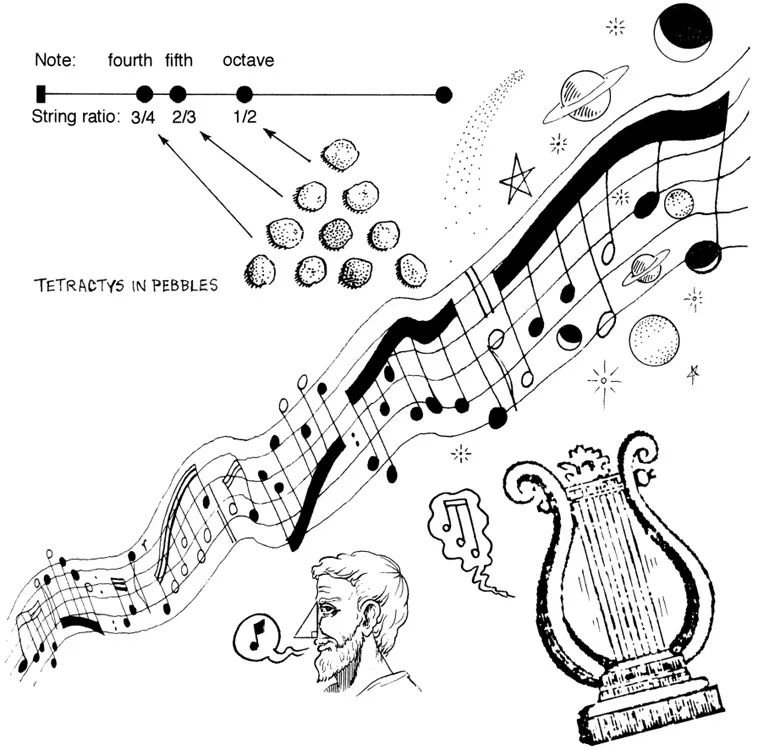
Pythagoras is credited with the discovery that musical harmony is based on numerical ratios between string lengths. Because music was considered to be the most mysterious of art forms, this backed up the belief that the entire cosmos was based on number: what the Pythagoreans called the Harmony of the Spheres.
Economics, and money itself, are also based on the Pythagorean idea that all things can be reduced to number. Indeed, it is believed that Pythagoras was involved in introducing the first coinage to his region.
Oikonomikos
The word “economics” was derived from a work by the philosopher Xenophon (431–c. 360 BC), who was influenced by Pythagoras. His tract Oikonomikos described how to efficiently organize and run an agricultural estate.

It must, I should think, be the business of the good estate manager at any rate to manage his own house or estate well.
He argued that complicated tasks could best be carried out through division of labour. An advantage of cities such as Athens, which was growing rapidly in size and complexity, was the availability of a variety of specialists. In smaller towns, people had to carry out more tasks themselves, which was less efficient.
While this conclusion predated Adam Smith’s thoughts on the same topic by a couple of millennia (see here), in a slave-based society the coordinating of these specialists was a task for the estate manager, not the markets.
Plato’s Republic
Plato (427–347 BC) took the idea of an optimally-managed estate a step further with his Republic, which described a utopian society ruled over by philosopher kings known as “guardians”.
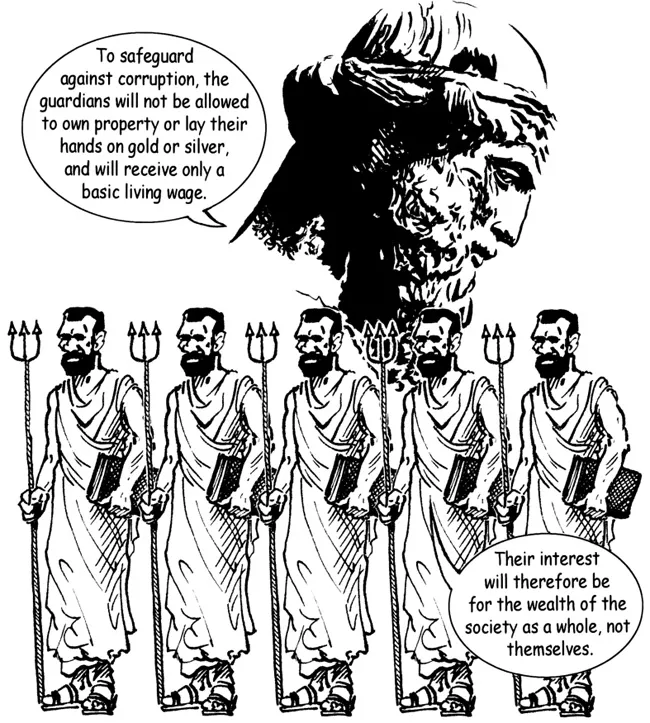
To safeguard against corruption, the guardians will not be allowed to own property or lay their hands on gold or silver, and will receive only a basic living wage.
Their interest will therefore be for the wealth of the society as a whole, not themselves.
Their interest will therefore be for the wealth of the society as a whole, not themselves.
Every task, including the raising of children, would be allocated to specialists. Property would be divided according to mathematical principles. The maximum number of citizens was computed by Plato to be 5,040, which has the property that it is divisible by the numbers 1 through 10 and so can be easily divided into separate administrative groups.
Aristotle
Plato’s most famous student was Aristotle (384–322 BC), who wrote and taught on subjects ranging from astronomy to medicine to ethics. He believed that the sole purpose of money was to act as a medium for exchange. As he wrote in Nichomachean Ethics, ‘all things are measured by money’.
According to Aristotle, the fair distribution of goods could be determined by different mathematical formulae, known as the Pythagorean means.

For example, suppose that one person wants to sell a piece of land to another. The seller wants at least 120 currency units, but the buyer wants to pay at most 80.
In this case the correct price will be the harmonic mean, which is 96. This number is 20 per cent more than the lower price, but 20 per cent less than the higher price.
In this case the correct price will be the harmonic mean, which is 96. This number is 20 per cent more than the lower price, but 20 per cent less than the higher price.
A system of opposites
In his Metaphysics, Aristotle attributes the following list of opposites to the Pythagoreans (who being highly secretive did not let it out themselves):

The Pythagoreans associated the left column with good, and the right column with evil. This list has been influential on the course of Western scientific thought, and therefore on economics.
Limited vs. unlimited
For example, the idea of limits was important to the Greeks, including Aristotle.
Aristotle noticed that merchants often accumulated immense amounts of money just through exchange, even though they did not produce anything themselves. In Politics, he therefore distinguished between two types of exchange.
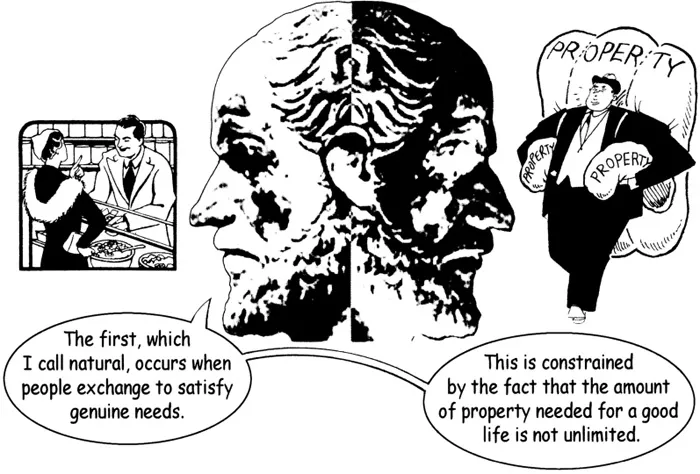
The fir...
Table of contents
- Cover
- Title Page
- Copyright
- Contents
- What is economics?
- Further Reading
- About the Author and Artist
- Acknowledgements
- Index
Trusted by 375,005 students
Access to over 1.5 million titles for a fair monthly price.
Study more efficiently using our study tools.
Frequently asked questions
Yes, you can cancel anytime from the Subscription tab in your account settings on the Perlego website. Your subscription will stay active until the end of your current billing period. Learn how to cancel your subscription
No, books cannot be downloaded as external files, such as PDFs, for use outside of Perlego. However, you can download books within the Perlego app for offline reading on mobile or tablet. Learn how to download books offline
Perlego offers two plans: Essential and Complete
- Essential is ideal for learners and professionals who enjoy exploring a wide range of subjects. Access the Essential Library with 800,000+ trusted titles and best-sellers across business, personal growth, and the humanities. Includes unlimited reading time and Standard Read Aloud voice.
- Complete: Perfect for advanced learners and researchers needing full, unrestricted access. Unlock 1.5M+ books across hundreds of subjects, including academic and specialized titles. The Complete Plan also includes advanced features like Premium Read Aloud and Research Assistant.
We are an online textbook subscription service, where you can get access to an entire online library for less than the price of a single book per month. With over 1.5 million books across 990+ topics, we’ve got you covered! Learn about our mission
Look out for the read-aloud symbol on your next book to see if you can listen to it. The read-aloud tool reads text aloud for you, highlighting the text as it is being read. You can pause it, speed it up and slow it down. Learn more about Read Aloud
Yes! You can use the Perlego app on both iOS and Android devices to read anytime, anywhere — even offline. Perfect for commutes or when you’re on the go.
Please note we cannot support devices running on iOS 13 and Android 7 or earlier. Learn more about using the app
Please note we cannot support devices running on iOS 13 and Android 7 or earlier. Learn more about using the app
Yes, you can access Introducing Economics Introducing Economics by David Orrell,Borin Van Loon in PDF and/or ePUB format, as well as other popular books in Economics & Economic Theory. We have over 1.5 million books available in our catalogue for you to explore.