- 176 pages
- English
- ePUB (mobile friendly)
- Available on iOS & Android
eBook - ePub
About this book
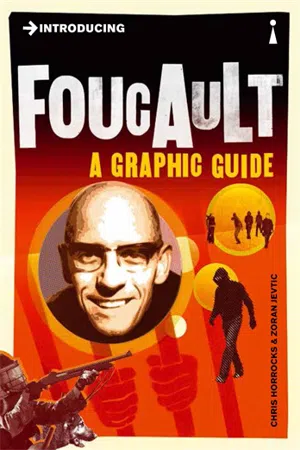
Michel Foucault's work was described at his death as 'the most important event of thought in our century'. As a philosopher, historian and political activist, he certainly left behind an enduring and influential body of work, but is this acclaim justified? "Introducing Foucault" places his work in its turbulent philosophical and political context, and critically explores his mission to expose the links between knowledge and power in the human sciences, their discourses and institutions. This book explains how Foucault overturned our assumptions about the experience and perception of madness, sexuality and criminality, and the often brutal social practices of confinement, confession and discipline. It also describes Foucault's engagement with psychiatry and clinical medicine, his political activism and the transgressive aspects of pleasure and desire that he promoted in his writing.
Information
Topic
PhilosophySubtopic
Modern PhilosophyI, Michel Foucault…
To find the real Michel Foucault is to ask “which one”?
Should we look at the life of the man himself, who as a boy wanted to be a goldfish, but became a philosopher and historian, political activist, leather queen, bestseller, tireless campaigner for dissident causes?
What about his literary skill, combined with painstaking historical inquiry, his excellence as a pasta cook, captivating lecturing style, passion for sex with men, occasional drug-taking, barbed sense of humour, competitiveness, fierce temper – and the fact that he came from a family of doctors and dearly loved his mother?

Do not ask who I am and do not ask me to remain the same.
Foucault the Author?
Or should we see Michel Foucault as the author, whose work combines brilliant insight and eccentric detail, uniting contemporary philosophical practice with the archaeology of the many documents he patiently retrieved from history? And what should we exclude, given the huge shifts in theoretical position over his career?
Foucault himself problematized the meaning of authorship – a function, he claimed, which resolved or hid many contradictions.

We must dispense with our habit of looking for an author’s authority, and show instead how the power of discourse constrains both author and his utterances.
So Foucault was reluctant to write his own biography or have someone do it for him. But many have, since his death.
A Transdiscursive Man
Foucault gave us the term transdiscursive, which describes how, for example, Foucault is not simply an author of a book, but the author of a theory, tradition or discipline.
We can at least say that he was the instigator of a method of historical inquiry which has had major effects on the study of subjectivity, power, knowledge, discourse, history, sexuality, madness, the penal system and much else. Hence the term, “Foucaldian”.

There are many “Foucaults” – whether they are all texts, or features in a network of institutional power, a regime of truth and knowledge, or the discourse of the author and his works. Let’s explore the many layers of Foucault.
Foucault’s Project
Foucault sought to account for the way in which human beings have historically become the subject and object of political, scientific, economic, philosophical, legal and social discourses and practices.
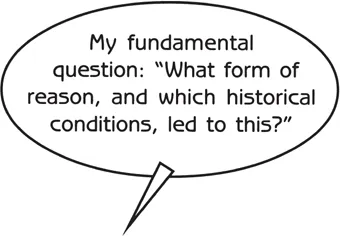
My fundamental question: “What form of reason, and which historical conditions, led to this?”
But Foucault does not take the idea of subjectivity in philosophical isolation. It becomes linked with – and even produced by knowledge and power through – dividing practices where, for example, psychiatry divides the mad from the sane.
Scientific classification: where science classifies the individual as the subject of life (biology), labour (economics) and language (linguistics).
Subjectification: the way the individual turns himself into a subject of health, sexuality, conduct, etc.
Scientific classification: where science classifies the individual as the subject of life (biology), labour (economics) and language (linguistics).
Subjectification: the way the individual turns himself into a subject of health, sexuality, conduct, etc.

Foucault Fiction
“In my books I do like to make fictional use of the materials I assemble or put together, and I deliberately make fictional constructions with authentic elements.”
Let’s “fictionalize” Foucault’s life by turning it into a biographical account of Foucault and his oeuvre or work.
He was born Paul-Michel Foucault, on 15 October 1926, to Anne Malapert and wealthy surgeon Paul Foucault, in conservative Poitiers in France. Paul-Michel Foucault had a sister Francine and a younger brother, Denys.
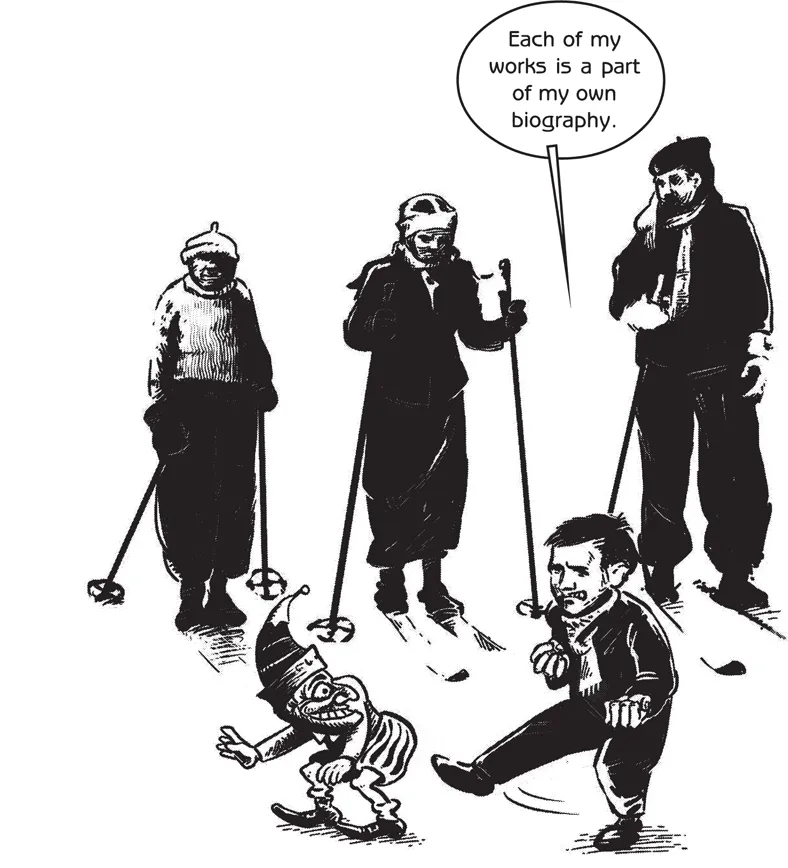
Each of my works is a part of my own biography.
Foucault had brown hair, a big nose and blue eyes. Foucault didn’t like the name Paul-Michel, because nasty children made it sound like Polichinello (Punch)! He changed it to Michel – perhaps expressing love for his Mum, who’d insisted on the name at his birth.
Camp Catholics and Choirboys
Foucault was of the Catholic faith. Later, he said he enjoyed its camp ritual. He was even a choirboy for a while.
1930. Paul-Michel was enrolled early in elementary class at the Lycée Henri-IV.
Because I want to be with my sister.
He was a young and disciplined student. Knowledge meant social promotion for his class.
He moved into the Lycée proper in 1932 and remained there until 1936 – the year he saw refugees arriving from the Spanish Civil War.
He was an enthusiastic cyclist and tennis player, but he was short-sighted, and often missed the ball. He enjoyed trips to the theatre, and occasionally the cinema.
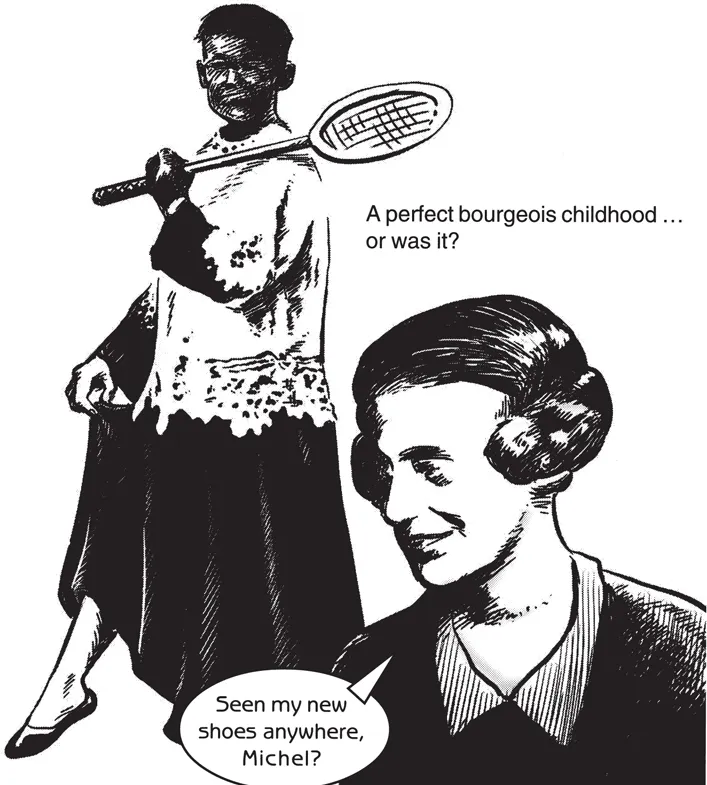
Seen my new shoes anywhere, Michel?
WAR!

1 Sept 1939: France falls to the Nazis, and her troops retreat south. Poitiers becomes a medical centre.
17 June 1940: Prime Minister Pétain requests armistice. Germans use the Foucaults’ holiday home as officers’ billet. Foucault steals firewood for school from collaborationist militia. Foucault does well at school, but messes up his summer exams in 1940.
I blame my failure on world war II, and the subsequent influx of their pupils from better schools!
17 June 1940: Prime Minister Pétain requests armistice. Germans use the Foucaults’ holiday home as officers’ billet. Foucault steals firewood for school from collaborationist militia. Foucault does well at school, but messes up his summer exams in 1940.
I blame my failure on world war II, and the subsequent influx of their pupils from better schools!
He transfers to the religious Collège Saint-Stanislas and gains prizes in French, history, Greek and English.
1942: Begins formal study in philosophy.
June 1943: Passes his baccalauréat. Argues with his father about his career. Medicine? Michel Foucault thought not – he wanted to go to the prestigious academic hothouse, the ENS (École Normale Supérieure) in Paris.
Paris – The Top 100
After two years’ study, he took the ENS entrance exam. He had to be in the top 100 to go to the oral exam. He came 101st! But parental influence gained him entry to the Lycée Henri IV in Paris’ Latin Quarter. Foucault was on his way to Paris …

I moved to a cold, lonely rented room in boulevard Raspail, and worked like crazy toward the ENS exam.
Foucault loved studying history, but Hyppolite showed him that philosophy could explain history.
But is history just a patient progress towards reason, and does philosophy have limits?
Georg Wilhelm Friedrich Hegel (1770–1831)
Hegel thought that what is real is rational, and that the truth is “the whole” – one great, complex system which he called the Absolute. He believed that Mind or Spirit was the ultimate reality. Mind has an ever-expanding consciousness of itself, and philosophy allows us to develop self-awaren...
Table of contents
- Cover
- Title Page
- Copyright
- Contents
- I, Michel Foucault…
- Selected Further Reading
- Acknowledgements
- About the Authors
- Index
Trusted by 375,005 students
Access to over 1.5 million titles for a fair monthly price.
Study more efficiently using our study tools.
Frequently asked questions
Yes, you can cancel anytime from the Subscription tab in your account settings on the Perlego website. Your subscription will stay active until the end of your current billing period. Learn how to cancel your subscription
No, books cannot be downloaded as external files, such as PDFs, for use outside of Perlego. However, you can download books within the Perlego app for offline reading on mobile or tablet. Learn how to download books offline
Perlego offers two plans: Essential and Complete
- Essential is ideal for learners and professionals who enjoy exploring a wide range of subjects. Access the Essential Library with 800,000+ trusted titles and best-sellers across business, personal growth, and the humanities. Includes unlimited reading time and Standard Read Aloud voice.
- Complete: Perfect for advanced learners and researchers needing full, unrestricted access. Unlock 1.5M+ books across hundreds of subjects, including academic and specialized titles. The Complete Plan also includes advanced features like Premium Read Aloud and Research Assistant.
We are an online textbook subscription service, where you can get access to an entire online library for less than the price of a single book per month. With over 1.5 million books across 990+ topics, we’ve got you covered! Learn about our mission
Look out for the read-aloud symbol on your next book to see if you can listen to it. The read-aloud tool reads text aloud for you, highlighting the text as it is being read. You can pause it, speed it up and slow it down. Learn more about Read Aloud
Yes! You can use the Perlego app on both iOS and Android devices to read anytime, anywhere — even offline. Perfect for commutes or when you’re on the go.
Please note we cannot support devices running on iOS 13 and Android 7 or earlier. Learn more about using the app
Please note we cannot support devices running on iOS 13 and Android 7 or earlier. Learn more about using the app
Yes, you can access Introducing Foucault Introducing Foucault by Chris Horrocks,Zoran Jevtic in PDF and/or ePUB format, as well as other popular books in Philosophy & Modern Philosophy. We have over 1.5 million books available in our catalogue for you to explore.