Introducing Keynes
eBook - ePub

Introducing Keynes

A Graphic Guide

  1. 176 pages
  2. English
  3. ePUB (mobile friendly)
  4. Available on iOS & Android
eBook - ePub

Introducing Keynes

A Graphic Guide

About this book

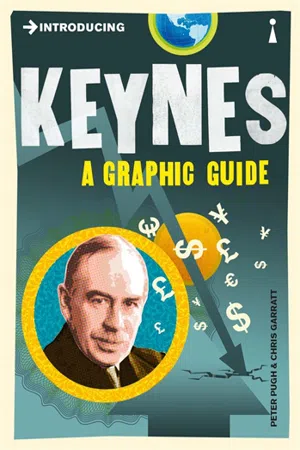
As we find ourselves at the cusp of an economic downturn, there has been a clear reinvigoration of Keynesian economics as governments are attempting to stimulate the market through public funds. Forming his economic theories in the wake of the Great Depression, John Maynard Keynes argued that a healthy economy depended on the total spending of consumers, business investors and, most importantly, governments too. Keynes formulated that governments should take control of the economy in the short term, rather than relying on the market, because, as he eloquently put it 'in the long run, we are all dead'. This graphic guide is the ideal introduction to one of the most influential economists of the 20th century, at a time when his theories may be crucial to our economic survival. Through a deft mixture of words and images, "Introducing Keynes" is a timely, accessible and enjoyable read.

Frequently asked questions

Yes, you can cancel anytime from the Subscription tab in your account settings on the Perlego website. Your subscription will stay active until the end of your current billing period. Learn how to cancel your subscription.
No, books cannot be downloaded as external files, such as PDFs, for use outside of Perlego. However, you can download books within the Perlego app for offline reading on mobile or tablet. Learn more here.
Perlego offers two plans: Essential and Complete
  • Essential is ideal for learners and professionals who enjoy exploring a wide range of subjects. Access the Essential Library with 800,000+ trusted titles and best-sellers across business, personal growth, and the humanities. Includes unlimited reading time and Standard Read Aloud voice.
  • Complete: Perfect for advanced learners and researchers needing full, unrestricted access. Unlock 1.4M+ books across hundreds of subjects, including academic and specialized titles. The Complete Plan also includes advanced features like Premium Read Aloud and Research Assistant.
Both plans are available with monthly, semester, or annual billing cycles.
We are an online textbook subscription service, where you can get access to an entire online library for less than the price of a single book per month. With over 1 million books across 1000+ topics, we’ve got you covered! Learn more here.
Look out for the read-aloud symbol on your next book to see if you can listen to it. The read-aloud tool reads text aloud for you, highlighting the text as it is being read. You can pause it, speed it up and slow it down. Learn more here.
Yes! You can use the Perlego app on both iOS or Android devices to read anytime, anywhere — even offline. Perfect for commutes or when you’re on the go.
Please note we cannot support devices running on iOS 13 and Android 7 or earlier. Learn more about using the app.
Yes, you can access Introducing Keynes by Peter Pugh,Chris Garratt in PDF and/or ePUB format, as well as other popular books in Economia & Biografie nell'ambito delle scienze sociali. We have over one million books available in our catalogue for you to explore.

Keynes is back!

This is what Maynard Keynes (1883–1946) said on the BBC in January 1931 as the whole world, the UK included, slid ever further into the greatest depression of modern times:
The best guess I can make is that whenever you save five shillings [25p, but about £12 in today’s money] you put a man out of work for a day. Your saving that five shillings adds to unemployment to the extent of one man for one day and so on in proportion. On the other hand, whenever you buy goods you increase employment – though they must be British, home-produced goods if you are to increase employment in this country … Therefore, oh patriotic housewives of Britain, sally out tomorrow early into the streets and go to the wonderful sales that are everywhere advertised. You will do yourself good – for never were things so cheap, cheap beyond your dreams. Lay in stock of household linen, sheets and blankets to supply all your needs. And have the added joy that you are increasing employment, adding to the wealth of our country, because you are setting on foot useful activities, bringing a chance and hope to Lancashire, Yorkshire and Belfast.
This is exactly what the British government (and governments round the world) are trying to persuade their voters, and encouraging them with tax breaks, to do in 2009.

We are all Keynesians now

As Martin Wolf wrote in the Financial Times at the end of 2008:
We are all Keynesians now. When Barack Obama takes office he will propose a gigantic fiscal stimulus package. Such packages are being offered by many other governments. Even Germany is being dragged, kicking and screaming, into this race.
And the long-living Marxist Eric Hobsbawm wrote:
It is certainly the greatest crisis of capitalism since the 1930s. As Marx and Schumpeter foresaw, globalisation not only destroys heritage, but is incredibly unstable. It operates through a series of crises. There’ll be a much greater role for the state one way or another. We’ve already got the state as lender of last resort, we might well return to the state as employer of last resort, which is what it was under FDR.
As we shall see in this book, Keynes’s approach to solving the economic problems of the 1930s – i.e. plunging demand leading to mass unemployment – was adopted in most of the countries of the world and was followed in various ways from the 1930s to the 1970s. However, Prime Minister Margaret Thatcher and President Ronald Reagan, along with their advisers, believed that Keynesianism led to inflation, and as a result it fell out of fashion in the 1980s and 1990s.
Now that we are once again faced with similar economic problems to those of the early 1930s, Keynesianism is once again in favour.

John Maynard Keynes (1883–1946)

John Maynard Keynes was the greatest and certainly the most influential economist of the 20th century. Keynes’ economic theories sprang from direct practical experience of three key moments of the 20th century: the post-World War One peace settlement, the Great Depression and World War Two.
image

The Keynes Family Background

image
John Maynard Keynes was born on 5 June 1883 at 6, Harvey Road, I Cambridge, a house built by his parents and occupied by them from 1882 until after Maynard’s death. His mother, Florence, born in1861, lived there with the same solid furnishings and William Morris wallpaper till she died in 1958.
image
Keynes’ father, John Neville Keynes (1852–1949), had switched from mathematics to moral sciences as a Cambridge undergraduate and became a fellow of Pembroke College after being declared a Senior Moralist, i.e. he came first in the moral science tripos.
Neville was an assistant to the economists Alfred Marshall (1842–1924), who regarded him as one of his best students, and Henry Sidgwick (1838–1900).
image
HE BROUGHT ME UP ON A MORAL SCIENCE TRADITION IN WHICH CAMBRIDGE ECONOMICS AND CAMBRIDGE MORAL PHILOSOPHY DEVELOPED SIDE BY SIDE. I REMEMBER NEVILLE AS AN EARNEST NON-CONFORMIST WHO PUT MORALITY FIRST AND LOGIC SECOND.
Maynard said of his father at a l...

Table of contents

  1. Cover
  2. Title Page
  3. Copyright
  4. Contents
  5. Keynes is back!
  6. Publications of John Maynard Keynes
  7. Bibliography
  8. Acknowledgements
  9. Index