Ever wonder why Estonian animation features so many carrots or why cows often perform pyramids? Well, neither question is answered in Chris Robinson's new book, Estonian Animation. Robinson's frank, humorous, and thoroughly researched book traces the history of Estonia's acclaimed animation scene from early experiments in the 1930s to the creation of puppet (Nukufilm) and cel (Joonisfilm) animation studios during the Soviet era, as well as Estonia's surprising international success during the post-Soviet era. In addition, Robinson writes about the discovery of films by four 1960s animation pioneers who, until the release of this book, had been unknown to most Estonian and international animation historians.
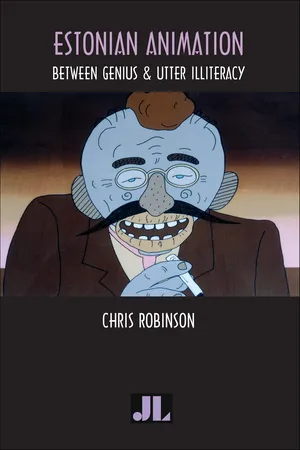
- 224 pages
- English
- ePUB (mobile friendly)
- Available on iOS & Android
eBook - ePub
About this book
Trusted by 375,005 students
Access to over 1 million titles for a fair monthly price.
Study more efficiently using our study tools.
Information
Chapter One
Previous Attractions
To see what is, we must see what was. I’ve no intention of going into Estonian history in great detail as there are already two fine books in English on the subject: Rein Taagerpera’s Estonia: Return To Independence and Toivo Raun’s Estonia and The Estonians. However, it is important to highlight a few characteristics of Estonian history in order to better contextualize this story.
In the beginning was land, and then came the word to deem it land. This particular land was located snugly between the Gulf of Finland, Lake Peipsi, Latvia and the Baltic Sea. This land, known by a variety of names including Kunda, Livonia, and Estonia (Eesti), became a corridor between the West and the East. Because of this enviable geographical location, Estonia has been a desirable target for many empires since the 13th century. Since about 1227, Estonia has been under the rule of Denmark, Poland, and most influentially, Sweden (1561–1710), Germany (1227–1561, 1941–45) and Russia (1710–1860, 1945–1991). There have only been three periods when Estonia was an independent country: 1200 A.D., 1918–1940 and 1991–present.
Given its small population and relatively small land size (noteworthy though, Estonia is bigger than The Netherlands), by all rights, Estonia should not exist today. The reason it does exist says a lot about the character of the people, but also the language they speak.
I’ve read various attempts that try to define the essence of an Estonian, and honestly they’re ludicrous. I’ve read of Estonians’ calmness, ironic sense of humour, pride, and sincerity, and while I’ve certainly encountered these traits, I’ve also seen their polar opposites. I’ve seen the good and the bad, just as I see it everyday in my own city. Furthermore, to speak of some homogeneity of race is misleading. Today, one can see traces of Swedish, German, and Russian, while emerging more recently is the influence of ‘American’ culture throughout Estonia. Estonians were once forced to speak Russian; now they are ‘forced’ to speak English. Certainly the reasons are entirely different – one was a gun to the head, the other is the enticing dollar bill. What has saved and made Estonians distinct, is their language.
North American English has swept across the planet forcing virtually every culture that wishes to participate in a global economy to embrace the language of Americans. I need not go into a long diatribe about the dangers of this global assimilation – if not perpetuated by the Americans, then it’d be by someone else. Nevertheless, along the way, we (English-speaking North Americans) have become spoiled modernists, racing through time crippled by historical amnesia. We now not only assume that everyone can and should speak English, but that they quite likely think like us as well (whoever ‘us’ is!). As ‘we’ invade every part of the world with our language and ‘culture’ we are not only forcing other languages to the background, but also the subconscious aspects of those languages that truly define the essence of difference. I speak of gestures, tone and pace. When we think, we think through language. Language influences how we perceive the world. In the Estonian language, gender does not exist. In place of pronouns, there are about 14 noun/adjective/pronoun and numeral cases. No definite or indefinite articles exist. And, most difficult, at least for me, is the three-quantity system (which might have North German roots) in vowels and consonants. For example, the short vowel: sada means “hundred”, long vowel: saada! means “send!” and the very long vowel: saada means “to receive”. In short, the Estonian language is drastically different from the more common Indo-European languages. With that difference comes a different way of thinking and seeing the world.
The Estonian language can be traced back some 5000 years. It is part of the Finno-Ugric group. Currently, aside from a part of the Volga region, Hungary, Finland and Estonia are the sole inheritors of this language group, with Finland aligned to the Finno branch, Hungary the Ugric, and Estonia a subgroup of the Finno branch, Balto-Finnic.
Today there are about 1million people who speak Estonian around the world. It’s almost like a secret society and there is little doubt that the uniqueness of the Estonian language is at the root of Estonia’s survival. The language is so complex for foreigners that assimilating or eradicating Estonian culture was made all the more difficult for invaders. Ironically, many of Estonia’s occupants had to learn Estonian to communicate their commands. Sure you could shoot everyone, but then who’d clean the dishes?
The Estonian language and character is deeply rooted in the land. In fact, some of the earliest known Estonian words like magi (hill) and mets (forest) are still in usage today. So Estonians might often be using words whose origins date back some 5000 years. Given the age of both the language and the land, there is a sense of stability or permanence found in Estonia that appears to be absent in, for example, North America, where the land is massive, relatively young, and continually abused. When islands comprise 10 per cent of a country that is already 44 per cent forest and 22 per cent wetland, it’s a given that landscape is closely bound up with the language and the people.
Not altogether surprisingly, animism was the predominant belief of early Estonians. Trees, stones, land, rivers, and even fire were believed to possess spirits. Unconvinced? Then just take a look at the meanings of the names of many of the Estonian animators: Pärn (close to lime, as in lime tree), Põldma (of the field), Kütt (hunter), Kalju (rock), Kivi (stone), Rand (Shore or coast), and Raamat (book).
Culture
While Estonia’s position as a ‘bridge’ between East and West led to centuries of occupation and bloodshed, it also had positive repercussions – namely a strange combination of isolation and openness. The isolation has helped Estonia preserve its roots and yet the diversity of its neighbours has meant an exposure to a wide range of cultural influences.
Prior to the 19th century, a strong oral tradition through folk songs prevailed in Estonia, in particular by the regivärss folk song, which used a lot of alliteration and thematic repetition (myths, weddings, daily life). The first written evidence of Estonian language appeared in the 13th century. Ironically, most of the early writings were published by foreigners keen on converting the pagan Estonians into God-fearing Christians. The first all-Estonian language book was published in 1535. The first known work written by an Estonian was Käsu Hans’ 1708 poem lamenting the destruction of Tartu (by Russians, naturally) during the Great Northern War (1700–21).
Formal education dates back to the 1600s. Most significantly, although Estonian was not initially taught at the school, Swedish rulers founded Tartu University in 1632. The University was closed in 1710 and re-opened in 1802. It continues to be Estonia’s most prestigious school.
It wasn’t until the 19th century that Estonian culture really took off (as it did in many European countries where Empires had started to collapse). This cultural period, most active from 1860–1885, is generally referred to as the National Awakening. In just three decades, Estonia became a nation with a weekly newspaper, books (including the publication of the National epic, Kalevipoeg, written by F.R. Kreutzwald), poetry, literary societies, theatre groups (the first Estonian play was written by Lydia Koidula, who was also Estonia’s first important poet), choirs, orchestras and, most significantly, song festivals. The first song festival was held in Tartu in 1869. There were about 900 participants and an audience of some 10–15,000. While Estonian music was not a major part of this first festival, the symbolic and literal importance of the event cannot be overlooked. Here were thousands of people singing about Estonians for Estonians. The energy from both the songs and the intimate gathering must have been overwhelming, and certainly stimulated a sense of togetherness and national pride in Estonians.
Cultural expression was not only a way of communicating with one another, but was also an essential means of self-preservation. During Soviet occupation, for example, a song festival provided a subtle and effective method of Estonian resistance. It was the one moment when Estonians gathered together and were able, albeit modestly, to express their world in their own voices. The song festival provided hope for the future and served as an important bridge to the past. Little wonder, then, that Estonia’s exit from the Soviet Union was deemed The Singing Revolution.
Chapter Two
The Lost Film
Because of World War 1 and the War of Independence, Estonian cinema did not develop until the 1920s. However, in 1916, prior to the first independence, a photographer named Johannes Pääsuke became a pioneer with the short film Karujaht Pärnumaal (Bear Hunt in Pärnumaa), a satire about the stupidity of city bureaucrats. Estonian cinema’s first feature film was Konstantin Märska’s Mineviku varjud (Shadows of the Past, 1924), which, either lost or destroyed, has not survived.
Like the films of almost every other country at the time, Estonian films were naïve and exaggerated. There were good guys and bad guys, gals needing to be rescued, lowered brows, and eye-rolling – the usual fare, just like every other national cinema. Aside from the occasional fictional film, there were many media-related films covering a wide range of domestic topics or showcasing local celebrities and politicians. There were also educational films showing viewers how to bind books, make crochet patterns, and even farms bees farm.
None of the filmmakers were professional. They received state support and, so it appears, made movies less out of a desire for financial gain (although there were some small businessmen involved, perhaps believing they could re-coup an investment) than a technical and artistic fascination with this new medium. But the period of experimentation was short-lived. A limited marketplace, the arrival of sound, and, with that, bigger budgets effectively killed off the first chapter of Estonian cinema.
In 1936, the Estonian government established Estonian Culture Film (although it was actually founded in 1931). The aim of the organization was not unlike that of the National Film Board of Canada (founded in 1939): to showcase what was perceived to be the nation’s life, culture and values. In short, Estonian Culture Film was a propaganda unit designed to flaunt the nation’s achievements, so its filmic output was mostly of the newsreel variety. Each cinema was obliged to show an Estonian newsreel before the main feature. The main features were generally what filmgoers of other nations saw: Hollywood, French, German, and British feature films. And what of Estonian features? The focus on short documentary newsreels left little money for expensive sound pictures.
Until 1986, it was assumed that animation was not among the many early cinematic experiments. It was always thought that Elbert Tuganov’s Little Peter’s Dream (1957) was Estonia’s first animation film. However, a roll of film was found in what was then the State Central Archives of the History of the Estonian Soviet Socialist Republic. The piece of film was discovered, oddly enough, in the section dedicated to the Estonian Temperance Society and turned out to be a cut-out animation film entitled The Adventures of Juku the Dog, whose main character is a puppy with long, floppy ears. The silent piece is awkward and sloppy in places, but an overall adequate emulation of 1930s-era American animation.
Juku appears to have been an attempt to create an Estonian national icon of the likes of Mickey Mouse. The making of Juku was also meant to jumpstart Estonia’s entrance into animation. As Nool, the society paper, noted in an article dated 1 May 1931, “This film is an endeavour to enter into the field where only big film countries, such as Germany and the United States have worked. Despite technical difficulties we tried to do our best to win the hearts of all Estonian film-lovers.”
Juku was the creation of at least three men: Voldermar Pats (photography), Elmar Janimagi (drawings), and Alexander Teppor. Teppor, a noted portrait photographer, was among those trying to establish an Estonian film industry in the early 1920s. Teppor often photographed on-set goings-on during filming and his photo studio served as a meeting place for film people. Pats, the nephew of Estonian President Konstantin Pats, had already served as the cinematographer on many feature films during the 1920s and Janimagi was a noted caricaturist (referred to as Jani in the film’s credits). For Janimagi this was the first and last animation film to which he would contribute. He was murdered in 1932.
Originally intending to make a series of films, the trio had not foreseen the numerous difficulties they’d encounter with their first:
Much had to be learned and discovered in this comparatively unfamiliar field of filming. This is why the new film has to be regarded as experimental. At first, when the landscape was drawn on ordinary paper, it started bouncing, as it is impossible to produce an identical landscape on so many drawings. This drawing was covered with transparent paper onto which the moving images were drawn. The film with a length of approximately 180 metres needed nearly 5000 individual drawings.

Making the film Kutsu Juku.
Elmar Janimä (left), Voldemar Päts and Aleksander Teppor.
Elmar Janimä (left), Voldemar Päts and Aleksander Teppor.

Frame from the film Kutsu Juku.
Interestingly, archivists only found 100 metres of the film, meaning that 80 metres are lost to the dustbin of history.
The film was to première, according to newspapers, on 7 November 1931, along with a feature film called Atlantis: Kalmistu Mere Sügavuses (Atlantis: The Graveyard in the Depth of the Sea), which was being promoted as the first “light and sound” film shown in Estonia. As for the newspaper’s billing of the other “great film”:
“Novelty! The First Estonian animated trick film, a sound grotesque “Juku the Dog”.
The premiere took place at the Capitol Cinema, which had recently installed “modern sound equipment.” But, as Juku was shot silent, its soundtrack was to be provided by “records of the Tormolen Co. Parlophon”, cued to play while the film unspooled.
Little is known of the film’s reception, or...
Table of contents
- Cover
- Title Page
- Copyright
- Contents
- Preface
- 1 Previous Attractions
- 2 The Lost Films
- 3 The Dictator and The Democrat
- 4 The Missing Links
- 5 The Preachers
- 6 Estonia Catches Up With Modern Art
- 7 Fat Chicks and Imbeciles
- 8 Nukufilm: Changing of the Guard
- 9 Music…Please
- 10 Uncorked
- 11 The Next Wave
- 12 Will The Strip Snap?
- Select Filmography
Frequently asked questions
Yes, you can cancel anytime from the Subscription tab in your account settings on the Perlego website. Your subscription will stay active until the end of your current billing period. Learn how to cancel your subscription
No, books cannot be downloaded as external files, such as PDFs, for use outside of Perlego. However, you can download books within the Perlego app for offline reading on mobile or tablet. Learn how to download books offline
Perlego offers two plans: Essential and Complete
- Essential is ideal for learners and professionals who enjoy exploring a wide range of subjects. Access the Essential Library with 800,000+ trusted titles and best-sellers across business, personal growth, and the humanities. Includes unlimited reading time and Standard Read Aloud voice.
- Complete: Perfect for advanced learners and researchers needing full, unrestricted access. Unlock 1.4M+ books across hundreds of subjects, including academic and specialized titles. The Complete Plan also includes advanced features like Premium Read Aloud and Research Assistant.
We are an online textbook subscription service, where you can get access to an entire online library for less than the price of a single book per month. With over 1 million books across 990+ topics, we’ve got you covered! Learn about our mission
Look out for the read-aloud symbol on your next book to see if you can listen to it. The read-aloud tool reads text aloud for you, highlighting the text as it is being read. You can pause it, speed it up and slow it down. Learn more about Read Aloud
Yes! You can use the Perlego app on both iOS and Android devices to read anytime, anywhere — even offline. Perfect for commutes or when you’re on the go.
Please note we cannot support devices running on iOS 13 and Android 7 or earlier. Learn more about using the app
Please note we cannot support devices running on iOS 13 and Android 7 or earlier. Learn more about using the app
Yes, you can access Estonian Animation by Chris Robinson in PDF and/or ePUB format, as well as other popular books in History & Eastern European History. We have over one million books available in our catalogue for you to explore.