This book is available to read until 23rd December, 2025
- 200 pages
- English
- ePUB (mobile friendly)
- Available on iOS & Android
eBook - ePub
Available until 23 Dec |Learn more
About this book
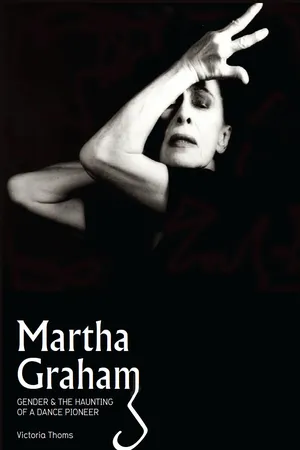
In her heyday, Martha Graham's name was internationally recognized within the modern dance world, and though trends in choreography continue to change, her status in dance still inspires regard. In this book, the first extended feminist look at this modern dance pioneer, Victoria Thoms explores the cult of Graham and her dancing through a feminist lens that exposes the gendered meaning behind much of her work. Thoms synthesizes a diverse archive of material on Graham from films, photographs, memoir and critique in order to uniquely highlight her contribution to the dance world and arts culture in general.
Frequently asked questions
Yes, you can cancel anytime from the Subscription tab in your account settings on the Perlego website. Your subscription will stay active until the end of your current billing period. Learn how to cancel your subscription.
At the moment all of our mobile-responsive ePub books are available to download via the app. Most of our PDFs are also available to download and we're working on making the final remaining ones downloadable now. Learn more here.
Perlego offers two plans: Essential and Complete
- Essential is ideal for learners and professionals who enjoy exploring a wide range of subjects. Access the Essential Library with 800,000+ trusted titles and best-sellers across business, personal growth, and the humanities. Includes unlimited reading time and Standard Read Aloud voice.
- Complete: Perfect for advanced learners and researchers needing full, unrestricted access. Unlock 1.4M+ books across hundreds of subjects, including academic and specialized titles. The Complete Plan also includes advanced features like Premium Read Aloud and Research Assistant.
We are an online textbook subscription service, where you can get access to an entire online library for less than the price of a single book per month. With over 1 million books across 1000+ topics, we’ve got you covered! Learn more here.
Look out for the read-aloud symbol on your next book to see if you can listen to it. The read-aloud tool reads text aloud for you, highlighting the text as it is being read. You can pause it, speed it up and slow it down. Learn more here.
Yes! You can use the Perlego app on both iOS or Android devices to read anytime, anywhere — even offline. Perfect for commutes or when you’re on the go.
Please note we cannot support devices running on iOS 13 and Android 7 or earlier. Learn more about using the app.
Please note we cannot support devices running on iOS 13 and Android 7 or earlier. Learn more about using the app.
Yes, you can access Martha Graham by Victoria Thoms in PDF and/or ePUB format, as well as other popular books in Médias et arts de la scène & Arts du spectacle. We have over one million books available in our catalogue for you to explore.
Information
Chapter 1
Martha Graham as Ghost
Modern dance pioneer Martha Graham died on 1 April, 1991, at the age of 96, after an almost inexhaustible career as a dance artist of international repute. She was an unreservedly compelling performer with enormous personal and physical charisma. Even after her retirement, when she needed to be helped on stage during company curtain calls, she could still command waves of standing ovations with the simple flourish of her arm. Graham began her career with vaudeville in the late 1910s and when she died in New York, almost 80 years later, she was still the artistic director of a globally recognised dance company. She was also an immensely perceptive choreographer and the creator of a potent and unique dance language that continues to be taught throughout the world. Her impact on the culture of the twentieth century is inestimable. Like her contemporaries Igor Stravinsky and Pablo Picasso, she forever altered the perception of her chosen art form. And like both Stravinsky and Picasso, her impact stretched well beyond the confines of this discipline into theatre, films, music, and popular culture.
Always considering herself a dancer above all else, she continued to create and perform compelling dance roles well into her 70s even while riddled with arthritis that turned her body into a shade of its former eloquence. Graham’s autobiography, Blood Memory (1991), movingly describes the devastation of this loss of physical eloquence, “I miss the animal strength, the beauty of the heel as it is used to carry one forward into life. This, I think more than anything, is the secret of my loneliness” (1991: 15). Yet she goes on to suggest that, even in the throes of ever-increasing physical disability, this failing body has a kind of timeless durability. The body, she suggests, “holds in its memory all matters of life and death and love” (Graham 1991: 4). This paradox captures the central concern of this book: the complexity of understanding and remembering bodies long after they cease to be. Therefore the book is set amidst the fading yet lingering apparitions of different bodies and different bodies of thought, arguing for the importance of understanding Graham as ghostly. The concept of haunting, derived from Derrida’s thinking on the Marxian legacy in Specters of Marx (1994) as well as other engagements with this conceptual theme (Thoms 2006, Buse and Stott 1999, Gordon 1997, and Spivak 1995) provide a way to analyse the tangled effects of Graham’s life and work. The Graham I theorise here is both solid and simultaneously fleeting, and this allows for a more complex appreciation of her extremely long and often complicated life as a woman and art producer.
Understanding Graham as ghostly allows a number of different perspectives. First, the body, as Graham so poignantly reminds us, is not made for permanence; and while the instability of the body poses problems for critical evaluation, the thinking here welcomes the temporary status of the body. Acknowledging the body as flimsy and unstable negates the desire to hold too tightly something that cannot entirely be captured while at the same time holding it long enough to theorise the forces that have given it its shape. The ghostliness of the body allows us to claim dance as a bodily form of cultural production that is precisely not stable while stressing its material political effects.
Furthermore, the body is fragmentary not only because of its physical impermanence but also because it is haunted by many different histories. It is burdened by the weight of numerous (and at times competing) ideological inheritances. The body is given multiple identities via the past; identities that are, amongst other things, raced, gendered, and classed. No one position or perspective can completely define the contradictory and intricate meanings circulating around Graham. Graham lived and produced work in a century that saw huge upheavals in political, social, and economic thought. Her accumulated history thus accrued many ghosts. Rather than attempt to exorcise the influences of these histories, the thinking here attempts to hold them in dynamic tension. Haunting allows recognition, no matter how precarious, of the multiple, conflicting, yet indispensable histories that lend definition to Graham’s life and art.
Moreover, if we acknowledge that understandings of the body in the present are troubled by understandings in the past, then history can no longer be thought an accounting of a dead past. Histories are alive and, although ghostly, live within us in the present. These histories live in the way that they inform the conditions that both constrain and enable the horizon of possibility in the here and now. In other words the present is a playing out of the histories of relations between bodies that shape the body’s ability to (using Graham’s words) hold in its memory all matters of life and death and love. One of the key aims of this book is to comprehend Graham’s past in order to argue for the importance and longevity of Graham’s future. Graham’s histories play a role in constraining or enabling both how we remember her and the continued engagement with the artistic material she set in motion. Understanding the past’s ghostly presence in the now allows us to deliberate and celebrate Graham’s futures.
Finally, this project emerged from a desire to celebrate Graham’s achievement as a woman but also to understand how her female identity influenced the things she did and the art she created. What did being a woman in the twentieth century mean for Graham? What did it allow her to do? Who did it allow her to be? Who did it allow her to love? And how does it still affect how we remember her today? To date there is no book-length study unpacking these questions. This book seeks to redress this omission by understanding how as a woman and artist Graham negotiated gender norms within specific yet shifting historical and social contexts. Examining these gendered forces is not straightforward. Graham was born into the last years of the nineteenth century and she lived into the last years of the twentieth. The way in which women’s identities changed over this expanse of time, as well as the different identities Graham herself inhabited during her life, make analysis particularly difficult. Haunting allows a means to interpret this influential artist’s life and work while at the same time acknowledging that no one history or identity has completely defined who she was, what she did, or the conflicting and intricate gendered meanings circling her.
Martha Graham
Graham came of age towards the end of the Victorian era and lived almost to the end of the twentieth century.1 Born in Allegheny, Pennsylvania, in 1894 into an affluent middle-class family, she was the oldest of three daughters, surviving a brother who died in infancy. Her father, George Greenfield Graham, was a medical doctor specialising in the emergent field of psychiatry. In her early teens the family moved to California where Graham was taken to see the celebrated concert dancer Ruth St. Denis. This event radically changed the course of Graham’s life. St. Denis so impressed her that Graham convinced her parents to allow her to attend the Cumnock School of Expression in Los Angeles, a junior college specialising in the performing arts.
In 1916, after graduation, Graham enrolled in Denishawn, the legendary dance school started by St. Denis and her husband, Ted Shawn, in Los Angeles a year before. Here she became both a teacher as well as a headlining dancer touring with Denishawn throughout North America and England. During this period of Graham’s life, the father whom she both rebelled against and revered passed away leaving herself, her mother, and two sisters without a significant means of living. Graham assumed a family leadership role, sustaining her mother financially until her mother remarried in 1927, and becoming the emotional centre of the family.
After breaking with Denishawn in 1926, Graham began a primarily solo career2 in New York City with the help of her then lover and creative mentor Louis Horst. Her choreographic interests also expanded to include working with a devoted group of female dancers, who would themselves become visionaries in the history of modern dance.3 Graham’s breakthrough came with the apocalyptic Heretic in 1929 and coincided with the renaming of her artistic endeavours to ‘Martha Graham and Dance Group’. From this initial success Graham created seminal works such as Lamentation (1930), Primitive Mysteries (1931), Frontier (1935), Chronicle (1936), and Deep Song (1937) and would become a dominant influence in concert dance for most of the century, creating approximately 180 works4 over a period of six decades.
If Graham’s creative life was lengthy and prolific, it was also tumultuous, often resulting in her working to the point of mental collapse. Graham’s personal life was equally turbulent and whether this fuelled her creativity or caused the tumult is often a source of debate.5 In 1938, in the middle of her long-standing affair with Horst, Graham fell deeply in love with the ballet dancer Erick Hawkins. Within the year, Hawkins joined her company as its first male dancer and his romantic and creative relationship with Graham stimulated one of her most productive and successful periods as a choreographer and a performer. During this time she created master works of Americana such as American Document (1938), Letter to the World (1940), and Appalachian Spring (1944), as well as perfecting her reinterpretation of classical mythology with Cave of the Heart (1946), Errand into the Maze (1947), and Night Journey (1947).6 Graham and Hawkins married in 1948 but the marriage collapsed with great bitterness in 1950 during the company’s first European tour. Graham never seemed to fully recover emotionally from this estrangement.7
Graham’s work in the 1950s and 1960s reached its zenith of influence with several lengthy and hugely successful international tours. Graham also created what is considered her magnum opus, Clytemnestra (1958), the only evening-length work in her oeuvre, where at the age of 64 she portrayed the queen of Troy. Despite success, her progressive physical decline damaged her self-identification as a dancer, leading to alcoholism and depression. Increasing pressure to retire from the stage also precipitated her anxiety. Contractual agreements finally forced her to retire as a dancer in 1970. This led to a mental and physical collapse that Graham was not expected to survive.
Graham did recover and moved to the role of choreographer for her existing dance company, enabling it once again to flourish. Yet this period was not without continued personal and artistic controversy. During her convalescence Graham developed a deep friendship with Ron Protas, a former law student turned freelance photographer. She began to promote Protas as an artistic advisor above people who had been working with her for more than two decades. In addition to this he subsequently served for almost 20 years as Graham’s live-in personal assistant and official representative in all company and school business. Consequently, at her death in 1991, Protas was named her sole heir.
Ten years later, Protas brought a number of lawsuits forward against the Martha Graham Center of Contemporary Dance, for trademark and copyright infringement respectively. These court battles ruled against Protas and re-established the Center’s entitlement to Graham’s dance legacy.8 However, a consequence of this confusion, which included the disbanding of the Graham Company in 2002, is that things have been difficult for the Graham organisation. It continues to rebuild with former Graham principal dancer Janet Eilber at the helm as its artistic director.
In summary, Graham lived a long, significant, and turbulent life. Her lifespan allowed her to experience momentous events that altered America and the world. Born into the Progressive Era, with its increasing industrialisation and mass immigration, she lived through World War I, the 19th Amendment extending suffrage to women, the Great Depression, World War II, the Cold War McCarthy witch-hunts, the Civil Rights Act of 1964, and the Vietnam War. Graham died two years after the fall of the Berlin Wall. During this time her influence on the founding of modern dance as an important and worthy form of art was immeasurable. Graham not only developed her own distinctive artistic signature but also stimulated the work of other significant choreographers and performers. This list could well be endless but might include Alvin Ailey, John Butler, Robert Cohan, Merce Cunningham, Mark Dendy, Jane Dudley, Jean Erdman, Erick Hawkins, Pearl Lang, Sophie Maslow, Donald McKayle, Richard Move, May O’Donnell, Anna Sokolow, Glen Tetley, Yvonne Rainer, Paul Taylor, and Yuriko. Additionally, through her influence with dance educators such as Martha Hill, Bonnie Bird, Gertrude Lippincott, Bessie Schönberg, and Gertrude Shurr, dance has become an integral part of various national curricula as well as a legitimate university discipline in its own right. Throughout her life, Graham also received a number of significant awards, including the Dance Magazine Award and the Capezio Dance Award. Yet it was receiving tributes like the Guggenheim Fellowship, the Kennedy Center Honours, the Aspen Award in the Humanities, the Medal of Freedom, and the Legion of Honour that indicate her widespread renown and the importance of her achievements in the twentieth century.
Previous research reflecting on Graham’s life and achievements has focused on either detailing her life in biography form or in reminiscences of former Graham dancers (see Bell-Kanner 1998, Freedman 1998, Bird and Greenburg 1997, Tracy 1997, de Mille 1991, Stodelle 1984, Terry 1975, and McDonagh 1973). These works are invaluable for their documentation of Graham but remain firmly in the genre of biography. There have also been investigations into the development of her dance training technique (see Bannerman 1999, Helpern 1999, 1994, Horosko 1991). This work is also crucial but, like the biographies, remains primarily documentative.
A number of scholars have undertaken important critical re-evaluations of Graham. These include Geduld (2008), Bannerman (2006), LaMothe (2006), Manning (2004), Reynolds (2002), Morris (2001), Banes (1998), Burt (1998a, 1998b), Graff (1999), Power (1999), Franko (1995), Thomas (1995), Corey (1990), and Siegel (2001; 1985), who have all taken up the topic of Graham from intertextual critical perspectives. This recent research though has not focused solely on Graham, taking place rather in journal articles or chapters in monographs or edited collections that concentrate on a broader discussion of the political dimensions of concert dance. Importantly, of the above engagements, Banes, Burt, Corey, Franko, Power, and Siegel make a gendered analysis or draw on feminist theory in critically assessing the dimensions of Graham’s life and work. Although this is a significant contribution to gender studies and feminist scholarship, this book-length project,9 devoted to a feminist discussion of Graham, draws attention to the significant influence that her identity as ‘woman’ had for her conditions of possibility.
In using the concept of haunting to examine the changing values and privileges attached to Graham’s identity as woman and art producer, this project appreciates recent research in dance studies that has sought to rediscover and re-evaluate the histories of American modern dance (Chatterjea 2004, Manning 2004, Jackson 2000, Graff 1999, and Tomko 1999). In her review of the spate of publications following Graham’s death, Lynn Garafola calls for a different way of exploring the dancer. She writes,
first the decks must be cleared. Even more than new research, what is needed is fresh thinking. The old assumptions no longer serve, nor the old hagiographies that once passed muster as history. A new history must be written, a history as brave, bold and daring as the dances of her prime.
(1993: 172)
Taking Garafola’s injunction seriously, this book immerses Graham in the politics of gender, using the concept of haunting to examine the changing and ongoing values attached to her identity as woman and art producer.
Searching for Graham: Finding Ghosts
I met Graham briefly in her dressing-room, but awe confined me to monosyllables. I had read too many daunting things about her: that “in more than one way she resembles Nefertiti” (de Mille), that her beauty was “of a formidable sort, eni...
Table of contents
- Cover Page
- Title Page
- Copyright
- Front Matter
- Contents
- Acknowledgements
- List of Images
- Chapter 1: Martha Graham as Ghost
- Chapter 2: Graham and the Spectres of Feminism
- Chapter 3: Haunting Cultural Imperialism: Graham, London, and the Phantom of the Ballet
- Chapter 4: Graham’s Haunted Relationship with the Camera: Reality, Time, and Dancing
- Chapter 5: Ways of Speaking with the Dead: Graham and Queer Resurrection
- Chapter 6: Martha Graham in Our Hands
- References
- Index
- Back Page