- 394 pages
- English
- ePUB (mobile friendly)
- Available on iOS & Android
eBook - ePub
Available until 23 Dec |Learn more
About this book
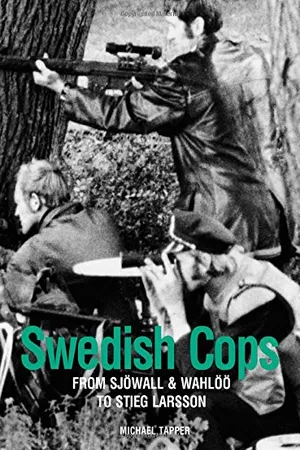
Michael Tapper considers Swedish culture and ideas from the period 1965 to 2012 as expressed in detective fiction and film in the tradition of Maj Sjöwall and Per Wahlöö. Believing the Swedish police narrative tradition to be part and parcel of the European history of ideas and culture, Tapper argues that, from being feared and despised, the police emerged as heroes and part of the modern social project of the welfare state after World War II. Establishing themselves artistically and commercially in the forefront of the genre, Sjöwall and Wahlöö constructed a model for using the police novel as an instrument for ideological criticism of the social democratic government and its welfare state project. With varying political affiliations, their model has been adapted by authors such as Leif G. W. Persson, Jan Guillou, Henning Mankell, Håkan Nesser, Anders Roslund and Börge Hellström, and Stieg Larsson, and in film series such as Beck and Wallander. The first book of its kind about Swedish crime fiction, Swedish Cops is just as thrilling as the novels and films it analyzes.
Frequently asked questions
Yes, you can cancel anytime from the Subscription tab in your account settings on the Perlego website. Your subscription will stay active until the end of your current billing period. Learn how to cancel your subscription.
At the moment all of our mobile-responsive ePub books are available to download via the app. Most of our PDFs are also available to download and we're working on making the final remaining ones downloadable now. Learn more here.
Perlego offers two plans: Essential and Complete
- Essential is ideal for learners and professionals who enjoy exploring a wide range of subjects. Access the Essential Library with 800,000+ trusted titles and best-sellers across business, personal growth, and the humanities. Includes unlimited reading time and Standard Read Aloud voice.
- Complete: Perfect for advanced learners and researchers needing full, unrestricted access. Unlock 1.4M+ books across hundreds of subjects, including academic and specialized titles. The Complete Plan also includes advanced features like Premium Read Aloud and Research Assistant.
We are an online textbook subscription service, where you can get access to an entire online library for less than the price of a single book per month. With over 1 million books across 1000+ topics, we’ve got you covered! Learn more here.
Look out for the read-aloud symbol on your next book to see if you can listen to it. The read-aloud tool reads text aloud for you, highlighting the text as it is being read. You can pause it, speed it up and slow it down. Learn more here.
Yes! You can use the Perlego app on both iOS or Android devices to read anytime, anywhere — even offline. Perfect for commutes or when you’re on the go.
Please note we cannot support devices running on iOS 13 and Android 7 or earlier. Learn more about using the app.
Please note we cannot support devices running on iOS 13 and Android 7 or earlier. Learn more about using the app.
Yes, you can access Swedish Cops by Michael Tapper in PDF and/or ePUB format, as well as other popular books in Desarrollo personal & Teoría y práctica del derecho. We have over one million books available in our catalogue for you to explore.
Information
Chapter 1
The Crime Genre
At the centre of modern crime fiction stands an investigating agent – an amateur detective, a professional but private investigator, a single lone policeman, a police force acting together.
(Knight 1980: 8)
Stephen Knight’s definition is certainly correct about the main characters, but in the genesis of the crime genre, crime itself was not a given. Many of the Sherlock Holmes stories, such as The Hound of the Baskervilles (1902), were about mysteries rather than crimes per se. ‘Mystery story’ was the preferred genre label in Arthur Conan Doyle’s time, defined in Encyclopaedia Britannica as ‘an ages-old popular genre of tales dealing with the unknown’, and with roots back to the Gothic novel and divided into ‘tales of the supernatural and riddle stories’. Mary Beth Haralovich (1979: 53) suggests that mystery was synonymous with the crime genre in general, but Mark Jancovich (2005: 35) claims that mystery and other genre labels are not solidified conventions, but constantly changing.
In his classic study Adventure, Mystery, and Romance, John G. Cawelti uses ‘mystery’ for narratives about ‘the investigation of hidden secrets’ ending in ‘a desirable and rational solution’, thus becoming a ‘moral fantasy’ (Cawelti 1977: 42–44) He also includes supernatural stories without a rational solution: i.e., the Gothic novel. Viktor Shklovsky ([1925] 1995: 193) wrote that the crime riddle that the detective solved explained the supernatural; however, there is no problem of taxonomy until the twentieth century. Many Gothic and mystery stories actually have a kind of detective, such as Abraham Van Helsing in the novel Dracula (Stoker 1897).
The crime genre was born in the inter-war years when mystery sprouted new genres: the film company Universal established the genre concept of horror with Frankenstein (Whale 1931) and Dracula (Browning 1931), pulp magazines such as Amazing Stories introduced the concept of science fiction, and realism became a prominent feature in hard-boiled crime stories (Kinnard 1995: 1; Newman 1996: 12–13; Skal 1990: 110–51; 1993: 144). During the Cold War years, spy narratives with professional intelligence agents separated and became a genre of its own; and then there were the metagenres and subgenres.
With Alfred Hitchcock’s films as his prime example, Martin Rubin (1999: 6) defines the thriller as a metagenre of suspense not unlike Tom Gunning’s concept of the silent film era’s ‘cinema of attractions’ (Gunning, 1986: 63–70). However, in Crime Movies, Carlos Clarens ([1980] 1997: 12–13) wants a clear delineation between the thriller and crime films. He regards the thriller as a genre taking place in a closed, private world of esoteric crimes, revenge and vigilante justice, with characters (the killers and their victims) that only represent themselves and their own interests. In crime films proper about detectives and police officers, the main characters are professionals that symbolically come to represent the philosophical clash of crime and the law. Making a claim for the police procedural as a separate genre, George N. Dove (1982: 51) elaborates on Clarens’ definition when arguing that the police have a privileged authority to enter people’s homes, make arrests, interrogate suspects and access confidential documents: that makes them even better suited to represent society and the law.
Then again, Thomas Leitch (2002: 1–17) asks in his introductory chapter to Crime Films, is it meaningful to discuss whether the crime genre is unified or divided into many subgenres? Considering that Julian Symons ([1974] 1975), Stephen Knight (2004) and John Scaggs (2005) equate the crime genre with stories about detectives and police officers, leaving out significant crime narratives involving gangsters or courtroom dramas, we need to know what we are talking about. On the one hand, looking at the gangster narrative for example, it marginalizes the force of the law to the gangster’s physical battles against rivals, and moral battles against conscientious relatives, priests and childhood friends. On the other hand, the courtroom drama is all about a moral and ideological conflict between the crime and the law, but the dramaturgy and iconography clearly distinguish it as a genre in its own right.
Leitch wants the crime genres to be one, but his taxonomy does not make a good case for ‘a coherent larger project’ (2002: 11). Rather, a flourishing diversity with some interconnections comes to mind. It would be more rewarding, then, to map the genre historically, and see how the various branches become separate. In that respect, there is a clear continuity between the detective and police narratives in their dramaturgy about crime, investigation and solution, and their literal and symbolic confrontation between crime and the law. As the guardians of civilization, they originate at the same time as the Western genre and action adventures with colonial heroes. While the heroes of the Western and colonial adventures fight barbarism at the outer frontiers, the detective and the police fights it from within.
Origins
Like John Scaggs (2005: 7–13), you could trace the roots of the crime genre back to Sophocles and Oedipus Rex, or to texts in the Bible or Shakespeare’s Hamlet, but none of them originated a narrative tradition that make up a genre. A better case could be made for the popular true crime stories of The Newgate Calendar (Anon 1750–1850), and, as an influence on Edgar Allan Poe, William Goodwin’s novel Caleb Williams (1794 [1998]) is mentioned often as an early example of the genre. The latter even has an amateur detective working for justice against all odds, but yet again, they did not inspire any followers.
The best candidate for the trendsetter that launched the crime genre seems to be the first chief of the French secret police, La Sûreté Nationale, Eugène François Vidocq and his Les Vrai Mémoirs de Vidocq/The True Memoirs of Vidocq (1828–29) (Knight 2004: 23–24; Morton 2005; Scaggs 2005: 17). In 1812 Vidocq developed the investigation techniques of Napoleon Bonaparte’s groundbreaking police organization, and in 1833 he founded an equally innovative private detective bureau. Not only did Vidocq’s partly true and partly tall tales influence Poe’s short stories written in 1841–45 about Paris detective C. Auguste Dupin, but his detective bureau sparked the imagination of an even more famous detective: Allen Pinkerton. When this Scottish immigrant to the United States opened his Pinkerton National Detective Agency in 1850, the organization, surveillance and investigation techniques, and even the aggressive spinning of Pinkerton’s legend, owed much to Vidocq. Together they stand as the pioneers of modern police work – collecting evidence, photographing victims and suspected perpetrators, interrogating witnesses – soon to be emulated by newly-founded national police forces worldwide.
In the first Dupin story, ‘The Murders in the Rue Morgue’ (Poe [1841] 1988:75–102), there is a sign of a genre in the making: intertextuality. Quite simply, Poe measures his hero Dupin against Vidocq and finds the former far superior. More than 45 years later, Arthur Conan Doyle repeats the stunt in A Study in Scarlet ([1887] 1989:11–63), allowing Sherlock Holmes not only to dismiss Dupin, but also crime novelist Émile Gaboriau’s detective hero Lecoq – an obvious Vidocq clone with a large fan following. From the Vidocq tradition, we have two basic crime genre ingredients. One is about criminal geniuses, from Vautrin in La Comedie humaine/The Human Comedy (Balzac 1830–47) to the film serial Fantômas (Feuillade 1913–14), James Bond villains such as Dr No and Thomas Harris’ Hannibal Lecter. The other is the police hero from Vidocq and Lecoq to Stanislas-Andrée Steema’s Wens, George Simenon’s Jules Maigret and Ed McBain’s Steve Carella.
In the Anglo-Saxon tradition, the amateur detective was the preferred hero. Sherlock Holmes is a lone, intuitive and analytical genius who, rather than relying on muscle power to enforce the law, uses his rationality and artistic sensibilities when investigating crime with scientific methods. His arch-enemy is the criminal genius Professor James Moriarty – a ‘Napoleon of crime’ – while Scotland Yard Inspector Lestrade is used mostly as a belittled and even ridiculous minor character. The Holmes tales set the pattern for the new genre: the detective puzzle. This would soon marinate in clichés such as LSP (Least Suspected Person) and the ‘locked room mystery’. This detachment from real crime, making the murder mystery into an intellectual game mainly set among the idle rich, was challenged in its inter-war heyday by the realist street tales of former Pinkerton detective Dashiell Hammett, introducing his professional detective, the Continental Op, in the two-fisted novel Red Harvest (Hammett 1929).
In his classic essay ‘The Simple Art of Murder’ ([1944] 1984), Raymond Chandler bantered about the limitations of the so-called soft-boiled British detective stories – many of them written by best-selling women authors such as Dorothy Sayers and Agatha Christie (see also Horsley 2005: 67). Chandler rejected the detective puzzle, and championed the hard-boiled masculine detective who was a descendant of the vigilantes of the American past, from James Fenimore Cooper’s Leatherstocking tales (1823–41), to the gunslingers of Western mythology (Horsley 2005: 66–86; Knight, 2004: 110–13; Scaggs 2005: 55–84). This hero walked ‘down these mean streets’ but was ‘not himself mean’ and ‘neither tarnished nor afraid’. He was a ‘complete man and a common man and yet an unusual man’. In short, he was ‘a man of honor’ working in a twilight zone between crime and law (Chandler [1944] 1984: 191).
Crime and the Law
According to Stephen Knight, the purpose of early tales of crime such as The Newgate Calendar was to reaffirm the social status quo under the threat from crime. Still, the perpetrator is not portrayed as evil or Other, but as one of us gone astray: ‘ordinary people who reject roles society and their family offer them’ (Knight 2004: 11). In many cases, their Christian consciences are awakened and they give themselves up voluntarily; otherwise they are apprehended by chance, for example, caught in the act or by someone recognizing them in the streets. No clear agent of the law actively seeking out and arresting criminals is visible in these stories, except in serious cases such as murder. Then a prominent citizen or a nobleman could take the lead in hunting down the killer. Sometimes the hunted was a prominent citizen or nobleman himself. They had means to escape justice by going into exile, to return when pardoned. The only unpardonable crime of the upper class was one that threatened their class, such as treason.
We can look to the two versions of Caleb Williams to give us an insight into a time of juridical and moral change in views of crime and punishment. The title character is from the lower classes, working for the wealthy Ferdinando Falkland who murdered his neighbour and got away with it, despite Williams’ efforts to bring him to justice. In the original manuscript, Williams goes to prison, but tries yet again after his sentence is served to inform on Falkland, only to be thrown into prison again. The published version, released in the aftermath of the French Revolution, tells us that Williams is reconciled with his master, comes to admire his ideals and is devastated when he dies soon after. His deepest regret is his neglect of loyalty to Falkland and to the social order that he represents (Goodwin [1794] 1998: 327–34).
The novel is a perfect example of a conflict between the old feudalism’s superior need for protecting the social order, and the Enlightenment’s call for the rights of the individual. In the published version, it is clearly God, not Man, who has the right to administer punishment for our sins, whereas in the original ending the full title Things As They Are; or, The Adventures of Caleb Williams becomes an ironic comment on the old social order. The author’s interest in the psychology of crime also makes it a forerunner of the twentieth-century thriller. For John Scaggs, both versions are problematic for the modern-day conservative crime fiction narrative, since they represent ‘ultimate rejection of the possibility of restoring the social order through the one-on-one conflicts between men that is structurally fundamental to much detective fiction’ (Scaggs 2005: 15).
However, at the formative time of the crime fiction genre, it developed under the influence of the Gothic novel, in which there is a mythical gap between the normality of society and the threat from dark forces of chaos. In parallel to Robin Wood’s (2003:
71) defining character of the horror genre, normality in crime fiction is threatened by the Other – perhaps not an outright monster but a criminal, perhaps of the atavist type. Like all conservative genres, normality equals the patriarchal society represented by the monogamous heterosexual couple, nuclear family and institutions of bourgeois society: the police, military, church and political and juridical institutions. The monster or criminal might have cunning, calculating intellect, but is driven mainly by uncontrollable brutal and insane impulses, not reason, and they are all deviants: by sexual desire (homosexuals, nymphomaniacs), gender (women), ethnicity (non-Europeans), class (working class, the ‘lumpen proletariat’), ideology (anarchists, communists) or religion (Muslim terrorists).
The crime genre was the answer to the bourgeois revolution’s Enlightenment ideals: scientific methods in combination with logical methods of analysis triumph over the threat from irrational and destructive forces. All the flaws and vices of Caleb Williams – curiosity, subjectivism, arrogance, lonely endurance – now become the virtues of the bourgeois detective, according to Stephen Knight: ‘the figure that Goodwin presents as misguided and destructive would emerge as a culture-hero bringing comfort and a sense of security to millions of individuals’. (1980: 28). In the luxurious surroundings of the detective puzzle, the mere disclosure of the culprit is enough to close the case, thus restoring bourgeois order. However, when confronting the hardened and violent criminals at the frontiers of civilization, physical violence is required. In his study of the Western narrative in Gunfighter Nation, Richard Slotkin points out the analogy between the dangerous tasks of James Fenimore Cooper’s wilderness hero Hawkeye, and the way in which Pinkerton writes about his agents’ work among criminals and communists:
[W]hen the corruption of civilization replaces wilderness as the scene of the drama, and the ‘urban savage’ replaces the Noble Red Man, Hawkeye is transformed from a saintly ‘man who knows Indians’ to a figure whose consciousness is ‘darkened’ by knowledge of criminality.
(Slotkin 1993: 139)
Pinkerton himself often stressed the parallels between Fenimore Cooper’s savages and the enemies of society that they were set against, be they anarchists, union people, strikers or common criminals. When Pinkterton agent James MacParlan infiltrates the Molly Maguires – an underground organization of Irish immigrants working in the coal-mining districts – it becomes a spiritual struggle in which MacParlan, like the Indian captives in Western narratives, risks losing his Protestant English soul, ‘having merged his “individuality” in the criminal tribe’ (Slotkin 1993: 142). Here, a colonial ideology based on race fuses with a moral dualism into a narrative that would flourish in the colonial era, from Sax Rohmer’s illustration of the ‘yellow peril’ in his Fu Manchu tales, to James Bond.
From the beginning, the bourgeois colonial or detective hero is an exceptional and even eccentric person, setting themselves apart from the very normality that they are set to defend. Poe’s Dupin and Conan Doyle’s Sherlock Holmes are described as alienated intellectuals, cut off from the lives of others, looking at the world with cool detachment. This outsider – prefiguring the existential anti-hero of Jean-Paul Sartre and Albert Camus – shares the physical and spiritual world of their savage antagonists in order to fight them, constantly at the risk of losing their mind and soul or even ‘going native’: crossing the frontier lines to become one of the enemy.
To ensure the detective’s connection to society and its law, order, morality and common sense, a go-between is often required. On the one hand, this go-between is the one who acknowledges the detective’s special status, exceptional qualities and need to use extreme methods in order to achieve a higher good: the preservation of society and, ultimately, civilization itself. On the other hand, he is the one who intervenes when the detective himself stray from the straight and narrow path. Dr Watson in the Sherlock Holmes stories became the model of this type of character, and a ‘Watson’ has subsequently become an established crime fiction term for characters of a similar narrative function.
Social, economic or psychological reasons for crime are rarely of any importance in a detective puzzle. Rather, the criminal comes from the same educated class as the detective, and the crime is explained mainly as the result of moral corruption (greed) or simply evil impulses. Sometimes there is an implied criticism of decadent aristocracy – for example, John Clay in the Sherlock Holmes story ‘The Red-Headed League’ (Doyle [1891] 1989:132–146) – which, like Dracula, echoes the nineteenth-century class war. A controversial case is Agatha Christie’s novel The Murder of Roger Ackroyd (Christie 1926), in which the confident narrator turns out to be the killer himself. Using psychoanalytical terms, Stephen Knight (1980: 112) regards this as a challenge to the struggle between the superego/detective and the id/criminal. It also could be seen an ideological challenge undermining the stability of the bourgeois universe.
The hard-boiled world of Hammett and Chandler is always unstable, oozing with cynicism and uncontrollable desires and impulses. Hammett’s Sam Spade and Chandler’s Philip Marlowe are alienated outsiders, and they look with disgust on the civilization that they are defending. However, this does not trigger any social or political reflections. Instead, Marlowe’s universe is one of solipsism, his cases starting out as professional but often turning personal, and so his moral code and vigilante justice is a continuation of the Western hero (Slotkin 1993: 218). Since there is no ‘Watson’ connecting him to society’s normality, and family is not an option in this world of femmes fatales, it is necessary to demonstrate in word or action his position on the right side of the law. A...
Table of contents
- Cover
- Half Title
- Title Page
- Copyright Page
- Contents
- Acknowledgements
- Preface
- Introduction
- Chapter 1 The Crime Genre
- Chapter 2 Enter the Police
- Chapter 3 Crime Scene: Sweden
- Chapter 4 The 1960s and 1970s: Sjöwall and Wahlöö
- Chapter 5 The 1980s: Leif G.W. Persson and Jan Guillou
- Chapter 6 The 1990s: Henning Mankell and Håkan Nesser
- Chapter 7 Millennium Cops
- Chapter 8 Into the Twilight
- References
- Index: Names
- Index: Titles of Works
- Back Cover