eBook - ePub
Available until 23 Dec |Learn more
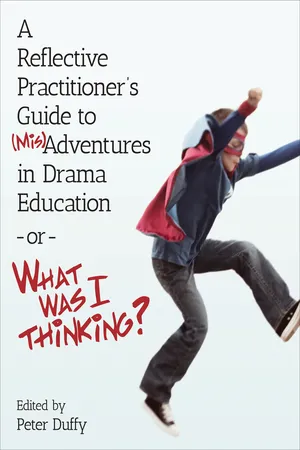
A Reflective Practitioner's Guide to (Mis)Adventures in Drama Education - or - What Was I Thinking?
- 290 pages
- English
- ePUB (mobile friendly)
- Available on iOS & Android
eBook - ePub
Available until 23 Dec |Learn more
A Reflective Practitioner's Guide to (Mis)Adventures in Drama Education - or - What Was I Thinking?
About this book
This collection of essays from many of the world's preeminent drama education practitioners captures the challenges and struggles of teaching with honesty, humor, openness, and integrity. Collectively the authors possess some two hundred years of shared experience in the field, and each essay investigates the mistakes of best-intentions, the lack of awareness, and the omissions that pock all of our careers. The authors ask, and answer quite honestly, a series of difficult and reflexive questions: What obscured our understanding of our students' needs in a particular moment? What drove our professional expectations? And how has our practice changed as a result of those experiences? Modeled on reflective practice, this book will be an essential, everyday guide to the challenges of drama education.
Frequently asked questions
Yes, you can cancel anytime from the Subscription tab in your account settings on the Perlego website. Your subscription will stay active until the end of your current billing period. Learn how to cancel your subscription.
At the moment all of our mobile-responsive ePub books are available to download via the app. Most of our PDFs are also available to download and we're working on making the final remaining ones downloadable now. Learn more here.
Perlego offers two plans: Essential and Complete
- Essential is ideal for learners and professionals who enjoy exploring a wide range of subjects. Access the Essential Library with 800,000+ trusted titles and best-sellers across business, personal growth, and the humanities. Includes unlimited reading time and Standard Read Aloud voice.
- Complete: Perfect for advanced learners and researchers needing full, unrestricted access. Unlock 1.4M+ books across hundreds of subjects, including academic and specialized titles. The Complete Plan also includes advanced features like Premium Read Aloud and Research Assistant.
We are an online textbook subscription service, where you can get access to an entire online library for less than the price of a single book per month. With over 1 million books across 1000+ topics, we’ve got you covered! Learn more here.
Look out for the read-aloud symbol on your next book to see if you can listen to it. The read-aloud tool reads text aloud for you, highlighting the text as it is being read. You can pause it, speed it up and slow it down. Learn more here.
Yes! You can use the Perlego app on both iOS or Android devices to read anytime, anywhere — even offline. Perfect for commutes or when you’re on the go.
Please note we cannot support devices running on iOS 13 and Android 7 or earlier. Learn more about using the app.
Please note we cannot support devices running on iOS 13 and Android 7 or earlier. Learn more about using the app.
Yes, you can access A Reflective Practitioner's Guide to (Mis)Adventures in Drama Education - or - What Was I Thinking? by Peter Duffy in PDF and/or ePUB format, as well as other popular books in Littérature & Théâtre. We have over one million books available in our catalogue for you to explore.
Information
Part One
Chapter 1
Dear Erstwhile Students,
This epistle is addressed to you by way of an apology that is long overdue. How time flies! I was given a stark reminder of this recently when I was approached in one of the parking-lots at my university by a very polite and helpful security guard who addressed me by name and asked whether I remembered coming to his school to conduct a drama class. It is always a little embarrassing when, at my stage in life, adults who bear little resemblance to the children they once were approach you and still appear hopeful that you will remember them. However, I do seem to have the uncanny ability to maintain a 100 per cent recall of the many dramas in which I have participated over time and once the security guard had prompted me with a brief description of the content of the drama in question, I realized it had taken place over 30 years before! Clearly such experiences remain vividly in the memories of many people, as does a particular one in mine, although for very different reasons, I fear, and for which I now feel the urgent need to atone.
You students who were with me on that fateful day must also be all quite grown up by now, and you may even have had the good fortune to develop into fine, well-adjusted individuals. If you have, and I hope that you have, it can be no thanks to me and my misguided attempts to enrich your lives through the experience of drama. It’s my own fault entirely, and I take full responsibility for my lack of competence. I really should have listened much more carefully to the briefing that I was offered ahead of time by your school administration. If I had done so then perhaps I would not have agreed to conduct that excruciating drama session in the first place. But then again, in my arrogance I considered myself to be both eminently well-qualified and up to the task. As far as I was concerned, you were simply a regular group of Jamaican primary school children, and, after all, I had already been working in the Jamaican primary school system for many years, so by then I had already worked with thousands of children just like you. I had also, by the time we met, been training teachers and supervising teaching practice in some very challenging situations across Jamaica. I had frequently travelled to schools in a variety of rural settings. Indeed, I had come to know the Jamaican parish of St. Mary like the back of my hand, with its schools in districts, villages and towns with names like Castleton, Devon Pen, Broadgate, Scott’s Hall, Annotto Bay, Port Maria and Galina. Your school, I felt, must be just like these were, albeit in the more urban setting of Jamaica’s capital city of Kingston, and with its own particular set of challenges.
I considered myself then, and still to this day, to be a committed teacher, and one who tries very hard never to stop learning. I had even taken off for a year to trek to the northern English city of Newcastle-upon-Tyne to study with that consummate teacher and educational philosopher Dorothy Heathcote. That experience in itself had been a baptism of fire, for it was there that I first became aware of just how inadequate I was as a teacher. Many years later I am, of course, still processing most of the things that happened during that year of study, but by the time of my encounter with you students, I had already begun dabbling about with my own personal interpretations of Dorothy’s concepts of teacher in role (TIR) and mantle of the expert with what I judged then to be a reasonable amount of success. So I really was not in the least bit fazed when the request arrived asking me to come and work with you.
As I recall, I had been invited by your school administration to conduct a drama session as part of a Summer Reading Programme that you were attending. In a follow-up session, one of your parents made the startling revelation that might have been very helpful to know in advance. The parent told me that so many of you student participants really associated reading with punishment. In my mind’s eye, I began to conjure up a somewhat fanciful vision of a Tenth Circle of Hell in Dante’s Inferno, where the unfortunate Damned would be condemned to suffer for Eternity sitting quietly reading their books!
You may have noticed the heading at the beginning of this missive. The first part consists of a Jamaican proverb that illustrates something of the economy of expression Jamaicans have in communicating deep traditional wisdom. “Chicken Merry, Hawk deh near” speaks to the fact that whenever, as humans, we become just the slightest bit complacent, something is very likely to happen to pull the rug from under our feet. And really, I should have known better. Alarm bells should have gone off when I heard the term “multi-grade” used to describe you as a group. Multi-grade schools still exist in many parts of rural Jamaica, particularly in districts where the population is too small to support a complement of full-grade classrooms. In the Jamaican multi-grade school, typically one teacher works with a combination of first and second grade students, another with grades three and four, and yet another with grades five and six. Often the teachers will be working together in one large space with their individual classes separated by free-standing partitions or chalkboards, so that the sounds of a music lesson may, on occasion, freely intermingle with the doleful chanting of the times tables, in a cacophony of pedagogic industry.
In my careless state of complacency, I did not pay sufficient heed to my briefing, and so had not fully prepared myself to meet a group of children ranging in age from 6-years old to 11, reflecting the entire spread from grades one to six. But even that was not the most troubling aspect of my negligence. I should have realized from the very outset that you were bound to have had younger or older brothers and sisters within the group. But the deep-seated resentment of the sibling rivalry that lurked unseen within the dark recesses of your hearts remained, as yet, masked by your beguiling, cherubic faces. All that, of course, remained to be unleashed in due course.
The encounter with drama that I had planned for you was, in my own personal estimation of my abilities at that time, absolutely wonderful. Needless to say, I had a very high opinion of both myself and my abilities as a teacher. I envisaged coming into your school to transform your lives permanently through imagined experience. Together we would create a wonderful story, and I would use TIR in order to open up all kinds of meaningful insights for you that would enrich your existence forever! At the time of our encounter I had not yet discovered the work of David Booth, but somehow intuitively, I felt that drama could lead you all towards an appreciation of story, and from there to storybooks and, “Hey, presto!,” to reading and universal literacy! Unfortunately, my perfectly conceived drama lesson continued to only ever really exist as a figment of my imagination and remained inside my head. In actuality, it was destined never to see the light of day, as you were all to discover to your own cost, since, not surprisingly, my thinking turned out to be characterized by a deeply flawed logic.
As you all shuffled into the room, my heart turned over when I suddenly realized the extent of my miscalculation. You were about as disparate a group of children as I was ever likely to encounter. You were all different ages, shapes and sizes, and the look in your eyes challenged me to engage you for the next two-and-a-half hours. Your attention was all totally focussed on me, this stranger, and once we had gone through the self-conscious preliminaries of introducing ourselves to each other, and you all just continued to stand there and stare at me. I felt I needed to deflect that attention somewhere else. And so I set off with Dorothy Heathcote’s distant voice ringing in my ears, “Find something to focus their attention on!” She would always talk to her own students about needing to have something that functioned in the classroom as “the other,” something that would divert attention away from the teacher and towards a dilemma to be resolved or task to be completed. We would spend hours with Dorothy preparing all kinds of “signs” to take with us into the classroom. I remember making ornate, ruffled, paper collars like the ones worn by people in portraits by Velasquez to be used in a class about the Golden Age of Spanish Drama. Once we wrote epitaphs on paper gravestones for children to puzzle over in a lesson about the Legend of the Holly and the Ivy. But in your case I had arrived woefully unprepared. I didn’t really have anything with me but my story and for some reason the surprisingly heterogeneous nature of the group shook my confidence to such an extent that I no longer trusted the story as something that would hold us together. I just felt that it was much too early in the game to take that kind of risk, and I would first of all have to try a different approach. I see now that one flicker of self-doubt led to a decision being made that set us off completely down the wrong path.
My on-the-spot decision to engage you all in a game felt like an absolutely brilliant solution to my quandary at the time. I decided then and there to draw on my tried and trusted pre-Dorothy approach! The justification to my-self was that lots of nice games and activities would warm us all up and get us in the right frame of mind to work together as a group. But how on earth could I have made the sweeping assumption that at your different levels of development you would already understand that most games have a structure and rules, and that once they were explained to you, you would abide by them? Now, safely distanced by time and experience from the scene of my mortification on that day, I am able to understand something of your response and have finally begun to appreciate why you all did what you did.
“Drop a Letter” is a straightforward enough game in and of itself. Players sit in a circle facing inwards, while one player with a small bean bag walks around the external perimeter of the circle. Once the bag is dropped behind one of the seated players, the player on the outside tries to move quickly around the whole circle in order to “tag” the seated player. Or if the seated player realizes the bag has been dropped, he/she picks it up and a chase ensues to get to the vacant spot in the circle. Now, this was not something I was introducing for the first time. I had played this same game many times before with other groups with great success. Yet I now fully understand how this seemingly harmless activity might, given the right circumstances, deteriorate into utter chaos, as it did with all of you. It is a great testament to your collective creativity that it had never even crossed my mind that anyone would take a short cut by running through the circle of bodies rather than around it as I thought had been agreed. Nor could I have ever envisaged that even the seated players would actually sabotage things by bringing down the runners with a series of physical tackles and spectacular dives.
And so I was forced to look on helplessly while what I thought had been a perfectly well-structured experience dissolved into a sprawl of flailing bodies playing rugby with a tiny, hapless bean bag. Dorothy Heathcote’s voice rang in my ears again, “Time to start thinking on your feet, lad!” But little did I know that the chaotic scene unfolding before me was about to take a turn for the worse. It was clear that I had to restore some sense of order and discipline to your experience with me, and so, having already decided to abandon my originally planned activities, I then began deftly to re-organize the game into something over which I felt I could have a little more control. After quickly spinning through the card index in my head, I came up with “Musical Statues.” In my first flush of enthusiasm I reasoned that this game or exercise would bring some much-needed discipline to the proceedings, while, at the same time, it would give you the opportunity to get rid of some of your excess energy. Getting you all to learn how to hold a “freeze” position would also give me a useful control device that would help me to move the session forward in a meaningful way. With hindsight I now begin to appreciate that all this cool consideration was actually born out of a deep sense of panic!
Having finally managed to extricate every last one of you from out of the heaving scrum of bodies on the floor and get you up on to your feet, and after some nimble negotiation to finally get you walking around the large room to the sound of my rhythmic clapping, I quite unreasonably thought I was back in business! This is, in fact, when I began to realize how bad the sibling rivalry actually was, as some of you older students used the opportunity to deliver a discrete cuff to the back of the head of your kindred nemesis, while you younger ones retaliated by attempting to push or trip your unsuspecting relation. Once I had delivered the command for an instantaneous freeze, it then took about another half a minute for everyone to finally screech to a halt. As I moved around the room inspecting your frozen positions, I caught sight in my peripheral vision of several of you changing your location in the room, and one or two of you even beginning to improvise your own version of “What time is it, Mr Wolf?” by getting up as close behind me as possible whenever I turned my back to you. This resulted in the rest of you dissolving into gales of laughter at my expense. My only consolation was that you had all clearly intuited the central theatrical concept of dramatic irony.
By the time the bell went for recess I was already a nervous wreck. The best part of an hour had gone by with no significant results. As I rather morosely watched you play in the school yard, it began to register with me that none of your own chosen play activities appeared to be very structured. None of you, for example, were playing a game that appeared to have a clearly defined set of rules. There was a lot of random chasing, and a great deal of flying karate kicks especially among you boys. “Structure!” “Control!” a little voice said inside my head. It didn’t sound like Dorothy Heathcote, so maybe she had become so disenchanted with my efforts thus far that she had abandoned me to my sorry fate. This new voice sounded much more authoritarian and there was something alien to me in its tone that I found rather disturbing.
What surprises me now looking back is the sheer extent and degree of my dogged tenacity and absolute refusal to be defeated in my misguided pursuit of my clearly impoverished agenda. And so, seized with a renewed vigour while you all continued to exchange blows outside the building, I moved swiftly into action like one possessed, flitting from one part of the room to another. I set up chairs, enough for each one of you, and placed them strategically a good distance apart from each other. I rationalized that at least this would keep you out of each other’s reach long enough for me to move us into some kind of positive drama experience. I think by this stage I must have started channelling the combined spirits of Harriet Findlay-Johnson and Sylvia Ashton-Warner as I busily set up the music sound system to play a selection of Orchestral Music by Giacomo Puccini. I was going to get some art into this room or expire in the process! But I am now also beginning to realize the extent to which I myself must have felt a desperate need to be rewarded for my pains.
After all your violent exertions in the playground, you returned to the room suitably sweaty and bedraggled and very happy to have the chance to sit down for a minute to catch your breath and recompose yourselves. So your temporary state of exhaustion, combined, of course, with the useful little tip from Dorothy Heathcote about spacing out the chairs, had worked beautifully in my favour. Things were now proceeding as planned and I now had you as my captive audience.
I have been trying to remember precisely when our encounter actually occurred. And it now seems to me that all this must have happened back in the early 1990s because it was around the time that Walt Disney’s animated feature Aladdin had been released, and had proved to be very popular with young Jamaican audiences. I began to think that here was an opportunity for us to meet each other half way so to speak. Teacher object interest meets student need interest to my way of thinking. So generously granting a small concession to popular culture I made the very conscious decision to bring you into the drama using the idea of the flying carpet. As I recall, I asked you all to close your eyes and imagine the chair you were sitting on as a magic carpet and to feel yourselves flying above a landscape. Once you were able and ready to describe what you were seeing in your mind’s eye you were permitted to stand on the chair and as I reached up and tapped you gently on the shoulder in turn you were free to share your description aloud with the rest of the class. For the next magical twenty minutes, I thought I had redeemed myself from the nightmare that had been the first hour. To the strains of Puccini’s Preludio Sinfonico played by the Berlin Radio Symphony Orchestra under the baton of Riccardo Chailly, you poured forth a torrent of poetic descriptions of crystal fountains, silver forests and fields of gold, flocks of birds, herds of animals and jewelled castles. Here was the reward I had so desperately laboured for. Immediately, I found myself glowing with the assurance that Peter Slade and Brian Way would have been proud of me and was already busily envisaging just how far I would be able to develop all this breath-taking imagery. I thought I was home and dry. Then, one of you decided to parachute off the flying carpet!
The drama that ensued moved from my gloriously conceived appreciation of Aladdin to a re-enactment of the D-Day landings in 1944 as one after another of you made spectacular parachute jumps and equally spectacular landings. Some of those among you, not satisfied with your initial attempts, jumped back up on the chairs in order to perfect your landing technique with forward rolls and somersaults. The room now began to look more like a training camp for an Airborne Infantry division during World War II.
The rest of the lesson is a blur. The playground suddenly manifested itself again, but this time inside the room, while I descended into some kind of catatonic shock. The melee was brought to a premature halt with the sudden appearance of your school principal in the doorway of the room. She hovered there for a few moments like the proverbial hawk, as you merry chickens continued your revelries unabated. As her presence began to register with each of you one by one, a gradual stillness descended on the room. With regimental precision you were all lined up and marched off to the lunch room, leaving me to ruminate on the sheer enormity of my spectacular failure.
I began this ...
Table of contents
- Cover Page
- Title Page
- Copyright
- Contents
- Foreword
- Introduction
- Part One: Hoops of My Making
- Part Two: Assumptions and Expectations: Failing Better
- Afterword: Looking Back to See Ahead
- Contributor Biographies
- Back Page