- 256 pages
- English
- ePUB (mobile friendly)
- Available on iOS & Android
eBook - ePub
Women's Ghost Literature in Nineteenth-Century Britain
About this book
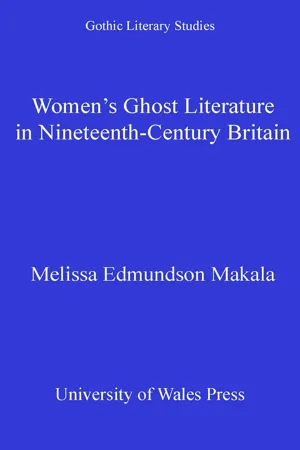
Women's Ghost Literature in Nineteenth-Century Britain examines the Female Gothic genre and how it expanded to include not only gender concerns but also social critiques of repressed sexuality, economics and imperialism.
Trusted by 375,005 students
Access to over 1 million titles for a fair monthly price.
Study more efficiently using our study tools.
Information
1
Female revenants and the beginnings of women’s ghost literature

Distressed heroines are a mainstay of Gothic literature. These characters, so integral to the Gothic landscape of the eighteenth and early nineteenth centuries, are repeatedly tormented by oppressive forces, kidnapped and imprisoned against their will, and otherwise deceived or misled by the sinister forces around them. In recent years, however, studies of women’s Gothic writing from the turn of the nineteenth century give us new ways of appreciating the extent to which women authors in particular used violent, nontraditional women in their writings as a means of embodying and claiming – through a piece of literature – a power that was denied them in the ‘outside’ world. In Women’s Gothic (2004), E. J. Clery challenges conventional notions of what anxieties lay beneath women’s writing of the early Romantic period:
the dualism of male and female traditions involves a simplification of the reality and fails to account for many aspects of women’s writing in the period. It has notably distorted our understanding of women’s achievements in Gothic writing. The current fascination with the Gothic genre in the academy and in the culture generally, has led to many studies of early female writers of Gothic, and almost invariably their works have been read as parables of patriarchy involving the heroine’s danger from wicked father figures, and her search for the absent mother.1
Yet Clery sees something missing from this traditional critical framework, asking, ‘But what happens if we lay aside our assumptions about women’s writing and look again at women’s Gothic? What we find there suggests the need for another story: wild passions, the sublime, supernatural phenomena, violent conflict, murder and torture, sexual excess and perversion, outlandish settings, strange minglings of history and fantasy.’2 Likewise, Adriana Craciun notices similar limitations in critical readings of Romantic women writers:
Central to feminist literary criticism on British women writers is the usually unspoken aim to demonstrate that women as a class (that is, as a sex outside of class) eschew violence, destructiveness, and cruelty, except in self-defense and rebellion, like Gilbert and Gubar’s imprisoned madwoman in the attic. This faith in women’s benevolence, for it is indeed a foundational belief of many modern feminisms, originated in the rise of the bourgeois order itself, which enshrined the maternal, nurturing, and domestic middle-class woman as the protected, private moral center of this new socio-economic order.3
In order to challenge this social stereotype, women writers of the Gothic appropriated the ballad tradition in order to voice concerns that they could not otherwise publicly articulate within the wider culture of their time. Craciun notes that Anne Bannerman’s otherworldly female figures – mermaids, revenants and prophetesses – ‘emerge as deadly “women” poets whose voices usher in destruction, not creation’.4 These figures are unwomanly because they destroy and refuse to remain silent.
The importance of the speaking dead body has also been commented on by Diana Fuss, who discusses how poems about speaking corpses ‘bring language more fully in line with death; they are literary fictions that seek to revivify and reauthorize the dead.’5 Fuss goes on to say that ‘the corpse poem poses a series of difficult questions about death, survival, and the animating power of language’.6 However, Fuss’s argument is centred on the notion that nineteenth-century corpse poems were written as comic or religious pieces, and that it is not until the twentieth century that poems spoken by the dead begin to concern themselves with history and politics.7 I would argue that Gothic ballads written by women complicate this idea by concerning themselves with socio-cultural assumptions that the truest, most feminine women were silent – seen but not heard. In other words, through poetic language, women claimed identities that were denied them elsewhere. Supernatural, otherworldly characters could embody this subversive language more easily than regular, everyday women because these women, being beyond the expectations of the natural world, did not have to fit into the prescribed gender roles of the time. According to Craciun, ‘Incarnations of fatal women – the seductress, the mermaid, the queen, the muse – recur throughout the works of women writers, demonstrating that fatal women played an important role in the development of women’s poetic identities in the Romantic period.’8 Subsequently, Romantic women poets allow scholars a ‘unique opportunity to reevaluate not only Romanticism and gender, but also the meaning and usefulness of a distinct female literary tradition and even a distinct femaleness.’9 It is not in the living, innocent Gothic heroine, but in the dead, vengeful revenant that this distinct female identity is fully realized.
In her essay, ‘La Belle Dame sans Merci: The Revenant as Femme Fatale in Romantic Poetry’, Lieselotte E. Kurth-Voigt lists the various forms in which fatal women appear in Romantic writing, such as ‘beautiful profligate’, ‘passionate temptress’, ‘power-hungry woman’, and ‘evil demon’.10 According to Kurth-Voigt, literary interest in the revenant began in 1725, after stories spread across Europe and Great Britain of a Hungarian man, who supposedly died, was buried, and then reappeared as a living being. This event was followed by numerous scientific studies attempting to prove the existence of the living dead. Kurth-Voigt provides an overview of early, maleauthored female revenant poems, such as Goethe’s ‘The Corinthian Bride’ (1798), Robert Southey’s ‘The Old Woman of Berkeley’ (1799), and M. G. Lewis’s ‘The Grim White Woman’ from Tales of Wonder (1801).11 These poems present female revenants that differ from those found in poems by women writers. The women in maleauthored poems are either taken from their lovers by forces beyond their lovers’ control (and often still remain faithful to their lovers after death) or are evil women in life who continue their treachery after death. Lewis portrays the character ‘Janet’ as the stereotypical helpless heroine of Gothic literature. As the wronged woman of the poem, she is unable to seek revenge through her own power. When her lover, Ronald, abandons her, she must seek assistance from the mysterious Grim White Woman in order to regain Ronald. Then, after losing him a second time because of a failed magic spell, Janet promptly becomes insane and dies a raving lunatic.
Women writers of the Gothic ballad chose, instead, to depict strong female revenants that are far from stereotypical, helpless heroines of earlier Gothic novels, or the unredeemable, oversimplified evil women of male-authored Gothic ballads. In Gothic ballads by women, there is a recurring motif in which female characters, who are either passive or in some way powerless in their lives, are transformed by death and return from the grave as empowered and often intimidating figures seeking revenge on those who wronged them. They seek no outside legitimization for their existence or their power. Their strength comes from within themselves and grows out of their past traumas as silenced or victimized women. This motif is at the centre of Anne Bannerman’s ‘The Perjured Nun’ and ‘The Penitent’s Confession’ from her Tales of Superstition and Chivalry (1802),12 as well as Charlotte Dacre’s ‘The Aireal Chorus’, and ‘The Skeleton Priest’ from her collection Hours of Solitude (1805). Victorian writer Elizabeth Harcourt Rolls continued this distinct genre with her 1854 poem, ‘The Ballad of Sir Rupert’, which features a ‘Spectre Nun’, who haunts a Spanish battlefield. Rolls’s poem, not only represents the transition from the Romantic to the Victorian eras, but, with its use of a revenant that blends gender issues with the larger problems of war, marks a shift in women’s ghost literature and signals Victorian women’s more direct and wider involvement with the supernatural as social critique. All three poets use the female ghost as a way of transforming helpless women into empowered figures who, only in death, are able to speak and act for themselves. The description of these revenants as implacable beings alludes to their connection to consciousness itself. They have privileged knowledge of the crimes and guilt of those around them and their unexpected or dreaded return represents the return of conscience to the living. These revenants provide the Female Gothic with its first representatives of social critique – women who embody and vocalize the dangers and crimes of gender inequality.
Female ghosts in Anne Bannerman’s Gothic tales
Though not much is known about Anne Bannerman’s (1765–1829) life (or death, for that matter), it is clear from reading her few published poetry collections that she possessed considerable talent for writing supernatural tales, culminating in the collection Tales of Superstition and Chivalry in 1802. With this use of the supernatural in her writing also came risqué subjects, such as illicit affairs and unashamedly sexual women.13 We do know that she never attained the success through her writing for which she hoped, despite the dedicated emotional and financial support Bannerman received from her long-time friend, the Edinburgh doctor, Robert Anderson, whose letters provide some of the most substantial biographical information available about the poet. He wrote to Joseph Cooper Walker in a letter dated 3 May 1800, after the publication of Bannerman’s first collection, Poems, that ‘the author is scarcely out of her teens’ but her works ‘are the production of no common mind’.14 In Anderson’s letters to Thomas Percy, it is clear that he cared deeply for Bannerman’s well-being, and he tried to provide for her following her mother’s death, a loss which left her financially destitute. Anderson encouraged Percy to read Tales of Superstition and Chivalry and later asked for Percy’s financial support for a planned volume of poems, which Bannerman chose to sell by subscription. Percy himself favoured Bannerman’s writing, telling Anderson in a letter dated 23 July 1803 of ‘the almost irresistible Spells which your enchanting Females are throwing over my mind’.15 However, Anderson seemed to sense that the reading public was not prepared for the daring subjects and themes of Bannerman’s literary ‘spells’. In a letter to Percy dated 24 January 1804, he expressed concern over her future as an author:
Her literary powers, eminent as they are, do not seem, for any of her efforts hitherto, to be of ready or popular application. They are, perhaps, better qualified to acquire fame than profit. The Almighty regards with an equal eye all the works of his hand, but I cannot conceive what is to become of my young friend. I think that, from her own inability to earn a livelihood, her total want of relations, and her great merits, the public money might be worse applied than in affording her a small annuity.16
Later, in June 1806, Anderson reported to Percy that Bannerman had undertaken the publication of her collected Poems (1807), which combined works from her first collection, Poems (1800) and Tales of Superstition and Chivalry (1802). He states that the subscription cost one guinea ...
Table of contents
- Cover
- Half Title
- Title Page
- Copyright
- Dedication
- Contents
- Acknowledgements
- Introduction
- 1: Female revenants and the beginnings of women’s ghost literature
- 2: Ghostly lovers and transgressive supernatural sexualities
- 3: ‘Uncomfortable houses’ and the spectres of capital
- 4: Haunted empire: spectral uprisings as imperialist critique
- Conclusion
- Notes
- Bibliography
Frequently asked questions
Yes, you can cancel anytime from the Subscription tab in your account settings on the Perlego website. Your subscription will stay active until the end of your current billing period. Learn how to cancel your subscription
No, books cannot be downloaded as external files, such as PDFs, for use outside of Perlego. However, you can download books within the Perlego app for offline reading on mobile or tablet. Learn how to download books offline
Perlego offers two plans: Essential and Complete
- Essential is ideal for learners and professionals who enjoy exploring a wide range of subjects. Access the Essential Library with 800,000+ trusted titles and best-sellers across business, personal growth, and the humanities. Includes unlimited reading time and Standard Read Aloud voice.
- Complete: Perfect for advanced learners and researchers needing full, unrestricted access. Unlock 1.4M+ books across hundreds of subjects, including academic and specialized titles. The Complete Plan also includes advanced features like Premium Read Aloud and Research Assistant.
We are an online textbook subscription service, where you can get access to an entire online library for less than the price of a single book per month. With over 1 million books across 990+ topics, we’ve got you covered! Learn about our mission
Look out for the read-aloud symbol on your next book to see if you can listen to it. The read-aloud tool reads text aloud for you, highlighting the text as it is being read. You can pause it, speed it up and slow it down. Learn more about Read Aloud
Yes! You can use the Perlego app on both iOS and Android devices to read anytime, anywhere — even offline. Perfect for commutes or when you’re on the go.
Please note we cannot support devices running on iOS 13 and Android 7 or earlier. Learn more about using the app
Please note we cannot support devices running on iOS 13 and Android 7 or earlier. Learn more about using the app
Yes, you can access Women's Ghost Literature in Nineteenth-Century Britain by Melissa Edmundson Makala in PDF and/or ePUB format, as well as other popular books in Literature & Literary Criticism. We have over one million books available in our catalogue for you to explore.