France has an admirable transport network that makes for quick and efficient travel. The autoroute (motorway) system runs throughout the country and allows long-distance travellers to go round rather than through the driving nightmare that is Paris. The greatest asset of the French road network is the superlative quality of its clearly signposted secondary roads, which are often strangely empty of traffic.
The 300kph (186mph) TGV (Train à Grande Vitesse) makes rail travel across much of France comfortable, quick and easy, connecting Paris with the major provincial cities.
The château of Chambord in the Loire Valley.
Sylvaine Poitau/Apa Publications
The north
Visitors coming from Britain via ferry or the Channel Tunnel might like to stretch their legs in the port towns before continuing the journey inland. Calais 1 [map] is distinctly shabby, but in the Parc St-Pierre you’ll find the famous bronze statue by August Rodin of the Burghers of Calais who, in 1346, offered their necks to Edward III, the English king, if he would spare the city. In Boulogne, the 13th-century ramparts of the picturesquely cobbled upper town (ville haute) make an interesting walk, with wonderful views into the Old Town and over the harbour. A little inland, St-Omer’s Basilique Notre-Dame, begun in 1200 and completed in the 15th century, is a triumphant union of Romanesque and Gothic styles, the jewel of Flanders’s ecclesiastical architecture.
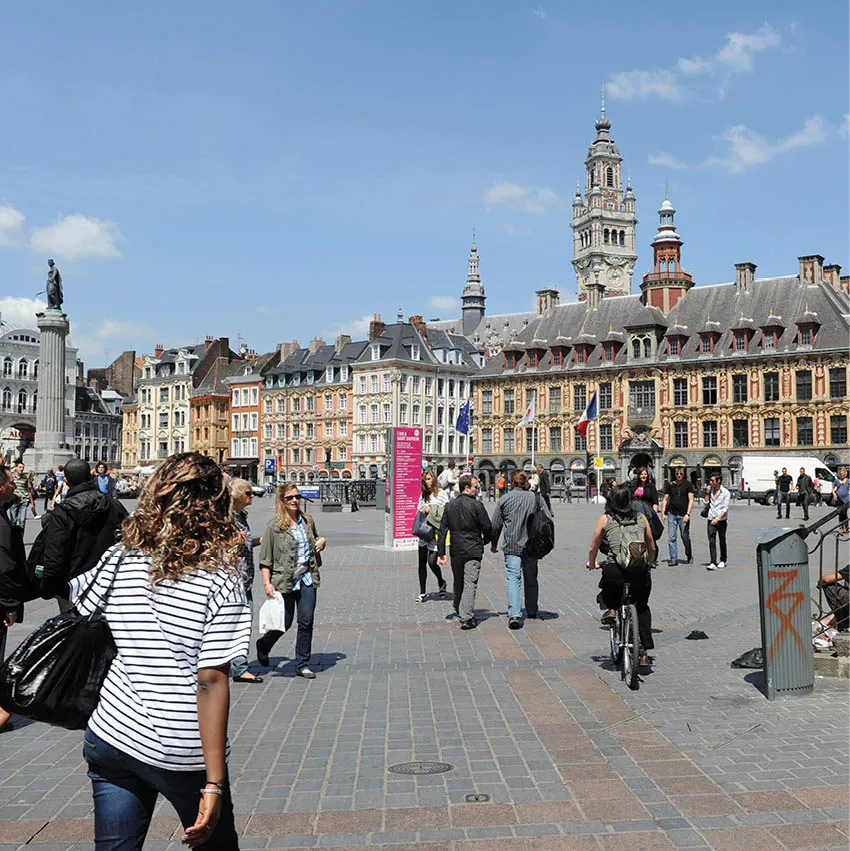
Close to the Belgian border is Lille 2 [map] , the capital of French Flanders, which is distinguished by its welcoming Flemish atmosphere and richly restored civic buildings, in particular the grand 17th-century Vieille Bourse and Louis XIV’s imposing citadel; a massive star-shaped construction that demanded the labour of 2,000 bricklayers. A little to the south in the old mining town of Lens is the Louvre-Lens (Tue–Sun), an ultra-modern art museum, opened only at the end of 2012, that will hold large-scale exhibitions and showcase items from the vast collections of the Paris Louvre not often seen in the main museum.
To the south are Arras and Amiens 3 [map] , the former famous to the English for the tapestries through which Hamlet stabbed old Polonius, and to the French as the home town of revolutionary leader Robespierre. It is worth a visit today for its spectacular Flemish-style squares the Place des Héros and Grand Place, some of the largest squares in Northern Europe, which still host bustling markets, especially in the weeks before Christmas.
The cathedrals of Amiens and several other French cities – usually including Rouen and Reims – are illuminated with remarkable coloured light shows every night during summer and (at Amiens) around Christmas. At Amiens, the lights faithfully reproduce the colours with which the medieval west facade was originally painted, an unmissable spectacle. In Chartres, the cathedral and several other historic buildings are lit up each summer, until 1am.
The 13th-century Gothic cathedral at Amiens is the tallest in France, a medieval jewel even more miraculous for having survived the bombardments of two world wars. Its great glory is the intricate stone carving of the west facade, described by critic John Ruskin as “the Bible in stone”; inside, the nave is wonderfully light, and the 16th-century wooden choir stalls are superbly carved. Back on the coast, between Boulogne and Dieppe, is the seaside resort of Le Touquet. Purpose-built in the early 20th century to attract the wealthy from Paris and London, it still has an air of 1920s gentility.
The north of France, flat and defenceless, has been the poignant arena for countless invasions throughout history, and its place names sound like a litany of battlefields.
Dunkirk is famous for the providential evacuation of 140,000 French and 200,000 British troops in May 1940. From the lighthouse or the Watier locks, you can see where it happened. English historians recall glorious Crécy (1346) and Henry V’s Agincourt (Azincourt in French) (1415), while the French prefer to remember even further back to Bouvines, an important victory over an Anglo-German alliance in 1214.
Other battles, whether ending in victory or defeat, soaked the fields of Flanders and Picardy, the plateau of the Ardennes and the banks of the Somme and Marne in blood. There are impressive monuments to Canadian troops at Vimy (north of Arras), to the Australians at Villers-Bretonneaux (east of Amiens) and to the Americans at Bellicourt (southwest of Le Quesnoy), while British cemeteries from World War I are found from the Somme through Flanders into Belgium.
Travellers in Normandy and other parts of northern France are constantly reminded of the colossal effort that went into rebuilding the towns and cities destroyed by fighting in World Wars I and II. Boulogne, Arras, most of Rouen and St-Malo were lovingly reconstructed from the rubble; in other cities – Le Havre, Calais, Brest – the scale of destruction was such that entirely new cities were built over the ruins.
Normandy
Within easy reach of Paris are the house and garden of Giverny (Apr–Oct Tue–Sun), created by the Impressionist painter Claude Monet, who lived there until his death in 1926. Beautifully restored, it has become a popular tourist spot, particularly the Japanese garden where the water lilies, so famously painted by the artist, still bloom.
Lille’s Grand’Place.
Sylvaine Poitau/Apa Publications
Downriver are the superb abbey ruins at Jumièges consecrated in 1067 to celebrate William’s conquest of England. Rouen 4 [map] , capital of upper Normandy, is famous as the city where Joan of Arc was burnt at the stake. The 11th- and 12th-century cathedral is only one of several splendid monuments in this great medieval city and port on the River Seine. Its exuberant facade was painted many times by Monet.
Dieppe 5 [map] , on the north Normandy coast, is one of the most attractive of the traditional Channel ports. The Boulevard du Maréchal Foch offers a pleasant promenade following the sweep of the pebble beach. The liveliest part of town, however, is around the Place du Puits Salé, where you will find the renowned Café des Tribunaux. The spectacular white cliffs of Etretat, west of Dieppe, demonstrate why this shoreline gained the epithet of the “Alabaster Coast”.
The white cliffs at Etretat, Normandy.
The most picturesque harbour towns of Normandy are further south on the Calvados coast, notably Honfleur. The Musée Eugène Bou...