This book is available to read until 8th January, 2026
- 208 pages
- English
- ePUB (mobile friendly)
- Available on iOS & Android
eBook - ePub
Available until 8 Jan |Learn more
Tools to learn more effectively

Saving Books

Keyword Search

Annotating Text

Listen to it instead
Information
1
Experiencing Meaning
To exist is to change, to change is to mature, to mature is to go on creating oneself endlessly.
—Henri Bergson
It’s not just about the money.
You’re good at what you do. You work long hours, and while you’d like to earn more, you may be earning a pretty good living. Perhaps you’ve acquired a certain amount of power, partly as a result of your skills and partly because you’ve learned how to climb the ladder and manage up. You care about your colleagues, your customers, and maybe even your business.
Despite all that, there are workdays when you feel you’re just going through the motions, and others when you feel you’re treading water, struggling just to keep from drowning in the minutiae of work and life. From the moment the alarm woke you in the morning to the minute your head hit the pillow at night, you were busy. You drank your morning coffee on the way to work, had lunch at your desk, and stayed late. Yet, as you close your eyes and try to think back on the day, you may not be able to single out anything you did that mattered. You may ask yourself, “Is this all there is?” String enough days like this together and soon you’re feeling hollow. And string enough seemingly purposeless years together and you’re convinced your work, and perhaps your life, is insignificant.
Well, you’re not insignificant. Your work matters. Every day, in countless ways, you have an impact, not just in your work, but on the lives of your customers, clients, and coworkers. I know it may not seem that way. Being, say, marketing director of a breakfast-cereal company doesn’t seem to be as meaningful as being a social worker or a teacher. But it can be. The seeds of making a difference are there all around you.
The emptiness you may be feeling inside is hunger; hunger to make a difference. Deep down you know work isn’t just about money or power. Sure, you need to take care of yourself and provide for your family and future—we all do—but there’s more to it than that. You need to feel that what you’re doing counts; that your work and you matter. And you can feel that.
By stepping up—by making right, just, and loving decisions throughout your day—you’ll experience meaning in your work and your life. You’ll feel as if you’re truly being the person you always thought you could be. You’ll wake up in the morning maybe even wanting to go to work.
It costs so much to be a full human being that there are very few who have the enlightenment, or the courage, to pay the price…. One has to abandon altogether the search for security, and reach out to the risk of living with both arms. One has to embrace the world like a lover, and yet demand no easy return of love. One has to accept pain as a condition of existence. One has to court doubt and darkness as the cost of knowing. One needs a will stubborn in conflict, but apt always to the total acceptance of every consequence of living and dying.
—Morris L. West
THE EPIDEMIC OF EMPTINESS
You’re not alone in feeling this hunger for meaning: emptiness is epidemic. I’m an Episcopal priest. Over the past twenty-five years I’ve ministered to hundreds of people who were facing death. Every one of them, whether it was the ninety-year-old family matriarch slowly drifting away or the nine-year-old boy losing his short and intense battle with cancer, asked me a similar question: “Did I matter? Have I counted? Did my life make a difference?” Since shifting my mission from parish work to the business world, I’ve seen how those questions don’t just represent end-of-life personal doubts, but daily workplace uncertainties. You may not always frame it so directly or dramatically, but that emptiness you sometimes feel about your work comes from the fear that what you’re doing doesn’t really matter.
The epidemic of emptiness has even become part of popular culture. In the film About Schmidt, Jack Nicholson plays insurance executive Warren Schmidt, who retires and shortly thereafter loses his wife. The sudden changes force Schmidt to look back on his life, and he’s not happy with what he sees: “I know we’re all pretty small in the big scheme of things, and I suppose the most you can hope for is to make some kind of difference, but what kind of difference have I made? What in the world is better because of me?”
Perhaps this epidemic was spawned by all the graying baby boomers who are realizing that, despite years of dutifully paying into the corporate Holiday Club, they’re unlikely to reach the bureaucratic heights to which they once aspired. Maybe it comes from our transition from an industrial to an information-and service-based economy: the more we’re removed from the creation of a tangible product, the less “real,” and therefore the less meaningful, our work seems. It could be that, as a society, we’re undergoing a values shift away from materialism and consumption to spirituality and community. Maybe cynicism is waning and idealism is waxing. Who knows, it could even be the result of a great historical cycle linked to our entering a new millennium. While a discussion of the causes could be fascinating and is certainly worthy of a book, that’s not what I’m writing about.
I entered the priesthood five years after graduating college and spent more than twenty years ministering to the needs of parishioners. I began at St. John’s Episcopal Church Lafayette Square, known as the Church of the Presidents, right across from the White House in Washington, D.C. Next I went to St. John’s Episcopal Church in the famed fishing town of Gloucester, Massachusetts. Finally, I served a well-heeled parish in a Philadelphia suburb.
Since leaving parish work, I’ve remained a priest but have worked as a communications specialist, conflict negotiator, and corporate consultant. I’ve often thought the Kris Kristofferson song “Pilgrim: Chapter 33” summed up my “career” pretty well: “He’s a walkin’ contradiction, partly truth and partly fiction / Takin’ ev’ry wrong direction on his lonely way back home.”
My own “lonely way back home” has led me to have a foot in both the spiritual and the business worlds. While I now spend most of my time in secular settings, I am in it, but not of it. This has provided me with the rare opportunity to see that the hunger for meaning is, as I suspected, just as common at work as it is in religious institutions. And I’ve found that you have far more chances to experience meaning and fill that emptiness at work than you may realize. That’s certainly true for me: I often do more counseling in a day in the secular world than I did in a week as rector of a parish.
YOU HAVE LOTS OF CHANCES TO MAKE A DIFFERENCE
I know that might sound strange, but it’s true. Most of us focus on our quest for meaning for perhaps ninety minutes or so a week. Maybe it’s on Sunday morning when you attend church, on Saturday when you go to synagogue, or when you go to Friday-evening prayers at a mosque. It could be the ten minutes or so you spend meditating each day, or even your twenty-minute run after work. Whatever form our spirituality takes, we usually devote less time to it than to our daily commute. So while we may dedicate ourselves for those handful of minutes to our quest for meaning, by its nature it’s a limited opportunity.
It’s sort of like when the revival show comes to a town and the evangelist brings a quick fix of religion and faith to the crowd. Everyone comes to get their shot of “Jesus Juice” on Sunday morning, and it works for a day or two, and then by Tuesday the “saved ex-drinker” is back at the local bar. Or it’s like the company that hires a motivational speaker to come in for a one-day seminar or a two-day “Cupcakes and Kumbaya” workshop to pump up morale, or the organization that provides yoga classes in response to employees’ needs.
THE GOD BOX
I believe spirituality belongs not only in places of worship, but in the workplace as well. Spirituality is central to our full humanity. Since I’m an ordained clergyman, I’m sure that doesn’t surprise you. But you might be surprised that I’m adamantly opposed to religion in the workplace. There’s a big difference. God is how I choose to define the higher power I believe infuses all of us and all the universe. He/She can and does go by countless names ranging from ethereal spirit to scientific gravity. Spirituality is about the human spirit and soul; how each of us individually and collectively become conscious of ourselves and our unique roles in the universe. It’s an expression of our values and beliefs. Religion, on the other hand, is a particular system of faith and belief with its own set of rules and practices.
To be the best managers, coworkers, employees, or just human beings that we can, we don’t need to bring religion into the workplace, we just need to be mindful of our spiritual selves. We need to provide a space for our values and ethics to be expressed. We need to make room in the office or factory for the higher power. Ironically, at the same time we need to keep dogma out of the workplace. Diversity is a great strength, one that businesses need to embrace to succeed. Religion, by its very nature, can be exclusive rather than inclusive. Spirituality in the workplace can empower individuals, if its mystery is respected, and bring people together so we can all step up.
The answer to the hunger for meaning isn’t a yoga class during lunch hour or even an hour of prayer on the weekend. The answer is to experience meaning in your entire life, particularly at work, where you spend most of your time. Think of how much time you spend on the job. If you’re like most of us, you’re in the office for at least forty hours a week, and many of us are working a lot more than that, whether in the office, on the road, or at home. In an average day we may have a dozen different chances to make a difference. On the rush-hour drive to work we can allow someone to merge into our lane or we can force her to wait. On the way to our office we can ignore the man in the company cafeteria from whom we buy a cup of coffee or we can step up and smile and wish him a good day. When our superior asks about the status of a problematic project, we can step up and take responsibility or we can pass the buck. If our coworker is about to make a potential mistake, we can step up and intervene or we can just stay out of it. Those are four chances and we haven’t even gotten to lunch yet.
Don’t think smiling to the man who serves you coffee qualifies as making a difference? You’re being an elitist. You see, making a difference isn’t just about what you do, it’s about how you do it. Sure, you could definitely make a difference by working as an elementary-school teacher in an inner-city school. But you could also make a difference by listening to the anger of a fellow department manager rather than striking back. The teacher educates a child and, let’s say, instills a lifelong love of reading, making a tremendous difference in that child’s life. The manager who chooses not to start internecine warfare in an organization not only stabilizes the environment but probably prevents financial turmoil that could lead to lower profits and possibly layoffs. Making a difference needn’t be a dramatic direct action. You don’t need to be like Alexander splitting the Gordian knot with his sword.
One of my clients, Gary Green, chief executive officer of Alliance Building Services, has told me that a manager’s manner and the subtle setting of a tone can be like a pebble cast into a placid bay, sending out positive ripples that can turn into positive waves throughout an organization. He has focused on developing a “leadership of presence,” where being is as important as doing. The success of his company is based on “the little things” as well as top-line growth. Your smile to the guy behind the coffee urn can turn into his exchanging pleasantries with the director of advertising, which results in her not blowing up at the staff meeting ten minutes later. Astronaut Neil Armstrong was making a profound statement when he first stepped onto the lunar surface and noted how what outwardly seems an almost insignificant act—a single human step—can have, pardon the pun, astronomical impact.
If your daily life seems poor, do not blame it; blame yourself that you are not poet enough to call forth its riches; for the Creator, there is no poverty.
—Rainer Maria Rilke
Just ask Chuck Henderson if little things make a difference.* The forty-seven-year-old married father of three is chief operating officer of a firm that produces components for high-tech electronic equipment. Short but well muscled with black, curly hair, Chuck’s model for effective management is his college wrestling coach. One day he was struck by how down his payroll department manager seemed. The thirty-five-year-old woman had joined the firm six months earlier and had been doing a great job. When Chuck asked her what was wrong, she immediately launched into a series of apologies. Chuck reassured her and asked again. Finally, she explained that her husband had just started a new job as well, and their schedules kept them from spending as much time together as they’d like. She went on to note that they couldn’t even take the same train into Manhattan from their suburban home, since she started work an hour earlier than he did. Chuck told me about the exchange later that afternoon during a meeting we were having on restructuring. Following our conversation and some reflection, he realized maybe flex hours could serve both the company and her marriage. Later that afternoon he went back to visit the payroll manager. He said he didn’t see any reason why she couldn’t just come into work one hour later and leave one hour later, so she could take the same train as her husband. It was as if he’d taken a ten-ton weight off her back. Her morale soared and her productivity, already good, became exceptional. Simple solution; potent results.
Being mindful of our decisions
One reason why we don’t experience all the chances we have to make a difference and find meaning at work is, we don’t even think about the opportunities…we just react. Our boss expresses outrage at the press kits being late and we instinctively blame the vendor who we’ve used for years but “will never use again.” One coworker dishes to us about a third coworker whose sales have fallen three quarters in a row and is about to be called on the carpet. We nod and take it all in just like always. A member of our project team shows up late again and explains he had to take his daughter to the doctor. We ask him not to let it happen again…even though it has become a regular occurrence and we’ve made the same request three times. Faced with situations at work, we fall into habitual, patterned behavior, just as we do in the rest of our lives. For better or worse, many of our decisions at work have become subconscious, like reflexes, rather than well-thought-out choices.
To step up and make a difference at work and, as a result, bring increased meaning to your life, you need to be mindful of the decisions you make during the day. You need to take responsibility for your actions. It’s really all up to you. Meaning is there for you, but it won’t come to you on its own, you have to reach out for it. God doesn’t bestow a meaningful life on us, like a ripe apple falling off a tree into someone’s lap. We’re all given the gifts of free will and the opportunity to make a difference…if we so choose.
Doing work that matters comes not from the work itself, but from what you as an individual bring to it. You give meaning to the work; the work doesn’t give meaning to you. That’s as true for a social worker helping to feed the hungry as it is for the chief financial officer of a construction supply company. If the social worker doesn’t step up, his work at the soup kitchen won’t feel meaningful. And if the chief financial officer does step up, her work for the annual report can have real meaning.
Sharon Campbell, sixty-one, has been a human resources professional for more than thirty years. A divorced woman with stylish, shoulder-length gray hair, Sharon was educated in both social work and management. She went into human resources fully intending to do all she could to bring a therapeutic touch to the corporate world. You’d think she was perfectly situated to find her work meaningful. But today, working in the HR department of a major financial company, she finds herself spending nine hours a day filling out government compliance forms and working on termination packages. Sharon has confided to me that she has actually started counting the days until retirement.
Winston Cliff, fifty-nine, works as a security guard for the same financial company where Sharon works. His job is to manage the flow of who can enter the building. If you were going to pick a job that made a difference, you wouldn’t pick his. Yet you’d be wrong. A married father of four, Winston has the build of an NFL offensive lineman. He has a shaved head and wears a perpetual smile. No one, from corporate executives to the deliveryman dropping off a pastrami sandwich, or at best an occasional visitor to the company, enters the bu...
Table of contents
- Cover
- Title Page
- Dedication
- Contents
- Preface
- Introduction
- 1
- 2
- 3
- 4
- 5
- 6
- Acknowledgments
- About the Author
- Credits
- Copyright
- About the Publisher
Frequently asked questions
Yes, you can cancel anytime from the Subscription tab in your account settings on the Perlego website. Your subscription will stay active until the end of your current billing period. Learn how to cancel your subscription
No, books cannot be downloaded as external files, such as PDFs, for use outside of Perlego. However, you can download books within the Perlego app for offline reading on mobile or tablet. Learn how to download books offline
Perlego offers two plans: Essential and Complete
- Essential is ideal for learners and professionals who enjoy exploring a wide range of subjects. Access the Essential Library with 800,000+ trusted titles and best-sellers across business, personal growth, and the humanities. Includes unlimited reading time and Standard Read Aloud voice.
- Complete: Perfect for advanced learners and researchers needing full, unrestricted access. Unlock 1.4M+ books across hundreds of subjects, including academic and specialized titles. The Complete Plan also includes advanced features like Premium Read Aloud and Research Assistant.
We are an online textbook subscription service, where you can get access to an entire online library for less than the price of a single book per month. With over 1 million books across 990+ topics, we’ve got you covered! Learn about our mission
Look out for the read-aloud symbol on your next book to see if you can listen to it. The read-aloud tool reads text aloud for you, highlighting the text as it is being read. You can pause it, speed it up and slow it down. Learn more about Read Aloud
Yes! You can use the Perlego app on both iOS and Android devices to read anytime, anywhere — even offline. Perfect for commutes or when you’re on the go.
Please note we cannot support devices running on iOS 13 and Android 7 or earlier. Learn more about using the app
Please note we cannot support devices running on iOS 13 and Android 7 or earlier. Learn more about using the app
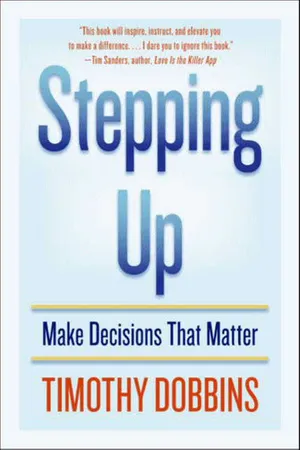
Yes, you can access Stepping Up by Timothy D. Dobbins in PDF and/or ePUB format, as well as other popular books in Business & Management. We have over one million books available in our catalogue for you to explore.