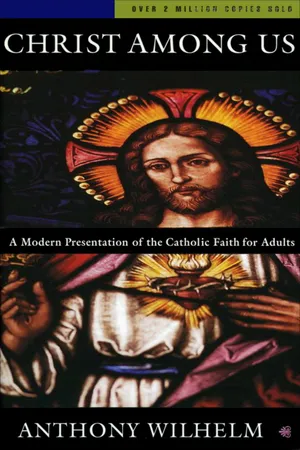
"For many of the nation's 52 million Catholics,
Christ Among Us has become an indispensable guide to applying Church teachings to contemporary problems." —
Time
Since it was first published in 1967, Anthony Wilhelm's
Christ Among Us has become America's most popular guide to modern Catholicism. This classic text presents a clear and accessible picture of Catholicism and its development in a post-Vatican II world. Perfect for both new Catholics and those returning to the faith,
Christ Among Us provides a thorough, up-to-date discussion of Catholic theology, traditions, and practices and examines Church teachings since the time of Vatican II. Including excerpts from the new Catechism of the Catholic Church, discussion questions, and suggestions for personal reflection,
Christ Among Us is the ideal handbook for anyone interested in the practice of Catholicism today.
Anthony Wilhelm, a religious educator, has taught theology and directed religious education programs for adults across America.
"The nation's most widely used introduction to Catholicism." —
The New York Times "Clear, comprehensive, and inspiring . . . Maintains its classic status among adult catechisms." —
Commonweal
Trusted by 375,005 students
Access to over 1.5 million titles for a fair monthly price.
What is life all about? Is there a God? If there is a God, does he care about us? Can I make contact with God? To answer these questions, we begin with something all people seek…
SOMETHING TO LIVE FOR
If there is one thing that people seek from life, it is fulfillment. We need a purpose, something to live for, a goal that will truly fulfill us and bring us happiness.
Many live for a successful marriage and a good home; some want a pleasant job with financial security; some seek power, or a life of pleasure and leisure, or friends and social position.
Many today, including many younger people, find their purpose in the service of others. In this age of great social change and consequent confusion these highly motivated individuals have brought about great good in our world.
Yet we must acknowledge that none of these things can completely satisfy our aspirations. No matter what we have, there is always something else we want. We also realize that these things cannot give us lasting and secure happiness, nor a lasting sense of accomplishment, for human weakness, tragedy, or death can destroy what we have. “Human beings are like a breath; their days like a passing shadow” (Psalm 144, 4).
The conviction of the Christian believer is that two thousand years ago Jesus Christ revealed to us an ultimate purpose to our life: to live forever with God after death. We know that our greatest happiness in this life comes from love. From childhood everyone has an insatiable desire to love and be loved. Our happiness in human love, Christ tells us, is but a dim reflection of the immense, unending joy of loving God and being loved by him forever.
Jesus told us that this unending life of happiness after death is such that we could not even begin to dream of it. It is as if someone lived in a closed room, never seeing or hearing anything outside. Then one day someone opened the door to the outside to display the world with its marvels. Christ did this for us, but he revealed that our destiny is infinitely more wonderful—so staggering that we can grasp it only bit by bit.
Jesus told us that we begin our life of love and happiness with God while still here on earth. But this happiness is different from what many people think. It does not come from satisfying our desire for pleasure or material things or social achievement. It comes from truly loving and often involves suffering and sacrifice. It is realistic. It brings not freedom from pain but a deep peace and sense of fulfillment even in the midst of pain.
Jesus showed us how to get along with others and how to bear sufferings and frustration. He told us and showed us what we can do about our loneliness and fears, our guilt and uneasiness, and how to have true peace and security.
Jesus revealed that God has a plan by which we are to share in his love and happiness, in other words, that there is a meaning to human history. He told us not only that we have a place in God’s plan but that (as is becoming more apparent today) the working out of this plan depends on us, on our free cooperation with God as coauthors of history. Jesus’ great follower, St. Paul, put it this way:
To me, though I am the very least of all the saints, this grace was given, to preach to the Gentiles the news of the boundless riches of Christ, and to make all humanity see what is the plan of the mystery hidden for ages in God who created all things; that through the Church the wisdom of God in its rich variety might now be made known…. This was according to the eternal purpose which he has realized in Christ Jesus our Lord (Ephesians 3, 8–11).
The unique claim that Jesus made for his teaching was that he has a special knowledge of God and his plan for us, and that he alone can lead us to God. He said that he was sent by God, and is, in fact, God’s only Son: “I am the way, and the truth, and the life. No one comes to the Father but through me” (John 14, 5).
Therefore the story of Jesus’ teaching and God’s plan begins with God himself…
HOW PEOPLE COME TO KNOW GOD
People come to a realization of God in countless ways. These are some of them:
Some have grown from childhood with a knowledge of God, are accustomed to pray and to make God a part of their thoughts and decisions.
Some reflect on the course of their life and have an unshakable conviction of God’s providence over them. Particularly in times of crisis, they realize, someone was there who heard and understood.
Some find God’s presence in nature. In hills and mountains, a peaceful lake, an expanse of sky, there comes the conviction of someone. A few might come closest while caught up in a moving piece of music, in the contemplation of an art masterpiece, or something similar.
Some are convinced that they have personally experienced God—a deeply moving, joyous, and unifying experience, giving great peace, clarity, and certainty, profoundly affecting their lives yet unexplainable to others. Many who testify to this—and it is usually with reluctance that they do so—are otherwise balanced and credible people.
For others, experiencing God is not as intense. It may be an experience of our human limitations or “boundaries,” a sense of wonder that we exist at all, and a hint of an otherness that lies beyond. It may be a glorious sunset, the sweep of stars in a clear nighttime sky, a look from a loved one or a touch of an understanding hand, a child’s laughter, an unexpected joy—all these tell of another that sustains, gives hope, and is always there.
Some come to God through their desire for perfect love. We know that everyone, from childhood, has a strong need for understanding and affection, perhaps accentuated by suffering or continual frustration. Yet we know that every human love has weaknesses and will eventually disappoint us. We then look to someone, beyond this life, who will never fail us, who can perfectly understand us and fulfill our aspirations and our desire for love.
Some are helped by demonstrations from reason of God’s reality. For example, an enormously complicated space satellite cannot make itself and launch itself into orbit. It has to be designed, built, launched, and sustained by intelligent humans. Our world and the countless star systems act according to amazingly consistent laws in a universe that is far more complicated than any satellite. The vast universe must, therefore, have been planned, made, and is being sustained by one of supreme intelligence and power. This one we call God.
Reasoning like this, “circumstantial evidence,” might show some the need for a limitless, timeless force sustaining the universe. But God himself must give us an insight into himself if we are ever to know him as close, personal, interested, loving.
Some are helped by those they love who are lovers of God. The example of the deep faith of a friend or beloved, its effect on that person’s life, and the generous love it seems to produce may gradually open the seeker to the divine lover.
Many cannot express why they believe in God or what God is to them. They are instinctively dumb before this unfathomable mystery. Even a master of language like Cardinal Newman said of this, “Words are such poor vehicles for what my mind holds and my heart believes.” Perhaps the greatest obstacle a believer encounters in expressing belief to an unbeliever—or even to him- or herself—is the inability to communicate in understandable concepts.
Seeking God is for many like peering through a fog to see if there is a house at a particular spot; often all we catch is a glimpse, confused, uncertain. We never see God. But most of us reach certainty about him by a “cumulation of converging probabilities,” which can give not just an opinion but the deepest conviction (Catechism, no. 31). Some never attain this deepest conviction but seem permitted by God to remain in a state of constant quest. In the search for truth it is perhaps not important how many fragments of the staggering whole one manages to perceive during one’s lifetime, but the courage and openness with which one continues the search.
As we move toward truth we may come to realize that we are as much being sought as seeking, that the truth we seek, the God we would love, is already deeply within us, soliciting our love. We come to realize our conviction of this all along: one who becomes convinced of God could never recognize him unless one had somehow known him before.
WHAT IS NECESSARY TO KNOW GOD
As in any honest pursuit, we must be open to truth, not only the truth of absolute values but also the truth about ourselves, who we are and what we ultimately want from the experience of life. This requires courage, a willingness to be threatened by often unpleasant realities. Those who are self-sufficient or self-satisfied will have no reason to push out beyond themselves in search of a higher good.
We must be willing to take time to question, observe, reflect. In our achievement-oriented society, particularly, it is hard for one to devote time to reflecting on ultimate values. Even when the satisfaction of achievement fails one and all one’s striving seems useless, the consideration of a possible God behind it all is often rejected as a demeaning crutch.
We must be open to our fellow humans and treat them as our conscience demands, with dignity and justice. The mature person sees that in each individual there is a spark, however dim, of enduring goodness. This spark is the divine within each person, and if one is ever to find God one must recognize and respect this spark in others. One who uses others or demeans them, who seeks only one’s own good, will inevitably find only oneself.
Christians believe that God has revealed—and is revealing—himself to humankind and that one must investigate this claim of revelation if one is to find God as he has shown himself to us. This seems logical to the Christian; if there is an infinite one, we who are finite cannot grasp him unless he reveals himself to us. Thus, although not everyone will find God’s revelation, it is the highest logic to search for it.
However, to meet God as he has revealed himself—to realize he is there—he must give us faith, the power to recognize him, the intuitive grasp of his reality. Ultimately whether one is a believer or not depends not only on one’s openness but on God. This explains why some find God while others of equal intelligence and good will do not.
Today many feel that God is missing from our world, or at least silent. For some, caught up by scientific advances and a technology by which humankind seems able to solve its own problems, a search for God seems irrelevant, meaningless.
The great majority of people in our culture, however, express belief in God. Some testify to experiencing God. Others are disposed to seek an experience of God—they know they need a source of security, meaning, or fulfillment in their lives. Yet often God is not evident or present in any felt, tangible way. They turn to him when they need him, but he is not there. He seems to keep eluding them.
Why does not God make himself unmistakably known to all people? We can only speculate about this, but a reason might lie in the Christian view of God: far from being a Supreme One who imposes himself on us, demanding that we acknowledge him and give him our obeisance, God is one who is among us, loving us with great and intimate tenderness, soliciting our free response of love.
Why are many people unable to find God? Some seem unable to detach themselves from the pursuit of modern false gods: money, social status, power, pleasure. As long as a person primarily seeks these, he or she will never find the living and true God.
Even the person of great good will who is continually occupied with material things—for example, the world of science or business—must expect difficulty in coming to realize spiritual reality, however noble his or her daily pursuits may be. To come to realize God takes time and persevering effort.
Some project a distorted image of God that pictures him as a disinterested power, perhaps capricious, even vengeful. These people usually have not had the proper kind of love in their lives, may have experienced much seemingly meaningless suffering, and so cannot accept a loving God. They have never experienced the love they have been told God is—and perhaps they have experienced the unlovingness of those who claim to be friends of God.
The Vatican Council says of this:
Some…seem more inclined to affirm [humanity] than to deny God. Again, some form for themselves such a fallacious idea of God that when they repudiate this figment, they are by no means rejecting the God of the Gospel…. Moreover, atheism results not rarely from a violent protest against the evil in this world…. Believers can have more than a little to do with the birth of atheism. To the extent that they neglect their own training in the faith, or teach erro...
Table of contents
Contents
Preface
1 Our Life and God
2 God’s Plan for Us Begins with Creation
3 God’s Gift of Himself and Our Rejection of Him
4 God’s Plan Unfolds in the Old Testament
5 Priests, Kings, and Prophets Prepare the Way
6 Christ Comes Among Us
7 Christ Reveals to Us the Father, the Spirit, and Himself
8 Christ Saves Us by His Death and Resurrection
9 Christ Sends the Holy Spirit to Form His Church
10 Those Who Serve as Our Guides
11 The Great Book in Which We Meet God
12 The Great Signs in Which We Meet God
13 Christ Unites Us to Himself and to One Another by Baptism
14 Our Worship Together: The Mass
15 The Eucharist in Christ’s Church Today
16 The Inner Life of a Christian
17 Our Christian Presence in the World
18 Sin and What It Can Do to Us
19 The Christian’s Continuing Conversion
20 When Illness or Disability Comes to a Christian
21 Christ Joins a Man and Woman in Marriage
22 The Family that Is the Church
23 The Greater Family to Which We Belong
24 Christ’s Church in the World Today
25 Living Daily the Christian Life
26 Fulfillment Forever
Appendix: Using Christ Among Us with the Rite of Christian Initiation of Adults (RCIA)
Searchable Terms
About the Author
Copyright
About the Publisher
Frequently asked questions
Yes, you can cancel anytime from the Subscription tab in your account settings on the Perlego website. Your subscription will stay active until the end of your current billing period. Learn how to cancel your subscription
No, books cannot be downloaded as external files, such as PDFs, for use outside of Perlego. However, you can download books within the Perlego app for offline reading on mobile or tablet. Learn how to download books offline
Perlego offers two plans: Essential and Complete
Essential is ideal for learners and professionals who enjoy exploring a wide range of subjects. Access the Essential Library with 800,000+ trusted titles and best-sellers across business, personal growth, and the humanities. Includes unlimited reading time and Standard Read Aloud voice.
Complete: Perfect for advanced learners and researchers needing full, unrestricted access. Unlock 1.5M+ books across hundreds of subjects, including academic and specialized titles. The Complete Plan also includes advanced features like Premium Read Aloud and Research Assistant.
Both plans are available with monthly, semester, or annual billing cycles.
We are an online textbook subscription service, where you can get access to an entire online library for less than the price of a single book per month. With over 1.5 million books across 990+ topics, we’ve got you covered! Learn about our mission
Look out for the read-aloud symbol on your next book to see if you can listen to it. The read-aloud tool reads text aloud for you, highlighting the text as it is being read. You can pause it, speed it up and slow it down. Learn more about Read Aloud
Yes! You can use the Perlego app on both iOS and Android devices to read anytime, anywhere — even offline. Perfect for commutes or when you’re on the go. Please note we cannot support devices running on iOS 13 and Android 7 or earlier. Learn more about using the app
Yes, you can access Christ Among Us by Anthony Wilhelm in PDF and/or ePUB format, as well as other popular books in Theology & Religion & Bibles. We have over 1.5 million books available in our catalogue for you to explore.