This "ingenious work about the course of human history" examines why civilizations evolved so differently in the Americas and Eurasia (
Kirkus, starred review).
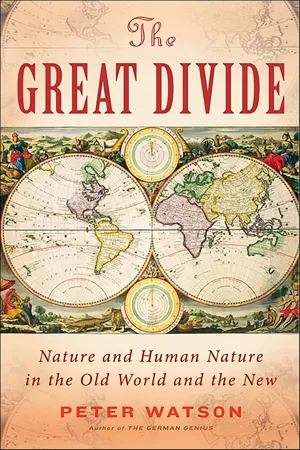
By 15,000 BC, humans had migrated from northeastern Asia across the frozen Bering land bridge to the Americas. When the last Ice Age came to an end, the Bering Strait refilled with water, dividing America from Eurasia. This division continued until Christopher Columbus voyaged to the New World in the fifteenth century.
The Great Divide compares the development of humankind in the Old World and the New between 15,000 BC and AD 1,500. Combining the most up-to-date knowledge in archaeology, anthropology, geology, meteorology, cosmology, and mythology, Peter Watson's masterful study offers uniquely revealing insight into what it means to be human.
- 640 pages
- English
- ePUB (mobile friendly)
- Available on iOS & Android
eBook - ePub
About this book
Information
Table of contents
- Cover
- Title Page
- Dedication
- Contents
- Author’s Note: The Aztecs ‘as evil as Nazis’
- Maps
- Introduction: 1500 BC–AD 1500: A Unique Period in Human History
- Part One: HOW THE FIRST AMERICANS DIFFERED FROM OLD WORLD PEOPLES
- Part Two: HOW NATURE DIFFERS IN THE OLD WORLD AND THE NEW
- Part Three: WHY HUMAN NATURE EVOLVED DIFFERENTLY IN THE OLD WORLD AND THE NEW
- Conclusion
- Appendices
- Index
- About the Author
- Notes and References
- Sources for Figures
- Also by Peter Watson
- Credits
- Copyright
- About the Publisher
Trusted by 375,005 students
Access to over 1.5 million titles for a fair monthly price.
Study more efficiently using our study tools.
Frequently asked questions
Yes, you can cancel anytime from the Subscription tab in your account settings on the Perlego website. Your subscription will stay active until the end of your current billing period. Learn how to cancel your subscription
No, books cannot be downloaded as external files, such as PDFs, for use outside of Perlego. However, you can download books within the Perlego app for offline reading on mobile or tablet. Learn how to download books offline
We are an online textbook subscription service, where you can get access to an entire online library for less than the price of a single book per month. With over 1.5 million books across 990+ topics, we’ve got you covered! Learn about our mission
Look out for the read-aloud symbol on your next book to see if you can listen to it. The read-aloud tool reads text aloud for you, highlighting the text as it is being read. You can pause it, speed it up and slow it down. Learn more about Read Aloud
Yes! You can use the Perlego app on both iOS and Android devices to read anytime, anywhere — even offline. Perfect for commutes or when you’re on the go.
Please note we cannot support devices running on iOS 13 and Android 7 or earlier. Learn more about using the app
Please note we cannot support devices running on iOS 13 and Android 7 or earlier. Learn more about using the app
Yes, you can access The Great Divide by Peter Watson in PDF and/or ePUB format, as well as other popular books in History & Historical Geography. We have over 1.5 million books available in our catalogue for you to explore.