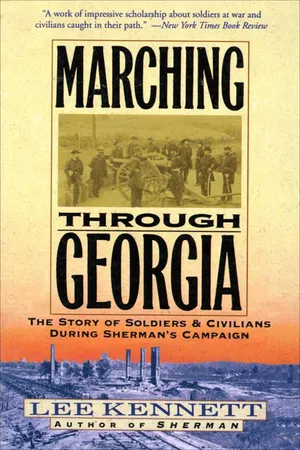
In this engrossing work of history, Lee Kennett brilliantly brings General Sherman's 1864 invasion of Georgia to life by capturing the ground-level experiences of the soldiers and civilians who witnesses the bloody campaign. From the skirmish at Buzzard Roost Gap all the way to Savannah ten months later, Kennet follows the notorious, complex Sherman, who attacked the devastated the heart of the Confederacy's arsenal. Marching Through Georgia describes, in gripping detail, the event that marked the end of the Old South.
eBook - ePub
Marching Through Georgia
The Story of Soldiers & Civilians During Sherman's Campaign
- 432 pages
- English
- ePUB (mobile friendly)
- Available on iOS & Android
eBook - ePub
About this book
Trusted by 375,005 students
Access to over 1.5 million titles for a fair monthly price.
Study more efficiently using our study tools.
Information
PART ONE
INVASION
1
Mise en Scène
On Saturday, April 30,1864, President Lincoln spent part of his day with his correspondence. He drafted several orders and directives and wrote three letters that we know of. Two of the letters are insignificant from the historian’s point of view; the third, though brief, is remarkable. Lincoln addressed it to Ulysses S. Grant, whom he had recently appointed lieutenant general and general in chief of all the Union forces. The letter was both an expression of confidence in the man and a carte blanche for his proposed campaign, to be set in motion within the week, for Lincoln knew the plan of campaign only in broad outline: “The particulars of your plan I neither know nor seek to know. You are vigilant and self reliant; and pleased with this, I wish not to obtrude any constraints or restraints upon you.” The president did have one concern. If there were to be reverses, he preferred them to be small ones that would not shake the people’s resolve or ruin his party’s chances in an election year: “I am very anxious that any great disaster, or the capture of our men in great numbers, shall be avoided.” Having deftly inserted this word of caution, Lincoln wished his general in chief Godspeed: “And now with a brave Army, and a just cause, may God sustain you.”
This expression of confidence was remarkable considering the doubts and disappointments the president had known with commanders he had previously sent into the field. But in Lincoln’s eyes Grant had the qualities now needed for command: He could be counted on to push the campaign along relentlessly and grind away at the enemy as long as the South continued to resist. It was a costly and uninspired way of winning a war, but it seemed to be working—albeit slowly—where nothing had worked before. A certain momentum had been built up that Grant would sustain. The Rebel invasion of Pennsylvania had been handsomely beaten back at Gettysburg; Grant’s own victory at Vicksburg had sundered the Confederacy along the line of the Mississippi; then too, Tennessee, Kentucky, the western part of Virginia—now called West Virginia—and portions of other rebellious states had fallen to the Union army. But if the scale had clearly tipped in the North’s favor, after three years of war the core of the South had not been pierced, and large Rebel armies were still intact; there was much work to be done.
A hundred miles to the south in Richmond another president sat in another executive mansion on that same Saturday, and his mind too was on the coming campaign, for Jefferson Davis had to prepare a message for the opening of the Second Confederate Congress, set for the following Monday, and there he would have to lay out the prospects for the coming campaign. His work was interrupted that afternoon by tragedy; his five-year-old son, Joseph, fell to his death while playing on the balcony of the Confederate White House. For a time Davis was as if stunned, unable to write and barely able to speak. But drawing on an inner strength, the stricken president finished the drafting of his message and delivered it as scheduled.
It was a somber document. On the diplomatic front the president could find no encouraging news, no hint that either Britain or France had moved closer to recognition of the Confederacy, much less intervention on its behalf, and he confessed that he saw “no prospect of an early change.” In the recent fighting there had been some minor successes in North Carolina and Florida; the Federal forces seemed completely balked in their effort against Charleston. Confederate forces in the transMississippi Davis scarcely mentioned. Speaking of the two great armies the Confederacy still maintained east of the river he said: “The armies in northern Georgia and in northern Virginia still oppose with unshaken valor a formidable barrier to the progress of the invader.” Davis thus cast the two armies in the role of shields, essentially defensive. Some of the lawmakers may have shaken their heads as they recalled the situation just a year ago, when the Army of Northern Virginia was winning a dazzling victory at Chancellorsville and opening the door to invasion of the North. If Lincoln’s watchword was perseverance on the exhausting road to victory, Davis seemed to be saying that as long as they endured they had a basis for hope. Perhaps the “Second American Revolution,” as some called the Southern cause, could be won the same way the first one had been: Their opponents, for all their superior resources, would finally decide the game wasn’t worth the candle.
It would not have been possible for Davis to draft the kind of letter Lincoln sent to Grant; it accorded neither with his conception of the office he held nor with his appreciation of his own abilities. And in a sense Davis was far more qualified for the supreme direction of war than Lincoln was: The Confederate president had commanded a regiment in the Mexican War and had served with distinction as secretary of war in the Pierce administration, while Lincoln’s previous contact with the military was as a militia captain in the Blackhawk War. So though there was talk of creating a Southern general in chief, the president was cold to the idea; he himself had largely assumed that role—with indifferent results, due in large part to his own flaws in character and judgment. Recently Davis had had a particularly frustrating exchange with General Joseph E. Johnston, commanding the Army of Tennessee. Davis believed that Johnston had the resources and the opportunity to launch an offensive against the Federal forces in Tennessee and tried to prod the general forward; Johnston resisted, saying he did not have the means. The exchange was not a frank and open one on either side. Davis relied on other, confidential sources of information about the state of Johnston’s army, notably General John Bell Hood, a close friend of the president and one of Johnston’s corps commanders. Johnston was a man of prickly sensibilities (he once returned an important letter from the secretary of war because the secretary had inadvertently failed to attach his signature); resenting what he considered an intrusion on his authority, he put up one argument, then another, or simply failed to respond. Thus the Confederacy’s western army, like the one in Virginia, entered the month of May waiting for the enemy’s initiative. Neither army would have long to wait.
General Grant had hastily put together a plan of campaign after his appointment as lieutenant general and commander of all the Union armies on March 9; he conferred first with General George Meade, who would continue to command the Army of the Potomac; then, after a brief stop in Washington to speak with Lincoln, Grant headed west to see General William T. Sherman, who would direct the Union effort in the vast Military Division of the Mississippi. The two friends had both made their reputations in the West, and they spent considerable time discussing what should be done there. Since Grant would be returning soon to the East where he could be at Meade’s elbow, he and Sherman would have contact only by mail or telegraph, so they tried to cover all the problems and opportunities that might arise in the West. Their deliberations stretched over three days, ending with a long session in a mapstrewn Cincinnati hotel room.
The plan they agreed upon was a simple one. Grant believed that earlier campaigns had often come to grief because the eastern and western armies had not established a harmony in their efforts; in Grant’s phrase they had been “like a balky team.” The Confederates had profited from this discordance by shifting troops to one theater, then to another, as need arose or opportunity presented itself. Now both Union armies would begin operations simultaneously (Grant later fixed the date as May 5), and thereafter maintain a strong and unrelenting pressure for as long as it took to topple the Confederacy. There were no timetables or deadlines, no complex schemes for combined operations. Each of the two Union hosts would have an opposing army to defeat and, they hoped, to destroy, and a city to take. Grant would drive for Richmond—he had already pledged to Lincoln he would take it if given enough men—and Sherman would push toward Atlanta.
While high strategy and the generals who formulated and executed it are for the most part peripheral to the subject at hand, an exception must be made in the case of the general commanding the Military Division of the Mississippi. In the spring of 1864 William Tecumseh Sherman was forty-four years old. The most momentous year in his life was before him, and it probably caught him at the peak of his intellectual powers. In 1861 his West Point years lay a quarter-century behind him, and in the 1850s he had left the service for a succession of positions in civilian life. He had returned to the army after the attack on Fort Sumter, but his wartime career had a shaky start. Given a command in Kentucky in the fall of 1861, he grossly exaggerated the Confederate forces in the area and bombarded his superiors with demands for reinforcements; his panicky behavior led to his replacement and newspaper stories that he was insane; the following April he redeemed himself with his performance at Shiloh. While he would still know fleeting periods of self-doubt and depression, and those who met him in 1864 would sometimes note his voluble, almost manic conversation and other quirks, his biographers agree that in thought and action the William Tecumseh Sherman of 1864 was clearly within the parameters marked “normal.” If in his final campaigns his soldiers sometimes referred to him as “Crazy William,” the term was one of affection.
Still, Sherman’s habits of mind, his “way of looking at things,” are of some interest in the present study, for they can help explain just what happened in Georgia in 1864 and why. If the general’s mind was essentially sound, and quick and fertile as well, it nevertheless ran in its own fashion. While his correspondence reveals that when time permitted, his interest covered a remarkable range of problems and concerns, he dedicated the great bulk of his time and thought to war in the narrow sense: marches and engagements, energetic and relentless effort against the enemy army. He felt military needs should override all other considerations; if it benefited the operations of his army, he might seize railway cars, put journalists in irons, refuse to feed starving civilians, stop the movement of evangelists and the shipment of religious tracts to his army, or forcibly displace populations that got in his way. Yet on the back shelf of his mind Sherman carried a range of problems and solutions on matters that did not bear directly on military operations in the narrow sense; for example, he came to Georgia armed with a considerable mass of data on the state’s economy and resources; he was also interested in the challenges the state’s topography would pose, and he brought with him a crack team of topographical engineers. He had picked up a great deal of information about how to run railroads and also how to wreck them. He was also interested in the social and psychological dimensions of the struggle, to which he had given some thought. When problems surfaced in any of these spheres, the general would rummage in that back shelf, pull out a field order or other directive, sometimes a draconian one and occasionally a bizarre one, and then return to the war at hand.
If he ranked his concerns in this manner, his mind also tended to label matters in rather emphatic fashion—a policy was good or bad, an argument or a decision right or wrong: On most subjects the general was a man of strong opinions. This tendency was linked to another: He also sought to reduce things to what seemed to him their essentials—to the point of seeing problems as simpler than most of his contemporaries found them. He knew exactly what the war was about: “The government of the United States is the issue. Shall it stand or fall?” Slavery he regarded as a “minor question,” and so apparently were the economic antagonisms between North and South. As the issue was clear and simple, so was its resolution. The Rebels had only to admit their error and lay down their arms and they would be welcomed back into the Union—a scenario most students of the war would find highly improbable. And very often to simplify is to exaggerate, to brush aside all qualification and nuance and think in absolutes. Thus if we define peace as essentially the total absence of violence, then the essence of war would be total violence—a proposition that could open many doors. At the very least the general believed with Clausewitz that war tended naturally toward absolute violence; occasionally he said that trying to stop the war’s momentum was like trying to stop a hurricane or other natural calamity.
Then too, Sherman brought to the war a number of well-matured prejudices that would color his policies and actions. At the beginning of the war he had a negative view of the volunteer soldiers he commanded, which he shared with virtually every officer who had soldiered with “regulars.” He complained notably about the volunteers’ lack of discipline and the depredations they committed. But he was not a strict disciplinarian and was primarily concerned over the soldiers’ availability for and comportment in battle. By 1864 he occasionally noted that his troops plundered or pillaged, but the tone of reprobation was largely gone. At the end of that year he would pronounce his volunteers good soldiers. In civil society Sherman disliked people of certain callings: journalists, politicians, religious activists and zealots; oddly enough, he had very little good to say about Southern Unionists; judging by conversations he had with them at various times, he felt they should have opposed secession more energetically. There is no evidence of any contempt for civilians in general—Sherman had after all made his way in their world for a number of years.
Many of the general’s political and social views would today be labeled both fascist and racist. He was a strong friend of order; indeed his most recent biographer sees this as Sherman’s most significant trait. He felt blacks were inferior, and he had no use for abolitionists who would improve their lot. Before the outbreak of war he had expressed his opinion that Southern whites and blacks would have to continue a master-servant relationship, for if equality reigned between the two races the result would be “amalgamation,” which he associated with decline; he saw proof of this very danger in the chaotic state of Mexico, whose misfortunes he traced to the intermarriage of Spaniards with the indigenous population. He did not think freed slaves would make good soldiers and stated his views to all who would listen; when Confederate troops under the command of General Nathan Bedford Forrest shot down black Union soldiers rather than accept their surrender—what came to be known as the Fort Pillow Massacre—Sherman was neither shocked nor surprised. “Of course Forrest and all Southerners will kill them and their white officers,” he wrote his brother, U.S. Senator John Sherman, “we all knew that.” A year after the Emancipation Proclamation he did not think the welfare of three million blacks should get in the way of an honorable peace: “When a people submit, I would not bother with little local prejudices & opinions.”
Sherman’s views in these and other matters would have made him feel at home in the Confederate high command, had he not seen secession as the crime that precipitated the war. As it was, that summer he wrote his wife, Ellen, from deep in Georgia: “I have been more kindly disposed to the people of the South than any general officer in the whole army.” From time to time in the course of 1864 he corresponded across the battle line, sending cordial messages to Confederate General William J. Hardee and writing well-turned letters to Southern women he had known twenty years before.
In truth, for Sherman the march into Georgia would be something of a return; he had spent considerable time in the state on army assignments in the 1840s. Then he had visited places he would soon see again—Marietta, Allatoona, the area around Cartersville, where he had stayed with a hospitable planter named Tumlin; indeed, he and Colonel Tumlin had corresponded for some years thereafter. But the extreme northwest comer of the state Sherman knew chiefly from maps, so on April 30, the same day Lincoln wrote his note to General Grant, Sherman rode out of Chattanooga, ascended nearby Lookout Mountain, and looked southward at the land his armies would invade within the week. Here he could see that the Southern Appalachians formed themselves into several lines of ridges and peaks with a general north-south alignment, though as they ran south they angled to the west into Alabama. They made an impressive ensemble: When one of Sherman’s soldiers from Illinois—the second flattest state in the Union—first beheld them he said: “I think God Almighty might have made the world in four days if he had not ruffed it up so”; another, with an eye to the coming campaign, allowed that nature had created the area for General Joe Johnston’s “special benefit.”
Clearly, North Georgia would be rough country for Sherman’s infantry. Here and there one found bare, perpendicular surfaces, such as Rocky Face Ridge, where there would be severe fighting; though generally the mountains’ flanks were more sloping, they tended to be densely wooded and could have considerable undergrowth as well. Wheeled traffic—artillery, supply wagons, ambulances, and the like—could move only through passes and gaps; they would be roadbound in a region where roads were few. It was something of an undeveloped country, a frontier. People called the northern third of the state “Cherokee Georgia” with good reason, for only thirty years before it had been Indian country. The Cherokees were hardly savages; by the 1830s they had a newspaper, an alphabet of their own creation, and an enlightened form of government. But when they were packed off to Oklahoma with the Creeks, Choctaws, and others, they left behind only a few thin settlements; the Georgians who took their place had not had much time to add improvements or even move very far beyond subsistence farming. The general knew he was also looking at a largely uncharted area; he had ordered new maps of the region, incorporating everything his cartographers could learn about it. In Chattanooga his mapmakers were putting the final touches on a “base map” of North Georgia that should help his troops find their way through the fastness before them.
Why was he obliged to invade Georgia across this particularly rough and inhospitable landscape? The answer lay below him—a thin, sinuous line of iron that ran from Chattanooga all the way to Atlanta: the Western and Atlantic Railroad. It was not strategy that dictated the general’s route, but logistics, for by 1864 the war had demonstrated that a rail line was virtually as good as a navigable waterway in supplying an army far from its base; where waterways were lacking, it was the only means to sustain an army in a deep penetration of enemy territory. Since Sherman’s base was Nashville and secondarily Chattanooga, and Atlanta was his goal, only the Western and Atlantic would take him there. General Johnston understood this quite as well as Sherman. He had his Army of Tennessee in position athwart the railroad some thirty miles to the south.
If driven south, the Confederates probably would leave behind them nothing but the roadbed, but Sherman knew his men could replace ties and rails quickly and had taken measures to provide them with a plentiful supply of both; putting bridges and trestles back would take a little longer. The single most important feature in the line, the one that gave him the most worry, lay beyond the range of his view that day: the twenty-five-hundred-foot-long tunnel that had been cut through the granite mass of Tunnel Hill, close to the town of Dalton (it would fall into Sherman’s hands intact). The line meandered quite a bit, especially as it approached Chattanooga. Because of the low tractive power of locomotives of the day, the grade had to be held to thirty feet per mile. The builders were obliged to bypass the important town of Cassville and put in more than a score of major bridges as well as innumerable cuts and fills. Engineers had to hold their speed down on such a road; the “fast passenger train” that ran between Dalton and Atlanta in the 1850s averaged fourteen miles an hour. Then too, the railroad had been built by the state of Georgia; the designers, mindful of the taxpayers’ feelings, made it a single-track affair for its entire length. Later, when it had become his army’s lifeline, Sherman would give serious thought to double tracking it.
The general knew that as his army moved south the way would be easier, and he would find more maneuvering room; the landscape would become less tortured, mountains would change to hills—he called the region below the Etowah “sub-mountainous”—and finally, in the vicinity of Atlanta, they would find rolling country with occasional prominences like Kennesaw Mountain. The streams, the Etowah, Oostenaula, and Chattahoochee, posed no great obstacle unless swollen by heavy rains. But the thick carpet of timber that clothed every ridge and valley within the general’s view would not disappear as his army moved southward; right to the gates of Atlanta, cleared ground would be the exception. Finally, under all the vegetation was a soil that was usually a distinctive red clay, “the reddest I ever saw,” wrote one Union soldier. In dry weather a much-traveled road made of such soil would produce dust particles of extreme fineness; they would billow up about the traveler in choking clouds, then drift off to give a reddish hue to trees, houses, and even animals. Wit...
Table of contents
- Cover
- Title Page
- Dedication
- Contents
- PART ONE
- PART TWO
- PART THREE
- Notes
- Bibliography
- Index
- Acknowledgments
- About the Author
- ALSO BY LEE KENNETT
- To the Reader
- Abbreviations
- Copyright
- About the Publisher
Frequently asked questions
Yes, you can cancel anytime from the Subscription tab in your account settings on the Perlego website. Your subscription will stay active until the end of your current billing period. Learn how to cancel your subscription
No, books cannot be downloaded as external files, such as PDFs, for use outside of Perlego. However, you can download books within the Perlego app for offline reading on mobile or tablet. Learn how to download books offline
Perlego offers two plans: Essential and Complete
- Essential is ideal for learners and professionals who enjoy exploring a wide range of subjects. Access the Essential Library with 800,000+ trusted titles and best-sellers across business, personal growth, and the humanities. Includes unlimited reading time and Standard Read Aloud voice.
- Complete: Perfect for advanced learners and researchers needing full, unrestricted access. Unlock 1.5M+ books across hundreds of subjects, including academic and specialized titles. The Complete Plan also includes advanced features like Premium Read Aloud and Research Assistant.
We are an online textbook subscription service, where you can get access to an entire online library for less than the price of a single book per month. With over 1.5 million books across 990+ topics, we’ve got you covered! Learn about our mission
Look out for the read-aloud symbol on your next book to see if you can listen to it. The read-aloud tool reads text aloud for you, highlighting the text as it is being read. You can pause it, speed it up and slow it down. Learn more about Read Aloud
Yes! You can use the Perlego app on both iOS and Android devices to read anytime, anywhere — even offline. Perfect for commutes or when you’re on the go.
Please note we cannot support devices running on iOS 13 and Android 7 or earlier. Learn more about using the app
Please note we cannot support devices running on iOS 13 and Android 7 or earlier. Learn more about using the app
Yes, you can access Marching Through Georgia by Lee B. Kennett in PDF and/or ePUB format, as well as other popular books in History & 19th Century History. We have over 1.5 million books available in our catalogue for you to explore.