- 160 pages
- English
- ePUB (mobile friendly)
- Available on iOS & Android
eBook - ePub
Trusted by 375,005 students
Access to over 1.5 million titles for a fair monthly price.
Study more efficiently using our study tools.
Information
Topic
Personal DevelopmentSubtopic
Business GeneralRULE 1
Work Hard and Smart
If you hear the words get rich quick, run for the hills. You are being scammed.
To make money, you have to work. To make lots of money, you have to work really hard and really smart.
Rule 1 is the cornerstone of this book: Remember, work hard and smart.
RULE 2
No One Is Entitled to Anything!
Hear this now. No one inside a company is entitled to anything. Not one thing. Not ever.
If you think you are entitled to keep your job, you are not.
If you think you are entitled to a promotion, you are not.
If you think you are entitled to more money, you are not.
If you think you are entitled to a big office, you are not.
Business has nothing to do with entitlement. Business is about achievement. If you consistently deliver the goods, your rewards will come.
I am not in favor of staff programs that reward seniority. The stakes for a new employee should be the same as those for a long-term employee. You deliver, you move ahead. You also get paid more.
I take a similar position with tenure. In some countries, for instance, teachers have a job for life once they survive a tenure period. That’s crap! I couldn’t care less about tenure. Under tenure arrangements, employees can coast. No way. That will never be allowed in a successful company.
If you don’t perform, you can’t keep your job!
RULE 3
Be Motivated
You can’t become a senior executive inside a large company today if you do not have a robust ego. The work that it takes to drive success at the elite level is too tough, too complex, and too demanding for a person who is not somewhat egocentric to survive.
Your ego can drive in you a need to achieve results and a blinding fear of failure. Every senior executive position is highly visible. It is no different from being the coach of any sporting team in the world today. Emmett Davis, head coach of men’s basketball at Colgate University, once told me: “My results are in the newspaper every day.” These comments were echoed by Australian Olympic basketball coach and Sydney Kings boss Brian Goorjian: “Everyone knows how my day in the office was. It was on radio and TV.” It’s the same inside a company, where the scorecard is the annual report—and lots of people read it. Coaches and managers with losing records don’t get to keep their jobs. Fear motivates.
Money also motivates. You can make plenty of money at the top of many large companies. The salary packages that are offered are often massive, because the impact an executive has on an organization is likewise massive—good or bad. Companies pay for both talent and performance. If money is a motivator for you—fantastic, you have a shot at moving up quickly.
If you are looking for a rewarding career that does not involve huge money, you can choose many professions that compensate you with “psychological income.” For example, social workers are usually unsung heroes; they help people resolve enormous problems, their work is usually very difficult, yet they make very little money. However, they do get the opportunity to make a difference in people’s lives, which can be hugely rewarding. That said, psychological income does not motivate people who want to run big companies.
Ego and money can be good. Let’s not pretend otherwise.
RULE 4
Put in the Hours
You can’t cheat the clock. You are not going to get ahead without a very major commitment to your job in terms of pure hours. I have worked all over the world over the past twenty years and have found this to be universally true. Some cultures require more than others. North America is the toughest. Ted Marzilli, vice president of corporate development of VNU, recalls his early days at a top consulting firm in the United States.
“We used to laugh when we had to complete a timesheet—the maximum we could ‘bill’ per week was forty hours (eight hours per day)—whereas in reality there were weeks when that forty-hour total we wrote down represented only half of the hours we spent at work. But that was the environment; we had to deliver for our clients and you, personally, had to maintain your internal reputation. Time spent on the job was certainly not the only measure of performance, but if the team was ordering a dinner delivery at 8 P.M., and you said, ‘No thanks, I plan to leave shortly,’ well, you could only get away with that once in a while, and your teammates certainly took notice. Leaving ‘early’ was definitely not the typical path to success.
“There is no shortage of work to be done on any consulting project. It’s a rare occasion when your project manager or project partner might say, ‘Gee, you have been working too hard lately, why don’t you leave early tonight?’ The environment is up or out—if you do not perform, you will be asked to leave the firm. You are always under pressure to perform, regardless of how senior you are in a company; every project is a new ‘proving’ ground. You can never rest on your laurels.”
Whether it’s by recording billable hours or setting up an environment where long hours are the expectation, professional service firms use time spent at work as an important way to measure an individual’s commitment and contribution. And it isn’t just about the number of hours; it’s about squeezing every bit of productivity possible out of every minute of the day. And you can forget lunch breaks. You can’t make money for a company while you’re eating lunch.
If you don’t put in the hours, someone just as smart and just as clever as you will. Fact of life: The strong survive. My own policy is to avoid working weekends. Frankly, it is good to get the break, but sometimes it can’t be helped. I’ve always allowed the company to really own me from Monday to Friday. I pound out the hours: never less than sixty a week, and sometimes way more. But I’ve always said, “Preserve the weekend.” You won’t perform well if you work all the time. It is important to stay fresh. Work like a dog during the week, but try not to work at all on weekends. You need two days to rest, relax, and have fun. You will be more productive when you are working if you have had a break.
Preserving the weekends is not as easy as it sounds—it’s very easy for one or two work tasks to really encroach on your free time. I always tell my coworkers that I don’t check e-mail or voice mail on the weekends, and pretty soon they realize I mean it.
You do need to be prudent, though: Sometimes there will be an emergency and you will need to work—just ensure that you make working on the weekends a rare exception to your usual rule. Your body and brain need to rest so they can perform on game days.
But talent without major commitment won’t get you to the top. As you work your way up in any organization, there will always be lots and lots of equally talented executives. The tie always goes to the harder worker.
Find out who is in the office before and after you. Take a walk around early and late in the day. Those who are working harder than everyone else consistently are chasing the title. They are your competition.
I can tell you, having been the CEO of several companies, I have always made a habit of walking around early and late to personally see who’s pumping it out. If they are getting results and working harder than everyone else, I promote them. They are the “Rock Stars”—the money players.
Couples who are trying to balance serious careers with raising a family have to consider how they can put in the hours needed while caring for their children. I have seen it work, and I have seen it fail. Quite simply: It works when you have a very flexible child-care situation; it fails when you don’t. You have to be available for last-minute meetings with the CEO that may run overtime. You can’t go running out the door at 5 P.M. if your work isn’t done. If you are determined to maintain your career at the elite level, pay the money to have a flexible and high-quality child-care situation. Lots of couples do it. You can, too.
Criteria for promotions inside companies are often thought to be black-and-white. Candidates who get promoted are often thought of as the perfect choice. Nothing could be further from the truth. Choices are muddy and difficult. In fact, sometimes the person who gets promoted is simply the least objectionable candidate. Honest, that happens!
No matter what your job is, do it a little harder and a little longer each and every day. Finish an extra report, call on one more customer, ask one more question…set yourself apart.
RULE 5
Do Whatever It Takes
James Carville, a political strategist, perfectly summed up what it takes to succeed on a winning team during an appearance on The Tonight Show with Jay Leno.
Carville explained to Leno that whenever he is interviewing a prospective candidate, if he or she says they won’t “suck up” to get ahead, the interview is over. He wants people on his team who are prepared to do whatever it takes to win.
Succeeding often means you have to be a chameleon. It doesn’t mean being dishonest or false; it does mean finding a legitimate way to achieve your goals. Sometimes it requires you to do things that are uncomfortable or unnatural to you. Stretch out and go for it. Don’t compromise your values, but find a way to win.
If you can’t make that total and complete commitment to winning, you won’t make it to the top; too many others—your competition—do have that drive and desire. Dig deep and see if you have it.
A friend of mine, Andrew Michael, works in the clothing business. He told me how he was once desperate to meet the then new managing director of a leading department store, Dawn Robertson. Frustrated after several attempts, he phoned her assistant and literally begged for an appointment, but to no avail. He then asked the assistant when Dawn’s next flight was, and said: “I don’t care where or when, ask her if I can sit next to her.” They took a flight together and the rest is history. Dawn thought Andrew was crazy but liked his persistence. They both laugh about the story now and have continued to do business together. A flight to nowhere can lead to somewhere!
RULE 6
Be Charming
In business you are always selling: sometimes to external customers, sometimes to internal employees. When you leave home in the morning, turn on your charm. Be upbeat, be happy, smile, be interesting, and be helpful.
Successful people sell themselves every minute of every day. This doesn’t mean you should come across as a slick salesperson, smarmy or insincere. The trick is to simply be sincere and charming. It is not terribly hard to do—it should just come naturally to most people.
RULE 7
Find Good Bosses
Look closely at the leadership above you and try to find a great boss to work for. It’s no different from when you attended high school or college. Think back. There were gre...
Table of contents
- Cover
- Title Page
- Dedication
- Contents
- Introduction
- Rule 1
- Rule 2
- Rule 3
- Rule 4
- Rule 5
- Rule 6
- Rule 7
- Rule 8
- Rule 9
- Rule 10
- Rule 11
- Rule 12
- Rule 13
- Rule 14
- Rule 15
- Rule 16
- Rule 17
- Rule 18
- Rule 19
- Rule 20
- Rule 21
- Rule 22
- Rule 23
- Rule 24
- Rule 25
- Rule 26
- Rule 27
- Rule 28
- Rule 29
- Rule 30
- Rule 31
- Rule 32
- Rule 33
- Rule 34
- Rule 35
- Rule 36
- Rule 37
- Rule 38
- Rule 39
- Rule 40
- Rule 41
- Rule 42
- Rule 43
- Rule 44
- Rule 45
- Rule 46
- Rule 47
- Rule 48
- Rule 49
- Rule 50
- Rule 51
- Rule 52
- Rule 53
- Rule 54
- Rule 55
- Rule 56
- Epilogue
- Acknowledgments
- About the Author
- Copyright
- About the Publisher
Frequently asked questions
Yes, you can cancel anytime from the Subscription tab in your account settings on the Perlego website. Your subscription will stay active until the end of your current billing period. Learn how to cancel your subscription
No, books cannot be downloaded as external files, such as PDFs, for use outside of Perlego. However, you can download books within the Perlego app for offline reading on mobile or tablet. Learn how to download books offline
Perlego offers two plans: Essential and Complete
- Essential is ideal for learners and professionals who enjoy exploring a wide range of subjects. Access the Essential Library with 800,000+ trusted titles and best-sellers across business, personal growth, and the humanities. Includes unlimited reading time and Standard Read Aloud voice.
- Complete: Perfect for advanced learners and researchers needing full, unrestricted access. Unlock 1.5M+ books across hundreds of subjects, including academic and specialized titles. The Complete Plan also includes advanced features like Premium Read Aloud and Research Assistant.
We are an online textbook subscription service, where you can get access to an entire online library for less than the price of a single book per month. With over 1.5 million books across 990+ topics, we’ve got you covered! Learn about our mission
Look out for the read-aloud symbol on your next book to see if you can listen to it. The read-aloud tool reads text aloud for you, highlighting the text as it is being read. You can pause it, speed it up and slow it down. Learn more about Read Aloud
Yes! You can use the Perlego app on both iOS and Android devices to read anytime, anywhere — even offline. Perfect for commutes or when you’re on the go.
Please note we cannot support devices running on iOS 13 and Android 7 or earlier. Learn more about using the app
Please note we cannot support devices running on iOS 13 and Android 7 or earlier. Learn more about using the app
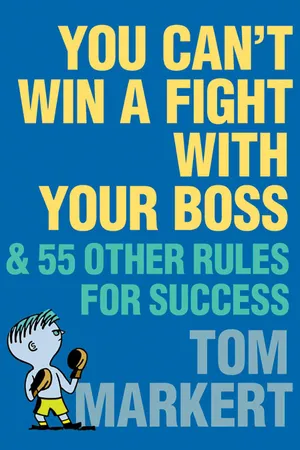
Yes, you can access You Can't Win a Fight with Your Boss by Tom Markert in PDF and/or ePUB format, as well as other popular books in Personal Development & Business General. We have over 1.5 million books available in our catalogue for you to explore.