eBook - ePub
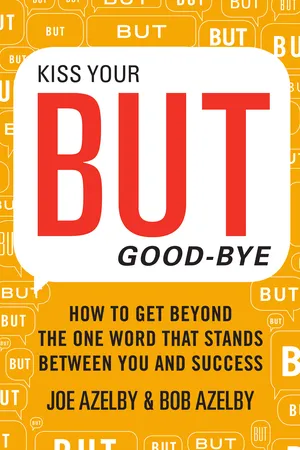
Kiss Your BUT Good-Bye
How to Get Beyond the One Word That Stands Between You and Success
- 224 pages
- English
- ePUB (mobile friendly)
- Available on iOS & Android
eBook - ePub
Kiss Your BUT Good-Bye
How to Get Beyond the One Word That Stands Between You and Success
Trusted by 375,005 students
Access to over 1.5 million titles for a fair monthly price.
Study more efficiently using our study tools.
Information
Subtopic
Business SkillsIndex
BusinessCHAPTER 1
THE BUT
Next time you are part of a formal or informal business discussion that involves an employee’s work performance or personal qualities, we want you to listen closely for the most important word to be spoken. That word is “but.” It usually comes in the middle of a statement, most often right after a compliment. As soon as “but” is uttered, people lean forward in their chairs in anxious anticipation to hear what imperfection or affliction one of their colleagues may have.
This is what we’re talking about:
“Jim is a great marketer, but he can’t close the deals.”
“Rachel works hard, but she can’t prioritize.”
“Larry is a great producer, but he’s a lousy manager.”
“Steven is an effective individual performer, but he doesn’t leverage the network.”
“Samantha is good at tasks, but she is not a strategic thinker.”
“Lisa has plenty of IQ, but she has no EQ whatsoever.”
Right now you are saying, “Oh, I get it. ‘But,’ that’s a really clever word, and you’re right. People say that all the time when they talk about other people at work.” There’s more to this little word, however, than meets the eye.
We don’t know what your BUT looks like, and we certainly don’t know how big it is. We also don’t know what your colleagues’ BUTs look like or how big they are. We do know, however, that you and your teammates have BUTs, because everyone we have ever met has at least one. Our mission is to help you find your BUT. We will make you stare at your BUT and show you the BUTs of your coworkers. We’ll discuss your BUT and help you get your hands firmly around it so that you can control it. Then we are going to give you some proven tools and methods to shrink your BUT so that you have the smallest one among all of your peers.
We have heard countless excuses and whining from people who are not progressing in their careers. It’s amazing how many people blame others for their situation, or how many make up reasons or excuses for why they are unfulfilled or underutilized in their current job. Some of our favorite pathetic excuses: “I don’t manage up well,” “I refuse to kiss ass,” “Promotions are political,” or “Only diversity candidates were considered for that assignment.” These ideas allow people to feel better about themselves. They are, however, merely excuses for failure that mask the truth.
Let’s start with a very common BUT that is well known in almost every office. We’re sure you can name a few colleagues with this particular affliction.
BUT BREAK: THE TALKER
“Cassandra is really smart, but she never shuts up.”
“You Talk Too Much” was a 1961 hit record by Joe Jones. You don’t want your manager singing this song about you. People who talk too much make their managers worry they will screw up a client presentation or suck the energy out of the next management committee meeting. If you speak a lot more than you listen, you most likely have a problem. In fact, you may even have a nickname like “Chatty Kathy” or “Mr. Blah Blah Blah.”
Every company has someone who has perfected the art of talking long after everyone else has stopped listening. This BUT is particularly annoying if the person talks mostly about himself or herself. Once the Talker gets on a roll, they are like the bus in the movie Speed. No matter how many times you try to knock their chatter off the road, somehow it just keeps going. How is it that they talk so much and say so little? And when they do it with clients, you have to muster every ounce of composure to stop yourself from strangling them.
If you are an incessant talker, please stop now! It’s killing your ability to advance. Self-awareness is one of the most important qualities of a leader, and talking too much is the surest sign you lack that important quality. You may not be the number-one “motor mouth” in your office, but if you are ranked in the top 10 percent, we guarantee it’s holding you back. In the history of mankind, no one has ever learned anything while they were talking. If you are presenting, take a breath every so often, look around, and see if your audience is with you or simply sleeping with their eyes open. Early in Joe’s career an old banker colleague pulled him aside after a meeting in which he had gone on for too long on a topic. He said, “Joe, you just blew a perfect opportunity to keep your mouth shut.” His comment had such an impact that Joe still remembers it twenty-three years later.
SOLUTION: If you suspect that talking too much is your BUT, we suggest that the next time you have an important meeting where you will be speaking, take one of those large black steel binder clips that hold big stacks of paper together and clip it to the end of your tongue. Leave it on for one minute just before the meeting starts. This will remind you just how much your tongue is hurting you.
In all seriousness, when speaking to your audience make sure you pay attention to the body language of the attendees. Are they looking back at you or staring into space? Do they seem interested or engaged? Are they asking questions, or are they checking their smartphones or doodling on their notepads? If you feel you have lost the audience, you have to try to get them back. Ask them if this is the information they wanted. Ask them if you should move on to the next section. Ask them what they would like to discuss. Make them engage with you. The best presentations are those that are interactive between speaker and audience. When presenting, you are, in essence, delivering a product to your important customer base. Give them exactly what they want, with no filler, and elicit the feedback you need to make sure that you can keep doing so.
In our experience, the major reason people’s careers do not advance is they are either lacking a skill, which disqualifies them for advancement, or they have a behavior that is annoying or destructive. The reason the promotion or best project goes to that other person is the hiring manager believes the other person is better than you. People will go to great lengths to convince themselves otherwise, but their BUT is what’s really standing in the way of their advancement.
Remember, every company is competing against other companies in their industry, and they want to win. Companies know that people make all the difference, and they want the most talented people in the biggest roles. Don’t get caught up in the blame game. Take ownership of your career, and remember your situation is a result of the actions and behaviors you control—your BUTs. In the corporate world, it’s the people with the smallest BUTs that rise the fastest and go the furthest. BUTs are like bad habits. They have to be acknowledged, accepted, and aggressively managed.
YOU HAVE A BUT
Let’s suppose you graduated summa cum laude from Duke University, and you received your MBA from Penn’s Wharton School. You are on the fast track for promotion at your market-leading firm. You are bright, attractive, ambitious, aggressive, and confident. You have impeccable taste in all wardrobe matters. When you look at your face in the mirror every morning you see perfection, endless possibility, and a future CEO.
Unfortunately, your manager and your colleagues don’t look into your magic mirror, and they definitely don’t see Prince Charming or Snow White. The thing they’re most focused on is your BUT. As we pointed out earlier, we guarantee you have one. Perhaps you have more than one. It’s hard to see your BUT in a mirror. In fact, you really need to hold up a second mirror to see it. Think of this book as your rearview mirror, because it will show you things only others can see.
We are going to describe for you a variety of BUTs. Some you will instantly recognize as those of your colleagues. More important, you need to recognize your own BUTs. This book was written for you.
Everyone is naturally the center of his or her own universe. However, if you spend so much time focusing inward instead of on everything that is orbiting around you, then you will inevitably miss things, good and bad, that will impact your career. A big step to confronting your BUT is to know just how small your own personal star system is in the grand scope of the corporate universe.
BUT BREAK: REPLACEABLE
“Jay exudes confidence, but he believes he is irreplaceable.”
The Bible says that “pride cometh before the fall.” The moment you start believing that you can’t be replaced is the beginning of the end. It’s much like the overconfident sports team on the cover of Sports Illustrated that believes it can’t be beaten. They stop working hard, and they lose their edge when they no longer respect opponents. They fail to do the little things that make the big difference, because they don’t feel they need to. That’s when they start losing. We are all replaceable, and we should never forget it. There is a talented colleague in your office who would love to have your job. And there is an army of talent in the market looking for good jobs like yours. If you act like you are irreplaceable, you may come to the office one day and find all of your personal effects packed up.
Last spring Joe’s daughter, Colleen, was studying in Spain. Joe had business to do in Paris, so he had her meet him there for the weekend. They took the opportunity to visit the catacombs, a series of caverns and tunnels under Paris that hold the remains of more than six million Parisians. The skulls and bones of all these people are stacked from floor to ceiling in a never-ending trail of underground rooms. It is a macabre yet humbling experience of the first order. We’re sure most of the six million people whose bones are stacked up like firewood in the catacombs, at some time in their life, felt irreplaceable.
SOLUTION: Never let up. Compete every day. Be paranoid about the competition. The more knowledgeable and productive you are, the more difficult you are to replace.
PEOPLE ARE TALKING ABOUT YOUR BUT
We can almost guarantee you that in the hallways and conference rooms of your office, your BUT is being discussed. Your BUT is a multimedia sensation! It is being talked about over the phone, discussed via email, texted across state lines, and is the catalyst for giggles around the water cooler. Your BUT may have been recently featured in a talent-review PowerPoint presentation with your name and face right next to it. Your colleagues and your manager tell stories and jokes about it that make them laugh—or make them furious. People just love talking about your BUT, especially your peers, who take every opportunity to bring it up. They look much better if they keep everyone focused on your BUT rather than their own.
If you spend a lot of time talking about other people’s BUTs, then you may very well have a BUT of your own. Even though you might be in possession of some juicy info that will make you popular at the water cooler, the more you gossip, the less your coworkers will trust you.
BUT BREAK: CONFIDENTIALITY
“Randy means well, but he loves to gossip.”
In every organization, there is an inner circle of key people. This group would of course include senior management but may also include people not that high on the org chart. Let’s call this group the circle of trust. If you want to stay in the circle of trust in your company, you must be able to keep confidential information . . . well, you know, just that: confidential. Don’t tell colleagues other people’s secrets. If subordinates, peers, or managers share things with you in confidence, keep them to yourself. We know information is power, and you can’t wait to show off what you know, but you need to fight the urge and keep it to yourself. Joe once had a colleague who said, “It’s not that I can’t keep a secret. It’s just that everyone I tell can’t keep a secret.” It’s that type of logic that will get you thrown out of the circle of trust.
SOLUTION: In the navy there is an expression, “Loose lips sink ships.” In the business world: “Loose lips torpedo careers.” Avoid the water-cooler chatter. Keep confidential what has been classified as confidential. Don’t blow a perfect opportunity to keep your mouth shut.
Guess who your colleagues aren’t talking to about your BUT? You! And you need to know this. Your colleagues are having too much fun with your BUT to tell you about it. They will spend hours—days, even weeks—discussing it with each other, but never with you. They know if they disclose it to you, you may stop exposing it. This will ruin all the fun and open up the possibility of their BUT shining in the spotlight. They want your BUT to hold you back so they can advance instead. A competitive peer telling you about your BUT would be like Patriots quarterback Tom Brady waving and pointing to Jets cornerback Darelle Revis to let him know he is out of position. This just does not happen in the full-contact competition of professional football or office politics.
Some BUTs are funny, but others just bring aggravation. Here’s a BUT that is sure to be grumbled about behind your back.
BUT BREAK: HIGH MAINTENANCE
“Jack is smart and ambitious, but he’s really high maintenance.”
There are people who, while doing their job, needlessly burn the time and energy of everyone around them. They create an incessant array of meetings, phone calls, emails, and conflict-resolution sessions that inundate their manager and colleagues. High-maintenance people need more help, more encouragement, and more handholding than their colleagues. They are often more emotional and easily slighted. These personal qualities create time-wasting activities for everyone around them.
Such distractions sharply raise the cost of employing this individual and greatly reduce their value to their firm. For example, a high-maintenance employee may be paid $75,000 per year, but their cost to the firm can be $150,000 if you account for the resources they drain from the company.
The problem with high-maintenance people is they are often oblivious to the immeasurable cost of their never-ending needs and attention grabbing. They can be hardworking, friendly, and very well intentioned. However, they involve others with their problems and challenges way too early and way too often. High-maintenance people are very squeaky and require a lot of oil. And oil is very expensive. This BUT affects so many people and it’s definitely one that will get you noticed—in a bad way.
SOLUTION: First, assess whether you could be perceived as high maintenance. How much of your manager’s and colleagues’ time is being taken up by issues that you have responsibility for? Remember, you are getting paid to manage these issues, and your job is to protect others from having to deal with them. If you are high maintenance, you’d better deliver some high productivity. Otherwise, your antics will not be tolerated for very long. Think carefully before bringing your problems to others and burning up their time. Try to solve things on your own. Your manager has plenty of other things to do. If you do show up at your manager’s door with a problem, make sure that you also bring a solution. Companies are looking for people who deliver high productivity and require a low l...
Table of contents
- Dedication
- Contents
- Preface
- Acknowledgments
- Introduction
- 1. The But
- 2. Finding Your But
- 3. Bouncing Off Your But
- 4. Buts Abound
- 5. All Buts All the Time
- Appendix A: A Case Study in But Talk
- Appendix B: Concept Summary
- Appendix C: Buts by APB
- Appendix D: Recommended Reading
- About the Authors
- Credits
- Copyright
- About the Publisher
Frequently asked questions
Yes, you can cancel anytime from the Subscription tab in your account settings on the Perlego website. Your subscription will stay active until the end of your current billing period. Learn how to cancel your subscription
No, books cannot be downloaded as external files, such as PDFs, for use outside of Perlego. However, you can download books within the Perlego app for offline reading on mobile or tablet. Learn how to download books offline
Perlego offers two plans: Essential and Complete
- Essential is ideal for learners and professionals who enjoy exploring a wide range of subjects. Access the Essential Library with 800,000+ trusted titles and best-sellers across business, personal growth, and the humanities. Includes unlimited reading time and Standard Read Aloud voice.
- Complete: Perfect for advanced learners and researchers needing full, unrestricted access. Unlock 1.5M+ books across hundreds of subjects, including academic and specialized titles. The Complete Plan also includes advanced features like Premium Read Aloud and Research Assistant.
We are an online textbook subscription service, where you can get access to an entire online library for less than the price of a single book per month. With over 1.5 million books across 990+ topics, we’ve got you covered! Learn about our mission
Look out for the read-aloud symbol on your next book to see if you can listen to it. The read-aloud tool reads text aloud for you, highlighting the text as it is being read. You can pause it, speed it up and slow it down. Learn more about Read Aloud
Yes! You can use the Perlego app on both iOS and Android devices to read anytime, anywhere — even offline. Perfect for commutes or when you’re on the go.
Please note we cannot support devices running on iOS 13 and Android 7 or earlier. Learn more about using the app
Please note we cannot support devices running on iOS 13 and Android 7 or earlier. Learn more about using the app
Yes, you can access Kiss Your BUT Good-Bye by Joseph Azelby,Robert Azelby in PDF and/or ePUB format, as well as other popular books in Business & Business Skills. We have over 1.5 million books available in our catalogue for you to explore.