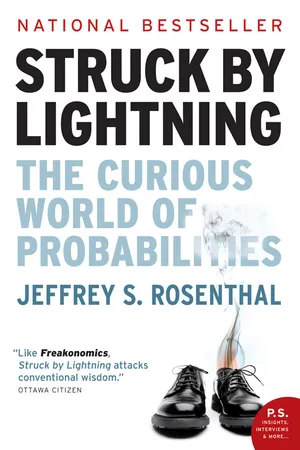
From lotteries, opinion polls and insurance to worries about murder rates, natural disasters and terrorism, probability plays a major part in our everyday lives—a part that is frequently and needlessly misunderstood. Jeffrey S. Rosenthal, a math professor and improvisational comedian, comes to the rescue with this irreverent, bestselling exploration of the odds and oddities of randomness. Looking at such familiar topics as poker hands, e-mail spam, political elections and game shows, Struck by Lightning puts probability into perspective and has fun along the way.
- 288 pages
- English
- ePUB (mobile friendly)
- Available on iOS & Android
eBook - ePub
About this book
Information
1
Surrounded by Randomness
Probabilities Everywhere
When I was a graduate student at Harvard University, I booked a flight to New York’s John F. Kennedy Airport to visit some relatives. Exactly one week before my flight, there was a major accident at the same airport: an Avianca airplane missed its first landing approach, ran out of fuel during its second approach, and crashed, killing 73 people.
At first I was shocked. How could I travel to Kennedy airport so soon after such a tragedy? Surely it wasn’t safe. I would have to cancel my visit!
In an effort to calm myself, I tried to think logically. At the time, I was working on a doctoral dissertation related to the mathematics of probability theory, but my research was rather theoretical, and not related to everyday life. Could I perhaps apply my abstract knowledge to this very concrete situation?
I did a quick calculation. I determined that there are about 5,000 flights per week to Kennedy airport. So, even if this airport accident was somehow the fault of the Kennedy Airport itself (which it probably wasn’t), and even if I knew that there would be another accident there sometime during the next week (which I didn’t), there would still be only one chance in 5,000 that my own flight would be affected.
Now, one chance in 5,000 isn’t so small, but it isn’t so large either. It was small enough to reassure me that my flight would probably be fine.
I flew to New York as scheduled and, in a victory for probability theory, I encountered no difficulties whatsoever.
In the years following my New York adventure, I began to realize that we are all constantly faced with situations and choices that involve randomness and uncertainty. A basic understanding of the rules of probability theory as they apply to real-life circumstances can help us to make sense of these situations, avoid unnecessary fear, seize the opportunities that randomness presents to us, and actually enjoy the uncertainties we face.
Human beings have always been both fascinated and appalled by randomness. On the one hand, we love the thrill of a surprise party, the unpredictability of a budding romance, the mystery of a good detective novel, and the freedom of not knowing what tomorrow may bring. We are inexplicably delighted by strange coincidences and striking similarities. Staid urban sophisticates gladly plunk down millions of dollars on lottery tickets and horse races–and on the stock market. Weary adults, after a hard day of work, are happy to play cards or roll the dice in a feisty game of chance. Audiences root for Casablanca’s inconsistent and unpredictable Rick Blaine (Humphrey Bogart), over the brave and heroic–but predictable–Victor Laszlo (Paul Henreid).
On the other hand, we hate uncertainty’s dark side. From cancer to SARS, diseases strike with no apparent pattern, ruining lives and baffling medical science. Terrorists attack, airplanes crash, bridges collapse, and we never know who will die next. Even the weather can suddenly and unexpectedly turn deadly, or just ruin an outdoor wedding. Successful politicians usually go out of their way to sound sure about everything, thus helping us to forget their (and our) lack of control over major national events that are ultimately, well, random.
Randomness is often neither good nor bad, but simply confusing. We are told of poll results accurate “to within four percentage points, 19 times out of 20,” or of a study that “proves” that a certain medication is good and certain lifestyle choices are bad. We are told that we have “nothing to lose” when we nervously ask someone out on a date, despitethe frightening possibility of rejection. We are assured that there is a “40% chance of rain today.” We are warned of the risk of “false positive” results when we are diagnosed with a disease. It is not always clear how we should react to such probabilities, or even what they really mean.
At times we try to ignore or explain away the random nature of our world. We imagine that God creates the weather intentionally, to punish us, or that counting flower petals can tell us whether “she loves me or she loves me not.” In Shakespeare’s Julius Caesar, Cassius denies the effect of luck on human destiny, declaring, “The fault, dear Brutus, is not in our stars/But in ourselves, that we are underlings.” In the movies, poker-playing, cigar-chewing cowboys get Royal Flushes through sheer willpower. In The Cooler, Bernie (William H. Macy) causes gamblers to lose just by standing nearby. And the rascally hero of Star Wars, Han Solo (Harrison Ford), warned by an android that the odds against successfully navigating an asteroid field are approximately 3,720 to one, scoffs “Never tell me the odds!”
But the reality is that when it comes to randomness, you can run but you can’t hide. So many aspects of our lives are governed by events not completely in our control, and uncertainty is here to stay. We have two options: we can let uncertainty get the better of us or we can learn to understand randomness. If we do the latter, we will make better choices and learn to harness uncertainty for our own purposes.
Let’s consider a few scenarios and how an understanding of uncertainty and probability might help us sort them out.
- You are planning a trip to a foreign country, but you are put off by reports of terrorist activities there. Should you go anyway? A simple understanding of probabilities will allow you to assess the risk of terrorism on your trip, and to decide whether the probabilities are high enough to affect your plans.
- You need a secret code to conduct a secure financial transaction over the Internet. If you just make up a code, an enemy agent might anticipate your psychology, guess the code, and obtain secret information. On the other hand, if you use randomness to generate your
- code, you can virtually guarantee security against even the cleverest enemy. Modern computers use randomness in this way all the time.
- You are involved in a battle of wits with a clever opponent and want to avoid being outsmarted. You can use randomness to create a Nash equilibrium strategy in which your opponent can do no better than guess.
- The local police chief and politicians all insist that crime is out of control and that more money is needed for law enforcement. You can use linear regression to decide for yourself whether or not crime is actually increasing.
- You are considering asking out that cute accountant in the business office, but you are worried that she will reject your advance or perhaps even complain about it. Utility theory allows you to quantify your feelings about your wants and fears, and to compute whether or not they justify making that phone call.
- Your doctor informs you that you must take a certain drug, shown conclusively to be effective by the latest medical study. By considering the study’s biases and p-value, you can determine for yourself whether or not to accept its conclusions.
- A rival scoffs that you are more likely to be struck by lightning than to succeed in your business venture. A simple check of the numbers will reveal just how unlikely lightning deaths really are and put your rival’s comments into context.
- You are annoyed by all the spam e-mail you receive, and you wish you could find a way to block it. Probability theory helps computers to separate spam from genuine messages, sparing you the burden of a jammed mailbox.
- In one day, you see three different people who have all dyed their hair green. Is this a new and popular fashion trend? Random events tend to occur in bunches due to Poisson clumping, and many apparently striking coincidences or trends are the result of pure chance, and are of no meaning or consequence.
- A friend tries to stump you with the “Monty Hall problem”: which of three doors is most likely to have a car behind it, if you already
- know that Door #3 is empty? The theory of conditional probability allows you to compute all the odds and make the right choice.
- You write a fantastic song, but you worry that perhaps someone else may have already written the exact same song. Probability theory provides a useful perspective on uniqueness and practically guarantees that your song is brand new.
- You wonder how scientists and engineers compute all of the complicated quantities required to build bridges, conduct medical studies, and design nuclear reactors. Monte Carlo sampling uses randomness on high-speed computers to compute many such quantities.
- You need to decide whether to call a poker bet, or how many houses to buy in Monopoly. Probability theory provides many insights into strategies for games of chance, and using it allows you to win more often in the long run.
These scenarios are many and varied, but they all have one thing in common. In each case, knowing the rules of probability, randomness, and uncertainty allows us to make better decisions and to understand the world around us more clearly. Even simple probability calculations can help reduce our stress and clarify our choices, by putting randomness in perspective: a “Probability Perspective” based on rational thought about randomness rather than on irrational emotional responses.
While no one can predict uncertain events with certainty, we can at least understand the uncertainty itself. This book will discuss the probabilities associated with many different events. By thinking logically about the likelihood of various outcomes, we can make better decisions and understand our lives more deeply. We can better cope with the uncertainties we face and perhaps even learn to enjoy them.
So the next time your daughter is flying in for the holidays, in the midst of a rainstorm and with thunder and lightning across the skies, don’t panic. Don’t despair. Don’t fill your mind with images of horrible accidents. Instead, remember the Probability Perspective. Remember that each year there are about 10 million commercial flights in the United States alone–including many during rainstorms–and on average onlyabout five crashes involving fatalities. The probability that your daughter’s flight will result in even one death is only about one chance in 2 million. It just isn’t going to happen.
In place of worrying, enjoy the moment. Eagerly anticipate her visit. Cook her favourite meal. Prepare for a fun game of chance involving cards or dice. Think about the fascination and intrigue that randomness adds to our daily lives.
And when your daughter finally arrives, a little wet and very hungry but perfectly safe, be sure to give her a big hug.
2
What Are the Odds of That?
Coincidence and Surprise
We are often struck by seemingly astounding coincidences. You meet three friends for dinner and discover that all four of you are wearing dresses of the same colour. You dream about your grandson the day before he phones you out of the blue. Your two office mates both get called for jury duty on the same day. You discover that your boss’s new bride went to the same tiny elementary school that you did. Such events amuse us, or fascinate us, or arouse our suspicions, or evoke deep mystical significance. But should they?
From the Probability Perspective, our first question should be, how unlikely was the event? Was the coincidence run of the mill or truly astounding?
Out of How Many?
Everything that happens is surprising in some sense, from someone’s perspective.
The Astounding Lottery Winner
“I don’t believe it,” Jennifer exclaims. “John Smith from Smalltown just won the lottery jackpot!”
“Wow, that’s great,” you reply cautiously. “Do you know him?” “No, unfortunately not.” “Had you heard of him before?” “No, never.”
“Have you ever been to Smalltown?” “Nope.”
“So why are you so surprised?”
“Because the probability of winning that lottery jackpot is about one in 14 million,” Jennifer declares with an air of authority. “And yet John Smith pulled it off!”
Winning any commercial lottery jackpot is extremely unlikely. On the other hand, millions of people buy lottery tickets every day, and usually at least one of them will win. This doesn’t surprise us at all, but why not? The reason is that one person out of millions has won the lottery. There are millions of different chances for someone to win the lottery, so of course usually someone does.
If you flip a coin 10 times and get heads every time, that would be rather surprising, because the chances of its happening were 1 in 1,024 (computed by taking a factor of 1/2 for each of the ten coins, and multiplying them all together), which is less than 0.1%. However, if you spend an entire afternoon repeatedly flipping the same coin, and after several hours you finally get 10 heads in a row, that was bound to happen and is not surprising at all.
So, whenever a friend announces a surprising development, the first thing you should ask yourself is, out of how many? That is, how many different chances were there for that event–or any other similarly surprising one–to arise?
A Cousin at Disney World (A True Story)
When I was 14 years old, my family travelled to Orlando, Florida, to visit Disney World. For two days we went on scary roller coasters and gentle train rides, saw haunted houses and singing puppets, and ate lots of junk food. Remarkably, in the midst of thousands of strangers, we ran into my father’s cousin Phil and his family. They lived in Connecticut, and none of us had any idea that the other family was in Florida. We were all stunned at the coincidence.
How surprised should we have been? There were about 230 million people in the United States at that time. So, the probability that any one person chosen at random at Disney World would be my father’s cousin Phil, was something like one chance in 230 million, unimaginably low. However, over the course of our two days at Disney World, we had passed many different strangers waiting in line for many different rides and treats. In total there must have been at least 2,000 people that we saw close enough to recognize, any one of whom could have been Phil. So, right away this increases the probability by a factor of 2,000, to one chance in 115,000.
But Cousin Phil wasn’t the only person we might have run into. What about my father’s other cousins? What about my mother’s cousins? What about numerous other relatives? Or our friends or work colleagues? Or our neighbours? Or classmates? Or relatives of friends? Or friends of neighbours? There must be at least 500 people whom we could have run into who would have surprised us as much as Phil did. This increases the probability by another factor of 500, to one chance in 230.
Of course, one chance in 230 is still less than half of one percent. So, on most trips to Disney World, you probably won’t run into anyone that you know. But still, over a lifetime of travelling and visiting and exploring, you are bound to run into people unexpectedly, now and then. It really isn’t so surprising after all.
This “out of how many” issue comes up in many ways. For example, a friend told me that the night before her father died, she had a dream in which her father appeared, looking surprisingly peaceful. Some might consider that this dream showed that my friend somehow “knew” that her father was about to die, or even that my friend’s father had somehowcommunicated with her on a subconscious level over the 500 kilometres between them.
Perhaps. But another explanation is that we all dream about many things every night. The dreams that we are most likely to remember or take note of or discuss with others are those that happen to have some surprising connection to other events. My friend might dream of her father on perhaps one night in 50, so the probability that she would dream about him the night before he died is only about one in 50. However, the probability that she would have some dream at some point in her life that would have some connection to some event, is much much higher. So, the question is: one profound dream out of how many dreams in total?
Nobel Prize winner Richard Feynman wrote about an incident that occurred when he was a student. Suddenly, the physicist got a feeling that he knew, somehow, that his grandmother had died. Just then the phone rang. Had his prediction come true? Had his grandmother passed away? No, the phone call was for another student, and Fe...
Table of contents
- Cover
- Title Page
- Contents
- 1 Surrounded by Randomness: Probabilities Everywhere
- 2 What Are the Odds of That?: Coincidence and Surprise
- 3 Laying Down the Law: Why Casinos Always Win
- 4 Dealing the Cards: Bridge,Poker, and Blackjack
- 5 Murder Most Foul: Measuring Trends
- 6 Utility Functions: How to Make Decisions
- 7 White Lab Coats: What Studies Do and Don’t Show
- 8 Ain’t Gonna Happen: Very Low Probabilities
- 9 Interlude: The Case of the Collapsing Casino
- 10 Fifty-one Percent to Forty-nine Percent: The True Meaning of Polls
- 11 Nineteen Times Out of Twenty: Margins of Error
- 12 Randomness to the Rescue: When Uncertainty Is Your Friend
- 13 Evolution, Genes, and Viruses: Randomness in Biology
- 14 That Wily Monty Hall: Finding Probabilities from Clues
- 15 Spam, Spam, Probability, and Spam: Blocking Unwanted E-mail
- 16 Ignorance, Chaos, and Quantum Mechanics: Causes of Randomness
- 17 Final Exam: Do You Have Probability Perspective?
- Index
- Acknowledgements
- About the Author
- More Praise for Struck by Lightning
- P.S. Ideas, interviews & features
- Copyright
- About the Publisher
Trusted by 375,005 students
Access to over 1.5 million titles for a fair monthly price.
Study more efficiently using our study tools.
Frequently asked questions
Yes, you can cancel anytime from the Subscription tab in your account settings on the Perlego website. Your subscription will stay active until the end of your current billing period. Learn how to cancel your subscription
No, books cannot be downloaded as external files, such as PDFs, for use outside of Perlego. However, you can download books within the Perlego app for offline reading on mobile or tablet. Learn how to download books offline
Perlego offers two plans: Essential and Complete
- Essential is ideal for learners and professionals who enjoy exploring a wide range of subjects. Access the Essential Library with 800,000+ trusted titles and best-sellers across business, personal growth, and the humanities. Includes unlimited reading time and Standard Read Aloud voice.
- Complete: Perfect for advanced learners and researchers needing full, unrestricted access. Unlock 1.5M+ books across hundreds of subjects, including academic and specialized titles. The Complete Plan also includes advanced features like Premium Read Aloud and Research Assistant.
We are an online textbook subscription service, where you can get access to an entire online library for less than the price of a single book per month. With over 1.5 million books across 990+ topics, we’ve got you covered! Learn about our mission
Look out for the read-aloud symbol on your next book to see if you can listen to it. The read-aloud tool reads text aloud for you, highlighting the text as it is being read. You can pause it, speed it up and slow it down. Learn more about Read Aloud
Yes! You can use the Perlego app on both iOS and Android devices to read anytime, anywhere — even offline. Perfect for commutes or when you’re on the go.
Please note we cannot support devices running on iOS 13 and Android 7 or earlier. Learn more about using the app
Please note we cannot support devices running on iOS 13 and Android 7 or earlier. Learn more about using the app
Yes, you can access Struck By Lightning by Jeffrey S. Rosenthal in PDF and/or ePUB format, as well as other popular books in Biological Sciences & Science General. We have over 1.5 million books available in our catalogue for you to explore.