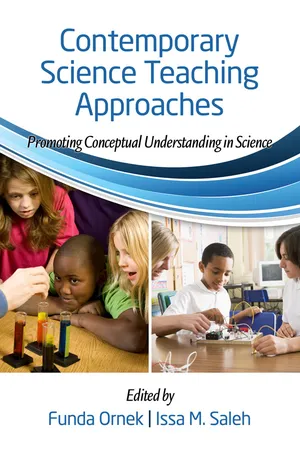
Contemporary Science Teaching Approaches
Promoting Conceptual Understanding in Science
- 237 pages
- English
- PDF
- Available on iOS & Android
Contemporary Science Teaching Approaches
Promoting Conceptual Understanding in Science
About this book
Contemporary science teaching approaches focus on fostering students to construct new scientific knowledge as a process of inquiry rather than having them act as passive learners memorizing stated scientific facts. Although this perspective of teaching science is clearly emphasized in the National Research Council's National Science Education Standards (NRC, 1996), it is however challenging to achieve in the classroom. Science teaching approaches should enhance students' conceptual understanding of scientific concepts which can be later utilized by students in deeper recognition of real world (Marsak & Janouskova, 2007).
This book identifies and describes several different contemporary science teaching approaches and presents recent applications of these approaches in promoting interest among students. It promotes conceptual understanding of science concepts among them as well. This book identifies pertinent issues related to strategies of teaching science and describes best practice The chapters in this book are culmination of years of extensive research and development efforts to understand more about how to teach science by the distinguished scholars and practicing teachers.
Trusted by 375,005 students
Access to over 1 million titles for a fair monthly price.
Study more efficiently using our study tools.
Information
Table of contents
- Cover
- Half Title
- Contemporary Science Teaching Approaches: Promoting Conceptual Understanding in Science
- Library of Congress Cataloging-in-Publication Data
- Contents
- Foreword
- Part I: Strategies in Teaching Science
- Chapter 1: Science Teaching Approaches to Promote Conceptual Understanding in Science
- Chapter 2: Differentiating Science Pedagogy
- Chapter 3: The Metacognitive Science Teacher
- Chapter 4: Teaching About Climate Change
- Chapter 5: Constructivist, Analogical, and Metacognitive Approaches to Science Teaching and Learning
- Chapter 6: Concept Mapping and the Teaching of Science
- Chapter 7: Physics Modeling
- Part II: Using Computers in Teaching Science
- Chapter 8: A Framework for the Integration of Technology into Science Instruction
- Chapter 9: Real-Time Experiments and Images (RTEI) as Open Learning Environments for Building Physics Knowledge
- Chapter 10: Enhancing Asynchronous Learning in a Blended Learning Environment
Frequently asked questions
- Essential is ideal for learners and professionals who enjoy exploring a wide range of subjects. Access the Essential Library with 800,000+ trusted titles and best-sellers across business, personal growth, and the humanities. Includes unlimited reading time and Standard Read Aloud voice.
- Complete: Perfect for advanced learners and researchers needing full, unrestricted access. Unlock 1.4M+ books across hundreds of subjects, including academic and specialized titles. The Complete Plan also includes advanced features like Premium Read Aloud and Research Assistant.
Please note we cannot support devices running on iOS 13 and Android 7 or earlier. Learn more about using the app