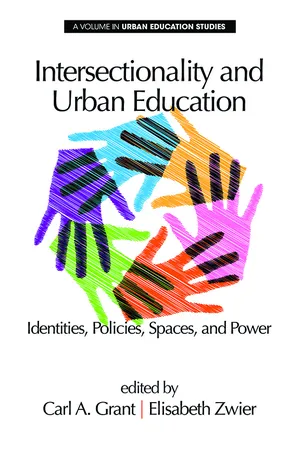
Intersectionality and Urban Education
eBook - PDF

Intersectionality and Urban Education

Identities, Policies, Spaces & Power

  1. 331 pages
  2. English
  3. PDF
  4. Available on iOS & Android
eBook - PDF

Intersectionality and Urban Education

Identities, Policies, Spaces & Power

About this book

In urban education, "urban" is a floating signifier that is imbued with meaning, positive or negative by its users. "Urban" can be used to refer to both the geographical context of a city and a sense of "less than," most often in relation to race and/or socioeconomic status (Watson, 2011). For Noblit and Pink (2007), "Urban, rather, is a generalization as much about geography as it is about the idea that urban centers have problems: problems of too many people, too much poverty, too much crime and violence, and ultimately, too little hope" (p. xv). Recently, urban education scholars such as Anyon (2005), Pink and Noblit (2007), Blanchett, Klinger and Harry (2009), and Lipman (2013) have elucidated the social construction of oppression and privilege for urban students, teachers, schools, families, and communities using intersectionality theories. Building on their work, we see the need for an edited collection that would look across the different realms of urban education—theorizing identity markers in urban education, education in urban schools and communities, thinking intersectionally in teacher education & higher education, educational policies & urban spaces—seeking to better understand each topic using an intersectional lens. Such a collection might serve to conceptually frame or provide methodological tools, or act as a reference point for scholars and educators who are trying to address urban educational issues in light of identities and power. Secondly, we argue that education questions and/or problems beg to be conceptualized and analyzed through more than one identity axis. Policies and practices that do not take into account urban students' intertwining identity markers risk reproducing patterns of privilege and oppression, perpetuating stereotypes, and failing at the task we care most deeply about: supporting all students' learning across a holistic range of academic, personal, and justice-oriented outcomes.

Can educational policies and practices address the social justice issues faced in urban schools and communities today? We argue that doing intersectional research and implementing educational policies and practices guided by these frameworks can help improve the "fit." Particular attention needs to be paid to intersectionality as a lens for educational theory, policy, and practice. As urban educators we would be wise to consider the intertwining of these identity axes in order to better analyze educational issues and engage in teaching, learning, research, and policymaking that are better-tuned to the needs of diverse students, families, and communities.

Trusted byĀ 375,005 students

Access to over 1.5 million titles for a fair monthly price.

Study more efficiently using our study tools.

Information

Year
2014
Print ISBN
9781623967321
9781623967338
eBook ISBN
9781623967345

Table of contents

  1. Cover
  2. Intersectionality and Urban Education
  3. Intersectionality and Urban Education
  4. Copyright
  5. CONTENTS
  6. INTRODUCTION
  7. THE HEEDING
  8. THE PROJECT
  9. AN OVERVIEW
  10. REFERENCES
  11. I : THEORIZING IDENTITY MARKERS IN URBAN EDUCATION
  12. II : EDUCATION IN URBAN SCHOOLS AND COMMUNITIES
  13. III : THINKING INTERSECTIONALLYIN TEACHER EDUCATION AND HIGHER EDUCATION
  14. IV : EDUCATIONAL POLICIES AND URBAN SPACES

Frequently asked questions

Yes, you can cancel anytime from the Subscription tab in your account settings on the Perlego website. Your subscription will stay active until the end of your current billing period. Learn how to cancel your subscription
No, books cannot be downloaded as external files, such as PDFs, for use outside of Perlego. However, you can download books within the Perlego app for offline reading on mobile or tablet. Learn how to download books offline
Perlego offers two plans: Essential and Complete
  • Essential is ideal for learners and professionals who enjoy exploring a wide range of subjects. Access the Essential Library with 800,000+ trusted titles and best-sellers across business, personal growth, and the humanities. Includes unlimited reading time and Standard Read Aloud voice.
  • Complete: Perfect for advanced learners and researchers needing full, unrestricted access. Unlock 1.5M+ books across hundreds of subjects, including academic and specialized titles. The Complete Plan also includes advanced features like Premium Read Aloud and Research Assistant.
Both plans are available with monthly, semester, or annual billing cycles.
We are an online textbook subscription service, where you can get access to an entire online library for less than the price of a single book per month. With over 1.5 million books across 990+ topics, we’ve got you covered! Learn about our mission
Look out for the read-aloud symbol on your next book to see if you can listen to it. The read-aloud tool reads text aloud for you, highlighting the text as it is being read. You can pause it, speed it up and slow it down. Learn more about Read Aloud
Yes! You can use the Perlego app on both iOS and Android devices to read anytime, anywhere — even offline. Perfect for commutes or when you’re on the go.
Please note we cannot support devices running on iOS 13 and Android 7 or earlier. Learn more about using the app
Yes, you can access Intersectionality and Urban Education by Carl A. Grant, Elisabeth Zwier, Carl A. Grant,Elisabeth Zwier in PDF and/or ePUB format, as well as other popular books in Education & Education General. We have over 1.5 million books available in our catalogue for you to explore.