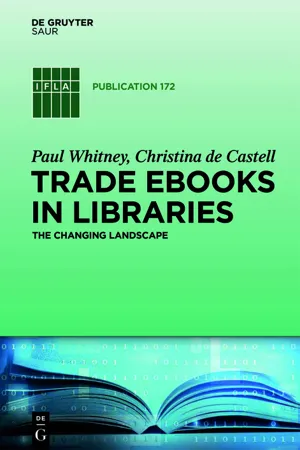
With the advent of downloadable retail eBooks marketed to individual consumers, for the first time in their history libraries encountered an otherwise commercially available text format they were prevented from adding to their collections. Trade eBooks in Libraries examines the legal frameworks which gave rise to this phenomenon and advocacy efforts undertaken in different jurisdictions to remove barriers to library access. The principal authors provide a general historical overview and an analysis of library/eBook principles developed by a variety of library associations and government reviews. In addition, experts from twelve countries present summaries of eBook developments in their respective countries and regions.
- 219 pages
- English
- ePUB (mobile friendly)
- Available on iOS & Android
eBook - ePub
About this book
Trusted by 375,005 students
Access to over 1 million titles for a fair monthly price.
Study more efficiently using our study tools.
Information
1Introduction
This book is intended to chart the evolving presence of trade eBooks1 in libraries since they became a significant factor in the English-language retail market in 2010. The focus of the study is downloadable eBooks whose primary distribution is to individual readers through a variety of types of online suppliers. As most trade print book sales are to public libraries, it is not surprising that the focus of the book will be on the interaction of public libraries with trade publishers, and to a certain extent, authors. This is not to say that trade eBooks are not present in education and research libraries or that these institutions do not experience many of the same issues as public libraries. Rather, from the outset, public libraries have been where the greatest impacts are felt, and public library collections have always been at the centre of negotiations with trade publishers and library and library association advocacy with governments and the general public.
Within a framework which examines the evolution of trade eBooks and the core principles which have informed advocacy, the book will also chart the development of trade eBooks in different regions and the extent to which they have been incorporated in library collections. Given the regional nature of trade publishing, often reinforced by language, and the very patchwork availability of technology infrastructure and marketing of trade eBooks by region, a portion of the book will be devoted to examining specific circumstances in specific markets which can be defined by national boundaries, regional groupings of countries or language spoken.
Contributions from librarians in different countries describe both advocacy efforts with regional and multinational publishers and the presence and use of trade eBooks in public libraries. Both library tactics and negotiating positions have varied by region and changed in the past six years. This book documents attempts to ensure the availability of trade eBooks in library collections. Many of these attempts failed, some are still works in progress and some have achieved considerable success. We can learn from them all.
Documentation on negotiations with publishers will of necessity have to deal with two sectors: the Big Five multinational publishers (the Big Six when trade eBooks were first introduced)2 and smaller independent publishers generally catering exclusively to the domestic market. Multinational trade publishers have adopted different approaches in different markets and it is helpful to understand changes in availability and terms and conditions in specific countries.
A few sections of the text constitute modified portions of previous reports and statements primarily written by the authors, specifically portions of the “Defining Our Terms” that appeared in International Federation of Library Associations and Institutions (IFLA) reports including the IFLA 2014 eLending Background Paper;3 and portions of the licensing terms and English-Canada content appeared in white papers for the Canadian Urban Libraries Council published in 2011 and 2014.4 The authors acknowledge and appreciate the contributions of colleagues in refining our thinking on these issues.
The appendix presents selected source documents including library statements of eBook principles and advocacy documents.
2Defining Our Terms
Prior to the introduction of digital text works, the concept of the book as physical object and its content were often conflated: seen as one and the same. The introduction of digital text and the devices used to read them undermined this unity. The Oxford Companion to the Book notes that the “e-book is a young medium and its definition is a work in progress”.5 The authors continue to argue for the utility of no longer focusing on the object when considering the eBook: “…it is less useful to consider the book as object – particularly as commercial object – than to view it as cultural practice, with the e-book as one manifestation of this practice”.6 The Oxford English Dictionary Online provides three definitions of eBook:
…a hand-held electronic device on which a book can be read. Also: a book whose text is available in an electronic format for reading on such a device or on a computer screen; (occas.) a book whose text is available only or primarily on the Internet.7
Consistent with the commonly held view, this book uses the term eBook to indicate the creative content in an individual work readable in electronic form on a device and not the device itself.
In deliberations in the library community over the past six years, it became evident that there was little consensus on how to define an eBook. It is useful in this regard to quote the IFLA 2014 eLending Background Paper: “An eBook is a digital version of a text-based work which is available publically (with or without payment) as a separate work”.8 The Background Paper continues:
For clarity an eBook may:
–be owned by an individual or library but is more commonly licensed from the publisher/vendor
–also be contained in a collection or bundle of eBooks marketed as one entity
–be augmented or supplemented by audio visual or other elements such as Global Positioning System (GPS) data as part of one file or through links to separate file(s)
–coexist with a print on paper book of the same text or have no physical equivalent
–be downloaded to a device or be streamed, which requires an Internet connection whenever the work is read
–be produced by a trade publisher or self-published for the general reader (the most common understanding) but may also be a scholarly or professional monograph published by entities such as university presses or professional organizations…
Digital versions of journals and newspapers are not considered to be eBooks.9
In developed countries technological advances in the provision of digital content mean that the commonly held understanding of what is an eBook is viewed as already outdated by informed industry participants. This book primarily focuses on the conventional understanding of what is an eBook in 2016 but it is understood that digital content provision is evolving rapidly and that it is possible, if not likely, that the current predominant model of digital text produced by publishers as a single file and downloaded by individuals to handheld devices will be eroded.
The emergence of new content formats does not necessarily mean that old formats and technologies disappear. They may, but in a number of instances formats for the same content coexist. While there is much to anticipate with interest, if not concern, in the new digital ecosystems of creating and disseminating content, it is also probable that the current model of linear narrative contained in a single work, produced by a publisher and marketed to readers, will continue to have a significant commercial market and a place in library collections for the foreseeable future.
It is also important to consider a definition of “eLending” in this discussion. The IFLA 2014 eLending Background Paper defines eLending as “the temporary provision of an eBook by a library to a registered user for use away from the library premises and in the library should the user wish”. The following clarifications follow this definition:
- the terms under which the eBook is lent may be dictated by purchase agreement, license or by the library itself, including number of simultaneous users, length of loan etc.
- the eBook may be supplied to the reader’s device from a vendor, publisher or library server.10
The term eLending is generally applied to the downloading of digital text accessed through a library website. In practice this most often involves the library user accessing the file from a location away from the library, which parallels how eBooks are purchased. It has been argued that the library provision of eBooks to readers who are not present in the library building does not in a legal sense constitute “lending”. This is discussed in Section 4.4.2.
3The Evolution of Trade eBooks
3.1Early History
3.1.1Project Gutenberg
Michael Hart, founder of Project Gutenberg, is generally credited as producing the first eBook. In July 1971, having been given free computer time on the mainframe computer at the University of Illinois, he keyed in the U.S. Declaration of Independence. In Hart’s 2011 obituary The Economist described what happened next:
This was the first free e-text, and none better as a declaration of freedom from the old-boy network of publishing. What he typed could not even be sent as an e-mail, in case it crashed the ancient Arpanet system; he had to send a message to say that it could be downloaded. Six people did, of perhaps 100 on the network.11
So began Project Gutenberg, a volunteer organization intended, as stated in Hart’s “Mission Statement”:
To encourage the creation and distribution of eBooks. This mission is, as much as possible, to encourage all those who are interested in making eBooks and helping to give them away.12
Hart with “hippy affability”13 outlined what he saw as the outcomes which would come from the digital revolution applied to books:
Books prices plummet. Literacy rates soar. Education rates soar. Old structures crumble, as did the Church. Scientific Revolution. Industrial Revolution. Humanitarian Revolution.14
As we well know with hindsight, such wide-reaching optimism was not justified. However there is no doubt that Project Gutenberg has had a lasting positive effect on improving access to public domain works in many languages accessible on a variety of hardware platforms. By October 2015 Project Gutenberg surpassed 50,000 titles in its catalogue, all in the public domain with the exception of a small number of copyright-protected works, included under a Creative Commons licence with the author’s permission. Hart was a determined opponent to copyright term extension which he correctly saw as impeding his project’s mission. While Project Gutenberg has been superseded in part by massive digitization projects, its aspirations mirror the impetus which would later motivate library eBook provision.
Following in the path of Project Gutenberg, Google began digitizing public-domain books in 2004 and soon would expand its activities by digitizing copyright-protected works, which in 2005 resulted in the first of a series of ongoing court challenges which were resolved in favour of Google in 2016.15 The HathiTrust Digital Library, a digital preservation repository, founded in 2008 by a group of research libraries in North America and Europe, provides access to books digitized by a variety of agencies including Google and the Internet Archive. Containing well over 13 million public-domain and copyright-protected works, the Hathi-Trust successfully won a series of court challenges on the basis of US fair use.
3.1.2The First Digital Books in Public Libra...
Table of contents
- Cover
- Title
- Copyright
- Contents
- List of Tables and Figures
- List of Abbreviations
- About IFLA
- 1 Introduction
- 2 Defining Our Terms
- 3 The Evolution of Trade eBooks
- 4 Legal Considerations
- 5 Library eBook Principles
- 6 Advocacy Campaigns
- 7 Regional Summaries
- 8 What Comes Next in Publishing, Distribution and Libraries?
- 9 Conclusion
- 10 Appendix
- 11 Bibliography
Frequently asked questions
Yes, you can cancel anytime from the Subscription tab in your account settings on the Perlego website. Your subscription will stay active until the end of your current billing period. Learn how to cancel your subscription
No, books cannot be downloaded as external files, such as PDFs, for use outside of Perlego. However, you can download books within the Perlego app for offline reading on mobile or tablet. Learn how to download books offline
Perlego offers two plans: Essential and Complete
- Essential is ideal for learners and professionals who enjoy exploring a wide range of subjects. Access the Essential Library with 800,000+ trusted titles and best-sellers across business, personal growth, and the humanities. Includes unlimited reading time and Standard Read Aloud voice.
- Complete: Perfect for advanced learners and researchers needing full, unrestricted access. Unlock 1.4M+ books across hundreds of subjects, including academic and specialized titles. The Complete Plan also includes advanced features like Premium Read Aloud and Research Assistant.
We are an online textbook subscription service, where you can get access to an entire online library for less than the price of a single book per month. With over 1 million books across 990+ topics, we’ve got you covered! Learn about our mission
Look out for the read-aloud symbol on your next book to see if you can listen to it. The read-aloud tool reads text aloud for you, highlighting the text as it is being read. You can pause it, speed it up and slow it down. Learn more about Read Aloud
Yes! You can use the Perlego app on both iOS and Android devices to read anytime, anywhere — even offline. Perfect for commutes or when you’re on the go.
Please note we cannot support devices running on iOS 13 and Android 7 or earlier. Learn more about using the app
Please note we cannot support devices running on iOS 13 and Android 7 or earlier. Learn more about using the app
Yes, you can access Trade eBooks in Libraries by Paul Whitney,Christina Castell in PDF and/or ePUB format, as well as other popular books in Languages & Linguistics & Library & Information Science. We have over one million books available in our catalogue for you to explore.