Solar Cells and Energy Materials takes an in-depth look at the basics behind energy, solar energy as well as future and alternative energy materials. The author presents insights into the current state-of-the-art of solar cells, including their basic science, inorganic, organic and Perovskite-type cells. The author also gives an outlook into next generation energy materials and sources. The focus of this book is not only the presentation of available and developing energy materials, but their thorough examination and characterization.
In addition to solar cell technology and the promising application of nanostructures like quantum dots, the author discusses the science and potential of nuclear fusion materials and other energy materials like hydrogen storage materials, BN nanomaterials, alternative fuel cells and SIC FET.
The word “energy” can have the following meanings:
The capacity for work that a certain system potentially has.
The ability to do physical work.
A useful resource for human society.
A resource required for physical or mental activity.
In the field of physics, energy generally refers to a quantity of work, as in definition (1). Heat, light, electromagnetic waves, and mass are also forms of energy. Within general usage, definitions (2) and (3) are more commonly used. There are many types of energy resources, and exhaustive energy and renewable energy have often been compared. Recently, a transition from exhaustive energy to renewable energy has begun taking place across the world.
The measurement used for energy in the International System of Units (SI unit) is the joule (J). The electron volt (eV) and kilowatt hour (kWh) are also used in the field of solar cells, as is shown in Table 1.1.
Table 1.1: Unit of energy.
Item
Symbol of quantity
Energy
E
Dimension
kg m2 s−2
Kind
scalar
SI unit
J (Joule)
CGS unit
erg = 10−7 J
MKS system of units
kgf m
Planck unit
Planck energy EP = 1.956× 10⁹ J
Atomic unit
Hartree Eh = 4.360× 10⁻¹⁸ J
Kilo watt hour (kWh)
3.6 MJ
Electron volt (eV)
1.602× 10⁻¹⁹ J
There are many types of energy, including: physical energy, kinetic energy, potential energy, elastic energy, chemical energy, ionization energy, heat energy, light energy, electric energy, acoustic energy, nuclear energy, mass energy and dark energy. Resources that are useful for industry, transportation and human life are generally referred to as “energy resources”, which include oil, coal, natural gas, nuclear power energy, water power, solar heat and so on. Recently, a distinction has been made between energy resources that are exhaustive forms of energy and those that are renewable. A development towards the increased use of renewable energy sources is currently in progress.
1.2Fermions and bosons
An atom consists of a nucleus with positive charge and electrons with negative charge. The nucleus consists of protons with positive charge and electrically neutral neutrons. An electron is believed to be an elementary particle, and measures less than 10−18 m in diameter. Elementary particle is a general term for particles that cannot be further divided. Electrons do not orbit around the nucleus in the usual sense of the word, even though textbook figures often illustrate them as if they did. Electron clouds are stochastically distributed around the nucleus, which contributes to the size of the atom (diameter: ~ 0.2 nm). Electron clouds also exist like waves, which can be observed as a particle when measured. However, it is difficult to define the size of electron clouds. When atoms connect through chemical bonding to form molecules, or they are ionized, the size of atomic clouds change naturally and the size of atoms also becomes different.
The nucleus consists of protons and neutrons, and measures ~ 10−15 m (1 fm) in diameter. Mesons transmit the force of protons at a minute scale. According to the standard model, protons and neutrons consist of up and down quarks, and there are six types of quarks with three stages of generation in nature.
An electron is one of the six particles referred to as leptons. A proton consists of two up quarks and one down quark, and a neutron consists of one up quark and two down quarks, as shown in Fig. 1.1. These quarks are believed to be elementary particles at present, though superstring theory has also been proposed as a further theory. Superstring theory indicates that elementary particles are a certain kind of string, and that quarks and leptons can be formed by the vibration of the strings. This theory is also called the quantum theory of gravity because of its inclusion of gravity.
Fig. 1.1: Structure of atom, proton and neutron.
Fermions are quantum particles with a spin angular momentum of half-integers such as 1/2, 3/2 and 5/2, as listed in Table 1.2. Fermions are guided by the Pauli Exclusion Principle, which indicates that two particles cannot occupy the same quantum state. Fermi-Dirac statistics apply to identical particles with half-integer spins in a system with thermodynamic equilibrium. The particles classified as fermions are quarks and leptons such as electrons, muons and neutrinos.
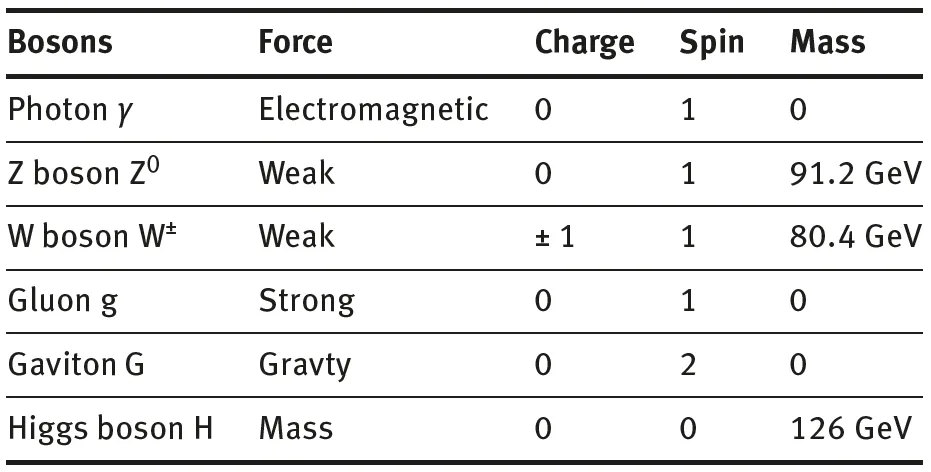
Table 1.2: Fermions and bosons.
On the other hand, bosons are quantum particles with an integer spin angular momentum, as listed in Table 1.2. A photon is a particle with a spin of 1. Bosons can occupy the same quantum state even in the case of more than one particle in one system. Bose-Einstein statistics apply to identical particles with an integer spin in systems with thermodynamic equilibrium. Examples of bosons include gauge particles, which carry the forces of elementary particles, such as photons, weak bosons and gluons. A graviton is an undiscovered boson with a spin of 2. A Higgs boson, which causes mass in elementary particles is a boson with a spin of 0. Cooper pairs, which are related to the phenomenon of superconductivity, obey Bose-Einstein statistics.
Neutrino is a general name for electrically neutral leptons, and neutrinos come in three flavors: electron neutrinos, muon neutrinos and tau neutrinos, associated with the electron, muon and tau, respectively. Although several quadrillion neutrinos pass through the human body each second, nobody feels them as they pass. Neutrinos almost never interact with matter, and it is quite difficult to observe them.
1.3Important physical constants in the universe
The most important physical constants in our universe are the following:
–Velocityoflightc (3.00 × 10⁸ m s−1)
–Planck constant h (6.63 × 10⁻³⁴ J s)
–Gravitational constant G (6.67 × 10⁻¹¹ m3 S−2 kg−1)
The Planck constant is a universal constant at the quantum scale. The energy of light (E) is proportional to the frequency (ν) of light, and the proportionality constant is a Planck constant.
The velocity of light and the gravitational constant are large-scale constants valid across the universe, while the Planck co...
Table of contents
Cover
Title Page
Copyright
Preface
Contents
Table for physical constants
Periodic table
1 Energy
2 Solar energy
3 Basics of solar cells
4 Inorganic solar cells
5 Organic-type solar cells
6 Perovskite-type solar cells
7 Future solar cells
8 Nuclear fusion materials
9 Other energy materials
Index
Frequently asked questions
Yes, you can cancel anytime from the Subscription tab in your account settings on the Perlego website. Your subscription will stay active until the end of your current billing period. Learn how to cancel your subscription
No, books cannot be downloaded as external files, such as PDFs, for use outside of Perlego. However, you can download books within the Perlego app for offline reading on mobile or tablet. Learn how to download books offline
Perlego offers two plans: Essential and Complete
Essential is ideal for learners and professionals who enjoy exploring a wide range of subjects. Access the Essential Library with 800,000+ trusted titles and best-sellers across business, personal growth, and the humanities. Includes unlimited reading time and Standard Read Aloud voice.
Complete: Perfect for advanced learners and researchers needing full, unrestricted access. Unlock 1.4M+ books across hundreds of subjects, including academic and specialized titles. The Complete Plan also includes advanced features like Premium Read Aloud and Research Assistant.
Both plans are available with monthly, semester, or annual billing cycles.
We are an online textbook subscription service, where you can get access to an entire online library for less than the price of a single book per month. With over 1 million books across 990+ topics, we’ve got you covered! Learn about our mission
Look out for the read-aloud symbol on your next book to see if you can listen to it. The read-aloud tool reads text aloud for you, highlighting the text as it is being read. You can pause it, speed it up and slow it down. Learn more about Read Aloud
Yes! You can use the Perlego app on both iOS and Android devices to read anytime, anywhere — even offline. Perfect for commutes or when you’re on the go. Please note we cannot support devices running on iOS 13 and Android 7 or earlier. Learn more about using the app
Yes, you can access Solar Cells and Energy Materials by Takeo Oku in PDF and/or ePUB format, as well as other popular books in Physical Sciences & Energy. We have over one million books available in our catalogue for you to explore.