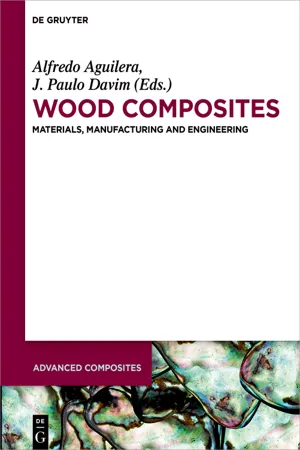
eBook - ePub
Wood Composites
Materials, Manufacturing and Engineering
- 219 pages
- English
- ePUB (mobile friendly)
- Available on iOS & Android
eBook - ePub
Wood Composites
Materials, Manufacturing and Engineering
About this book
Wood composites as part of wood engineering materials has been reaching a constant developing trend, being used on a wide range of applications and becoming worldwide as a very promising alternate material face to traditional building materials such as concrete, metal and plastics. In this part of the series are treated aspects among which advances functionalities in laminates, the activation of natural fibres, the natural matrix, and others industrials manufacturing research advances for wood material as composite.
Tools to learn more effectively

Saving Books

Keyword Search

Annotating Text

Listen to it instead
Information
Ana Henriques, Cristina Coelho, João M. Ferra, Jorge Manuel Martins, Fernão D. Magalhães, and Luísa Carvalho
1Introduction of advanced functionalities in laminates for wood-based panels: surface quality evaluation
Abstract: High-pressure laminates (HPL), manufactured with paper and thermosetting resins, are a value-added product that has been increasingly used for home and commercial surfaces and a practical solution for horizontal or vertical surfaces that require high physical, mechanical, and chemical performances, with a high versatility and excellent decoration ability. Intensive applications as scholar furniture with mar resistance, abrasion resistance, and dirt repellent; laboratory countertops with chemical resistance and dirt repellent; exterior flooring with UV resistance, mar resistance, and abrasion resistance; technical flooring with phosphorescent properties, abrasion and mar resistance for public buildings; hospital furniture with dirt repellence and antimicrobial properties; whiteboards with mar and abrasion resistance demands the introduction of advanced functionalities in high-pressure laminates not existent in the market. The development of innovative impregnation resins with new functionalities could result in multifunctional laminates as the result of the combination of new and better properties. In this chapter, the focus is on the production and characterization of decorative laminates, as well as the modification of this material in order to provide advanced functionalities.
Keywords: high-pressure laminates, advanced functionalities
1.1The HPL and its manufacture
1.1.1Introduction
According to the European Standard EN 438-2 [1] a high pressure laminate (Fig. 1.1) consists of layers of cellulosic fibrous material. These layers consisting of an assembly of kraft paper sheets impregnated with thermosetting resins (the number of such sheets is dependent on the intended thickness), a printed or patterned layer designated as the decorative paper impregnated with a melamine resin, and in some cases an overlay paper sheet on the surface [2]. The decorative paper represents a cost between 2.1 and 18.4% of HPL total price, the kraft paper a cost between 17.3 and 32.2%, the phenolic resin between 11.5 and 28.2%, the overlay between 0.5 and 3.4%, the melamine resin between 1.2 and 10.4%, and the energy between 6.9 and 8.2% to the manufacturer [3].

Decorative HPL are available in a wide range of colors, patterns, and abstracts combined with different textures and gloss levels. Excellent reproductions of natural materials such as textiles, fabrics, exotic wood veneers, and stone can be achieved. Different printing technologies, e.g. digital, screen, and offset printing, can be used to produce customized designs. Because of their impervious surfaces, HPL are easy to clean and maintain. Offered in various sizes, they allow large areas to be covered without seams.
The manufacture of such laminates commonly starts with impregnation of decorative and kraft papers (Fig. 1.2 (a)). After a drying process, the impregnated paper sheets are bonded together by high-pressure pressing (Fig. 1.2 (b)). The high pressure is defined as the simultaneous application of heat (temperature ≥ 120 °C) and high pressure (5MPa), to provide flowing and subsequent curing of the melamine and the phenolic resins. Curing the melamine resin makes the surface hard, providing scratch and damage resistance, while curing the phenolic resin bonds the kraft layers together and developing water resistance. The press cycle time is designed to cure the laminates within the pack as uniformly as possible, so that they all perform the same. The longer they are pressed, the more extensively cured and less flexible is the laminate.

The market share of laminates has been growing over the years. Global demand for decorative laminates is expected to rise 5.6% per year to 10.7 billion m2 in 2018, valued at US$ 40.8 billion [4]. Due to its durability and versatility, HPL is a common choice for horizontal and vertical applications in the construction and furnishing industries for high traffic settings such as hospitality, office furniture, healthcare, retail casework, commercial interiors, and education facilities [5]. Furniture and cabinets were the largest market for decorative laminates in 2013, accounting for nearly 70% of the total demand. However, the expected increase of ready-to-assemble (RTA) furniture and flooring, which are made from engineered wood and laminates, will benefit from the demand of these products [4].
Nowadays, Pacific Asia represents the largest and fastest growing market for decorative laminates, followed by North America and Europe. The Chinese market alone accounted for 31% of the global demand in 2013. India is expected to post the most rapid gains in laminate demands worldwide through 2018 [4]. Increasing available income, constant economic growth, rising standards of living, and increased demand for housing in urban areas are some of the key growth drivers in the Pacific Asian region. Increasing available income allow the customer to spend more on furniture, home accessories, and furnishings, among which decorative laminates play a key role. Additionally, a wide range of colors, designs, textures, and styles led to increased consumer interest and is expected to provide ample growth opportunities for the decorative laminates market [5]. Germany, France, and Sweden, where wood and paper industries are highly developed, are regional leaders in RTA furniture. The US also has a significant production capacity for RTA furniture, cabinets, and l...
Table of contents
- Cover
- Title Page
- Copyright
- Contents
- List of contributing authors
- 1 Introduction of advanced functionalities in laminates for wood-based panels: surface quality evaluation
- 2 Activation of natural fibers using physical routes: Applications for composites materials
- 3 Natural matrix/non wood natural fibers composites
- 4 Ultrasonic press control and evaluation of wood-based composite panel properties
- 5 Reconstituted composite from crop stalks
- 6 Wood welding without adhesives
- 7 Surface quality of mechanically processed wood
- 8 Strategies to reduce formaldehyde emissions from wood-based panels: Impact on physico-mechanical properties and machinability
- Index
Frequently asked questions
Yes, you can cancel anytime from the Subscription tab in your account settings on the Perlego website. Your subscription will stay active until the end of your current billing period. Learn how to cancel your subscription
No, books cannot be downloaded as external files, such as PDFs, for use outside of Perlego. However, you can download books within the Perlego app for offline reading on mobile or tablet. Learn how to download books offline
Perlego offers two plans: Essential and Complete
- Essential is ideal for learners and professionals who enjoy exploring a wide range of subjects. Access the Essential Library with 800,000+ trusted titles and best-sellers across business, personal growth, and the humanities. Includes unlimited reading time and Standard Read Aloud voice.
- Complete: Perfect for advanced learners and researchers needing full, unrestricted access. Unlock 1.4M+ books across hundreds of subjects, including academic and specialized titles. The Complete Plan also includes advanced features like Premium Read Aloud and Research Assistant.
We are an online textbook subscription service, where you can get access to an entire online library for less than the price of a single book per month. With over 1 million books across 990+ topics, we’ve got you covered! Learn about our mission
Look out for the read-aloud symbol on your next book to see if you can listen to it. The read-aloud tool reads text aloud for you, highlighting the text as it is being read. You can pause it, speed it up and slow it down. Learn more about Read Aloud
Yes! You can use the Perlego app on both iOS and Android devices to read anytime, anywhere — even offline. Perfect for commutes or when you’re on the go.
Please note we cannot support devices running on iOS 13 and Android 7 or earlier. Learn more about using the app
Please note we cannot support devices running on iOS 13 and Android 7 or earlier. Learn more about using the app
Yes, you can access Wood Composites by J. Paulo Davim, Alfredo Aguilera, J. Paulo Davim,Alfredo Aguilera in PDF and/or ePUB format, as well as other popular books in Technology & Engineering & Chemical & Biochemical Engineering. We have over one million books available in our catalogue for you to explore.