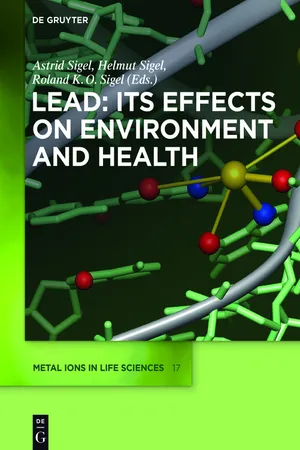
Volume 17, entitled Lead: Its Effects on Environment and Health of the series Metal Ions in Life Sciences centers on the interrelations between biosystems and lead. The book provides an up-to-date review of the bioinorganic chemistry of this metal and its ions; it covers the biogeochemistry of lead, its use (not only as gasoline additive) and anthropogenic release into the environment, its cycling and speciation in the atmosphere, in waters, soils, and sediments, and also in mammalian organs. The analytical tools to determine and to quantify this toxic element in blood, saliva, urine, hair, etc. are described. The properties of lead(II) complexes formed with amino acids, peptides, proteins (including metallothioneins), nucleobases, nucleotides, nucleic acids, and other ligands of biological relevance are summarized for the solid state and for aqueous solutions as well. All this is important for obtaining a coherent picture on the properties of lead, its effects on plants and toxic actions on mammalian organs. This and more is treated in an authoritative and timely manner in the 16 stimulating chapters of Volume 17, which are written by 36 internationally recognized experts from 13 nations. The impact of this recently again vibrant research area is manifested in nearly 2000 references, over 50 tables and more than 100 illustrations (half in color). Lead: Its Effects on Environment and Health is an essential resource for scientists working in the wide range from material sciences, inorganic biochemistry all the way through to medicine including the clinic ... not forgetting that it also provides excellent information for teaching.
eBook - ePub
Lead: Its Effects on Environment and Health
- 596 pages
- English
- ePUB (mobile friendly)
- Available on iOS & Android
eBook - ePub
Lead: Its Effects on Environment and Health
About this book
Information
Topic
Physical SciencesSubtopic
Biochemistry in MedicineTitles of Volumes 1–44 in the Metal Ions in Biological Systems Series
edited by the SIGELs and published by Dekker/Taylor & Francis (1973–2005)
| Volume 1: | Simple Complexes |
| Volume 2: | Mixed-Ligand Complexes |
| Volume 3: | High Molecular Complexes |
| Volume 4: | Metal Ions as Probes |
| Volume 5: | Reactivity of Coordination Compounds |
| Volume 6: | Biological Action of Metal Ions |
| Volume 7: | Iron in Model and Natural Compounds |
| Volume 8: | Nucleotides and Derivatives: Their Ligating Ambivalency |
| Volume 9: | Amino Acids and Derivatives as Ambivalent Ligands |
| Volume 10: | Carcinogenicity and Metal Ions |
| Volume 11: | Metal Complexes as Anticancer Agents |
| Volume 12: | Properties of Copper |
| Volume 13: | Copper Proteins |
| Volume 14: | Inorganic Drugs in Deficiency and Disease |
| Volume 15: | Zinc and Its Role in Biology and Nutrition |
| Volume 16: | Methods Involving Metal Ions and Complexes in Clinical Chemistry |
| Volume 17: | Calcium and Its Role in Biology |
| Volume 18: | Circulation of Metals in the Environment |
| Volume 19: | Antibiotics and Their Complexes |
| Volume 20: | Concepts on Metal Ion Toxicity |
| Volume 21: | Applications of Nuclear Magnetic Resonance to Paramagnetic Species |
| Volume 22: | ENDOR, EPR, and Electron Spin Echo for Probing Coordination Spheres |
| Volume 23: | Nickel and Its Role in Biology |
| Volume 24: | Aluminum and Its Role in Biology |
| Volume 25: | Interrelations Among Metal Ions, Enzymes, and Gene Expression |
| Volume 26: | Compendium on Magnesium and Its Role in Biology, Nutrition, and Physiology |
| Volume 27: | Electron Transfer Reactions in Metalloproteins |
| Volume 28: | Degradation of Environmental Pollutants by Microorganisms and Their Metalloenzymes |
| Volume 29: | Biological Properties of Metal Alkyl Derivatives |
| Volume 30: | Metalloenzymes Involving Amino Acid-Residue and Related Radicals |
| Volume 31: | Vanadium and Its Role for Life |
| Volume 32: | Interactions of Metal Ions with Nucleotides, Nucleic Acids, and Their Constituents |
| Volume 33: | Probing Nucleic Acids by Metal Ion Complexes of Small Molecules |
| Volume 34: | Mercury and Its Effects on Environment and Biology |
| Volume 35: | Iron Transport and Storage in Microorganisms, Plants, and Animals |
| Volume 36: | Interrelations Between Free Radicals and Metal Ions in Life Processes |
| Volume 37: | Manganese and Its Role in Biological Processes |
| Volume 38: | Probing of Proteins by Metal Ions and Their Low-Molecular-Weight Complexes |
| Volume 39: | Molybdenum and Tungsten. Their Roles in Biological Processes |
| Volume 40: | The Lanthanides and Their Interrelations with Biosystems |
| Volume 41: | Metal Ions and Their Complexes in Medication |
| Volume 42: | Metal Complexes in Tumor Diagnosis and as Anticancer Agents |
| Volume 43: | Biogeochemical Cycles of Elements |
| Volume 44: | Biogeochemistry, Availability, and Transport of Metals in the Environment |
Contents of Volumes in the Metal Ions in Life Sciences Series
edited by the SIGELs
Volumes 1–4
published by John Wiley & Sons, Ltd., Chichester, UK (2006–2008)
<http://www.Wiley.com/go/mils>
<http://www.wiley.com/WileyCDA/Section/id-300350.html>
Volumes 5–9
published by the Royal Society of Chemistry, Cambridge, UK (2009–2011)
since 2015 by Walter de Gruyter GmbH, Berlin, Germany
since 2015 by Walter de Gruyter GmbH, Berlin, Germany
<http://www.bioinorganic-chemistry.org/mils> <http://www.mils-WdG.com>
Volumes 10–16
published by Springer Science & Business Media BV, Dordrecht,
The Netherlands (2012–2014; MILS-10 to MILS-14)
and by Springer International Publishing AG, Cham, Switzerland
(2015–2016; MILS-15 and MILS-16)
The Netherlands (2012–2014; MILS-10 to MILS-14)
and by Springer International Publishing AG, Cham, Switzerland
(2015–2016; MILS-15 and MILS-16)
<http://www.bioino...
Table of contents
- Cover
- Title Page
- Copyright
- ABOUT THE EDITORS
- HISTORICAL DEVELOPMENT AND PERSPECTIVES OF THE SERIES
- PREFACE TO VOLUME 17
- CONTRIBUTORS TO VOLUME 17
- TITLES OF VOLUMES 1–44 IN THE METAL IONS IN BIOLOGICAL SYSTEMS SERIES
- CONTENTS OF VOLUMES IN THE METAL IONS IN LIFE SCIENCES SERIES
- THE BIOINORGANIC CHEMISTRY OF LEAD IN THE CONTEXT OF ITS TOXICITY
- BIOGEOCHEMISTRY OF LEAD. ITS RELEASE TO THE ENVIRONMENT AND CHEMICAL SPECIATION
- ANALYTICAL METHODS FOR THE DETERMINATION OF LEAD IN THE ENVIRONMENT
- SMART CAPSULES FOR LEAD REMOVAL FROM INDUSTRIAL WASTEWATER
- LEAD SPECIATION IN MICROORGANISMS
- HUMAN BIOMONITORING OF LEAD EXPOSURE
- SOLID STATE STRUCTURES OF LEAD COMPLEXES WITH RELEVANCE FOR BIOLOGICAL SYSTEMS
- LEAD(II) COMPLEXES OF AMINO ACIDS, PEPTIDES, AND OTHER RELATED LIGANDS OF BIOLOGICAL INTEREST
- LEAD(II) BINDING IN METALLOTHIONEINS
- LEAD(II) BINDING IN NATURAL AND ARTIFICIAL PROTEINS
- COMPLEX FORMATION OF LEAD(II) WITH NUCLEOTIDES AND THEIR CONSTITUENTS
- THE ROLE OF LEAD(II) IN NUCLEIC ACIDS
- HISTORICAL VIEW ON LEAD: GUIDELINES AND REGULATIONS
- ENVIRONMENTAL IMPACT OF ALKYL LEAD(IV) DERIVATIVES: PERSPECTIVE AFTER THEIR PHASE-OUT
- LEAD TOXICITY IN PLANTS
- TOXICOLOGY OF LEAD AND ITS DAMAGE TO MAMMALIAN ORGANS
- SUBJECT INDEX
Trusted by 375,005 students
Access to over 1.5 million titles for a fair monthly price.
Study more efficiently using our study tools.
Frequently asked questions
Yes, you can cancel anytime from the Subscription tab in your account settings on the Perlego website. Your subscription will stay active until the end of your current billing period. Learn how to cancel your subscription
No, books cannot be downloaded as external files, such as PDFs, for use outside of Perlego. However, you can download books within the Perlego app for offline reading on mobile or tablet. Learn how to download books offline
Perlego offers two plans: Essential and Complete
- Essential is ideal for learners and professionals who enjoy exploring a wide range of subjects. Access the Essential Library with 800,000+ trusted titles and best-sellers across business, personal growth, and the humanities. Includes unlimited reading time and Standard Read Aloud voice.
- Complete: Perfect for advanced learners and researchers needing full, unrestricted access. Unlock 1.5M+ books across hundreds of subjects, including academic and specialized titles. The Complete Plan also includes advanced features like Premium Read Aloud and Research Assistant.
We are an online textbook subscription service, where you can get access to an entire online library for less than the price of a single book per month. With over 1.5 million books across 990+ topics, we’ve got you covered! Learn about our mission
Look out for the read-aloud symbol on your next book to see if you can listen to it. The read-aloud tool reads text aloud for you, highlighting the text as it is being read. You can pause it, speed it up and slow it down. Learn more about Read Aloud
Yes! You can use the Perlego app on both iOS and Android devices to read anytime, anywhere — even offline. Perfect for commutes or when you’re on the go.
Please note we cannot support devices running on iOS 13 and Android 7 or earlier. Learn more about using the app
Please note we cannot support devices running on iOS 13 and Android 7 or earlier. Learn more about using the app
Yes, you can access Lead: Its Effects on Environment and Health by Astrid Sigel, Helmut Sigel, Roland K.O. Sigel, Astrid Sigel,Helmut Sigel,Roland K.O. Sigel, Astrid Sigel, Helmut Sigel, Roland K. O. Sigel in PDF and/or ePUB format, as well as other popular books in Physical Sciences & Biochemistry in Medicine. We have over 1.5 million books available in our catalogue for you to explore.