Start Your Own Food Truck Business and Satisfy Your Hunger for SuccessAt over a billion dollars, the mobile food industry is enjoying more publicity and notoriety than ever before. Catering to a new generation of foodies looking for quick and unique specialties, the mobile food business is booming with new opportunities for eager entrepreneurs like you.From gourmet food to all-American basics and hot dog wagons to bustaurants, our experts give you the delicious details behind starting and running a successful mobile food business.This guide covers:
Six of the hottest mobile food options: food carts, concession trailers, kiosks, standard and gourmet trucks, mobile catering, and bustaurants
Identifying the perfect foodie niche and customer base
Creating menu items that save time, money, and space in the kitchen
Finding a profitable location, time and time again
Attracting new and loyal customers with social media platforms like Instagram, Facebook, and Twitter
Managing daily operations, costs, and setting prices
Licenses, codes, regulations, parking, and other considerationsPlus, gain recipes, shopping lists, favorite equipment buys and more from practicing food truck entrepreneurs.From choosing a vehicle to franchising and everything in between, learn what you need to know to get your business moving toward success!
eBook - ePub
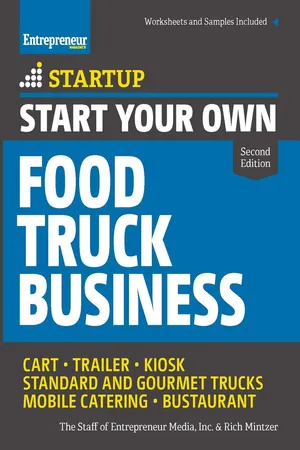
Start Your Own Food Truck Business
Cart • Trailer • Kiosk • Standard and Gourmet Trucks • Mobile Catering • Bustaurant
- 176 pages
- English
- ePUB (mobile friendly)
- Available on iOS & Android
eBook - ePub
Start Your Own Food Truck Business
Cart • Trailer • Kiosk • Standard and Gourmet Trucks • Mobile Catering • Bustaurant
About this book
Trusted by 375,005 students
Access to over 1.5 million titles for a fair monthly price.
Study more efficiently using our study tools.
Information
CHAPTER 1
From Hot Dog Wagons to Bustaurants
Today, a new generation of street food lovers are lining up at food trucks and food carts like never before. Little do they know that neither food trucks nor food carts are new to the streets of American cities. Like so many other popular trends, they are the latest version of a long-standing part of American and world culture. Yet the street food industry has never enjoyed so much publicity or notoriety. It is booming—to the delight of some foodies and the chagrin of others, especially those who own restaurants that are not witnessing the same long lines as their mobile counterparts.
But before taking a look at this burgeoning industry and giving you the lowdown on how to get started, here’s a brief lesson in mobile food history. After all, even the modern carmaker knows a little bit about Henry Ford and the growth of the auto industry.
The History of Mobile Food

The concept of mobile food actually began centuries ago when carts brought food to armies at war in Europe and other parts of the world. Farmers also used carts to bring their foods to nearby towns, often stopping to sell goods along the way. In the United States in cities such as New York, immigrants who landed at Ellis Island took jobs selling food from carts. In fact, street food vendors as far back as the 17th century helped New York City’s rapid growth, because foods were readily available to merchants, business owners, and inhabitants of the growing city. These foods were mostly taken home to be cooked, rather than eaten straight from the cart. However, not unlike the growing battles between restaurant owners and food truck owners today, public market owners and street food vendors had their share of disputes. In 1691, an ordinance was passed that said food vendors could not open until two hours after the public markets were open.
While carts were around for years, the forerunner of the food truck in the United States was the chuckwagon, which carried food and cooking equipment for the wagon trains as they headed west. In 1866, Charles Goodnight, a Texas rancher, gathered foods in a wagon to accompany long cattle drives. The chuckwagons were especially strong so they could carry a Dutch oven, a cast iron pot with legs, plus a cook’s worktable, utensils, and the food, which was known as chuck. Hence the term “chuckwagon.” Stew, roast beef, grits, boiled potatoes, beans, and fruit pies were typically on the chuckwagon menus.
Shortly thereafter, in 1872, the first diner was established. It was in a trailer. Diners—complete with service counters dominating the interior, a food preparation area against the back wall, and floor-mounted stools for the customers—were a means of bringing restaurants to new locations in the 1920s and ’30s. Many were modeled after railroad dining cars. Some took on the art deco design of the time, and most were pulled on flat back trucks.
The next significant mobile food vehicles were World War I mobile canteens, also known as field kitchens. Often field kitchens were made up of two pieces: the supply section and the rear oven area. These original trailers, typically pulled by horses, evolved into mobile canteen trucks of World War II, providing food and drinks for soldiers as they returned from overseas. When the war ended, the idea of mobile food continued. The proliferation of highways led to the growing suburbs, and as a result, offices and factories also began to spread out, moving away from the big cities. As a result, early snack trucks became common at factories and construction sites.
It was also in the postwar years of the early 1950s that ice cream trucks began cruising the suburbs, to the delight of children in both the United States and Canada. On the early ice cream trucks, the driver would turn a crank to sound the chimes and let it be known that the ice cream truck was on the way. The ice cream was kept cold by blocks of dry ice. Of course by the 1950s, food carts had already become a staple at amusement parks and other venues where people gathered for fun. In fact, it was in 1936 that Oscar Mayer rolled out the first portable hot dog cart and called it the Wiener mobile. It was a big hit.
From the 1960s and ’70s on, sandwich trucks and lunch wagons, as they were called, became a staple in all parts of America. Meanwhile, urban areas, tight for space, were able to squeeze in numerous hot dog, ice cream, soda, and pretzel carts wherever foot traffic was heavy. By the late 20th century, there was enough modern technology available to make it more feasible to keep a wider range of foods fresh cooked and served from a mobile vehicle. As a result, today’s food truck owner and mobile caterer have more options than ever before.
The Industry Is Booming
There is still no official count of food trucks in the United States, with estimates ranging from 20,000 to 3 million, depending on which statistics you find. The actual number probably falls in the 30,000 to 50,000 range. The problem is that no national records are kept in conjunction with the local licensing. In addition, there are a growing number of food carts as well as kiosks which are a fixture in malls as well as at train and bus stations, airports, stadiums, conference centers, resorts, and other locations in recent years.
tip


While the mobility of a cart, trailer, or truck sounds appealing and even liberating as one drives from place to place, most successful mobile food vehicles find they spend the vast majority of time in a few regular locations.
Food industry observers claim that the food truck business is increasing in recent years largely in response to the slow-growing economy. People are seeking inexpensive breakfasts and/or lunches. Also, employees today are often pressed for time, with more work and shorter lunch hours. These factors make the mobile food concept more appealing than ever.
From an entrepreneurial standpoint, kiosks, carts, trailers, and food trucks have a lower overhead than restaurants and can be moved if one location does not generate enough business. Rather than having to determine where to open a restaurant and worry about the old real estate adage “location, location, location,” the owner can actually drive to a new location, location, location if business is doing poorly.
The Benefits of Mobile Food
Because food is a necessity and you add the convenience of having food favorites right outside a particular location—or inside with a kiosk—you meet several needs by serving mobile food. First, you offer food that is cost friendly because you need not pay wait people or busboys. You also offer the convenience of quick service. In many cases you provide food choices that can save those on a busy schedule from the need to sit down. Typically they can eat street foods while en route to their next destination. Finally, mobile food is often fun to eat and (if it’s good) great to talk about.
The Increase in Mobile Food Businesses
In a slow economy, many people want to try other skills that they were not using at those desk jobs from which they were let go. For others, it’s a chance to take on a second way of making money. Then there are restaurant owners who want to make up for falling profits, while also using mobile vehicles to market their brick-and-mortar businesses.
The boom is partly the result of new technology that allows for safer, cost-effective food preparation inside a mobile vehicle. From freezers to ovens to grills, the latest innovations offer more possibilities. Additionally, cleaning products have made it easier to keep a vehicle sanitary and up to code—a long-time concern and major criticism of food trucks.
There are also well-known food companies—from food chains like Johnny Rockets, Sizzler, or White Castle to food manufacturers such as Taste D-Lite or Colorado’s organic burrito makers, EVOL, that were brave pioneers when they took trucks to the streets to increase sales and/or market their brands to new customers.
Yes, there are many reasons why the mobile truck industry is going bananas, so to speak. Although there aren’t many banana-themed food trucks . . . yet.
tip
It’s important ...
Table of contents
- Cover
- Title Page
- Copyright
- Contents
- Acknowledgments
- Preface
- Chapter 1: From Hot Dog Wagons to Bustaurants
- Chapter 2: Planning a Business
- Chapter 3: What’s On the Menu?
- Chapter 4: What’s Off the Menu?
- Chapter 5: Can I Park Here? Licenses, Regulations, and Points of Sales
- Chapter 6: The Work Environment: Commercial Kitchens, Cleaning, and Hiring Help
- Chapter 7: If You Park It, They Will Come—or Not: Marketing, Promotion, and Pricing
- Chapter 8: Mobile Event Catering
- Chapter 9: The All-Important Costs
- Chapter 10: Finding Funding
- Chapter 11: Franchising
- Chapter 12: Moving On
- Appendix: Food Truck Resources
- Glossary
- Index
Frequently asked questions
Yes, you can cancel anytime from the Subscription tab in your account settings on the Perlego website. Your subscription will stay active until the end of your current billing period. Learn how to cancel your subscription
No, books cannot be downloaded as external files, such as PDFs, for use outside of Perlego. However, you can download books within the Perlego app for offline reading on mobile or tablet. Learn how to download books offline
Perlego offers two plans: Essential and Complete
- Essential is ideal for learners and professionals who enjoy exploring a wide range of subjects. Access the Essential Library with 800,000+ trusted titles and best-sellers across business, personal growth, and the humanities. Includes unlimited reading time and Standard Read Aloud voice.
- Complete: Perfect for advanced learners and researchers needing full, unrestricted access. Unlock 1.5M+ books across hundreds of subjects, including academic and specialized titles. The Complete Plan also includes advanced features like Premium Read Aloud and Research Assistant.
We are an online textbook subscription service, where you can get access to an entire online library for less than the price of a single book per month. With over 1.5 million books across 990+ topics, we’ve got you covered! Learn about our mission
Look out for the read-aloud symbol on your next book to see if you can listen to it. The read-aloud tool reads text aloud for you, highlighting the text as it is being read. You can pause it, speed it up and slow it down. Learn more about Read Aloud
Yes! You can use the Perlego app on both iOS and Android devices to read anytime, anywhere — even offline. Perfect for commutes or when you’re on the go.
Please note we cannot support devices running on iOS 13 and Android 7 or earlier. Learn more about using the app
Please note we cannot support devices running on iOS 13 and Android 7 or earlier. Learn more about using the app
Yes, you can access Start Your Own Food Truck Business by Rich Mintzer in PDF and/or ePUB format, as well as other popular books in Business & Entrepreneurship. We have over 1.5 million books available in our catalogue for you to explore.