OPEN THE STORE OF YOUR DREAMS: START YOUR OWN RETAIL BUSINESSRetail is one of the fastest-growing—and fastest-changing—segments of the economy. Apps, pop-up shops, and online shopping have made it easier to reach, interact with, sell to, and gain loyal customers. Making this the perfect time for eager entrepreneurs, like you, to stop dreaming and start selling.Whether you’re interested in opening a storefront, online shop, or portable kiosk, this detailed guide will help you decide if retail is right for you. Supported by practicing entrepreneurs and experts, you will understand what it takes to open a business, common mistakes to avoid, and how to keep your retail enterprise running successfully.Learn how to:
Choose the right retail niche
Spot and capitalize on consumer trends
Select merchandise that flies off the shelves
Set prices that maximize profits
Promote your business, products, and gain loyal customers using Pinterest, Facebook, and other social media and online marketing tools
Hire a staff that will help you succeedPlus, gain priceless tips, tricks, and insight from successful retailers who share hard-won
advice and cautionary notes.Everything you need to open and run your store is in your hands—get started today!
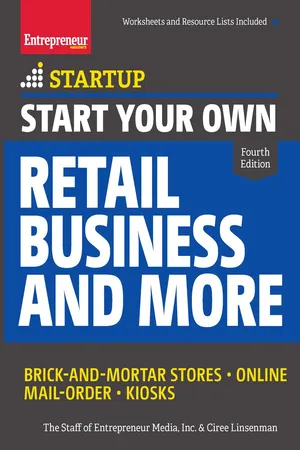
eBook - ePub
Start Your Own Retail Business and More
Brick-and-Mortar Stores • Online • Mail Order • Kiosks
- 282 pages
- English
- ePUB (mobile friendly)
- Available on iOS & Android
eBook - ePub
Start Your Own Retail Business and More
Brick-and-Mortar Stores • Online • Mail Order • Kiosks
About this book
Trusted by 375,005 students
Access to over 1.5 million titles for a fair monthly price.
Study more efficiently using our study tools.
Information
CHAPTER
1
Introduction to Retailing
The retail industry provides an exciting way of life for the more than 42 million people who earn their livelihoods in this sector of the U.S. economy. Those retail establishments provide the goods and services you and I need—from food, auto parts, apparel, home furnishings, appliances, and electronics to advice, home improvement, and skilled labor. Let’s take a look behind the scenes at the many facets of this exciting business.
Welcome to the Big Leagues

Retailing is one of the fastest-growing segments of the economy. As one of the nation’s largest employers, the retail industry provides excellent business opportunities. Entrepreneurs behind these ventures risk their capital, invest their time, and make their livings by offering consumers something they need or want. You’ll meet several of them in this guide and learn how they created a niche for themselves.
Most retailing involves buying merchandise or a service from a manufacturer, wholesaler, agent, importer, or other retailer and selling it to consumers for their personal use. The price charged for the goods or services covers the retailer’s expenses and includes a profit. Each year, this vital sector of our economy accounts for approximately two-thirds of all economic activity. The National Retail Federation (NRF)—the world’s largest retail trade association—reported that retailing currently contributes $2.6 trillion to our annual gross domestic product, giving employment to 42 million (one in four) Americans.
Who Are Your Competitors?
W to know what the world’s retailing status? Deloitte’s Global Powers of Retailing 2015 Report illuminates the top ten retailers by their 2013 net income:

Storefront ventures run the gamut from clothing boutiques and health-food stores to hardware stores, coffee shops, bars, laundry mats, convenience stores, and so on. Recent arrivals include mobile and temporary “pop-up” shops that set up for months, weeks, or days. Pretty Parlor A Go Go (prettyparloragogo.com) in San Francisco is a mobile beauty shop that goes to the customer and Spirit Halloween (spirithalloween.com) in New York sets up each annually to sell nightmarish get-ups from August through November. Vacant (govacant.com) in L.A. and New York helps pop-up retailers locate space and create a presence.
The NRF says there are more than three million retail establishments in the United States. Most are store retailers, though there are other types of enterprises—such as electronic commerce (etailing), mail order, automatic-merchandising (vending) machines, direct retailing (door-to-door selling), and service providers. The service and retail sectors of the U.S. economy continue to report the largest numbers of startup companies.
What about Jobs?
Chain Store Age’s 2015 Retail Forecast predicts blue skies and cool breezes for the coming year—shoppers are increasingly more willing and able to spend. Managing director of industry economics at Moody’s Analytics, Sophia Koropeckyj, says “stronger job growth, record low debt service burdens, record high stock values, and rebounding house prices” foster the upswing. The current rate of unemployment is 5.5, which is classified as “full employment”, an ideal balance according to mainstream economists, who say that rates as low as zero cannot control inflation. We are coming to a point of balance from years of a struggling recession state and purse strings are more relaxed. Chain Store Age reported brick-and-mortar sales of $3 trillion in 2013 within the Top 100 Retailers group, dominated by big box, discount home stores like Walmart. According the National Retail Federation’s 2015 economic forecast retail sales will increase 4.1 percent through 2015, up from 3.5 percent in 2014. The market is shifting toward what millenials will buy. Time magazine says by 2017 millenials will have more buying power than any other generation and have much different priorities and spending habits than their forefathers. They won’t spend much money on pay TV (preferring media consumption on mobile devices), mass market beer (preferring craft beer), homes (can’t afford them), weddings (waiting longer to get married), children (fewer than half plan to have them), and bulk warehouse goods, which is connected to not owning a home. An impressive list put out by Stores.org, in November 2014, demonstrates the hoops retailers are jumping through to earn business. They include using extremely fast delivery options from companies like UberRUSH and Deliv, offering same day delivery for local purchases, sometimes within mere minutes. Retailers are including extensive retail management options on their websites that let lookers see every possible color and size option available and even show dressed up doll versions of an outfit.
stat fact


The NRF says the retail industry supports nearly five million logistics jobs, four million management and administration jobs, two million healthcare and service jobs, two million finance, insurance, and real estate jobs, and 800,000 technology jobs.
Basic Kinds of Retailers
Retailing is one of the most mature industries in our economy, and constantly being reinvented with the advent of new technologies. Changes in buying behavior, attitudes and buying patterns, and the restructuring of the retail industry, have all had a significant impact on small businesses. While some predict the local retailer may become a thing of the past, there is a bright future for those who can identify and respond to changing consumer needs faster and better than their larger competitors. With the internet, TV, telephone, overnight delivery, and credit and debit cards, any enterprising individual can find a niche and begin making commercial transactions right away.
To give you an overview of the competitive marketplace, we’ll take a brief look at the various faces and configurations of selling to the consumer. Keep in mind that all of these enterprises began as simple concepts and grew to various proportions through popularity and perseverance. At this point in your exploration, anything is possible for you, too.
Store Retailing
The retail scene in America is a dazzling array of independent shops, department stores, discount and off-price enterprises, convenience stores, membership warehouse clubs, national and regional chains, category-killer stores (superstores like Home Depot and Staples), conventional supermarkets, and other large-scale enterprises that seem to dominate the retail sector.
Store retailers operate fixed point-of-sale locations designed to attract a high volume of walk-in customers. In general, stores have extensive merchandise displays and use mass-media advertising to attract customers. They typically sell merchandise to the general public for personal or household consumption, but some also serve business and institutional clients. These include establishments such as office supply stores, computer and software stores, building materials dealers, and plumbing and electrical supply stores. Catalog showrooms, gasoline service stations, automotive dealers, and mobile home dealers are treated as store retailers by the U.S. Census Bureau.
tip


Successful retailers do not run their business to suit themselves. Retailers must cater to the tastes and requirements of customers. This can mean keeping the doors open on holidays and weekends, and opening early or staying late on some weekdays. You marry the store when you go into business for yourself, so expect many compromises along the way to profits.
To understand this diverse business sector, government reporting and other information is broken down into several sectors for easier digestion and fact-finding. The sector...
Table of contents
- Cover
- Title Page
- Copyright
- Contents
- Preface
- Chapter 1: Introduction to Retailing
- Chapter 2: Making a Plan
- Chapter 3: Decisions, Decisions
- Chapter 4: Location
- Chapter 5: Legal and Finance Issues
- Chapter 6: Operations
- Chapter 7: Store and Website Design
- Chapter 8: Inventory
- Chapter 9: Equipment
- Chapter 10: Pricing
- Chapter 11: Human Resources
- Chapter 12: Marketing
- Chapter 13: Social Network Marketing
- Chapter 14: Customer Service
- Chapter 15: Risk Management
- Chapter 16: Planning for the Future
- Appendix: Retail Store Resources
- Glossary
- Index
Frequently asked questions
Yes, you can cancel anytime from the Subscription tab in your account settings on the Perlego website. Your subscription will stay active until the end of your current billing period. Learn how to cancel your subscription
No, books cannot be downloaded as external files, such as PDFs, for use outside of Perlego. However, you can download books within the Perlego app for offline reading on mobile or tablet. Learn how to download books offline
Perlego offers two plans: Essential and Complete
- Essential is ideal for learners and professionals who enjoy exploring a wide range of subjects. Access the Essential Library with 800,000+ trusted titles and best-sellers across business, personal growth, and the humanities. Includes unlimited reading time and Standard Read Aloud voice.
- Complete: Perfect for advanced learners and researchers needing full, unrestricted access. Unlock 1.5M+ books across hundreds of subjects, including academic and specialized titles. The Complete Plan also includes advanced features like Premium Read Aloud and Research Assistant.
We are an online textbook subscription service, where you can get access to an entire online library for less than the price of a single book per month. With over 1.5 million books across 990+ topics, we’ve got you covered! Learn about our mission
Look out for the read-aloud symbol on your next book to see if you can listen to it. The read-aloud tool reads text aloud for you, highlighting the text as it is being read. You can pause it, speed it up and slow it down. Learn more about Read Aloud
Yes! You can use the Perlego app on both iOS and Android devices to read anytime, anywhere — even offline. Perfect for commutes or when you’re on the go.
Please note we cannot support devices running on iOS 13 and Android 7 or earlier. Learn more about using the app
Please note we cannot support devices running on iOS 13 and Android 7 or earlier. Learn more about using the app
Yes, you can access Start Your Own Retail Business and More by Ciree Linsenmann in PDF and/or ePUB format, as well as other popular books in Business & Entrepreneurship. We have over 1.5 million books available in our catalogue for you to explore.