Macrolide antibiotics represent a class of natural macrocyclic products, one of the most clinically important antibiotics. Unfortunately, the production and development of new macrolide antibiotics are not represented enough in the pharmaceutical industry today. The intention of the book is therefore not only to be a teaching tool for students and experts, but also to draw the attention of the general public to this extremely useful, cheap and relatively unharmful effective anti-macrobials, and potential anti-malarials. The authors introduce the different classes of macrolides and their derivatives, principles of their biological activity, their structure and interactions with biological targets as well as synthetic methods to produce new macrolide antibiotics of similar or improved properties. Special emphasis was put on conjugates of macrolides with nucleobases or nucleosides with numerous applications; among them the most important remains the attempt to overcome bacterial resistance.
1The macrolide antibiotics and their semi-synthetic derivatives
Erythromycin A (1) was first described in 1952, at the height of the golden age of antibiotic discovery [1]. Its structure was determined by chemical degradation, a venture that seems heroic to twenty-first century eyes [2]. The first crystal structure confirmed the results of these chemical tests [3] but showed only relative stereochemistry and, interestingly, the absolute stereochemistry was guessed incorrectly, and the wrong enantiomer of erythromycin recorded. A potent antibacterial agent, it is a product of the soil microorganism Saccharopolyspora erythraea. Saccharopolyspora erythraea produces several other erythromycins [4–9], precursors of erythromycin A and by-products of its biosynthesis (2–7). All are characterized by a 14-membered polyketide ring decorated with two sugars. The presence of 18 chiral centers in erythromycin A makes it a poor candidate for structure-activity relationships, and until very recently, analogues were limited to those that are found naturally and those that can be made from erythromycin in a few steps. Very recently and excitingly, a synthetic methodology has been developed that may lead to high yields of novel macrolides [10].
The British National Formulary currently recognizes just four macrolides for the treatment of bacterial infections: erythromycin, clarithromycin (8), azithromycin (9) and the ketolide telithromycin (10). In addition, spiramycin (11), which is an effective antibacterial, is used for the treatment of toxoplasmosis. Roxithromycin (12) is used as an antibacterial drug in a number of countries, including Australia, New Zealand and Israel. The term macrolide can be applied to other drugs, such as the immunesuppressant drugs tacrolimus and sirolimus and the polyene anti-fungals nystatin and amphotericin B, but these are beyond the scope of this chapter.
Clarithromycin, azithromycin, telithromycin and roxithromycin are all semi-synthetic derivatives of erythromycin A [11–14]. At first sight they appear to be structurally similar. Certainly, their primary mode of action is similar: they all bind to the bacterial 50S ribosomal subunit and inhibit protein synthesis, and yet small structural changes have important consequences for the actions of these drugs. For example, the semi-synthetic macrolide clarithromycin differs from erythromycin A by a single substitution of a hydroxyl group by a methoxy group, yet clarithromycin is acid-stable, whereas erythromycin is highly labile, and clarithromycin is rigid, confined almost entirely to a single conformer, whereas erythromycin A has several minima detectable by NMR and molecular modeling. In the body, clarithromycin (8) and azithromycin (9) have long half-lives and favorable pharmacokinetics, allowing short courses (3–5 days) and daily or twice daily doses, compared with the 7-day, four doses per day standard course of erythromycin A.
In this chapter we discuss the chemistry of the macrolide antibiotics, addressing particularly the features that give them their distinctive characteristics.
1.1What happens to macrolides in the stomach? The effect of acid on the erythromycins and their derivatives
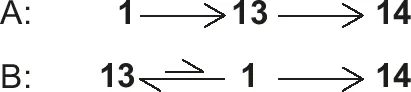
When exposed to acid, the Achilles heel of erythromycin A proves to be the combination of the 6-OH, 9-ketone and 12-OH. Both the 12-OH and the 6-OH are capable of attacking the ketone to give 5-membered rings. Two compounds, erythromycin enol ether (13) and anhydroerythromycin (14), were isolated from the acid treatment of erythromycin A and extensive kinetic measurements were made to understand their relationship to erythromycin A and to one another. Two mechanisms were proposed as shown in Fig. 1.1 [15, 16].
Fig. 1.1: Proposed mechanisms for the conversion of erythromycin A (1) to anhydroerythromycin A (14). A: Atkins et al. [15]; B: Cachet et al. [16].
Both mechanisms were based on kinetic data obtained using HPLC-based experiments, and were carried out before the structures of 13 and 14 had been solved unambiguously. Nuclear magnetic resonance (NMR) spectroscopy data proved important in confirming that the mechanism proposed by Cachet et al. [16] was correct. Firstly, the aqueous solution structure of erythromycin A was determined [17]. Surprisingly, this was an equilibrium mixture of the 9-ketone (1), as seen in the crystal structure and the 12,9-hemiacetal caused by cyclization of the 12-OH group with the ketone (15) (Fig. 1.2). A small amount of the 6–12 hemiacetal (16) could also be detected in DMSO solution. Next, the structure of erythromycin enol ether (13) was confirmed [18]. It was particularly important to establish that the 5-membered ring was formed by cyclization of the 6-OH (rather than the 12-OH) group with the 9-ketone. Anhydroerythromycin A was also described by NMR spectroscopy [19]. Until 2006, however, the additional chiral center (at C-9) formed by cyclization of erythromycin A to give anhydroerythromycin A had gone almost unnoticed, and the structure was generally drawn with 9S stereochemistry. X-ray crystallography and molecular modeling of anhydroerythromycin A acetate [20] revealed that the correct stereochemistry was in fact 9R, as shown in structure 14.
The similarity of structures 14 and 15 already points towards a mechanism in which the enol ether (13) is formed from 16 and anhydroerythromycin A (14) from 15, broadly in agreement with Cachet et al. [16]. The use of NMR, in particular the FIDDLE algorithm, allowed us to obtain very detailed kinetic measurements for erythromycin degradation [21]. The FIDDLE algorithm [22] compares the experimental time-domain signal of a reference (such as tetramethylsilane) with that predicted by theory, multiplying the raw experimental data by the complex ratio of the two signals to produce a corrected free induction decay (FID); this results in excellent line shapes in the NMR spectrum from which kinetic parameters can be deduced.
Fig. 1.2: Part of the 500 MHz 1H NMR spectrum of erythromycin A in D2O, showing the presence of two interconverting isomers.
When the intensities of representative signals from 1, 13 and 14 were plotted (Fig. 1.3) it could be seen, because of the high quality of the data, that the Cachet et al. model did not perfectly describe the concentrations of these compounds at long times. Incubation of anhydroerythromycin A in acid conditions gave rise to small amou...
Table of contents
Cover
Title Page
Copyright
Preface
Contents
1 The macrolide antibiotics and their semi-synthetic derivatives
2 The semisynthetic routes towards better macrolide antibiotics
3 Interactions of macrolides with their biological targets
4 Hybrids of macrolides and nucleobases or nucleosides: synthetic strategies and biological results
Index
Frequently asked questions
Yes, you can cancel anytime from the Subscription tab in your account settings on the Perlego website. Your subscription will stay active until the end of your current billing period. Learn how to cancel your subscription
No, books cannot be downloaded as external files, such as PDFs, for use outside of Perlego. However, you can download books within the Perlego app for offline reading on mobile or tablet. Learn how to download books offline
Perlego offers two plans: Essential and Complete
Essential is ideal for learners and professionals who enjoy exploring a wide range of subjects. Access the Essential Library with 800,000+ trusted titles and best-sellers across business, personal growth, and the humanities. Includes unlimited reading time and Standard Read Aloud voice.
Complete: Perfect for advanced learners and researchers needing full, unrestricted access. Unlock 1.4M+ books across hundreds of subjects, including academic and specialized titles. The Complete Plan also includes advanced features like Premium Read Aloud and Research Assistant.
Both plans are available with monthly, semester, or annual billing cycles.
We are an online textbook subscription service, where you can get access to an entire online library for less than the price of a single book per month. With over 1 million books across 990+ topics, we’ve got you covered! Learn about our mission
Look out for the read-aloud symbol on your next book to see if you can listen to it. The read-aloud tool reads text aloud for you, highlighting the text as it is being read. You can pause it, speed it up and slow it down. Learn more about Read Aloud
Yes! You can use the Perlego app on both iOS and Android devices to read anytime, anywhere — even offline. Perfect for commutes or when you’re on the go. Please note we cannot support devices running on iOS 13 and Android 7 or earlier. Learn more about using the app
Yes, you can access Macrolides by Biljana Arsic,Predrag Novak,Goran Kragol,Jill Barber,Maria Grazia Rimoli,Federica Sodano in PDF and/or ePUB format, as well as other popular books in Physical Sciences & Biochemistry. We have over one million books available in our catalogue for you to explore.