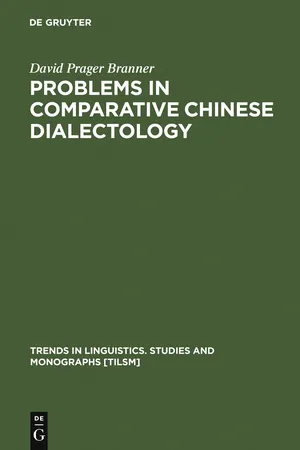
Problems in Comparative Chinese Dialectology
eBook - PDF

Problems in Comparative Chinese Dialectology

The Classification of Miin and Hakka

  1. 492 pages
  2. English
  3. PDF
  4. Available on iOS & Android
eBook - PDF

Problems in Comparative Chinese Dialectology

The Classification of Miin and Hakka

About this book

This book discusses the methodology of systematic Chinese Dialect classification, with particular attention to the conservative Miin and Hakka groups spoken in southern China. The primary linguistic methodology employed is the historical-comparative method, and the dialects chosen as examples of classification are those spoken in and around the township of Wann'an in western Fukien's Longyan country.

The book features extensive comparative tables of dialect forms, and a two-hundred page appendix outlining the diasystem of the four principal Wann'an dialects.

Trusted by 375,005 students

Access to over 1.5 million titles for a fair monthly price.

Study more efficiently using our study tools.

Information

Year
2011
Print ISBN
9783110158311
eBook ISBN
9783110802849

Table of contents

  1. 1. The ideas of Chinese dialect classification
  2. 1.1. Introduction
  3. 1.2. Dialect and the Chinese idea of dialect
  4. 1.3. Goals and methods in classification and comparison
  5. 1.4. The primacy of data and the cultivation of data
  6. 1.5. Reconstruction
  7. 1.6. Under-description and the need for correspondence sets
  8. 1.7. Rigor in classification — reinventing the wheel
  9. 1.8. Bundling of features
  10. 1.9. Beentzyh and meaningful elicitation
  11. 1.10. To recapitulate
  12. 2. Wann’an and the problem of this study
  13. 2.1. Wann’an township
  14. 2.2. The meaning of the names “Hakka” and “Miin”
  15. 2.3. The settlement of Wann’an, its geography, and local trades
  16. 2.4. Major sites
  17. 2.5. Markets and roads
  18. 2.6. The problem of this study: Norman’s diagnostic rules
  19. 2.7. Common Miin initial-types
  20. 2.8. The “Shawwuu Hypothesis”
  21. 3. Wann’an’s affiliation and the cohesiveness of diagnostic features
  22. 3.1. The Hakka test
  23. 3.2. Comparative Wann’an tones
  24. 3.3. The Miin test
  25. 3.4. Is Norman’s Hakka criterion an artifact of his sources?
  26. 3.5. Evidence from rural Liancherng
  27. 3.6. Hakka in general
  28. 3.7. Conclusions and prospects for future research on Hakka
  29. 4. The character of Wann’an dialects
  30. 4.1. Other features of Miin
  31. 4.2. The classification of Wann’an within Miin
  32. 4.3. Subclassification within Coastal Miin
  33. 4.4. Conclusion
  34. 5. Wann’an evidence about Common Miin
  35. 5.1. A fourth nasal initial correspondence
  36. 5.2. Rogue nasalization and evidence of voiceless nasals
  37. 5.3. The shaang tone glottal stop in Miin
  38. 5.4. Addendum: chiuhsheng lengthening?
  39. 6. Conclusion: The place of Miin in the greater history of Chinese
  40. 6.1. Introduction
  41. 6.2. The question of the history of spoken Chinese
  42. 6.3. Chinese linguistic macro-history
  43. 6.4. The tonal proto-system of Miin
  44. 6.5. A digression on the relative date of tone splitting
  45. 6.6. Miin as a relic of Chinese before massive palatalization
  46. 6.7. Conclusion and hopes for the future
  47. Appendix A: Introduction to the Kengyunn
  48. Appendix B: The Kengyunn
  49. Appendix C: Index to the Kengyunn
  50. Notes
  51. References
  52. 1. Spelling conventions and special symbols
  53. 2. Sources of dialect data
  54. 3. Bibliography
  55. Index of glosses
  56. Index of subjects

Frequently asked questions

Yes, you can cancel anytime from the Subscription tab in your account settings on the Perlego website. Your subscription will stay active until the end of your current billing period. Learn how to cancel your subscription
No, books cannot be downloaded as external files, such as PDFs, for use outside of Perlego. However, you can download books within the Perlego app for offline reading on mobile or tablet. Learn how to download books offline
Perlego offers two plans: Essential and Complete
  • Essential is ideal for learners and professionals who enjoy exploring a wide range of subjects. Access the Essential Library with 800,000+ trusted titles and best-sellers across business, personal growth, and the humanities. Includes unlimited reading time and Standard Read Aloud voice.
  • Complete: Perfect for advanced learners and researchers needing full, unrestricted access. Unlock 1.5M+ books across hundreds of subjects, including academic and specialized titles. The Complete Plan also includes advanced features like Premium Read Aloud and Research Assistant.
Both plans are available with monthly, semester, or annual billing cycles.
We are an online textbook subscription service, where you can get access to an entire online library for less than the price of a single book per month. With over 1.5 million books across 990+ topics, we’ve got you covered! Learn about our mission
Look out for the read-aloud symbol on your next book to see if you can listen to it. The read-aloud tool reads text aloud for you, highlighting the text as it is being read. You can pause it, speed it up and slow it down. Learn more about Read Aloud
Yes! You can use the Perlego app on both iOS and Android devices to read anytime, anywhere — even offline. Perfect for commutes or when you’re on the go.
Please note we cannot support devices running on iOS 13 and Android 7 or earlier. Learn more about using the app
Yes, you can access Problems in Comparative Chinese Dialectology by David Prager Branner in PDF and/or ePUB format, as well as other popular books in Languages & Linguistics & Historical & Comparative Linguistics. We have over 1.5 million books available in our catalogue for you to explore.