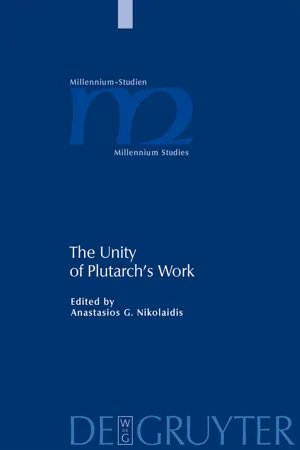
The Unity of Plutarch's Work
eBook - PDF

The Unity of Plutarch's Work

'Moralia' Themes in the 'Lives', Features of the 'Lives' in the 'Moralia'

  1. 872 pages
  2. English
  3. PDF
  4. Available on iOS & Android
eBook - PDF

The Unity of Plutarch's Work

'Moralia' Themes in the 'Lives', Features of the 'Lives' in the 'Moralia'

About this book

Millennium ĂŒberschreitet Grenzen, Grenzen zwischen den Epochen und regionalen RĂ€umen wie auch Grenzen zwischen den Disziplinen. Die Schriftenreihe Millennium-Studien ist, genauso wie das Jahrbuch, international, interdisziplinĂ€r und epochenĂŒbergreifend ausgerichtet. Das Herausgebergremium und der Beirat reprĂ€sentieren ein breites Spektrum von FĂ€chern: Kunst- und literaturwissenschaftliche BeitrĂ€ge kommen ebenso zu ihrem Recht wie historische, theologische und philosophische, Arbeiten zu den lateinischen und griechischen Kulturen genauso wie zu den nordafrikanischen und vorderasiatischen.

In die Studien finden einschlÀgige Monographien und Sammelwerke aus dem gesamten Themenspektrum Aufnahme, zudem Kommentare und Editionen. Publikationssprachen sind vornehmlich Deutsch und Englisch; die Aufnahme französischer, italienischer und spanischer Arbeiten ist möglich.

Reihenherausgeber*innen

Wolfram Brandes, Frankfurt, Deutschland (Byzantinistik und FrĂŒhes Mittelalter): [email protected]

Laura Carrara, Pisa, Italien (GrĂ€zistik): [email protected]

Dennis Pausch, Marburg, Deutschland (Latinistik): [email protected]

Rene Pfeilschifter, WĂŒrzburg, Deutschland (Alte Geschichte): [email protected]

Karla Pollmann, TĂŒbingen, Deutschland (FrĂŒhes Christentum und Patristik): [email protected]

Falls Sie ein Manuskript fĂŒr die Millennium-Studien einreichen möchten, bitten wir Sie, sich an den fachnĂ€chsten Reihenherausgeber zu wenden. Alle Manuskripte werden von dem jeweiligen Reihenherausgeber und von einem externen Gutachter beurteilt. Dabei gilt das Single-blind peer review-Verfahren.

Wissenschaftlicher Beirat:

Phil Booth, University of Oxford, UK

Patricia Ciner, National University of San Juan, Argentinien

Babett Edelmann-Singer, Freie UniversitÀt Berlin, Deutschland

Philip Forness, Katholieke Universiteit Leuven, Belgien

Lea Niccolai, Trinity College, University of Cambridge, Vereinigtes Königreich

Claudia Rapp, UniversitĂ€t Wien, Österreich

Verena Schulz, Katholische UniversitÀt EichstÀtt, Deutschland

Chiara Tommasi, UniversitĂ  di Pisa, Italien

Lieve Van Hoof, UniversitÀt Ghent, Belgien

Trusted by 375,005 students

Access to over 1.5 million titles for a fair monthly price.

Study more efficiently using our study tools.

Information

Publisher
De Gruyter
Year
2008
Print ISBN
9783110202496
eBook ISBN
9783110211665

Table of contents

  1. Frontmatter
  2. Contents
  3. Introduction
  4. Synopsis
  5. Lives and Moralia: How Were Put Asunder. What Plutarch Hath Joined Together
  6. Synopsis
  7. On the Problematic Classification of Some Rhetorical Elements in Plutarch
  8. La reutilizaciĂłn de citas de epigramas: una manifestaciĂłn del diĂĄlogo intratextual en el corpus plutarqueo
  9. Notes and Anecdotes: Observations on Cross-Genre Apophthegmata
  10. The Moral Interplay. Between Plutarch’s Political Precepts and Life of Demosthenes
  11. Grecs, MacĂ©doniens et Romains au « test » d’HomĂšre. RĂ©fĂ©rence homĂ©rique et hellĂ©nisme chez Plutarque
  12. Moralia in the Lives: Tragedy and Theatrical Imagery in Plutarch’s Pompey
  13. Scholarship and Morality: Plutarch’s Use of Inscriptions
  14. Plutarch’s Habits of Citation: Aspects of Difference
  15. Why Does Plutarch’s Apollo Have Many Faces?
  16. Plutarch’s Quaestiones Romanae and his Lives of Early Romans
  17. How Lives Begin
  18. Plutarco compositor de Vitae y Moralia: anĂĄlisis intratextual
  19. Plutarch’s Heroes in the Moralia: a Matter of Variatio or Another (More Genuine) Outlook?
  20. Synopsis
  21. Setting a Good Exemplum. Case Studies in the Moralia, the Lives as Case Studies
  22. Sempre in bilico tra vizi e virtĂč
  23. Moralia in the Lives: The Charge of Rashness in Pelopidas/Marcellus
  24. Is Plutarch’s Nicias Devout, Superstitious, or Both?
  25. Self-esteem and Image-building. On Anger in De cohibenda ira and in Some Lives
  26. Genres and Their Implications: Meddlesomeness in On Curiosity versus the Lives
  27. Synopsis
  28. The Ideal Statesman: A Commonplace in Plutarch’s Political Treatises, His Solon, and His Lycurgus
  29. Two Roads to Politics. Plutarch on the Statesman’s Entry in Political Life
  30. The Education of Rulers in Theory (Mor.) and Practice (Vitae)
  31. Dion and Brutus: Philosopher Kings Adrift in a Hostile World
  32. Eunoia bei Plutarch: von den Praecepta Gerendae Reipublicae zu den Viten
  33. Struggling with the PlĂȘthos: Politics and Military Leadership in Plutarch’s Life of Lucullus
  34. Greek Lawgivers in Plutarch: A comparison Between the Biographical Lycurgus and the Rhetorical Alexander
  35. Synopsis
  36. Plutarch’s Life of Lycurgus and the Philosophical Use of Discourse
  37. Boethus and Cassius: Two Epicureans in Plutarch
  38. « Fania di Lesbo, un filosofo e assai esperto di ricerca storica » (Plut., Them., 13, 5). Plutarco e i rapporti tra biografia, storia e filosofia etica
  39. Plutarch and the Character of the Sapiens
  40. Plutarch on Solon and Sophia
  41. El Banquete de los Siete Sabios y la Vida de SolĂłn de Plutarco : mito polĂ­tico y contexto literario
  42. Las Vidas frente a los Moralia en las alusiones plutarqueas sobre SolĂłn
  43. Synopsis
  44. Parallel Narratives: the Liberation of Thebes in De Genio Socratis and in Pelopidas
  45. Standing in the Shadows: Plutarch and the Emperors in the Lives and Moralia
  46. Plutarque et la scĂšne du banquet
  47. El trofeo de Maratón: Adaptación y desarrollo de un tópico ético en Plutarco
  48. Recursos humorĂ­sticos en la obra de Plutarco
  49. Some Notes on Grammarians in Plutarch
  50. La dinastĂ­a de los Ptolomeos en Plutarco: etopeya de los personajes
  51. Plutarco y la elegĂ­a helenĂ­stica
  52. Plutarch and the Music
  53. Synopsis
  54. Donne, cultura e societĂ  nelle Vite Parallele di Plutarco
  55. El prototipo de mujer espartana en Plutarco
  56. Plutarch on the Role of Eros in a Marriage
  57. Integrating Marriage and Homonoia
  58. Parent-Child Affection and Social Relationships in Plutarch: Common Elements in Consolatio ad uxorem and Vitae
  59. Synopsis
  60. Les digressions scientifiques dans les Vies de Plutarque
  61. Pharmakon en Plutarco
  62. Deformity (anapĂȘria): Plutarch’s Views of Reproduction and Imperfect Generation in the Moralia and Lives
  63. Due testi a confronto: De Iside 352F–353E – Quaestio convivalis VIII, 8 728C– 730F.
  64. Plutarch in Crete
  65. Plutarco (Cim. 13, 4) y las islas Quelidonias
  66. El judaĂ­smo en las Vitae y Moralia de Plutarco
  67. Backmatter

Frequently asked questions

Yes, you can cancel anytime from the Subscription tab in your account settings on the Perlego website. Your subscription will stay active until the end of your current billing period. Learn how to cancel your subscription
No, books cannot be downloaded as external files, such as PDFs, for use outside of Perlego. However, you can download books within the Perlego app for offline reading on mobile or tablet. Learn how to download books offline
Perlego offers two plans: Essential and Complete
  • Essential is ideal for learners and professionals who enjoy exploring a wide range of subjects. Access the Essential Library with 800,000+ trusted titles and best-sellers across business, personal growth, and the humanities. Includes unlimited reading time and Standard Read Aloud voice.
  • Complete: Perfect for advanced learners and researchers needing full, unrestricted access. Unlock 1.5M+ books across hundreds of subjects, including academic and specialized titles. The Complete Plan also includes advanced features like Premium Read Aloud and Research Assistant.
Both plans are available with monthly, semester, or annual billing cycles.
We are an online textbook subscription service, where you can get access to an entire online library for less than the price of a single book per month. With over 1.5 million books across 990+ topics, we’ve got you covered! Learn about our mission
Look out for the read-aloud symbol on your next book to see if you can listen to it. The read-aloud tool reads text aloud for you, highlighting the text as it is being read. You can pause it, speed it up and slow it down. Learn more about Read Aloud
Yes! You can use the Perlego app on both iOS and Android devices to read anytime, anywhere — even offline. Perfect for commutes or when you’re on the go.
Please note we cannot support devices running on iOS 13 and Android 7 or earlier. Learn more about using the app
Yes, you can access The Unity of Plutarch's Work by Anastasios Nikolaidis in PDF and/or ePUB format, as well as other popular books in Literature & Ancient History. We have over 1.5 million books available in our catalogue for you to explore.