- 516 pages
- English
- PDF
- Available on iOS & Android
eBook - PDF
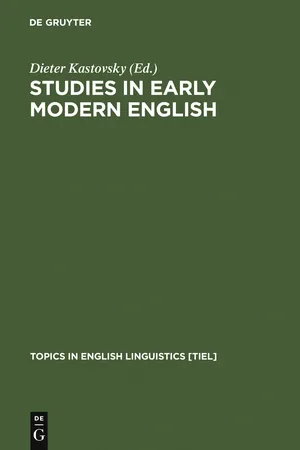
Studies in Early Modern English
About this book
No detailed description available for "Studies in Early Modern English".
Information
Table of contents
- Introduction
- Initial adverbials and word order in English with special reference to the Early Modern English period
- Are Shakespeare’s agent nouns different from Chaucer’s? – On the dynamics of a derivational sub-system
- The construction be going to + infinitive in Early Modern English
- “Sumer is icumen in”: the seasons of the year in Middle English and Early Modern English
- The place-name evidence for the distribution of Early Modern English dialect features: The voicing of initial /f/
- Text deixis in Early Modern English
- On phrasal verbs in Early Modern English: Notes on lexis and style
- The use of thou and you in Early Modern spoken English: Evidence from depositions in the Durham ecclesiastical court records
- Orthoepists and reformers
- Vocalisation of “post-vocalic r”: an Early Modern English sound change?
- From stress-timing to syllable-timing: Changes in the prosodic system of Late Middle English and Early Modern English
- Lexical semantics and the Early Modern English lexicon: The case of antonymy
- Early Modern English passive constructions
- Infl in Early Modern English and the status of to
- Aspects of adverbial change in Early Modern English
- Periodisation in language history: Early Modern English and the other periods
- Degree adverbs in Early Modern English
- The ugly sister – Scots words in Early Modern English dictionaries
- The development of the compound pronouns in -body and -one in Early Modern English
- Social conditioning and diachronic language change
- The position of not in Early Modern English questions
- William Turner and the English plant names
- The history of the English language and future English teachers
- You that be not able to consyder thys order of things: Variability and change in the semantics and syntax of a mental verb in Early Modern English
- The expression of deontic and epistemic modality and the subjunctive
- Any as an indefinite determiner in non-assertive clauses: evidence from Present-day and Early Modern English
- Loss of postvocalic r: Were the orthoepists really tone-deaf?
- Early Modern London business English
- The mystery of the modal progressive
- Index of subjects and languages
- Index of names
Trusted by 375,005 students
Access to over 1.5 million titles for a fair monthly price.
Study more efficiently using our study tools.
Frequently asked questions
Yes, you can cancel anytime from the Subscription tab in your account settings on the Perlego website. Your subscription will stay active until the end of your current billing period. Learn how to cancel your subscription
No, books cannot be downloaded as external files, such as PDFs, for use outside of Perlego. However, you can download books within the Perlego app for offline reading on mobile or tablet. Learn how to download books offline
Perlego offers two plans: Essential and Complete
- Essential is ideal for learners and professionals who enjoy exploring a wide range of subjects. Access the Essential Library with 800,000+ trusted titles and best-sellers across business, personal growth, and the humanities. Includes unlimited reading time and Standard Read Aloud voice.
- Complete: Perfect for advanced learners and researchers needing full, unrestricted access. Unlock 1.5M+ books across hundreds of subjects, including academic and specialized titles. The Complete Plan also includes advanced features like Premium Read Aloud and Research Assistant.
We are an online textbook subscription service, where you can get access to an entire online library for less than the price of a single book per month. With over 1.5 million books across 990+ topics, we’ve got you covered! Learn about our mission
Look out for the read-aloud symbol on your next book to see if you can listen to it. The read-aloud tool reads text aloud for you, highlighting the text as it is being read. You can pause it, speed it up and slow it down. Learn more about Read Aloud
Yes! You can use the Perlego app on both iOS and Android devices to read anytime, anywhere — even offline. Perfect for commutes or when you’re on the go.
Please note we cannot support devices running on iOS 13 and Android 7 or earlier. Learn more about using the app
Please note we cannot support devices running on iOS 13 and Android 7 or earlier. Learn more about using the app
Yes, you can access Studies in Early Modern English by Dieter Kastovsky in PDF and/or ePUB format, as well as other popular books in Languages & Linguistics & Languages. We have over 1.5 million books available in our catalogue for you to explore.