Johannine Exegesis of God is a stimulating study of the explicit and implicit theological language of the Johannine community. It exegetically explores crucial questions concerning the Fourth Evangelist's language used to characterize God. It makes a sojourn into the relationship between Johannine Christology and Theology. It examines the dialogue dynamics of a theological conversation between those who do not share the same theological affirmations, and enumerates how the Johannine community derives benefit, becomes enriched and learns inclusiveness through its dialogue/conflict with its pluralistic environment. In approaching and interpreting the Gospel narrative, the implications of 'Theo-logy' in the Johannine community's struggle for legitimacy, identity and existence become clear. The Theology of the Johannine community shows a creative dialect with its sociological context, and its experiential theologising makes its theological language authentic, clear and precise.
eBook - PDF
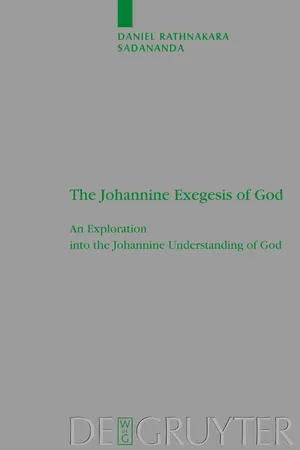
The Johannine Exegesis of God
An Exploration into the Johannine Understanding of God
- 372 pages
- English
- PDF
- Available on iOS & Android
eBook - PDF
The Johannine Exegesis of God
An Exploration into the Johannine Understanding of God
About this book
Trusted by 375,005 students
Access to over 1.5 million titles for a fair monthly price.
Study more efficiently using our study tools.
Information
Table of contents
- Acknowledgements
- Chapter One: Introduction
- 1.1 The Quest
- 1.2 The Problem of the Theology of the New Testament
- 1.3 The Theological Re-Reading
- 1.4 Theology in Christological Captivity?
- 1.5 Travails of a Theological Quest – Compositional History of the Fourth Gospel
- 1.6 Theologising History – Historidty of the Fourth Gospel
- 1.7 Theological Re-Reading of the Fourth Gospel – Towards Understanding the Johannine Exegesis of God
- Chapter Two: Is Jesus God? Thomas' Confession in the Light of the Passion Narrative
- 2.1 Introduction
- 2.2 Thomas’ Confession – “My Lord, My God”
- 2.3 Self-Giving Jesus – Composure and Sovereignty in the Midst of Betrayal and Arrest
- 2.4 Jesus – The Pascal Lamb
- 2.5 The Trial of Jesus – The Man, The King
- 2.6 Mission Completed – Jesus Heralds Victory Even in Death
- 2.7 That You may Believe – Jesus the Christ, the Son of God
- 2.8 Summary and Conclusions
- Chapter Three: Theology in Conflict – Is Jesus Equal to God? (John 5:17-30)
- 3.1 Introduction
- 3.2 Order of Chapters Five and Six
- 3.3 The Pericope
- 3.4 The Structure
- 3.5 TheContext
- 3.6 Exegesis
- 3.6.1 Verses 17-18: Overture – Is Jesus Equal to God?
- 3.6.2 Verses 19-30: The Father and the Son – Relationship Explained
- 3.7 Summary and Conclusions
- Chapter Four: Theology in Conflict – Is Jesus Pre-existent? (John 8:12-59)
- 4.1 The Literary Structure
- 4.2 The Context
- 4.3 Exegesis
- 4.3.1 Verses 12-20: Jesus the Light of the World – the Authority of Jesus' Witness
- 4.3.2 Verses 21-30: Jesus the One from Above – The Origin of Jesus' Authority
- 4.3.3 Verses 31-34: Truth and Liberation
- 4.3.4 Verses 35-36: Operation Liberation
- 4.3.5 Verses 37-47: God's Party and the Devil's Party
- 4.3.6 Verses 48-59: Jesus the Pre-existent Son is the Revealer and Embodiment of Salvation
- 4.4 Summary and Conclusions
- Chapter Five: Theology in Conflict – Are Jesus and the Father One? (John 10:22-39)
- 5.1 The Context
- 5.2 The Structure
- 5.3 Exegesis
- 5.3.1 Verses 22-30: Oneness of the Father and the Son
- 5.3.2 Verses 31-39: Mutual In-dwelling of the Father and the Son
- 5.4 Summary and Conclusions
- Chapter Six: The God of the Johannine Jesus: Characterisation of God in the Prayer of Jesus (John 17:1-26)
- 6.1 Introduction
- 6.2 Exegesis
- 6.2.1 Verses 1-5: The True God
- 6.2.2 Verses 6-10: The God who gives identity
- 6.2.3 Verses 11-15: The God who protects
- 6.2.4 Verses 16-19: The God who sanctifies
- 6.2.5 Verses 20-23: The God who unites
- 6.2.6 Verses 23b-26: The God who loves
- 6.3 Summary and Conclusions
- Chapter Seven: Incamate Logos as Historical Theophany (John 1:1-18)
- 7.1 Integrity of the Prologue
- 7.1.1 In Search of a pre-Johannine Hymn
- 7.1.2 The Prologue is a Unity
- 7.1.3 Analysis
- 7.1.4 A Possible Solution
- 7.2 The Logos – A Search for a Mythological Context
- 7.2.1 The Origin
- 7.2.2 Old Testament Wisdom Tradition?
- 7.2.3 Philonic Exegesis of the Old Testament?
- 7.2.4 Targumic Traditions?
- 7.2.5 Gnostidsm?
- 7.2.6 Analysis
- 7.3 Exegesis
- 7.3.1 Verses 1-2: The Logos and God
- 7.3.2 Verses 3-5: The Logos and the World
- 7.3.3 Verses 6-8: Witness to and Interpreter of God's Acts in the World – God's Human Instrument 'the Man' John
- 7.3.4 Verses 9-13: God's A-historical Presence and Covenant with the World through the Logos
- 7.3.5 Verses 14-18: The Incarnation and the Exegesis of God – a Historical Theophany
- 7.4 Summary and Conclusions
- Chapter 8: Theology in Dialogue – Dialogue with the Considerate Jews (John 3:1-21)
- 8.1 Introduction
- 8.2 Exegesis
- 8.2.1 Verses 3-6: God Creates a New Eschatological Community
- 8.2.2 Verses 7-8: A New Community – The Sign of God's Freedom to Act
- 8.2.3 Verses 9-15: Jesus – The Normative Determinant to Understand God's Action
- 8.2.4 Verses 16-17: Jesus – The Metaphor of the Self-emptying God
- 8.2.5 Verses 18-21: Only a Self-emptying Community. Can Represent a Self-emptying God
- 8.3 Summary and Conclusions
- Chapter Nine: Theology in Dialogue – Dialogue with the Samaritans (John 4:1-42)
- 9.1 Introduction
- 9.2 Exegesis
- 9.2.1 Verses 5-6: The Place of the Dialogue
- 9.2.2 Verses 7-15: Dialogue on God's Gift which Transcends all Traditions
- 9.2.3 Verses 16-26: Dialogue on God's Worship, the Centre of a New Tradition
- 9.2.4 Verses 27-38: Dialogue on God's Will – The Basis of New Traditions
- 9.2.5 Verses 39-42: The Dialogue's Ultimate Goal – Recognising the God-sent Saviour and Confessing the Saviour-hood of God
- 9.3 Summary and Conclusions
- Chapter Ten: Revelation Continued – the Authentic Theology: The Paraclete and the Understanding of God
- 10.1 Composition of the Farewell Discourses
- 10.2 The Paraclete – God's Comforting and Challenging Presence
- 10.3 The Paraclete – Re-enactor of God's Revelation in Teaching and Remembering
- 10.4 God Creates the Possibility of 'Authentic Witness' in the Face of the World's Vicious Contempt through Paraclete
- 10.5 The Paraclete Creates a 'Mirror Model' of God's World
- 10.6 The Paraclete – the Sign of God's Revelation Continued
- 10.7 Summary and Conclusions
- Chapter Eleven: Conclusion: Johannine Exegesis of God
- 11.1 The Characterisation of God in the Fourth Gospel
- 11.2 Johannine Theo-centric Christology
- 11.2.1 Agent Christology
- 11.2.2 Mediator Christology
- 11.2.3 ’I am’ Christology
- 11.2.4 Oneness Christology
- 11.3 Theological Hermeneutic
- 11.4 Whither Theo-logy?
- Bibliography
- Select Index of References
- Index of Modern Authors
Frequently asked questions
Yes, you can cancel anytime from the Subscription tab in your account settings on the Perlego website. Your subscription will stay active until the end of your current billing period. Learn how to cancel your subscription
No, books cannot be downloaded as external files, such as PDFs, for use outside of Perlego. However, you can download books within the Perlego app for offline reading on mobile or tablet. Learn how to download books offline
Perlego offers two plans: Essential and Complete
- Essential is ideal for learners and professionals who enjoy exploring a wide range of subjects. Access the Essential Library with 800,000+ trusted titles and best-sellers across business, personal growth, and the humanities. Includes unlimited reading time and Standard Read Aloud voice.
- Complete: Perfect for advanced learners and researchers needing full, unrestricted access. Unlock 1.5M+ books across hundreds of subjects, including academic and specialized titles. The Complete Plan also includes advanced features like Premium Read Aloud and Research Assistant.
We are an online textbook subscription service, where you can get access to an entire online library for less than the price of a single book per month. With over 1.5 million books across 990+ topics, we’ve got you covered! Learn about our mission
Look out for the read-aloud symbol on your next book to see if you can listen to it. The read-aloud tool reads text aloud for you, highlighting the text as it is being read. You can pause it, speed it up and slow it down. Learn more about Read Aloud
Yes! You can use the Perlego app on both iOS and Android devices to read anytime, anywhere — even offline. Perfect for commutes or when you’re on the go.
Please note we cannot support devices running on iOS 13 and Android 7 or earlier. Learn more about using the app
Please note we cannot support devices running on iOS 13 and Android 7 or earlier. Learn more about using the app
Yes, you can access The Johannine Exegesis of God by Daniel Rathnakara Sadananda in PDF and/or ePUB format, as well as other popular books in Theology & Religion & Biblical Criticism & Interpretation. We have over 1.5 million books available in our catalogue for you to explore.