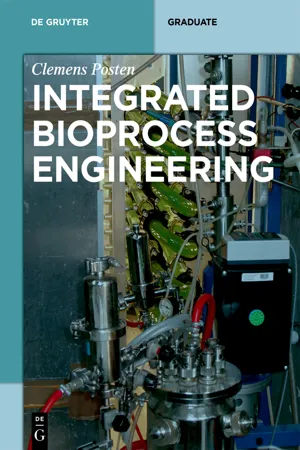
Bioprocess engineering employs microorganisms to produce biological products for medical and industrial applications. The book covers engineering tasks around the cultivation process in bioreactors including topics like media design, feeding strategies, or cell harvesting. All aspects are described from conceptual considerations to technical realization. It gives insight to students of technical biology, bioengineering, and biotechnology by detailed explanations, drawings, formulas, and example processes. In Bioprocess Engineering upstream, bioreaction, and downstream stages are closely linked to each other. From a biological point of view photo-biotechnology is in the centre of interest as well as processes, where the particulate properties play an important role. The main technical means are fermentation under highly controlled conditions, mathematical modelling of bioprocesses including measurement of intracellular compounds, as well as mechanical separation methods arising from downstream processing.
Trusted by 375,005 students
Access to over 1 million titles for a fair monthly price.
Biotechnology is a fascinating science and an invaluable weapon in the battle against hunger and diseases. It uses the capabilities of enzymes, microorganisms and isolated cells that produce complex molecules to bring comfort to our daily lives. Success stories about groundbreaking techniques in genetic engineering and the discovery of new bioactive compounds are at the center of public interest. Integrated bioprocess engineering provides the means to go from ideas to actually achievable products for the benefit of our society. This is not an easy path. The challenge can only be approached by sound application of engineering sciences and smart use of biological capabilities.
The chapters of this book follow the workflow during usual bioprocess design and operation, from lab work through fermentation to the final product. On the way, standard unit operations such as bioreactor design, including mixing and aeration, are addressed. This is achieved by fundamental chapters giving descriptions of state-of-the-art techniques and leading the reader through the jungle of technical calculations. Beyond this ‘hardcore’ process engineering, concluding paragraphs raise additional questions and suggestions meant to strengthen the ability to take the broader view, which is essential for further success.
In several case studies special processes will be introduced. Different aspects of the interplay between cell physiology and the process conditions become clear for these examples. Here, know-how is complemented by know-why for these special cases. This is meant to allow for knowledge transfer from basic approaches to the huge diversity of other already existing processes, and to allow the reader to find ideas for their own projects. Further examples are given in smaller formats as an overview of different solutions for a given problem.
Integration takes place on different levels from direct coupling of process steps to societal aspects. The examples for integrative aspects given in the previously mentioned chapters are summarized and generalized in specifically dedicated paragraphs. Frameworks and concepts of the current way of thinking in science and industry are highlighted and outlined. Finally, exercises provide an opportunity to reinforce and train the teaching contents, as well as to encourage further investigations.
1.1Motivation – window shopping for biotechnological products
People encounter more and more biotechnological products in everyday life, whether they know it or not. Dairy products like yoghurt or kefir are traditional examples. Fermented foods are found in many cultures all over the world. Wine and beer have consumed for millennia thanks to the fermentative activity of yeast. Furthermore, yeast lets dough rise. Acetic acid has been known since antiquity for the acidification and conservation of foods. Since the Middle Ages it has been produced by the so-called Orleans method, an example for surface fermentation. This provides the acid bacteria for oxidation of ethanol (wine) to acetate. Later it was intensified (by increasing the air/water interface) by letting the suspension trickle over beech wood chips. For technical usage, acetic acid production even by modern fermentation processes is not competitive with chemical production. That does not hold for vinegar, a good example of integration into society, where public perception is an important issue, especially in the food area Figure 1.1.
Convenience food is commercially processed food that includes biotechnological steps or ingredients to optimize taste, smell or ease of consumption. The flavor enhancer glutamate is the most prominent example and is present in many different packaged foods. It has been produced in a direct fermentation process since the 1950s by the bacterium Corynebacterium glutamicum. Today, total world production of this amino acid is estimated to be two million tons per year. Less well known is the polysaccharide xanthan. It is present as food thickener and gelling agent in many soups, dressings and ice creams. It is produced by the bacterium Xanthomonas campestris. Citric acid is not only used in detergents to dissolve limescale but also for acidification of fruit juices. Its production with Aspergillus niger is one of the most important biotechnological processes with respect to market volume Figure 1.2.
Fig. 1.2: Convenience food: (a) many instant soups, here the famous Asian ramen soup, contain glutamate or yeast extract as flavor enhancers; (b) sauces like salsa and dips get their physical consistency from xanthan as food thickener and contain acetate, citrate, or glucose fructose syrup for better taste.
A modern aspect in our daily diet is the regular consumption of food supplements and functional foods. An example of living cells as a product is found in probiotics. They contain live bacteria and yeasts that are meant to be good for human health, especially the digestive system. However, the medical effect is not fully assessed. Polyunsaturated fatty acids (PUFA) and antioxidants are typical food supplements that are increasingly derived from microalgae, thus relieving the limited resource fish oil. Vitamin C is present in multivitamin products or in high doses in effervescent tablets. Each supermarket has a wide choice of different formulations of vitamins Figure 1.3.
Cosmetics is another field for biotechnological products. Many face creams contain hyaluronic acid (HA). This polysaccharide is widely distributed in the extracellular matrix of animal connective and epithelial tissues, where it fulfills many chemical and physical functions. Its application as a cosmetic agent promises skin tightening. HA is still extracted from cockscombs. Growing ethical thinking on the producer and the consumer side has led to a biotechnological process, where HA is produced by filamentous fungi. This ‘bio-hyaluronic acid’ captures more and more market share. In this case, production by plants is not an alternative as for other compounds like lipids or amino acids. A protective agent for microorganisms is ectoine, a low molecular natural compound. It is present in many microorganism that can stand high temperature and salinity. It is used as an active ingredient in skincare products, protecting the skin against ultraviolet (UV) light and mucous membranes against dryness Figure 1.4.
Fig. 1.3: Food supplements and functional food: (a) living bacteria are the biotechnological basis of fermented dairy products and are nowadays specifically selected and designed for use in functional foods, here a probiotic milk drink; (b) vitamins as supplements to the usual diet have become standard in many countries. Which of the vitamins listed on the label of a multivitamin preparation are biotechnologically produced.
Biotechnologically produced drugs for pharmacological application are of specific importance, as in most cases they cannot be manufactured by any other means or substituted readily by other substances. Penicillin is the classic example, which has extremely beneficially contributed to human health. Nowadays different antibiotics are available in any pharmacy. Bad compliance has led to spreading of multidrug resistant pathogens, an example where integration into society creates a drawback. A more modern product in healthcare is the peptide hormone insulin, which is also known to everybody. Other highly effective vaccines or antibodies are available only in hospitals Figure 1.5.
The portfolio of bioproducts in the areas of food and pharmaceuticals have long been exceeded by products for practical use. Many products can be found in every household and are available in every supermarket. Technical enzymes like proteases or lipases are important active compounds in washing powder and cleaning agents. Another group of products is detergents, an application of surface active molecules (surfactants). Biotechnologically produced and biodegradable surfactants (e.g., rhamnolipids) are labeled as ‘biotensides’ and are produced by microbial fermentation or enzymatic catalysis of plant derived oils. Especially for outdoor applications, they are more environmentally friendly than surfactants based on fossil oils Figure 1.6.
Fig. 1.4: Cosmetics: (a) product for skincare based on hyaluronic acid written as ‘biohyaluronic acid’ when produced by microorganisms; (b) nasal spray with ectoine to prevent drying out of the nasal mucous membrane in winter when heated air in the living room is very dry.
Fig. 1.5: Pharmaceutical products: (a) penicillin is still the most powerful weapon against bacterial infections; (b) insulin was the first medical drug made by genetically engineered bacteria. Since then it has helped millions of people live with diabetes.
Fig. 1.6: Products for use in the household: (a) washing powder contains different enzymes like proteases; (b) a relatively new product is biotensides in environmentally friendly household cleaners.
Fig. 1.7: Technical products: (a) polylactide is one of the current biobased plastics and a major material for 3D printing, here employed to form a globe; (b) vehicles can be fueled in many countries with pure bioethanol or with ethanol as a fuel additive.
Beyond food, cosmetics and medicine, bioproducts have acquired their place in technical applications. Sodium gluconate is used as aggregate in concrete mixes and acts as set retarder to prevent cracking during fast curing. Metal surface treatment is another application. Great hopes are placed on biobased, biodegradable and biocompatible plastics. A success story is polylactides (polylactic acid, PLA), for which the lactic acid is produced by fermentation. PLA blends are already in use in different specific applications such as packaging (especially deep drawn products like yoghurt pots and coffee pads), small parts of technical appliances, or as fibers for technical fabrics. However, the most significant biotechnological product in terms of volume is ethanol. Even at the petrol station we can make a find. With bioethanol, biotechnology made the step into the energy market. Thehugeneedfor sugar cane in competition with its use as food however makes this process controversial Figure 1.7.
1.2Bioprocess engineering – attempt at a definition
The bioprocess engineer deals with living material employed in technical processes. This basic view states two characteristics as the heart of the activity field. However, it is not intuitively clear exactly what ‘bio’ means and exactly what kind of ‘process’ is the target. The process or chemical engineer deals with the processing of raw materials that are being converted into added value products, employing physical, chem...
Table of contents
Cover
Title Page
Copyright
Preface – a short pitch for this book
Contents
1 Introduction – a thread through this book
2 Biosystems – microorganisms and other biocatalysts
3 Media – supplying microorganisms with a comfortable environment and building blocks for growth
4 Kinetics – finding quantities for bioprocess reactions
5 Bioreactors – designing a home for the bioreaction
6 Not always so simple – the batch process reconsidered
7 Little by little one goes far – the fed-batch process
8 Microalgae – the solar cell factory
9 Continuously operating bioprocesses – production under steady state conditions
10 Measuring principles – how to put an end to the blind flight
11 The practice of fermentation – a step by step guide through the workflow
12 Modeling – art and handcraft of mathematically describing bioprocesses
Further Reading – still curious?
Acknowledgments – dedicated to all the people who supported the compilation of this book
Copyrights – pictures provided with courtesy and accepted with thanks
Index
Frequently asked questions
Yes, you can cancel anytime from the Subscription tab in your account settings on the Perlego website. Your subscription will stay active until the end of your current billing period. Learn how to cancel your subscription
No, books cannot be downloaded as external files, such as PDFs, for use outside of Perlego. However, you can download books within the Perlego app for offline reading on mobile or tablet. Learn how to download books offline
Perlego offers two plans: Essential and Complete
Essential is ideal for learners and professionals who enjoy exploring a wide range of subjects. Access the Essential Library with 800,000+ trusted titles and best-sellers across business, personal growth, and the humanities. Includes unlimited reading time and Standard Read Aloud voice.
Complete: Perfect for advanced learners and researchers needing full, unrestricted access. Unlock 1.4M+ books across hundreds of subjects, including academic and specialized titles. The Complete Plan also includes advanced features like Premium Read Aloud and Research Assistant.
Both plans are available with monthly, semester, or annual billing cycles.
We are an online textbook subscription service, where you can get access to an entire online library for less than the price of a single book per month. With over 1 million books across 990+ topics, we’ve got you covered! Learn about our mission
Look out for the read-aloud symbol on your next book to see if you can listen to it. The read-aloud tool reads text aloud for you, highlighting the text as it is being read. You can pause it, speed it up and slow it down. Learn more about Read Aloud
Yes! You can use the Perlego app on both iOS and Android devices to read anytime, anywhere — even offline. Perfect for commutes or when you’re on the go. Please note we cannot support devices running on iOS 13 and Android 7 or earlier. Learn more about using the app
Yes, you can access Integrated Bioprocess Engineering by Clemens Posten in PDF and/or ePUB format, as well as other popular books in Biological Sciences & Biotechnology. We have over one million books available in our catalogue for you to explore.