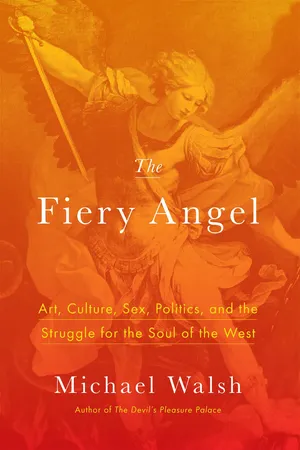
Without an understanding and appreciation of the culture we seek to preserve and protect, the defense of Western civilization is fundamentally futile; a culture that believes in nothing cannot defend itself, because it has nothing to defend. The past not only still has something to tell us, but it also has something that it must tell us. In this profound and wide-ranging historical survey, Michael Walsh illuminates the ways that the narrative and visual arts both reflect and affect the course of political history, outlining the way forward by arguing for the restoration of the Heroic Narrative that forms the basis of all Western cultural and religious traditions. Let us listen, then, to the angels of our nature, for better and worse. They have much to tell us, if only we will listen.
eBook - ePub
The Fiery Angel
Art, Culture, Sex, Politics, and the Struggle for the Soul of the West
- 280 pages
- English
- ePUB (mobile friendly)
- Available on iOS & Android
eBook - ePub
About this book
Trusted by 375,005 students
Access to over 1.5 million titles for a fair monthly price.
Study more efficiently using our study tools.
Information
Subtopic
Cultural PolicyCHAPTER ONE


The Fiery Angel: Guardian, Herald, Phoenix
The Fiery Angel
From Death, Life—and Vice Versa
In the great Narrative of our existence, angels have been with us as long as the recorded history of humanity. Call them what you will: divine spirits, ghosts, the unseen, celestial creatures who worship at the throne of God, boon companions to various Biblical figures, and even, in the form of the Angel Gabriel, the being who helped Daniel interpret his dreams, the harbinger of both the coming of John the Baptist and the birth of Christ, and who delivered a verse of the Koran to Muhammad.
Angels are both guardians and heralds, connecting us imperfectly in the realm of fantasy or revelation or hallucination to our futures and our fates; the Greek αγγ∊λος and Hebrew ma’lāk both literally mean “messenger,” delivering dispatches, or warnings, from God. More seen than heard, angels sometimes whisper in our ears at moments of crisis or peril. In his first inaugural address, Abraham Lincoln memorably evoked them at a time of national crisis:
Though passion may have strained it must not break our bonds of affection. The mystic chords of memory, stretching from every battlefield and patriot grave to every living heart and hearthstone all over this broad land, will yet swell the chorus of the Union, when again touched, as surely they will be, by the better angels of our nature.
“Better angels,” of course, is comparative: better than what? So there must be worse angels as well, cosmologically speaking; fallen angels, if you will. One need not believe, literally, in angels in order to grasp the metaphor, but without a knowledge of them, and their role throughout human history in literature, myth, legend, and scripture, one is hard-pressed to understand or appreciate much of the art of the Christian era.
Angels may be good or bad, then, but almost never are they anything less than dramatic; how could they be otherwise, given their primordial role in the Battle in Heaven (described in Revelation), the titanic struggle between the forces of Lucifer, the Light-bringer, and of God, led by his champion, the Archangel Michael? It was Michael who confronted Lucifer and his host—a full third of all the angels in Heaven, according to lore—and sent them hurtling into the Lake of Fire, which is where we find them at the opening of Milton’s Paradise Lost. At the end of the poem, it is Michael of the flaming sword who banishes Adam and Eve and bars them from re-entering Paradise until their original sin—of wanting to be like God (so very much like Lucifer’s sin) by knowing both good and evil—is expiated and expunged by the coming of the Redeemer.
Asexual, angels nonetheless contain erotic theological qualities, if only implicitly. That Gabriel announces two significant pregnancies is in itself fraught with subtext; Raphael is a patron of Christian marriage; and Michael, the hyper-masculine commander of the Heavenly Host, is the archetype for every fearless warrior who’s ever lived. But let them fall, as Lucifer fell, and the contained and repressed eroticism bursts forth. Concupiscent demons abound in our literature, from the nocturnal demon lovers, the incubus and succubus, to seductive devils of all descriptions. In fact, they are central to the dark side of the Western narrative, in part because they make such compelling characters and in part because they force us, through art, to face up to our worst impulses and our darkest desires.
One of the most vivid angels in the literature is to be found in Sergei Prokofiev’s challenging and chilling opera The Fiery Angel, written between 1920 and 1926, but unproduced until 1955, two years after the composer’s death.1 Its raw intensity, its obsessive reliance on a handful of themes (one of them—the first notes of the opera and thus the most important—derives from the opening ostinato of Stravinsky’s seminal ballet The Firebird, thus instantly linking its never-glimpsed title character with the mythological phoenix), vividly reflects the characters’ own sexual obsessions.
And what obsessions they are. Set in the sixteenth-century Rhineland, with a libretto by the composer based on the 1908 novel by the Russian Symbolist poet and author Valery Bryusov, the opera tackles sexual hysteria, conventional morality, black magic, the Inquisition, overwhelming lust, and blind love in the face of constant rejection; along the way, both Faust and Mephistopheles make cameo appearances. Indeed, the full title of Bryusov’s novel—based on his own sobering and frustrating experience as a member of a love triangle involving a femme fatale named Nina Petrovskaya—is:
The Fiery Angel, or a True Story of the Devil who at Various Times Appeared to an Innocent Virgin in the Shape of a Holy Angel, Luring her to Sinful Actions; of the Ungodly Practices of Magic, Alchemy, Astrology, Cabalistic Art, and Necromancy; of the Trial of the Aforesaid Virgin under the Presidency of his Reverence, the Bishop of Trier; and also of Meetings and Conversations with the Knight and Thrice Doctor Agrippa of Nettesheim, and Doctor Faust, Written by an Eyewitness.
In other words, expect from both novel and opera a symphony of cultural references. In this, we come to one of the strengths of Western culture: its accretionary and syncretic approach to its own existence. Few works of art—just as few political developments—come about or exist in a vacuum, although the increasingly sterile manner of their study at the university level would lead an unwary student to think otherwise. One might object that, at its worst, this is the portmanteau school of artistic creation, to cram as many references into the chosen form as possible until it bulges and explodes. But just as Puccini in his mature works often foreshadowed the musical material of his next opera in the one he was currently writing, so also do artists from Euripides to the present adumbrate each other. “You have no idea how it feels to hear behind you the tramp of a giant like Beethoven,” complained Brahms, struggling to write his C minor symphony. But he managed.
This is also, as the reader may have already noticed, my approach in both this book and its predecessor: by tracing artistic themes and connections backward through the ages we can, like Hänsel and Gretel, eventually find our way home—deep in our past, near the origin of species, to coin a phrase. If Bryusov’s novel fired the imagination of an artist of Prokofiev’s stature, it not only must have had some larger cultural resonance but also have had, inherent in the material, the potential for enlargement and expansion—another series of signposts on the way into our future, which is to say, back to our past.
The story involves a knight named Ruprecht, who returns to Germany from a trip to the Americas and takes temporary lodgings at an inn on the outskirts of Cologne. The only available room, in the attic, is rude and dingy, but Ruprecht has no choice. Curiously, inside the room a connecting door is nailed tightly shut. To an eerie, trilling orchestral accompaniment reminiscent of Salome’s erotic fixation on the head of John the Baptist in Richard Strauss’s Salome, a woman’s piteous cries and alarums coming from behind it cause Ruprecht to break it down—and there stands Renata, in dishabille and cringing in terror from invisible threat. She immediately rushes into his arms.
His response: “Libera me, Domine, de morte aeterna.” (“Save me, Lord, from Death eternal,” a responsory from the Catholic Office of the Dead). If you think this all will end badly, you’re right.
In a kind of grotesque parody of the first act of Puccini’s La bohème, Renata—addressing Ruprecht by name, to his wonderment—immediately pours out her life story: how she was visited as a girl by a fiery angel named Madiel who protected and nurtured her until the time she turned sixteen; when she begged the angel to become her lover, he suddenly vanished. Later, she met Count Heinrich, whom she believed to be the living incarnation of her angel Madiel, and they lived together in his castle for one magical year, until he, too, abandoned her. Ever since, she’s been tortured by demons.
When Ruprecht makes a romantic overture, the formerly pliant girl suddenly turns cold and spurns him. But he’s already lost; even the landlady’s insinuation that Renata is a prostitute cannot dissuade him from his physical passion for her. So when Renata suggests they flee the accursed inn and seek the mysterious Heinrich in the city, the suddenly bewitched hero immediately agrees. And demons and spirits and black magic are set loose in the land.
Of course, she won’t let him have her; as Ruprecht’s sexual frustration mounts, a soothsayer predicts Renata’s life will end bloodily. To assist in their quest for Heinrich, Ruprecht and Renata consult a bookseller named Yakov Glock in order to study the black arts, including the kabbalah. Glock leads them to the magister magician Agrippa, who informs Ruprecht that true magic lies in the study of science and philosophy. (We can practically smell Faust and Mephisto coming.) But three skeletons in the corner rattle their bones and shout, “You lie!”
In Cologne, where the great cathedral is under construction in the background, Ruprecht and Renata find Heinrich’s townhouse and even encounter Heinrich himself, who immediately recoils from the girl in horror, blaming her for seducing him and wishing nothing more to do with her. A vengeful Renata demands that Ruprecht defend her honor by challenging the cad Heinrich to a duel—but then, when he does, she insists that he not injure her fiery angel. Disarmed, Ruprecht is severely wounded and, reverting to her seductive nature, Renata finally tells him she loves him. But when he asks her to marry him, she decides that their relationship is a sin and he a tool of the Devil. Cutting herself with a knife, she bleeds and flees.
Ruprecht is counseled by Faust and Mephistopheles, who have been watching the entire charade. They lead him to a nunnery, in which Renata has taken refuge to seek divine forgiveness. But she’s brought her hyper-sexuality with her, and has infected the nuns with it; the cloister is being plagued by supernatural occurrences. An Inquisitor is summoned to effect an exorcism in the dark and dank cellar, but it goes badly. As Ruprecht, Faust, and Mephisto watch unseen from a hidden gallery above, Renata and the nuns attack the Inquisitor. One of the Inquisitor’s men throws open the cellar door, allowing piercing daylight to stream into the room. As the nuns scream in terror, the Inquisitor pinions Renata, declares her guilty of carnal intercourse with Satan, and condemns her to torture and death at the stake.
Wow. It’s almost no wonder the opera never got a performance during the composer’s lifetime, although that had more to do with Prokofiev’s residence in the Soviet Union and the exigencies of production elsewhere in Europe at the time. Still, the opera’s extravagant subject matter, its frank depiction of sexuality, its blending of the realistic and the supernatural—as if there were no material difference between them—and its stark musical language (its principal themes are driven by rhythmic ostinatos that ape the characters’ psychological obsessions), pretty much ensured that, even in a time when modern opera was being born—Alban Berg’s seminal Wozzeck was premiered in 1925—The Fiery Angel would have a tough time coming into the world.
But, as noted, even something as starkly original as The Fiery Angel is not, and could not be, sui generis. Its panoply of references and allusions extends in every direction, from its spooky German setting to its Symbolist literary origins, to its early-twentieth-century avant-garde musical language. Unlike Béla Bartók’s one-act opera Bluebeard’s Castle, The Fiery Angel is not a work that seduces and astonishes as it draws the listener into its supernatural environment; rather, it bludgeons its audience into submission with a relentless assault on both the senses and the soul.
This is meant as both a compliment and a recommendation for further study, for this recondite work is a symbol—an optimistic symbol—of Western culture. For only in depicting the terrors and wonders of many of our greatest cultural pathologies in our art, are we able to face up to them, and thus face them down.
To begin: this is very much Renata’s story. While the elusive Angel Madiel is the title character, and while Ruprecht is the nominal hero, at the end of the opera he can only watch helplessly—unheroically—from the wings for the entire last act (depending on how you count, there are five), while Renata battles her satanic nature and her fate. Defiant to the end, like a female Don Giovanni, she is essentially dragged down to Hell, kicking every cloven-hoofed step of the way. As the Inquisitor pronounces his sentence, the music climaxes on a rising brass fanfare, and then simply stops. We have reached the end of our story, and there is nothing more for anybody to say. Ruprecht’s ineffectuality—his impotence—one of the opera’s subtexts, could hardly be more intensely illustrated; his powerlessness in the face of demon woman is also ours. Camille Paglia, whose understanding of and appreciation for the chthonic is unsurpassed, would have a black-leather-clad field day with Renata.2
Who, exactly, is Renata? When we first meet her, she is the crazy lady in the attic, who once met a man . . . and thought he was an angel. She is possibly a hooker. She is almost certainly possessed by the Devil. She, like Rosemary in Roman Polanski’s 1968 film Rosemary’s Baby, may have had sexual intercourse with Satan. She may be a witch. She is manifestly dangerous, both to herself and any man she encounters. She begins and ends the opera in some form of captivity. She certainly deserves to be locked up, if not tortured and burned alive.
Further: is her story real? Is, in fact, the story we are watching unfold on stage, or reading in Bryusov’s novel, even supposed to be real? Are we to believe in its admixture of realism (duels, bloodshed) and the supernatural (talking skeletons, Mephisto)? Of course, it’s a fable and an allegory—but what sort of fable? A cautionary tale that violates—or in Ruprecht’s case, tries to violate—the third and most important of Nelson Algren’s three rules: “Never sleep with a woman whose troubles are worse than yo...
Table of contents
- Cover
- Title Page
- Copyright
- Dedication
- Contents
- Introibo
- Prologue: Into the West
- Introduction: The Unanswered Question
- Chapter One: The Fiery Angel
- Chapter Two: Gaspard de la Nuit
- Chapter Three: The Raft of the Medusa
- Chapter Four: The Woman Without a Shadow
- Chapter Five: The Mystery of Dorabella
- Chapter Six: The Birth of Tragedy
- Chapter Seven: La Belle et la Bête
- Chapter Eight: Deus lo Vult
- Chapter Nine: La Commedia è Divina
- Chapter Ten: Miraculous Mandarins
- Chapter Eleven: Adrift in Bistritz
- Chapter Twelve: The Stone Guest
- Chapter Thirteen: O Magnum Mysterium
- Epilogue: From Erinyes to Eumenides
- Bibliography
- Acknowledgements
- Index
Frequently asked questions
Yes, you can cancel anytime from the Subscription tab in your account settings on the Perlego website. Your subscription will stay active until the end of your current billing period. Learn how to cancel your subscription
No, books cannot be downloaded as external files, such as PDFs, for use outside of Perlego. However, you can download books within the Perlego app for offline reading on mobile or tablet. Learn how to download books offline
Perlego offers two plans: Essential and Complete
- Essential is ideal for learners and professionals who enjoy exploring a wide range of subjects. Access the Essential Library with 800,000+ trusted titles and best-sellers across business, personal growth, and the humanities. Includes unlimited reading time and Standard Read Aloud voice.
- Complete: Perfect for advanced learners and researchers needing full, unrestricted access. Unlock 1.5M+ books across hundreds of subjects, including academic and specialized titles. The Complete Plan also includes advanced features like Premium Read Aloud and Research Assistant.
We are an online textbook subscription service, where you can get access to an entire online library for less than the price of a single book per month. With over 1.5 million books across 990+ topics, we’ve got you covered! Learn about our mission
Look out for the read-aloud symbol on your next book to see if you can listen to it. The read-aloud tool reads text aloud for you, highlighting the text as it is being read. You can pause it, speed it up and slow it down. Learn more about Read Aloud
Yes! You can use the Perlego app on both iOS and Android devices to read anytime, anywhere — even offline. Perfect for commutes or when you’re on the go.
Please note we cannot support devices running on iOS 13 and Android 7 or earlier. Learn more about using the app
Please note we cannot support devices running on iOS 13 and Android 7 or earlier. Learn more about using the app
Yes, you can access The Fiery Angel by Michael Walsh in PDF and/or ePUB format, as well as other popular books in Politics & International Relations & Cultural Policy. We have over 1.5 million books available in our catalogue for you to explore.