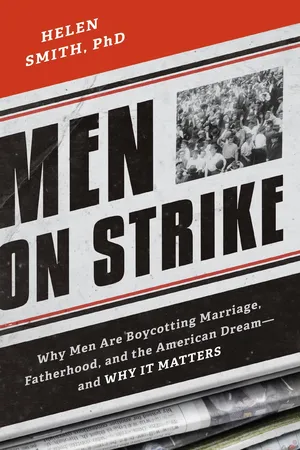
American society has become anti-male. Men are sensing the backlash and are consciously and unconsciously going "on strike.” They are dropping out of college, leaving the workforce and avoiding marriage and fatherhood at alarming rates. The trend is so pronounced that a number of books have been written about this "man-child” phenomenon, concluding that men have taken a vacation from responsibility simply because they can. But why should men participate in a system that seems to be increasingly stacked against them? As Men on Strike demonstrates, men aren’t dropping out because they are stuck in arrested development. They are instead acting rationally in response to the lack of incentives society offers them to be responsible fathers, husbands and providers. In addition, men are going on strike, either consciously or unconsciously, because they do not want to be injured by the myriad of laws, attitudes and hostility against them for the crime of happening to be male in the twenty-first century. Men are starting to fight back against the backlash. Men on Strike explains their battle cry.
eBook - ePub
Men on Strike
Why Men Are Boycotting Marriage, Fatherhood, and the American Dream - and Why It Matters
- 240 pages
- English
- ePUB (mobile friendly)
- Available on iOS & Android
eBook - ePub
Men on Strike
Why Men Are Boycotting Marriage, Fatherhood, and the American Dream - and Why It Matters
About this book
Trusted by 375,005 students
Access to over 1.5 million titles for a fair monthly price.
Study more efficiently using our study tools.
Information
CHAPTER 1
The Marriage Strike
Why Men Don’t Marry
I guess I’m one of the boycotters. . . . About 6 or 7 years ago I gradually just quit dating. Without really thinking about it, I came to the decision that I would not get married, so I wasn’t interested in going through the hassle of dating. The interesting part is that I share a house with two other guys in similar situations. We all seem to have voluntarily removed ourselves not just from the population of marriageable men, but from the dating pool. One is a few years older than me, the other [is] in his early 30s. Both of them were previously married and don’t seem eager to repeat the experience.
—A commenter named Ernie from PJMedia.com in response to my question, “Should Men Get Married?”1
There are many guys like Ernie all over the country who are no longer getting married. And why should they? Western culture has spent the past fifty years making marriage a better deal for women, while for men it’s become a real ball and chain, sometimes almost literally. Men used to go to work, come home and, after a hard day’s work providing for their families, they rested, ate dinner and felt like “the king of the castle.” Fast forward to today, where the man works all day, comes home to cook or wash dishes, is chided for not doing a good enough job, is relegated to the basement while the wife and kids enjoy the run of the house, and spends the weekends watching the kids with a dirty diaper bag slung across his shoulders or hanging out in a shopping mall holding his wife’s purse. On top of an already stressful life, he also gets a bunch of pitying stares from the younger men who wonder what he has become and how they can avoid the same fate.
Now, instead of equality in marriage, he can expect to share household tasks, act as unpaid bodyguard and home repairman, pay for most of the bills, help with the kids and, for all his efforts, be denigrated by the wife and society. And if he does fight back? He pays child support, gets half or more of his stuff taken and has to leave the house, and he might even get a restraining order or, worse, be charged with child or domestic abuse. What is there to gain?
It’s no wonder that fewer and fewer men are getting married now than in the past. Kay Hymowitz states in her book, Manning Up, that “in 1970, 80 percent of 25-to 29-year-old men were married; in 2007, only about 40 percent of them were. In 1970, 85 percent of 30- to 34-year-old men were married; in 2007, only 60 percent of them were.”2
Men no longer see marriage as being as important as they did even fifteen years ago. “According to Pew Research Center, the share of women ages eighteen to thirty-four that say having a successful marriage is one of the most important things in their lives rose nine percentage points since 1997—from 28 percent to 37 percent. For men, the opposite occurred. The share voicing this opinion dropped, from 35 percent to 29 percent.”3
Even in middle age, fewer men are getting married, especially those without a college degree. The New York Times reports that “about 18 percent of men ages 40 to 44 with less than four years of college have never married, according to census estimates. That is up from about 6 percent a quarter-century ago. Among similar men ages 35 to 39, the portion jumped to 22 percent from 8 percent in that time.”4 Even college-educated men are marrying less often at 84 percent, which is a decline of 9 percent since 1980.5 And the marriage rates in general keep plummeting. According to men’s activists Glenn Sacks and Dianna Thompson:
The US marriage rate has dipped 40% over the past four decades, to its lowest point ever. There are many plausible explanations for this trend, but one of the least mentioned is that American men, in the face of a family court system which is hopelessly stacked against them, have subconsciously launched a “marriage strike.”6
There are many reasons that men are not marrying, and one of them is certainly the marriage strike as described by Sacks and Thompson. However, though family court injustice plays a big part in why men are no longer marrying as often, it is just one aspect. Men have other psychological and legal concerns about marriage in today’s post-feminist society that increase the likelihood of the marriage strike. This chapter will address those concerns and look to answer the question, “Why aren’t men marrying as readily now as they did in the past?”
WHY MEN DON’T MARRY—FROM THE “EXPERTS’ ” PERSPECTIVE
As I read through all of the comments I have received from men around the country over the years on why they do not want to marry, I can’t help but feel that many so-called experts are wrong when they say that men are poor communicators. My interactions and observations show that men often know their minds very well, but they are reluctant to communicate in interpersonal and political settings for fear of coming across as weak or, worse, being accused of being sexist or misogynistic. Or sometimes, they are communicating, it’s just that no one is listening or people are actively rejecting what they say.
I have even had relatives or case workers—almost always women—who tell me that the boy or man they have accompanied for an evaluation or therapy will not talk; they are too closed down. Yet, not once in my twenty-plus-year career has one of those men or boys refused to talk. How did I get them to talk? I listened.
The problem today is that society is not listening to what men have to say if they do open up, and, at the same time, the risks for men in talking about these politically charged issues keep them silent, making it hard to glean the truth. Even those experts or authors who write books on the topic of male reluctance to marry and who profess to be somewhat pro-male seem to get it wrong. What they don’t realize is that the incentives to marry have changed for men, and they are no longer willing to risk so much more than in previous years to gain potentially so much less.
Authors Kay Hymowitz and Kathleen Parker have written books that, on the surface, seem to advocate for men. Hymowitz’s Manning Up: How the Rise of Women Has Turned Men into Boys7 and Kathleen Parker’s Save the Males: Why Men Matter, Why Women Should Care8 are a good start to recognizing the war against men in our society, but the condescending titles alone give the impression that the authors care not so much about men as about how men relate to women. This is not to say these two books aren’t important. They are, as they give some good background on how and why society treats men in unhealthy ways. But I do have some serious criticisms.
Newsflash: If you want to be pro-male, using terms like “child-man in the promised land,” as Hymowitz does, is not the way to do it—and, frankly, comparing “saving the males” to “saving the whales” as Parker’s book does is, well, insulting. It implies that men are comparable to animals, which of course is how some women and their sexist male counterparts think.
When reading through these two books, I get the impression not that men are autonomous beings who deserve equality as equal citizens in a democratic society, but rather that they should be treated well enough so that they will want to marry women, have children and support them so that women will have a better life. I have a different take: I propose that men are autonomous beings who are entitled to justice and equality and the pursuit of their own happiness because they are human beings in a supposedly free society. Too bad this is such a radical departure that a whole book has to be written just to make this point. One would think it would be obvious, but it is not obvious in today’s America.
Other books, such as Guyland9 by Michael Kimmel or Boys Adrift: The Five Factors Driving the Growing Epidemic of Unmotivated Boys and Underachieving Young Men10 by Leonard Sax, along with Hymowitz’s book, treat the men’s lack of interest in marriage as a kind of extended adolescence where men sit around playing video games and farting in order to ward off having to grow up. And all these “guys are losers” types stick together to add fuel to the negative image of men as boys. For example, Richard Whitmire, the author of Why Boys Fail11—another positive title!—endorses Hymowitz’s book by stating:
Kay Hymowitz does an exacting job describing the growing flock of man/children we’re seeing, and she lays out the disturbing reality of the “marriageable mate” dilemma. . . . Not only are there fewer college-educated men to marry, but many of those men who are available are little more than man/children—not anyone you would want your daughters to marry!12
As if that endorsement of Hymowitz’s book isn’t bad enough as an example of the condescension these men’s issues writers have for their subjects, Hymowitz, who professes herself to be “sympathetic” to men,13 has a chapter called “Child-Man in the Promised Land.” This chapter pokes fun at the men of today who refuse to grow up and who also—much to her chagrin—refuse to participate in “more civilized society”:
Nothing attests to the SYM’s [straight young male’s] growing economic and cultural muscle more than video games. Once upon a time, video games were for little boys. . . .
Indeed, the child-man’s home sweet media home is the Internet, where no meddling censor or nervous advertiser can come between him and his desires. . . . Contemporary undomesticated SY maledom appears in its darkest form in the person of Tucker Max, whose eponymous website is a favorite among his peers. . . . Crudity is at the heart of the child-man persona—the bad-boy tone epitomizes his refusal to grow up—but Max remains fixated on his penis and his “dumps” like a toddler stuck somewhere around the oedipal stage.14
Another of these books on the decline of men is Hanna Rosin’s The End of Men and the Rise of Women, which is frankly the most matronizing of all of these books.15 Rosin’s main thesis is that women have pulled ahead of men in many areas of society and are able to adapt and be flexible at home and work in ways that men cannot. In fact, in her book she refers to the “Plastic Woman” who is able to bend and do everything at once and who is climbing the ladder past men. These loser men are referred to as “Cardboard Men,” who are apparently inflexible and unable to adapt to the new world order.
What she doesn’t mention is that this new world order is a place where men are discriminated against, forced into a hostile environment in school and later in college, and held in contempt by society—and for the honor, are expected to conform to a society for women only. What she calls inflexibility is men rejecting her and other feminists’ suggestions that they become more like women. She has no clue how men really feel or why they behave the way they do, nor does she seem to care.
Case in point: Even her young son is appalled at the title of her book. In an interview with The Daily Beast, we learn the following:
There are a few things that happen when you attempt to travel the streets of New York with a bright yellow book that screams The End of Men under your arm. First, you get a lot of inquisitive stares. Some people snicker. When you accidentally leave the book on the counter of your morning coffee shop, the man who returns it to you points to the cover, giggles, and does a little jig.
But if you are the author of a book called The End of Men—with a man for a husband and a boy for a child—you get sticky notes left on your bedroom door. “My 6-year-old, to whom the book is dedicated, writes things like, ‘Only bullies write books called The End of Men,’” says author Hanna Rosin, whose 2010 Atlantic essay turned 310-page book hit stands this week. She clarifies: “He’s learning about bullying in school.”16
It seems that Rosin’s young son, Jacob, has a better grasp of gender relations than this “celebrated” feminist who doesn’t have a clue. Yes, Jacob, mommy is a bully, and maybe when you grow up, you will lead the revolution that teaches bullies like your mom that men are not defective girls.
How are men going to grow up and relate well to women if women don’t seem to like them?
Clowns, failures, unmotivated and child-men: With friends like the authors mentioned, who needs enemies? Publishers and women complain that men don’t read self-help or relationship books, but after reading these books, who can blame them? How many women would buy books where women were made out to be failure-to-launch goofballs who couldn’t carry their own weight? I do think that some of these books have merit and are at least attempting to shed light on male development, and a couple of these books even include interviews with actual men. However, they do so in a way that is unflattering to men to say the least and they reinterpret men’s behavior to give credence to their views of men as uncivilized, verbally stunted semibarbarians who refuse to do what society expects of them: Marry women and shut the hell up!
These books treat men and their behavior as the problem, but that’s superficial. The real question is: What is it about our society that has made growing up seem so unattractiv...
Table of contents
- Cover
- Title Page
- Copyright
- Dedication
- Contents
- Preface to the Paperback Edition
- Prologue
- Introduction
- Chapter 1. The Marriage Strike: Why Men Don’t Marry
- Chapter 2. My Body, My Choice—Your Body, No Choice
- Chapter 3. The College Strike: Where the Boys Aren’t
- Chapter 4. Why Does Dad Stay in the Basement?
- Chapter 5. Why It Matters
- Chapter 6. Fighting Back, Going Galt or Both?
- Conclusion
- Acknowledgments
- Resources for Men
- About the Author
- Notes
- Index
Frequently asked questions
Yes, you can cancel anytime from the Subscription tab in your account settings on the Perlego website. Your subscription will stay active until the end of your current billing period. Learn how to cancel your subscription
No, books cannot be downloaded as external files, such as PDFs, for use outside of Perlego. However, you can download books within the Perlego app for offline reading on mobile or tablet. Learn how to download books offline
Perlego offers two plans: Essential and Complete
- Essential is ideal for learners and professionals who enjoy exploring a wide range of subjects. Access the Essential Library with 800,000+ trusted titles and best-sellers across business, personal growth, and the humanities. Includes unlimited reading time and Standard Read Aloud voice.
- Complete: Perfect for advanced learners and researchers needing full, unrestricted access. Unlock 1.5M+ books across hundreds of subjects, including academic and specialized titles. The Complete Plan also includes advanced features like Premium Read Aloud and Research Assistant.
We are an online textbook subscription service, where you can get access to an entire online library for less than the price of a single book per month. With over 1.5 million books across 990+ topics, we’ve got you covered! Learn about our mission
Look out for the read-aloud symbol on your next book to see if you can listen to it. The read-aloud tool reads text aloud for you, highlighting the text as it is being read. You can pause it, speed it up and slow it down. Learn more about Read Aloud
Yes! You can use the Perlego app on both iOS and Android devices to read anytime, anywhere — even offline. Perfect for commutes or when you’re on the go.
Please note we cannot support devices running on iOS 13 and Android 7 or earlier. Learn more about using the app
Please note we cannot support devices running on iOS 13 and Android 7 or earlier. Learn more about using the app
Yes, you can access Men on Strike by Helen Smith in PDF and/or ePUB format, as well as other popular books in Social Sciences & Gender Studies. We have over 1.5 million books available in our catalogue for you to explore.