At the end of the nineteenth century, Austro-Hungarian society was undergoing a significant re-evaluation of gender roles and identities. Debates on these issues revealed deep anxieties within the multi-ethnic empire that did not resolve themselves with its dissolution in 1918. Concepts of gender and modernity as defined by the Habsburg Monarchy were modified by the conservative, liberal, radical right-wing and Communist regimes that ruled the empire's successor states in the twentieth century.
While these values have taken on new dimensions again in the post-Communist period, the Habsburg Monarchy's influence on gender and modernity in Central Europe is still palpable. With a truly interdisciplinary approach – drawing on the fields of women's studies, gender studies, sociology, history, literature, art, and psychoanalysis – that touches on a variety of subjects – gender roles, sexual identities, misogyny, painting, writing, minorities – this volume explores the lasting impact of the Austro-Hungarian Empire in contemporary Central Europe, which is fraught with gender conflict and tension between modernist and anti-modernist forces. The Austro-Hungarian Empire was a fascinating multi-ethnic society. Its experience and understanding of gender and modernity provides important, relevant lessons for today's world as it becomes increasingly intercultural and as issues of identity become more and more complex.
Published in English.
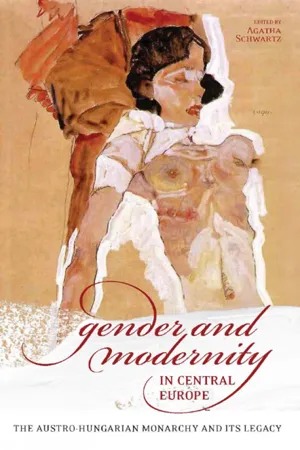
eBook - ePub
Gender and Modernity in Central Europe
The Austro-Hungarian Monarchy and Its Legacy
- 338 pages
- English
- ePUB (mobile friendly)
- Available on iOS & Android
eBook - ePub
About this book
Information
Topic
Ciencias socialesSubtopic
Historia europeaPart I
CONSTRUCTING GENDER
IN VIENNA AND BEYOND
Chapter 1
ETHNIC AND SEXUAL TENSION IN THE AUSTRO-HUNGARIAN MONARCHY:
A Case of Mistaken Identity in Grete Meisel-Hess’s “Zwei vergnügte Tage”
HELGA THORSON
“The word of our time is already found. Separation, breaking away, splitting— differentiation are the fundamental characteristics of our era: we stand under the sign of the Secession”: these words, written by the twenty-one-year-old aspiring author Grete Meisel in the year 1900, sum up the feeling that the turn of the century represented a new direction for humanity, a break from the past, with its outdated lifestyles and traditions, and the forging of new paths and new directions. The title of the article from which I have translated these words— “Jugendbewegung” (“Youth Movement”, 535)—illustrates the optimism of youth at the beginning of the 20th century and highlights the emergence of a fresh, new worldview that resulted in creative initiatives in many areas. This breaking away from the past was symbolized not only in the Secessionist movement in art, but also in many other innovative endeavours in fields as diverse as music, literature, philosophy, architecture, science, and medicine.
Grete Meisel’s article appeared in the second volume of Dokumente der Frauen (Documents of Women), a journal associated with a middle-class women’s organization, the Allgemeiner Österreichischer Frauenverein (General Association of Austrian Women). In the article, Meisel draws attention to the intersection of gender and generation, in the double sense of the word. She maintains that men and women of her generation are different from those of their parents’ generation, and that this generation of youth is coming together to create, in a Nietzschean sense, a new humanity that will embody “the transvaluation of all values” (238). Meisel argues not only for individual rights for women and for youth, but also for their right to individuality. In much of her work she attempts to dismantle internal and external barriers that block individuals from becoming who they are and from developing their own unique personalities. Meisel concludes her article with a plea to change the laws in Austria regarding the age of majority. She maintains that, whereas in most countries young men and women are considered minors until they are somewhere between eighteen and twenty-one years old, in Austria they have to wait until the age of twenty-four before they are able to “break away” from their parents or guardians, unless, of course, they receive permission to leave home or marry at an earlier age (538).
Separation, breaking away, splitting, and differentiation also characterize a different aspect of modernism, one in which individuals began to increasingly identify themselves, or be identified by others, in terms of their gender, class, ethnicity, religion, national origin, linguistic groupings, sexual orientation, age, or other markers. Identity politics—working together in groups formed through shared experiences of perceived injustice—has become a significant feature that defines modernism, and it was especially strong in Austria–Hungary, where many different kinds of groups existed and interacted within its borders. It was around this time that Theodor Herzl published his book Der Judenstaat (1896, The Jewish State), one example of how forging a common identity and culture meant separation and breaking away from the confines of existing boundaries. Emancipation movements flourished at the end of the 19th and early 20th century. Whether their concern was the emancipation of women, of Jews, of the working class, of certain ethnic or linguistic groups, sexual emancipation, or even emancipation from restrictive clothing, various groups came together to fight for the collective, while at the same time attempting to preserve and obtain individual rights.
Modernism is often viewed as a crisis of the self, a crisis of language, an inability to attain a unified subject, and thus separation, breaking away, splitting and differentiation are seen as existing within the individual as well. The individual came to be viewed as fragmented and unable to process the modern world as a unified whole. This was an era associated with hysteria, neurasthenia, and other nervous or psychological disorders. Freud’s “talking cure” was one method developed to discover order within disorder. The analyst was called upon to analyze the disjointed and “hysterical” narrative produced by the patient and interpret its significance and meaning. This same method was used by the reading public when confronted with stream-of-consciousness narratives or other literary “inventions” in the fields of literature and popular medicine at the time (Thorson 1996, 4).
The fragmentation of the self, the ambiguity of the subject as a point of reference, and the disconnectedness and randomness of individual thoughts, impressions, and experiences became important features in both the content and form of literature. Early examples of literary modernism can clearly be linked to fin-de-siècle Vienna, and not only in works by male authors (see Schwartz, 198). In fact, as Christa Gürtler and Sigrid Schmid-Bortenschlager have shown, Else Kotányi, later known under her married name, Else Jerusalem, introduced the literary technique of interior monologue into Austrian literature a full year before Schnitzler’s Leutnant Gustl was published (Gürtler and Schmid-Bortenschlager, 229–33, cited by Schwartz, 150–51).
When discussing the topic of gender and modernism in the Dual Monarchy, it is important to look at all three of the aspects of differentiation that I have outlined above. To begin with, fin-de-siècle culture was characterized by the belief that the new century meant a break from the past and a turn towards something new, for the turn of the century was a time characterized by new fields of inquiry, a time when new disciplines such as sexology, gynaecology, and psychology were beginning to emerge, and new notions of gender and sexuality were being intensely negotiated. It was also a time when women were contributing to these discourses in ever increasing numbers. Second, differentiation can be viewed with regard to the politics of identity formation, the coming together of individuals based on distinctive identity groupings, the shaping and reshaping of identity in response to various “anti” movements, such as antifeminism, antisemitism, anti-capitalism, anti-communism, or even antimodernism, and the grouping and labelling of identity based on a group’s perceived traits. Differentiation in this sense could be put on display, it could be “staged” or, in the words of Judith Butler, it could be “performed.” Third, internal differentiation, the crisis of the modernist fragmented self highlighted through modernist fiction and non-fiction alike, illustrates the widespread sentiment that the early 20th century was a time marked by crisis, manifesting itself above all in the crisis of the self and the way in which the self perceives the world. Literary modernism displayed this “crisis” in both its form and its content. However, the nature of the crisis and its causes were often perceived as different for the male self and the female self. In the words of Agatha Schwartz, from her study of women’s writing in Austria and Hungary at the end of the 19th century and beginning of the 20th century (Schwartz, 198):
Although formally these Austrian narratives written by female authors (mostly unrecognized today) share many commonalities with texts written by their (canonized) male counterparts, their crucial difference is the particular cause for the crisis of the female self, which is rooted in male sexual violence or other forms of inhibition imposed on the free expression of female sexuality and creativity.
Grete Meisel’s characterization of differentiation as the word of her era is captured quite well in her writing. Much of her work, written under her pen name of Meisel-Hess following her first marriage, focused on issues of gender, sexuality, and sexual reform, whether in the form of her trilogy on the sexual crisis (Die sexuelle Krise, 1909, Das Wesen der Geschlechtlichkeit, 1916, and Die Bedeutung der Monogamie, 1917) or in the depictions of the “New Woman” in her fiction. For example, her first novel, Fanny Roth (1902), depicts a young female musician who at the outset of the novel is wearing an uncorseted Secessionist skirt and is later seen riding her bicycle with a male friend, two symbols of ways in which the modern woman was able to burst through imposed barriers and transgress traditional restrictions, while at the same time experiencing physical and erotic pleasure. Fanny and Josef ’s excursion on their bicycles, for example, is described as follows: “But precisely the jiggling and joggling was enjoyable to them, because in doing so they sensed their young bodies so well” (19). The protagonists of Meisel-Hess’s later novels also embodied the modernist image of the “New Woman.” In fact, the Russian revolutionary Alexandra Kollontai cited Meisel-Hess’s literary protagonists, especially Maja in Die Stimme (1907) and Olga in Die Intellektuellen (1911), as prime exemplars of the “New Woman” of the early 20th century (Kollontai, 14 and 18–20), a woman striving to gain economic as well as sexual independence in a society marked by the application of a double morality for men and women to sexual conduct and behaviour.
For my contribution to the discussion of gender and modernity in Austria– Hungary, I have chosen to concentrate on the topic of differentiation as presented in “Zwei vergnügte Tage” (“Two Amusing Days”), a novella by Grete Meisel-Hess first published in 1905 in a collection of stories, Eine sonderbare Hochzeitsreise: Neue Novellen. (It was reprinted in Die Aktion in 1911, but my citations are from the first publication. All translations are my own.) In my opinion, Meisel-Hess was one of the few intellectuals in fin-de-siècle Vienna who discussed issues of gender and modernity from a proto-feminist perspective. From her earliest publications, Generationen und ihre Bildner and In der modernen Weltanschauung (both first published in 1901), and in her critique of Otto Weininger’s theories on sex and character in her Weiberhaß und Weiberverachtung (1904), Meisel-Hess fused issues of modernism with those of gender. Although she was not a leader in the organized women’s movement, at least in the political sense of the word, she was actively involved, as both a speaker and a writer, in issues of women’s emancipation. After moving to Berlin in 1908 she became an active member, until her death in 1922, of the Bund für Mutterschutz und Sexualreform (League for the Protection of Motherhood and for Sexual Reform), headed by Helene Stöcker.
In its depiction of a humorous case of mistaken identity, “Zwei vergnügte Tage” illustrates the complex identity politics of the era, and emphasizes the ethnic and sexual tensions prevalent in the Austro–Hungarian Monarchy. The novella highlights both the increasing tensions surrounding ethnic nationalism in the Dual Monarchy in the early years of the 20th century, as well as what Meisel-Hess later called the “sexual crisis” of her time. Through humour, Meisel-Hess is able to allude to the anxieties inherent in turn-of-the-century Vienna while simultaneously allowing her readers to experience a cathartic release of tension.
Whereas the majority of Meisel-Hess’s fictional texts focus on a female protagonist in crisis, this novella portrays a male protagonist oblivious to the crisis at hand. Ottokar Kralik, the protagonist of “Zwei vergnügte Tage,” has decided to travel from Prague to Vienna in order to enjoy a long holiday weekend. He anticipates his time as follows: “Museum—Prater—dinner at the Stephanskeller— Schönbrunn—opera—and then—” (104). Yet it is not so much the places he will see that excite him, but the joy of being accompanied by a beautiful young lady in the metropolis. To facilitate this process and not waste any time, he places a personal ad in the paper (105):
Young, pretty lady with an appreciation for art, who would like to spend two days over the holiday weekend with a young man from Prague, is requested to meet him on Saturday at 3:20 at the Franz Joseph train station. Identifiable through a red silk scarf in each of our hands.
When Ottokar arrives in Vienna, things turn out much differently than he expected. The train station is crammed full of women waving red scarves and, instead of two amusing days in Vienna, Ottokar spends the rest of the weekend at the police station.
Upon his arrival at the Franz Joseph train station, Ottokar stages, without even realizing it, a performance of identity. Yet whose identity is being performed? Who is involved in the staging? And who is viewing and interpreting the performance? For Ottokar the performance is far from how he imagined it to be. As he arrives in the train station, ready to embark on a long weekend away from the business he inherited six months earlier following his father’s death, Ottokar anticipates reliving his former life as a student and artist, at least for two days. Yet when the train rolls into the station he is shocked, for the scene is nothing like the one he had been imagining. The station is crammed full of women waving red scarves and behind every woman stands a man. As the men proceed to escort the women out of the station, Ottokar offers the following interpretation: “the women there had come with their husbands and were making fun of him!” (109). The police major, however, interprets the performance very differently. He smiles in a superior manner as Ottokar describes the personal ad he placed in the paper and comments: “That was splendidly staged” (“famos inszeniert,” 110). For the police, Ottokar’s performance of identity has nothing to do with a young bachelor looking for an amusing, erotic weekend away from business, but rather with political anarchy and unrest. Therefore the major has requested a police officer for every woman present at the station in order to stop the demonstrations once the sign, interpreted as the waving of the red scarf, is given. The staging of the event, as far as the police major is concerned, is splendid, but he is also confident that he and his officers have upstaged the performance.
Given the fact that Ottokar is travelling from Prague, in the Kingdom of Bohemia, one might assume that the tension described in the novella would revolve around the ethnic tension between that kingdom’s linguistic groups, particularly between the Czech-speaking and German-speaking populations. Meisel-Hess herself was most likely well-versed in these tensions, given that she grew up in a German-speaking Jewish family in Bohemia before moving with her mother and father to Vienna. Yet the ethnic tensions that are alluded to in this novella were taking shape outside the Dual Monarchy itself, in the Balkans. The Macedonian question was of utmost importance at the time, not only shaping the Monarchy’s foreign policy but also having internal ramifications regarding ethnic boundaries as well as religious and ethnic tolerance. During the Ilinden Uprising in 1903, rebels against the Ottoman empire had proclaimed a short-lived republic in the Macedonian town of Kruševo. The town was almost completely destroyed by the Ottoman army once the uprising had been suppressed, but the rebels had succeeded in drawing attention to their “Kruševo Manifesto,” in which they called for all the people of Macedonia, regardless of their nationality or religion, to fight together against the Ottomans and then live peacefully in a free country. Emperor Franz Joseph had met with Nicholas II of Russia in Mürzsteg and sponsored a series of reforms, including international policing of the troubled region (see Duncan for a comprehensive study of the Macedonian conflict).
Meisel-Hess’s fictional case of mistaken identity serves as an interesting way to focus on the complexities of identity formation. Her novella highlights the intersectional and multifaceted workings of gender, age, class, ethnicity, nationality and sexuality in Austria–Hungary in the early 20th century. Whereas Ottokar’s initial reaction to his performance of identity is personal, filled with the fear that people have gathered in order to make fun of him, that he is the centre of a huge joke, and that his proposed adventures in Vienna have turned him into a laughing stock, the police major’s reaction is political. He believes that Ottokar is actually Count Ixdorff, who is travelling on the same train by way of Prague and Vienna to Macedonia in order to stir things up, and that the women waving “red flags” upon his arrival are fellow anarchists, capable of arousing discontent and unrest.
The waving of a handkerchief, a gesture quite common in train stations, denotes a personal connection between the people travelling and those either staying behind or greeting the new arrivals. Like flags, scarves represent not only unity and connection, but also differentiation and distance. The waving of the scarf or flag can thus be viewed as an important symbol of modernity, a symbol that reflects the spontaneity, emotion, and differentiation characteristic of modern life, or what Meisel-Hess referred to (as we have seen) as the separation, breaking away and splitting typical of her time. Whereas Ottokar’s intention is to signal recognition and connection, the police major views th...
Table of contents
- Cover
- Title Page
- Copyright
- Contents
- Introduction
- Part I: Constructing Gender in Vienna and Beyond
- Part II: The Impact of Viennese Modernity in Literature
- Part III: The Contribution of Jewish Women to Viennese Modernity
- Part IV: Early Psychoanalysis and Its Legacy
- Part V: The Historical and Cultural Legacy of Austria–Hungary
- Works Cited, by Chapter
- Contributors
- Index
Trusted by 375,005 students
Access to over 1.5 million titles for a fair monthly price.
Study more efficiently using our study tools.
Frequently asked questions
Yes, you can cancel anytime from the Subscription tab in your account settings on the Perlego website. Your subscription will stay active until the end of your current billing period. Learn how to cancel your subscription
No, books cannot be downloaded as external files, such as PDFs, for use outside of Perlego. However, you can download books within the Perlego app for offline reading on mobile or tablet. Learn how to download books offline
Perlego offers two plans: Essential and Complete
- Essential is ideal for learners and professionals who enjoy exploring a wide range of subjects. Access the Essential Library with 800,000+ trusted titles and best-sellers across business, personal growth, and the humanities. Includes unlimited reading time and Standard Read Aloud voice.
- Complete: Perfect for advanced learners and researchers needing full, unrestricted access. Unlock 1.5M+ books across hundreds of subjects, including academic and specialized titles. The Complete Plan also includes advanced features like Premium Read Aloud and Research Assistant.
We are an online textbook subscription service, where you can get access to an entire online library for less than the price of a single book per month. With over 1.5 million books across 990+ topics, we’ve got you covered! Learn about our mission
Look out for the read-aloud symbol on your next book to see if you can listen to it. The read-aloud tool reads text aloud for you, highlighting the text as it is being read. You can pause it, speed it up and slow it down. Learn more about Read Aloud
Yes! You can use the Perlego app on both iOS and Android devices to read anytime, anywhere — even offline. Perfect for commutes or when you’re on the go.
Please note we cannot support devices running on iOS 13 and Android 7 or earlier. Learn more about using the app
Please note we cannot support devices running on iOS 13 and Android 7 or earlier. Learn more about using the app
Yes, you can access Gender and Modernity in Central Europe by Agatha Schwartz in PDF and/or ePUB format, as well as other popular books in Ciencias sociales & Historia europea. We have over 1.5 million books available in our catalogue for you to explore.