eBook - ePub
The Building of England
How the History of England Has Shaped Our Buildings
- English
- ePUB (mobile friendly)
- Available on iOS & Android
eBook - ePub
Tools to learn more effectively

Saving Books

Keyword Search

Annotating Text

Listen to it instead
Information

Splendid is this masonry – the fates destroyed it; the strong buildings crashed, the work of giants moulders away. The roofs have fallen, the towers are in ruins, the barred gate is broken.
The End of Rome
In 410, when the Roman army finally left Britain, neither England nor the English existed. The geographical area that is now England was part of the Roman province of Britannia and was occupied by British and Romano-British peoples. It took a long time for England to emerge from the ruins of Britannia. The first real king of England was Athelstan (924–39), who struck his coins with Rex totius Britanniae (King of all Britain). Athelstan inherited a rich, successful, populous kingdom ornamented with churches, cathedrals, monasteries and palaces. So, technically, the history of England’s architecture begins in around 900, but to understand how England looked then, and why, we need to start in 410.
This is easier said than done. The evidence is wafer thin – few buildings, a few more manuscripts and a volume of archaeological excavation carried out, not systematically, but where opportunities arose. The result is that the period 410 to 1000 is an incredibly controversial one, with heated debate among archaeologists and historians not only about why things happened, but what happened, and when.
One of the difficulties is that England was at least two and sometimes three different places before 1000. Indeed, Roman Britain itself had culturally been two places: the south and east, which were more Romanised, and the north-west and west, which were less heavily Romanised. Similar distinctions remained in Saxon England, with the Anglo-Saxons and the Vikings making a bigger impact in the south and east than, for example, in Cornwall. The southern parts, particularly Kent, had closer ties with the continent, while Northumbria was more influenced by Ireland. As a result, it is very hard to generalise about England as a whole, but it will be necessary to make some generalisations if any sense is to be made of this complex period.
The Romans were in Britain for an extremely long time – if they had left in the year 2000 they would have arrived in the reign of Queen Elizabeth I. During the centuries of their occupation they built a very great deal: there were over 60 towns, places of administration, justice, manufacture, trade and latterly church administration. Some were large, with populations of 15,000 or more, at least as large as medieval towns such as Norwich. In some areas the countryside was littered with villas and the coast with a messy series of forts. Hadrian’s Wall, with its forts and towns, protected the Empire’s northern border. Internal fortifications, too, were mighty. Many towns were walled, and the largest of these, like York, was built almost impregnably in stone (fig. 1).
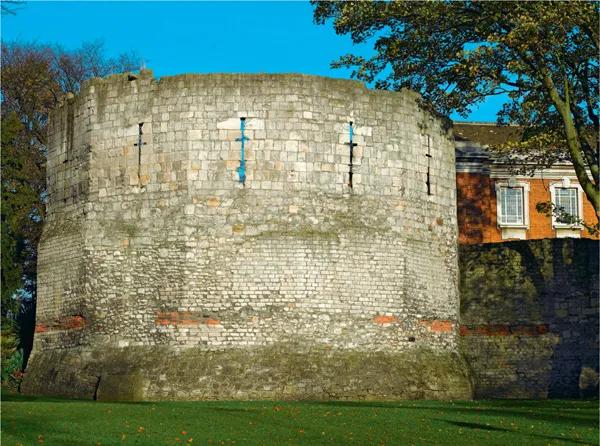
Fig. 1 The Multangular Tower, York. The lower part of this fourteen-sided tower dates from the late 3rd or early 4th century and formed part of the Roman fortress of York. The upper stages were rebuilt and reused in the 13th century. Throughout the early Middle Ages large Roman structures such as this dominated many English towns.
In 410, in the face of complex problems across the empire and a decline in the importance of Britannia, the Emperor Honorius ordered the remaining units of the Roman army to leave Britain and told the Romano-British to fend for themselves. With the exit of the army came the collapse of Roman state control and its economy. The legions had been responsible for maintaining centralised government with coinage and taxation, laws and the physical infrastructure of roads and fortifications. Their removal exposed what was to become England to the destructive forces of the barbarian world.1
The first wave of settlers that came to East Anglia in the first half of the 5th century was from northern Germany. They were farmers attracted by the agricultural potential of England who had little direct experience of the Roman way of life – and even less interest in it. These peoples kept contact with their homelands, moving backwards and forwards, bringing and transferring fashions in everything from weapons to jewellery and, of course, buildings. The newcomers were not especially numerous but were highly successful at establishing themselves, by force, as the landlords of the native British population. So much so that by 600, although the genetic make-up of what is now England was still heavily British, people spoke Anglo-Saxon, worshipped Germanic gods and shared Germanic fashions. A hundred years later there was a sense of emerging Englishness, but not politically, for the land that became England was still divided into a number of small kingdoms, each with its own kings, customs and ambitions (fig. 2).
Many towns had already been in decline before the legions left, but after their departure the collapse was sudden and fundamental. We know that people continued to live in some of them after the Roman administration ended – in Colchester, Cirencester, Wroxeter, Carlisle, St Albans. But this was not a continuation of urban life, with civic, social and economic structures. It was life in towns, not town life. This is fundamentally different to what happened in Gaul; there, Roman cities formed the building blocks of Frankish rule. From these places taxes were levied, in them administration was centred, and to them secular and ecclesiastical rulers were attracted. So why were the British Roman towns abandoned?2
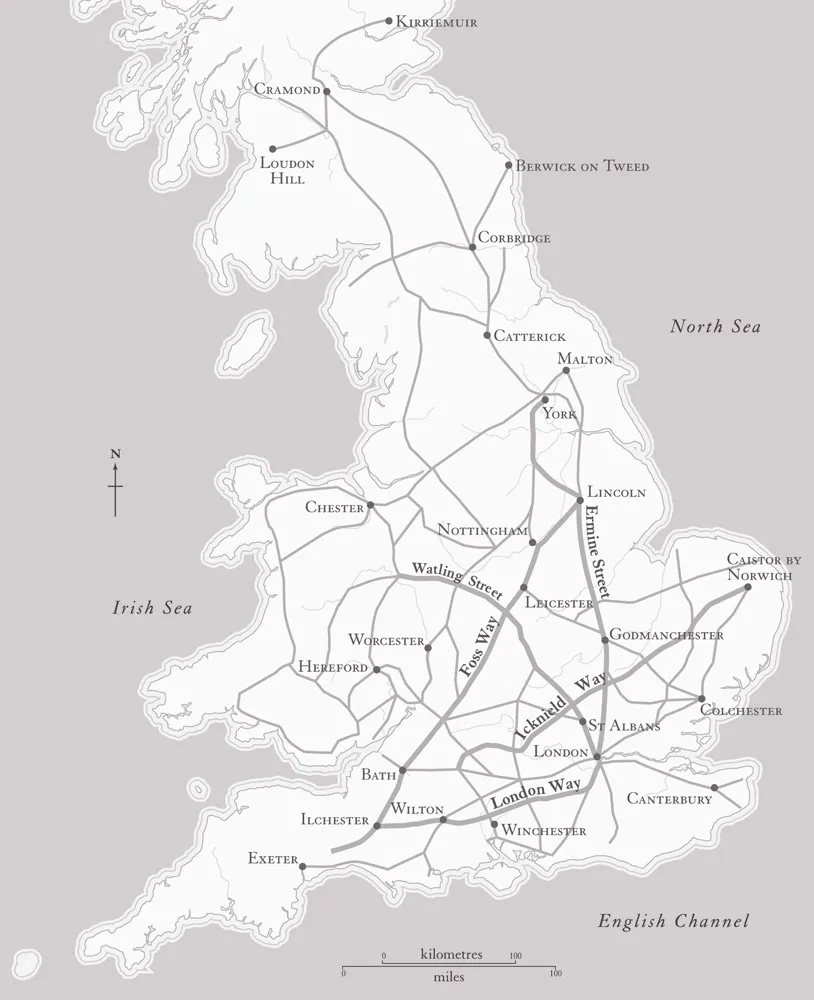 |
Fig. 2 Early Anglo-Saxon England showing the Roman road network and, overlaid in a thicker line, the roads that remained in regular use in the Anglo-Saxon period. |
The walled towns of Roman Britain were generally much larger than those in Gaul, where, in the late Roman period, only the central part was protected. The walls of Winchester or Canterbury, for instance, enclosed the entirety of the settlement and were thus much longer than their continental counterparts (most enclosed around forty hectares). Such places were difficult to defend and expensive to repair. A Roman legion could do both jobs, but after the collapse of Roman authority, mechanisms were simply not in place for this to happen. Towns in Gaul, smaller, and easier to maintain and defend, had a strong afterlife in a way that the English towns did not. |
As a result, what happened in Britain after the Romans left was more radical and fundamental than what happened to its nearest Romanised neighbours. In the years after 410 new social and economic structures emerged in which towns played no part – England was now agrarian, localised and small-scale, elites were mobile and there was no market economy. |
Yet importantly, the physicality of Rome had not been forgotten. The Northumbrian monk, Bede, England’s first historian, writing in 731, tells us that Roman ‘cities, forts, bridges and roads’ were still visible, while an anonymous contemporary of his wrote a poem about the ruins of Aquae Sulis, modern-day Bath: ‘Splendid is this masonry – the fates destroyed it; the strong buildings crashed, the work of giants moulders away. The roofs have fallen, the towers are in ruins, the barred gate is broken.’3 |
As we shall see, in many places the ruins of Roman towns and fortifications dominated the landscape well into the Middle Ages. Roman buildings were, after all, built with iron-hard hydraulic lime mortar; they did not fall down, they needed to be demolished. Parts of the Roman road network survived, too. The Anglo-Saxons appropriated the most important of these as ‘royal roads’: the former Roman Watling Street, Ermine Street and Foss Way, together with the prehistoric Icknield Way (fig. 2). In addition to these it is known that other roads, such as Dere Street north of Hadrian’s Wall, remained in serviceable use. |
Bridges were an essential component of the Roman network, too, and it seems some of the most important of these remained intact. Roman bridges at Rochester, Chester, London and Cambridge are likely to have been maintained by the Saxons, and several others were rebuilt in timber.4 Roads and bridges were not only important factors in the growth of settlements; they helped the movement of building materials. The Roman stone from which the church at Brixworth, Northamptonshire, was built (p. 42), was brought down the Fosse Way and then Watling Street from Leicester 28 miles away. |
Even more important than the physical remains of Rome was its intellectual and cultural legacy. With the fall of the political and military empire, Rome entered a new phase as the headquarters of world Christianity and, for educated Anglo-Saxons such as Bede, became the headquarters of the world. For the whole Anglo-Saxon period there was a real sense that the cultural and intellectual capital of England was Rome. The East Anglian king, Raedwald, who was buried in a great ship at Sutton Hoo, Suffolk, in around 624, was surrounded by objects identifying him as much as a Roman ruler as an Anglo-Saxon feast-giver. Julius Caesar was claimed by 8th-century Saxon kings as among their ancestors, and some East Anglian coins even included an image of Romulus and Remus.5 |
This fascination with Rome is a thread that runs through this book. There is a sense in which the history of English architecture until the late 18th century can be explained as a quest to re-create Roman buildings. King Alfred the Great at Winchester (p. 46), William the Conqueror at the White Tower (p. 69), Edward Seymour at Somerset House (p. 280) and Lord Burlington at Chiswick (p. 318) were all trying to achieve the same thing. And it was not just the 18th-century Grand Tourists who went to Rome in person; in Anglo-Saxon England kings, bishops, parish clergy and ordinary people all made the long and dangerous pilgrimage to Rome. In the Leonine City on the edge of Rome was the Schola Saxonum, a lodging house for English pilgrims supported by a tax raised by English kings. England was no provincial outpost; those who had the wealth to commission buildings were not ignorant of the great buildings of the ancients in Rome.6
How the Saxons Built
The early Anglo-Saxon world, unlike ours, was not primarily a built one. Special places were normally natural ones: rivers, hills, woods. Indeed, their language had words for circles and curves, but expressing straight lines and right angles was difficult. The natural world therefore played a large role in building. Most churches, for instance, were not aligned by compass point to the east, but were laid out by sighting the sun at sunrise and sunset either on saints’ feast days, Easter, or on the spring or autumn equinoxes.7
Almost all secular buildings were built of timber; indeed, the Anglo-Saxon verb ‘to build’ is timbrian, and buildings were getimbro. Timber was not seen as a lower-status material than stone, nor was the skill to use it effectively lesser than that of the mason. Indeed, even in the early Saxon period, the achievements of leading English carpenters were considerable. That English building between the Romans and the Vikings was almost entirely of timber demonstrates that efficient woodland management must have continued after 410, albeit at a local level. This involved cyclically harvesting the underwood (coppicing) but allowing the oaks to grow in longer rotations (between twenty and seventy years). Coppicing provided fuel as well as all the non-structural building timber, including poles for scaffolding. Oaks were selected by carpenters, felled, their branches and bark removed, and then squared up and used for the structure of buildings. Oak was worked green (without being seasoned), the structure tightening up as the timber dried out. The most important woodworking tool was the axe used for cutting and smoothing, but hammers, adzes, boring-bits, chisels, gouges, planes and saws have been excavated from Anglo-Saxon sites. Nails were not used and fastening was by simple joints with timber pegs. The highest-status buildings might also include iron straps, hinges and catches, as ironworking and smithing continued after the Romans left.

Fig. 3 St Peter’s, Wearmouth, County Durham. The lowest stage of the tower was built in around 680 and was originally a single-storeyed porch; it was heightened c.700 and then again in the later Middle Ages. The remarkable porch, which never had doors, is flanked by cylindrical stone drums probably turned on a lathe like timber balusters. The Saxon nave lies behind the tower; the aisle to the left is 13th century.
Coppicing produced the wattles necessary for certain types of wall construction. Wattling involves a row of upright stakes, the spaces between which are filled by interweaving flexible branches, often rods of hazel, which are then covered with daub, either mud, clay or, in more sophisticated buildings, lime plaster. Roofs were not covered with sl...
Table of contents
- Title Page
- Contents
- Introduction
- 1—Beginnings: The Collapse of Rome: 410–700
- 2—The Foundations of England: 700–1000
- 3—England and Europe: 1000–1130
- 4—The Invention of English Architecture: 1130–1250
- 5—Extravaganza: 1250–1350
- 6—From the Black Death to the Reformation: 1350–1530
- 7—From the Reformation to the Civil War: A Century of Growth: 1530–1630
- 8—Protestantism, Power and Prosperity: 1630–1720
- 9—Property, Commerce and Consensus: 1720–1760
- 10—War, Inventions and Introspection: 1760–1830
- 11—World Dominance: 1830–1870
- 12—1870s to the Second World War: 1870–1939
- Endnotes
- Picture credits
- Index
- Acknowledgements
- Copyright
- About the Publisher
Frequently asked questions
Yes, you can cancel anytime from the Subscription tab in your account settings on the Perlego website. Your subscription will stay active until the end of your current billing period. Learn how to cancel your subscription
No, books cannot be downloaded as external files, such as PDFs, for use outside of Perlego. However, you can download books within the Perlego app for offline reading on mobile or tablet. Learn how to download books offline
Perlego offers two plans: Essential and Complete
- Essential is ideal for learners and professionals who enjoy exploring a wide range of subjects. Access the Essential Library with 800,000+ trusted titles and best-sellers across business, personal growth, and the humanities. Includes unlimited reading time and Standard Read Aloud voice.
- Complete: Perfect for advanced learners and researchers needing full, unrestricted access. Unlock 1.4M+ books across hundreds of subjects, including academic and specialized titles. The Complete Plan also includes advanced features like Premium Read Aloud and Research Assistant.
We are an online textbook subscription service, where you can get access to an entire online library for less than the price of a single book per month. With over 1 million books across 990+ topics, we’ve got you covered! Learn about our mission
Look out for the read-aloud symbol on your next book to see if you can listen to it. The read-aloud tool reads text aloud for you, highlighting the text as it is being read. You can pause it, speed it up and slow it down. Learn more about Read Aloud
Yes! You can use the Perlego app on both iOS and Android devices to read anytime, anywhere — even offline. Perfect for commutes or when you’re on the go.
Please note we cannot support devices running on iOS 13 and Android 7 or earlier. Learn more about using the app
Please note we cannot support devices running on iOS 13 and Android 7 or earlier. Learn more about using the app
Yes, you can access The Building of England by Simon Thurley in PDF and/or ePUB format, as well as other popular books in Architecture & Architecture General. We have over one million books available in our catalogue for you to explore.