eBook - ePub
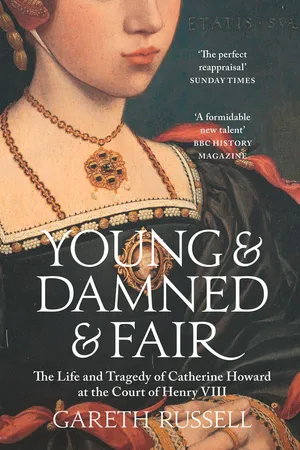
Young and Damned and Fair
The Life and Tragedy of Catherine Howard at the Court of Henry VIII
- English
- ePUB (mobile friendly)
- Available on iOS & Android
eBook - ePub
Young and Damned and Fair
The Life and Tragedy of Catherine Howard at the Court of Henry VIII
About this book
SHORTLISTED FOR THE SLIGHTLY FOXED BEST FIRST BIOGRAPHY PRIZE 2017
Born into nobility and married into the royal family, Catherine Howard was attended every waking hour – secrets were impossible to keep. In this thrilling reappraisal of Henry VIII's fifth wife, Gareth Russell's history unfurls as if in real time to explain how the queen's career ended with one of the great scandals of Henry's reign. This is a grand tale of the Henrician court in its twilight, a glittering but pernicious sunset during which the king's unstable behaviour and his courtiers' labyrinthine deceptions proved fatal to many, not just to Catherine Howard.
Trusted by 375,005 students
Access to over 1 million titles for a fair monthly price.
Study more efficiently using our study tools.
Information
Chapter 1
The Hour of Our Death

Renounce the thought of greatness, tread on fate,
Sigh out a lamentable tale of things
Done long ago, and ill done; and when sighs
Are wearied, piece up what remains behind
With weeping eyes, and hearts that bleed to death.
– John Ford, The Lover’s Melancholy (1628)
A benefit of being executed was that one avoided any chance of the dreaded mors improvisa, a sudden death by which a Christian soul might be denied the opportunity to make their peace. So when Thomas Cromwell was led out to his death on 28 July 1540, he had the comfort of knowing that he had been granted the privilege of preparing to stand in the presence of the Almighty. The day was sweltering, one in a summer so hot and so dry that no rain fell on the kingdom from spring until the end of September, but the bulky hard-bitten man from Putney who had become the king’s most trusted confidant and then his chief minister1 walked cheerfully towards the scaffold.2 He even called out to members of the crowd and comforted his nervous fellow prisoner Walter, Lord Hungerford, whose sanity was questionable, and who had been condemned to die alongside him for four crimes, all of which carried the death penalty. Firstly, he had allegedly committed heresy, in appointing as his private chaplain a priest rumoured to remain loyal to the pope. Secondly, he was accused of witchcraft, by consorting with various individuals, including one named ‘Mother Roche’, to use necromancy to guess the date of the king’s death. Treason was alleged through the appointment of his chaplain and his meeting with the witch, which constituted a crime against the king’s majesty. He was also found guilty of sodomy, ‘the abominable and detestable vice and sin of buggery’, made a capital crime in 1534, in going to bed with two of his male servants, men called William Master and Thomas Smith.3
Rumours, fermenting in the baking heat and passed between courtiers, servants, merchants and diplomats who had nothing to do but sweat and trade in secrets, had already enlarged the scope of Lord Hungerford’s crimes. The French ambassador reported back to Paris that the condemned man had also been guilty of sexually assaulting his own daughter. It was whispered that Hungerford had practised black magic, violating the laws of Holy Church that prohibited sorcery as a link to the Devil. Others heard that Hungerford’s true crime had been actively plotting the murder of the king.4 None of those charges were ever mentioned in the indictments levelled against Hungerford at his trial, but the man dying alongside him had perfected this tactic of smearing a victim with a confusing mélange of moral turpitudes guaranteed to excite prurient speculation and kill a person’s reputation before anyone was tempted to raise a voice in their defence.
The hill where they now stood had been the site of the finales to some of Cromwell’s worst character assassinations. It had been there, four years earlier on another summer’s day, that George Boleyn had perished before similarly large crowds after Cromwell arranged a trial that saw him condemned to death on charges of incest and treason. The details of Boleyn’s alleged treason had been kept deliberately vague during the trial, while the prosecution’s fanciful descriptions of his incestuous seduction of his sister had been excruciatingly, pornographically vivid. Boleyn, as handsome as Adonis and proud as Icarus, had defended himself so well against the accusations there had been bets that he would be acquitted.5 When he was not, when he was condemned to die alongside four other men two days later, no one could risk speaking out for a man found guilty of committing such a bestial act.
Boleyn had died in sight of the Tower’s brooding walls, its cupolas and fortifications twin testaments to the inescapably neurotic nature of power. Within the Tower’s sheltered courtyards, George’s Boleyn’s sister, Queen Anne, was executed in a more private setting, before a carefully vetted crowd of around one thousand, which was tiny in comparison to that allowed to gather beyond the walls to watch her brother perish – and now Cromwell and Walter Hungerford.6 Like Thomas More before her, another political heavyweight in whose destruction Cromwell had been intimately involved, Anne Boleyn had embraced the sixteenth century’s veneration for the ars moriendi – the art of dying.
The veil between life and death was made permeable by the teachings of Christianity. Everywhere one looked, there was proof of society’s lively fascination with the next life. Death was the great moral battleground between one’s strengths and weaknesses; the supreme test came when the finite perished and the eternal began. To die well, in a spirit of resignation to the Will of God and without committing a sin against hope by despairing of what was to come next, was a goal endlessly stressed to the Faithful in art, sermons, homilies and manuals. Within the great basilica of Saint-Denis in Paris, the tomb of King Louis XII and Anne of Brittany, his queen, showed the couple rendered perfect in the stonemasons’ marble, united atop the monument, their bejewelled hands clasped in prayer, their robes and crowns exquisitely carved; but beneath that sculpture the craftsmen had offered a very different portrait of the royal forms – there, the bodies of the king and queen were shown twisting and writhing in the first stages of putrefaction, their feet bare, their hair uncovered and their flesh pullulating with the onset of corruption.7 Throughout Europe, these cadaver tombs, the transi, were commissioned by the rich and the powerful to show their submission to the final destruction of their flesh and with it the removal of this sinful world’s most potent temptations. In corruption they had been born and so through corruption they could be born again.
In the sixteenth century, life was precious, truncated at any moment by plague, war or one of a thousand ailments that would be rendered treatable in the centuries to come, and so the people embraced it with a rare zeal. But living well, as Anne Boleyn had noted at her trial, also meant dying well.8 Christians were supposed to die bravely because of the surety of mercy that even the weakest and most sinful was guaranteed by their religion, provided he or she had respected its doctrines and honoured its God. Before they were marched to the hill, Cromwell told Lord Hungerford that ‘though the breakfast which we are going to be sharp, yet, trusting to the mercy of the Lord, we shall have a joyful dinner’.9 To the overwhelming number of Henry VIII’s subjects, Christianity was not a theory, it was not a belief system, it was not one religion among many – it was, more or less, a series of facts, the interpretation of which could be debated, but whose essential truth was inescapable and uncontested. The result of this way of accepting and experiencing their faith was that sixteenth-century Christians often behaved in ways which were paradoxically far more devout but also far more relaxed than their modern-day co-religionists. The line between sinners and the flock was not so clearly delineated, because even the worst members of society were still, in one way or the other, almost certainly believing Christians. All men were weak, all men would fail, all men would die, all men could be saved.
A celebrated person’s execution, their final public performance, was such an exciting event that people made the journey into London especially for it. Vast crowds surged through London, converging on Tower Hill to watch the annihilation of the detested commoner who had somehow risen to become Earl of Essex – a sign of royal favour given to him only a few weeks before he was arrested at a meeting of the Privy Council and taken to the Tower. The last ascent in the life of the Englishman who had risen farther than anyone else in his century were the wooden steps to the scaffold. Thomas Cromwell had not been a popular figure, but royal advisers seldom are. Snobbery played a large role in his reputation – an English diplomat described Cromwell as a man who had been ‘advanced from the dunghill to great honour’ – but so did his actions.10 Ruthless, determined, brilliant, and utterly Machiavellian, Cromwell had overseen the destruction of many an aristocratic career and the evisceration of the old religion in England. Many of his opponents blamed him for tearing asunder the spiritual framework that they had lived, and hoped to die, by. The sacraments and liturgies of the Church had given a rhythm to the year, they had bestowed the tools for salvation on the faithful for centuries, and marked every major moment in a Christian’s life. In 1536, Cromwell had weathered the Pilgrimage of Grace, a traditionalist uprising which spread through most of northern England and which had demanded his removal from power. However, he could not survive the loss of the king’s favour four years later. His enemies surrounded him and he was condemned to death on a long list of crimes that included heresy, treason, and financial corruption.
The crowds entering the capital on 28 July 1540 came from every background, with well-born women wearing veils to shield their faces from the sun, while urchins wore battered hand-me-down cheap leather shoes which prevented their feet from being cut on the animal bones and refuse that littered the city streets. With no rain, the mud in the streets had become a dry dust that would turn into ankle-depth filth when the clouds broke in autumn. The spectators passed through the capital’s eighteen-foot high defensive walls via one of the seven gates. Those travelling in from the Hampshire and Surrey countryside entered through Newgate, while those from nearby Smithfield, home to a bustling meat market, accessed the City at Aldersgate. Smithfield also contained London’s designated red-light district, the aptly named Cock Lane. Subtlety in the assigning of place names was not a medieval strongpoint. The southwestern city of Exeter had renamed one of its rivers Shitbrook, because of the amount of faeces and waste it contained, and in Oxford, students hoping for an early sexual experience courtesy of the town’s prostitutes could find it on Gropecunt Lane, a narrow alley that ran from just opposite the university church of St Mary the Virgin down to the entrance of Oriel College.11
Rather more elegant sights awaited those who were travelling towards Cromwell’s execution via the Strand, a long straight road lined with the episcopal palaces and impressive homes of the aristocracy. The Strand had been the site of the Savoy Palace, principal residence of Richard II’s powerful uncle John of Gaunt, until it was burned down during the Peasants’ Revolt of 1381. It was eventually replaced by the Hospital of St John the Baptist, one of the most impressive medical establishments in early modern Europe, founded under the patronage of Henry VIII’s father. Near the hospital was one of the Eleanor Crosses, funerary monuments erected by a grief-stricken Edward I in 1290 to mark each of the fourteen spots where his wife’s coffin rested on its final journey to Westminster Abbey. This, the last halt before the interment, was now where professional water-sellers took advantage of the area’s excellent plumbing, which on occasion pumped the local fountains with wine or beer to celebrate an especially significant royal event – the last time had been for the birth of the heir to the throne, Prince Edward, in 1537. On a hot and busy day like this, as families and groups of friends swarmed towards the Tower, the Charing Cross water-sellers could reasonably have expected to turn a handsome profit.12
London in July 1540 was the perfect capital for Henry VIII’s domains: a broken society whose fracture lines were both reflected and grotesquely magnified throughout the city. Along the banks of the Thames, formerly semi-rural areas like Deptford and Woolwich were now shipyards for the Royal Navy, where titanic amounts of money poured into the construction of warships designed to repel the French and Spanish, if they ever came. Londoners grumbled at the despoiling of some of the few green areas left to them; they valued their leaf-dappled refuges so much that earlier in the king’s reign thousands had rioted over plans to encroach on the area of parkland around Soho, a district which got its name from a traditional hunting cry, ‘So, ho!’
Riots were rare in Henrician England, but tensions were constant and none were more intense than those caused by the country’s break with Rome. Seven years before Cromwell’s execution, the king had repudiated papal authority and embarked upon his own version of the Reformation in what rapidly became one of the least articulate government policies in British history. There was absolutely no clear strategy for where the Church of England should go once it was commanded from London rather than Rome. The king, who had harnessed anti-clericalism in Parliament to secure his dream of annulling his marriage to Katherine of Aragon, had then hurled himself into what initially looked like the wholesale dismemberment of English Catholicism. The severing of obedience to the Vatican was the initial step in a legal, cultural, and economic revolution. The monasteries were dissolved, or pressured to surrender, first the smaller abbeys, then the larger and wealthier. On the eve of the Reformation, about one-third of the land in England belonged to the Church and so the seizure of its assets became an unsavoury bonanza for the government and its supporters, whose loyalty to the regime was often bought with gifts of land taken from the religious orders.
The first human casualties after the break with Rome had been the conservatives who could not in good conscience abjure their oaths of loyalty to the pope. There were some among them who, despite their misgivings, were prepared to acknowledge that canon law just about permitted the king’s banishment of Katherine of Aragon and marriage to Anne Boleyn, whom even Thomas More had acknowledged as ‘this noble woman royally anointed queen’, but under no circumstances could they accept that Henry had the right to make himself Supreme Head on Earth of the Church of England and Ireland.13 Thomas More, the country’s former Lord Chancellor, and the esteemed scholar Cardinal John Fisher went to the block in 1535. The leaders of the Carthusian order of monks were hanged until they were half dead, cut down to be castrated, disembowelled and only then beheaded. The country folk coming into London through Newgate for Cromwell’s death had to pass by the looming, grey-stoned edifice of Newgate prison, where three hermits, one deacon and six monks had been stripped, chained to posts with their hands tied behind their backs and simply left to starve to death in their cells, rotting towards martyrdom in excruciating pain and their own gathering excrement. One plucky Catholic lady, a doctor’s wife, disguised herself as a milk maid, bribed the guards to let her into the cell and fed, watered and bathed the condemned gentlemen. The gaolers tightened security after the king irritably asked how the condemned men had remained alive for so long.14
A few miles to the west of the prison was Tyburn, the site of near-daily executions of criminals – rapists, horse thieves, forgers and murderers. It was here that many of the Carthusian monks met their end after being processed through the streets tied to a wicker hurdle pulled by a slow-moving horse. Back at Smithfield, within sight of the grubby walkways of Cock Lane, Father John Forest had been burned to death atop a pyre that consisted of religious statues, including one of Saint Derfel, taken from a pilgrimage centre in north Wales. There was a hideous poetic irony in using the symbols of pre-Reformation Christianity to incinerate one of its most vocal sympathisers.
For the poorest of the poor, the Reformation initially brought a different kind of martyrdom. Admittedly, the Church had not always done all that it could to alleviate poverty, but as medieval Catholicism’s emphasis on charity as a means to secure salvation came under attack by reformers, beggars would have been a depressingly and increasingly familiar sight for the spectators. This was especially true for those from Smithfield whose monastic hospital and poorhouse, St Bartholomew’s Priory, had been shut down during the dissolutions, leaving the local poor and invalided defenceless, friendless and often homeless. Throughout London it was the same, with those who had relied on the Church either for charity or work, wandering the streets, joined by the hundreds who poured in from the countryside where the dissolutions had closed off many traditional forms of employment or benefice. Nor were the seized properties being put to edifying use in the post-monastic world. Courtiers, lawyers and merchants who benefited from the government’s liberality often turned the former abbeys and churches into stinking tenements, overpacked and overpriced, where families lived in pathetically cramped quarters with rampant disease and indifferent landlords. The church of St Martin-le-Grand was demolished to make way for a tavern; Bermondsey Abbey, where Henry VIII’s grandmother Elizabeth Woodville had spent the final few years of her life, became a bull-fighting arena, before it was demolished to make way for the private home of a lawyer who worked on the Court of Augmentations, the legal body set up to deal with former monastic lands; the Priory of St Mary Overy became a bear-baiting pit. Statues of saints and angels had been torn from their niches and burned in a crusade against the old ways; yet even with such zeal from the iconoclastic reformers, clear religious policy, vital in an age which still carried the death penalty fo...
Table of contents
- Title Page
- Copyright
- Dedication
- Epigraph
- Contents
- Maps
- Family Trees
- Introduction
- 1. The Hour of Our Death
- 2. Our Fathers in Their Generation
- 3. Lord Edmund’s Daughter
- 4. The Howards of Horsham
- 5. Mad Wenches
- 6. The King’s Highness Did Cast a Fantasy
- 7. The Charms of Catherine Howard
- 8. The Queen of Britain Will Not Forget
- 9. All These Ladies and My Whole Kingdom
- 10. The Queen’s Brothers
- 11. The Return of Francis Dereham
- 12. Jewels
- 13. Lent
- 14. For They Will Look Upon You
- 15. The Errands of Morris and Webb
- 16. The Girl in the Silver Dress
- 17. The Chase
- 18. Waiting for the King of Scots
- 19. Being Examined by My Lord of Canterbury
- 20. A Greater Abomination
- 21. The King Has Changed His Love into Hatred
- 22. Ars Moriendi
- 23. The Shade of Persephone
- Appendix I: The Alleged Portraits of Catherine Howard
- Appendix II: The Ladies of Catherine Howard’s Household
- Appendix III: The Fall of Catherine Howard
- Acknowledgements
- List of Illustrations
- Picture Section
- Bibliography
- Notes
- Index
- About the Author
- By the Same Author
- About the Publisher
Frequently asked questions
Yes, you can cancel anytime from the Subscription tab in your account settings on the Perlego website. Your subscription will stay active until the end of your current billing period. Learn how to cancel your subscription
No, books cannot be downloaded as external files, such as PDFs, for use outside of Perlego. However, you can download books within the Perlego app for offline reading on mobile or tablet. Learn how to download books offline
Perlego offers two plans: Essential and Complete
- Essential is ideal for learners and professionals who enjoy exploring a wide range of subjects. Access the Essential Library with 800,000+ trusted titles and best-sellers across business, personal growth, and the humanities. Includes unlimited reading time and Standard Read Aloud voice.
- Complete: Perfect for advanced learners and researchers needing full, unrestricted access. Unlock 1.4M+ books across hundreds of subjects, including academic and specialized titles. The Complete Plan also includes advanced features like Premium Read Aloud and Research Assistant.
We are an online textbook subscription service, where you can get access to an entire online library for less than the price of a single book per month. With over 1 million books across 990+ topics, we’ve got you covered! Learn about our mission
Look out for the read-aloud symbol on your next book to see if you can listen to it. The read-aloud tool reads text aloud for you, highlighting the text as it is being read. You can pause it, speed it up and slow it down. Learn more about Read Aloud
Yes! You can use the Perlego app on both iOS and Android devices to read anytime, anywhere — even offline. Perfect for commutes or when you’re on the go.
Please note we cannot support devices running on iOS 13 and Android 7 or earlier. Learn more about using the app
Please note we cannot support devices running on iOS 13 and Android 7 or earlier. Learn more about using the app
Yes, you can access Young and Damned and Fair by Gareth Russell in PDF and/or ePUB format, as well as other popular books in History & Historical Biographies. We have over one million books available in our catalogue for you to explore.