![]()
Aldershot Cathedral
RC – BISHOPRIC OF THE FORCES
Cathedral Church of St Michael and St George,
Queens Avenue, Aldershot, Hampshire, GU11 2BY
01252 329684 | www.rcbishopricforces.org.uk/cathedral
The Cathedral Church of St Michael and St George serves as the Roman Catholic cathedral for the Bishopric of the Forces, which provides chaplains to the British Armed Forces. The church was designed in 1892 by two military engineers; Ingers Bell and Aston Webb. It was originally intended as the principal church for the Anglican chaplaincies of the British Army and therefore the ruling British monarch (the ‘Supreme Governor of the Church of England’), Queen Victoria, laid the cathedral’s foundation stone on 27 June 1892 and was present at the consecration by the Bishop of Winchester on 7 October 1893.
However, in the early 1970s the number of Catholic soldiers in the area was on the rise and their previous place of worship, the Church of St Michael and St Sebastian, was becoming unsuitable. Since there were other Church of England churches locally, the cathedral became the seat of the Roman Catholic Bishop of the Forces and was dedicated to both St Michael and St George. Originally dedicated solely to St George, an image of the Saint standing above the slain dragon still resides above the main entrance. Interestingly, several of the stained glass windows do not fit neatly into their frames because they were painstakingly moved from their original home at the Church of St Michael and St Sebastian when it closed in 1973.
![]()
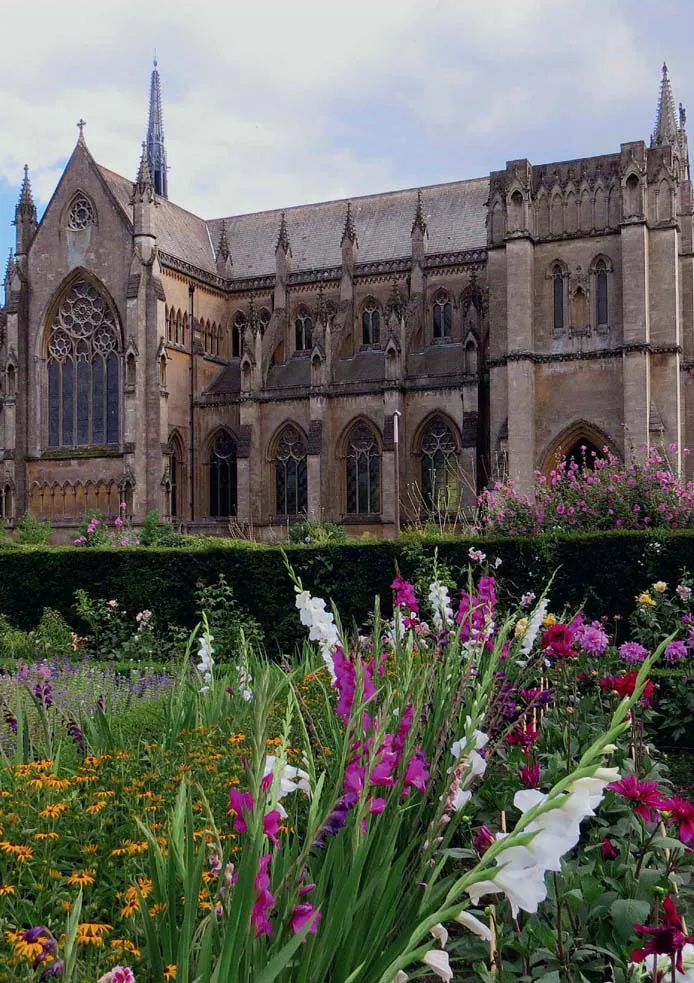
Arundel Cathedral
RC – DIOCESE OF ARUNDEL AND BRIGHTON
Cathedral Church of Our Lady and St Philip Howard, London Road, Arundel, West Sussex, BN18 9AY 01903 882297 | www.arundelcathedral.org
The Cathedral Church of Our Lady and St Philip Howard was originally dedicated to the Italian St Philip Neri in 1873, having been established by Henry Fitzalan-Howard, 15th Duke of Norfolk, as the Catholic parish church of Arundel. Interestingly, Joseph Hansom, inventor of the Hansom cab, was responsible for the French Gothic architecture of the church. As Dukes of Norfolk and Earls of Arundel, the Howard family plays a particularly prominent part in the history of Arundel and their family seat is still the nearby castle. Indeed, when the church was designated a cathedral in 1965 and rededicated to both Our Lady and St Philip, the dedication was changed eight years later to Howard ancestor St Philip Howard (1557–95) who was canonised as a martyr after his death in the Tower of London.
![]()
ronald ian smiles
![]()
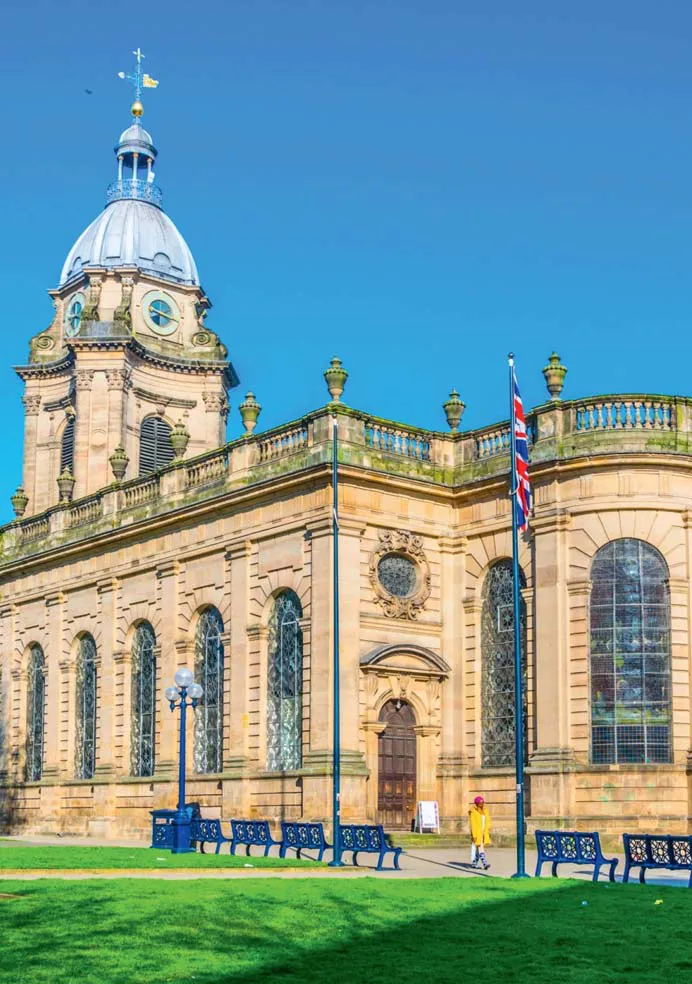
Birmingham Cathedral
COE – DIOCESE OF BIRMINGHAM
The Cathedral Church of St Philip,
Colmore Row, Birmingham, B3 2QB
0121 262 1840 | www.birminghamcathedral.com
Designed by the English Baroque architect, Thomas Archer, St Philip’s was built as a parish church in 1715 to accommodate Birmingham’s growing population. The church was built at the highest point in Birmingham, on land provided by local landowners Inge and Elizabeth Phillips. Most churches of the time were dedicated to a prominent saint, however in this instance the Philips family were rewarded for their generosity with a dedication to their namesake saint, the Apostle Philip. Following Birmingham’s promotion to city status in 1889 the church became the cathedral seat for the newly formed diocese and Bishop of Birmingham, Charles Gore, in 1905. It is modest in size for a cathedral and at 150 feet long (46 metres). Whilst the cathedral was heavily bombed in 1940 during the Second World War, thankfully Birmingham Civic Society had the forethought to remove and protect the cathedral’s precious stained glass windows in the early stages of the war. The windows were replaced during restoration work in 1948.
![]()
trabantos
![]()
Birmingham Cathedral
RC – ARCHDIOCESE OF BIRMINGHAM
St Chad’s Cathedral,
Cathedral House, St Chad’s Queensway,
Birmingham, B4 6EU
0121 236 2251 / 0121 236 5535 |
www.stchadscathedral.org.uk
St Chad’s was the first Catholic cathedral to be built in England after the English Reformation, which was initiated in 1534 by King Henry VIII. Designed by the famous Gothic revivalist architect, Augustus Welby Northmore Pugin, it was completed in 1841 and raised to cathedral status in 1850 when Pope Pius IX restored the Catholic hierarchy of England and Wales. Pugin’s son and grandson have both added to his work over the years with a memorial spire and chapel respectively.
One hundred years after it was built the cathedral was granted minor basilica status by Pope Pius XII. This allows for the papal coat-of-arms to be placed above the main entrance and use of other symbols designating the cathedral’s special relationship with the Pope, such as the scarlet and purple ‘cappa parva’ worn by the Canons of the Chapter. The cathedral escaped serious damage during the Second World War ‘Blitz’ of 1940–1 despite a direct hit from a bomb in November 1940. Entering through the roof of the building, the bomb exploded on contact with the cathedral’s central heating pipes. Perhaps the work of divine intervention, water from the burst pipes dowsed the flames of the explosion, saving the cathedral from any further damage.
![]()
Birmingham Cathedral
Nick Maslen
![]()
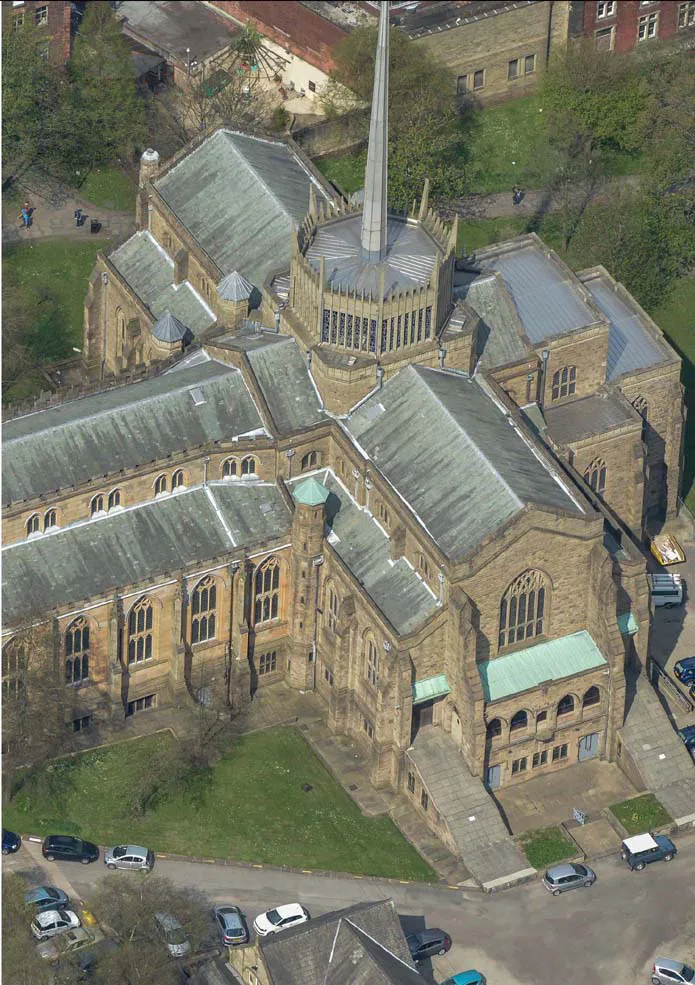
Blackburn Cathedral
COE – DIOCESE OF BLACKBURN
Cathedral Church of Blackburn Saint Mary the Virgin with St Paul
Cathedral Close, Blackburn, BB1 5AA
01254 277430 | www.blackburncathedral.com
This cathedral is one of England’s newest cathedrals, having been elevated to cathedral status in 1926 with the creation of the Diocese of Blackburn. The existing parish church of St Mary the Virgin, which was built on the site in 1826 by Georgian architect John Palmer, now forms the cathedral’s nave.
With the outbreak of the Second World War, plans to extend the existing building were put on hold. The impressive additions that make up the building we see today began in 1938 and were completed in 1977, when the church was formally consecrated as a cathedral. It has seen further restoration to blend modern (1960s) architecture with the earlier structure. The concrete lantern tower was replaced with natural stone and the east end roof and parapets rebuilt. The site of the cathedral has been home to a holy building since the 11th century, with the 5th Abbot of Whalley, John Lindley, suggesting a link to Romano-British Christianity as far back as AD 596.
![]()
Commission Air
2323__perlego__chapter_...