![]()
Andromeda
Andromeda represents the daughter of Queen Cassiopeia who was chained to a rock as a sacrifice to the sea monster Cetus until saved by Perseus, whom she subsequently married. The constellation originated in ancient times. Despite its fame, Andromeda is not particularly striking: its brightest stars are only 2nd magnitude. Its most prominent feature is a crooked line of four stars extending from the Square of Pegasus; the first of these stars marks a corner of the Square, although it is actually part of Andromeda. This star, known as Alpheratz, marks the head of the chained Andromeda; another star in the line, Mirach, represents her waist and a third, Almach, is her chained foot. The most celebrated object in the constellation is the Andromeda Galaxy, M31, a spiral galaxy like our own Milky Way; it is the most distant object visible to the naked eye. Two stars leading from Mirach, β (beta) Andromedae, act as a guide to it.
α (alpha) Andromedae, 0h 08m +29°.1, (Alpheratz), mag. 2.1, is a blue-white subgiant 97 l.y. away.
β (beta) And, 1h 10m +35°.6, (Mirach), mag. 2.1, is a red giant 197 l.y. away.
γ (gamma) And, 2h 04m +42°.3, (Almach), 355 l.y. away, is an outstanding triple star. Its two brightest components, of mags. 2.2 and 4.8, form one of the finest pairs for small telescopes: their colours are orange and blue. The fainter, blue star also has a close 6th-mag. blue-white companion that orbits it every 64 years. This fainter pair will be at their widest separation around 2047 and should be divisible in 200-mm apertures for several years either side of this date.
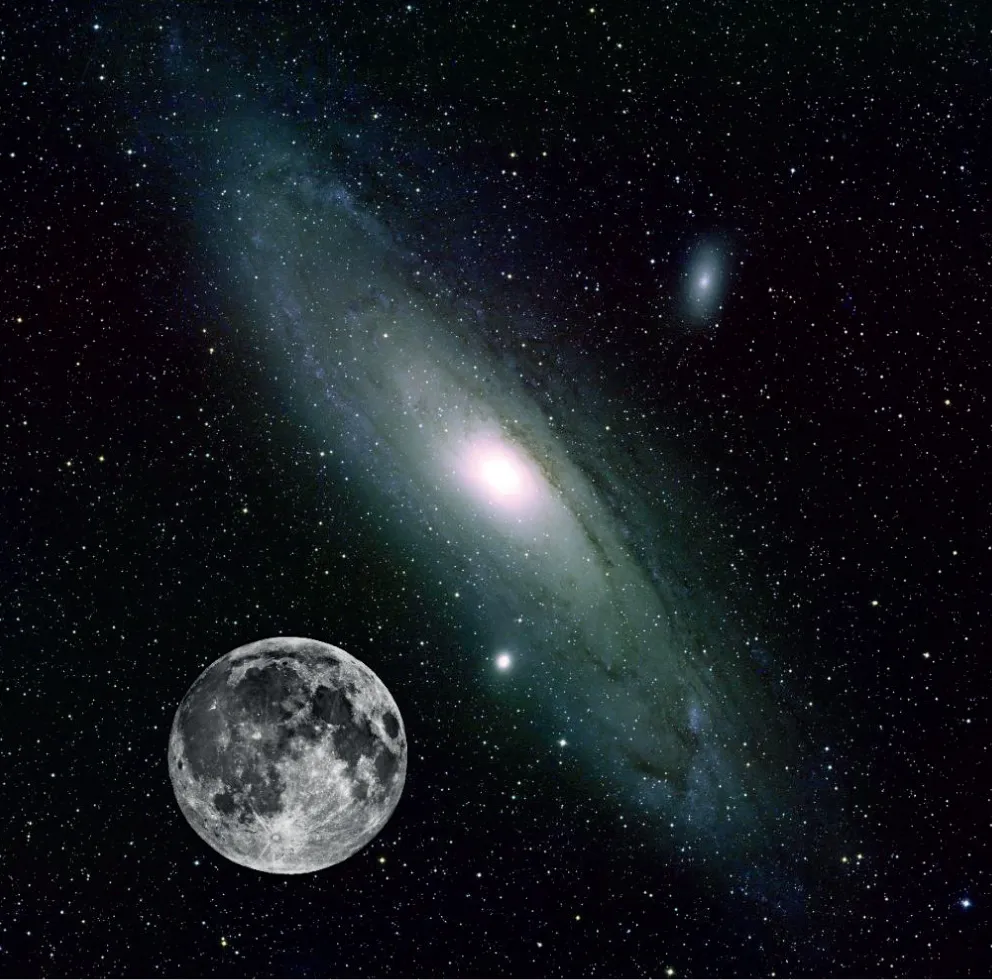
M31, the Andromeda Galaxy, is a magnificent spiral visible to the naked eye, with two smaller companion galaxies that can be seen in small telescopes: M32, superimposed on one of the spiral arms just below centre, and the larger but fainter M110 to the upper right. The full Moon has been added to the same scale to give an impression of the Andromeda spiral’s full extent. (Galaxy image: Bill Schoening, Vanessa Harvey/REU program/NOAO/AURA/NSF)
δ (delta) And, 0h 39m +30°.9, mag. 3.3, is an orange giant 106 l.y. away.
μ (mu) And, 0h 57m +38°.5, mag. 3.9, is a white main-sequence star 130 l.y. away.
π (pi) And, 0h 37m +33°.7, 600 l.y. away, is a blue-white main-sequence star of mag. 4.4 with a mag. 8.6 companion visible in small telescopes.
υ (upsilon) And, 1h 37m, +41°.4, mag. 4.1, is a yellow-white main-sequence star 44 l.y. away. Astronomers have found that it is accompanied by four planets, the first known multi-planet system around a star other than our own Sun.
56 And, 1h 56m +37°.3, is a yellow giant star of mag. 5.7, 316 l.y. away, with an orange giant companion, mag. 5.9 and 920 l.y. away, easily split in binoculars. The two stars are found near the star cluster NGC 752 but are actually closer to us.
M31 (NGC 224), 0h 43m +41°.3, the Andromeda Galaxy, is a spiral galaxy 2.5 million l.y. away. It is visible to the naked eye as an elliptical fuzzy patch, and becomes more prominent when seen through binoculars or a telescope with low magnification (too high a power reduces the contrast and renders the fainter parts of the galaxy less visible). Dark lanes can be seen in the spiral arms surrounding the nucleus. But the full extent of the galaxy becomes apparent only on long-exposure photographs (visual observers see just its brightest, central portion). If the entire Andromeda Galaxy were bright enough to be seen by the naked eye, it would appear five or six times the diameter of the full Moon, as demonstrated in the composite image here. M31 is accompanied by two small satellite galaxies, the equivalents of our Magellanic Clouds but both elliptical rather than irregular in shape. The brighter of these, M32 (NGC 221), is visible in small telescopes as a fuzzy, 8th-mag. star-like glow ½° south of M31’s core. The second companion, M110 (also known as NGC 205), is larger but visually more elusive, and over 1° northwest of M31.
NGC 752, 1h 58m +37°.7, is a widely spread cluster of about 60 stars of 9th mag. and fainter, 1500 l.y. away, visible in binoculars and easily resolved in telescopes.
NGC 7662, 23h 26m +42°.6, is one of the brightest and easiest planetary nebulae to see with a small telescope. At low powers it appears as a fuzzy, 9th-mag. blue-green star, but magnifications of ×100 or so reveal its slightly elliptical disk. Larger apertures show a central hole; the central star is a difficult object for amateur telescopes. NGC 7662 lies about 4000 l.y. away.
Antlia – The Air Pump
An obscure southern constellation introduced on a map published in 1756 by the French astronomer Nicolas Louis de Lacaille to commemorate the air pump invented by the French physicist Denis Papin. Lacaille, the first person to map the naked-eye stars in the southern skies completely (see here), introduced 14 new constellations to fill gaps between existing ones. Most of these new figures are unremarkable, as is Antlia.
α (alpha) Antliae, 10h 27m −31°.1, mag. 4.3, the constellation’s brightest star, is an orange giant 366 l.y. distant.
δ (delta) Ant, 10h 30m −30°.6, 434 l.y. away, is a blue-white star of mag. 5.6 with a mag. 9.6 companion visible in small telescopes.
ζ1 ζ2 (zeta1 zeta2) Ant, 9h 31m −31°.9, is a wide pair of stars of mags. 5.7 and 5.9, 406 and 384 l.y. away, visible in binoculars. Small telescopes show that ζ1 Ant is itself double, with components of mags. 6.2 and 7.0.
NGC 2997: Knots of young blue stars and pink gas as well as lanes of dark dust are visible in the curling arms of this handsome 9th-magnitude spiral galaxy in central Antlia, presented virtually face-on to us. Moderate-sized amateur telescopes are required to see it. (M. Bessell, R. Sutherland and M. Buxton, RSAA – Australian National University)
Apus – The Bird of Paradise
A faint constellation near the south celestial pole, one of the 12 new figures introduced in the 1590s by the Dutch navigators Pieter Dirkszoon Keyser and Frederick de Houtman during voyages to the southern hemisphere. This one represents the exotic bird of paradise, native to New Guinea.
α (alpha) Apodis, 14h 48m −79°.0, mag. 3.8, is an orange giant star 447 l.y. away.
β (beta) Aps, 16h 43m −77°.5, mag. 4.2, is an orange giant 157 l.y. away.
γ (gamma) Aps, 16h 33m −78°.9, mag. 3.9, is an orange giant 156 l.y. away.
δ1 δ2 (delta1 delta2) Aps, 16h 20m −78°.7, is a naked-eye or binocular pair of unrelated red and orange giant stars of mags. 4.7 and 5.3, 762 and 613 l.y. away.
θ (theta) Aps, 14h 05m −76°.8, 369 l.y. away, is a red giant that varies semi-regularly between 5th and 6th mags. every 4 months or so.
Aquarius – The Water Carrier
Aquarius is one of the most ancient constellations. The Babylonians saw in this area of sky the figure of a man pouring water from a jar. In Greek mythology the constellation represents Ganymede, a shepherd boy carried off by Zeus to Mount Olympus, where he became wine-waiter to the gods.
The most prominent part of Aquarius is the Y-shaped asterism of four stars representing the Water Jar itself, centred on the star ζ (zeta) Aquarii. The flow of water from the jar is represented by a cascade of stars running southwards from κ (kappa) Aquarii to Fomalhaut in the mouth of the southern fish, Piscis Austrinus. Aquarius lies in an area of ‘watery’ constellations that includes Pisces, Cetus and Capricornus.
The Sun, on its annual passage around the sky, is within the boundaries of Aquarius from late February to early March. Aquarius will one day contain the vernal equinox, the point at which the Sun crosses into the northern celestial hemisphere each year. This astronomically important point, from which the coordinate of right ascension is measured, will move into Aquarius from neighbouring Pisces in AD 2597 because of the effect of precession. Hence the so-called Age of Aquarius is a long way off yet.
Two main meteor showers radiate from Aquarius each year. The first, the Eta Aquariids, is the richer, reaching a maximum of 40 meteors per hour around May 5–6. The Delta Aquariids produce about 15 meteors per hour around July 29. Each shower is named after the bright star closest to its radiant.
α (alpha) Aquarii, 22h 06m −0°.3, (Sadalmelik, from the Arabic for ‘the lucky stars of the king’), mag. 2.9, is a yellow supergiant 524 l.y. away.
β (beta) Aqr, 21h 32m −5°.6, (Sadalsuud, from the Arabic for ‘luckiest of the lucky stars’), mag. 2.9, is a yellow supergiant 537 l.y. away.
γ (gamma) Aqr, 22h 22m −1°.4, (Sadachbia), mag. 3.8, is a blue-white main-sequence star 164 l.y. away.
δ (delta) Aqr, 22h 55m −15°.8, (Skat), mag. 3.3, is a blue-white main-sequence star 161 l.y. away.
ε (epsilon) Aqr, 20h 48m −9°.5, (Albali), mag. 3.8, is a blue-white main-sequence star 208 l.y. away.
ζ (zeta) Aqr, 22h 29m −0°.0, 92 l.y. away, is a celebrated binary consisting of twin white stars of mags. 4.3 and 4.5 orbiting each other every 540 years. The two stars are gradually moving apart as seen from Earth and hence are becoming increasingly easy to divide in small telescopes.
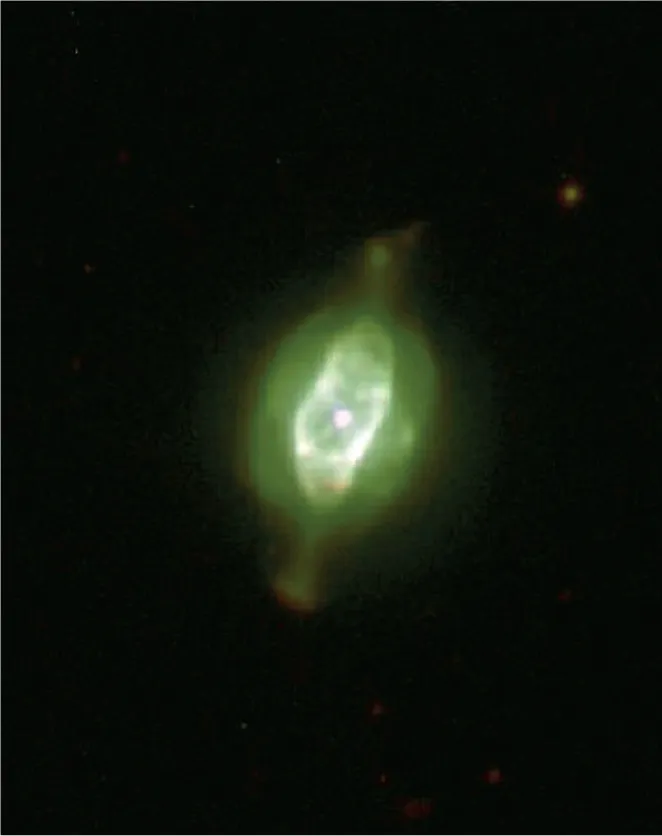
NGC 7009 is popularly known as the Saturn Nebula because of the faint ‘handles’ either side of it, like Saturn’s rings, that can be seen through large telescopes and in photographs. The name Saturn Nebula was given to it in the 19th century by Lord Rosse. (SAAO)
M2 (NGC 7089), 21h 34m −0°.8, is a mag. 6.5 globular cluster easily visible in binoculars or small telescopes, but requiring 100 mm aperture to resolve the brightest individual stars. This rich and highly concentrated globular lies 37,500 l.y. away.
M72 (NGC 6981), 20h 54m −12°.5, is a 9th-mag. globular cluster 55,000 l.y. away, much smaller and less impressive than M2.
NGC 7009, 21h 04m −11°.4, is a famous planetary nebula, 3000 l.y. away, known as the Saturn Nebula because of its resemblance to that planet when seen in large telescopes (see the photograph). But in most amateur telescopes, of 75 mm aperture or more, it appears as merely an 8th-mag. blue-green ellipse of similar apparent size to the globe of Saturn. Its central star is of mag. 11.5.
NGC 7293, 22h 30m −20°.8, is the nearest planetary nebula to the Sun, about 700 l.y. away, and is commonly known as the Helix Nebula. It is the largest planetary nebula in apparent size, covering ¼° of sky, half the apparent size of the Moon. Its popular name arises because on early photographs it appeared to consist of two overlapping turns of a spiral, although t...