![]()
THE MAIDEN QUEEN
‘How proud I felt to be the Queen of such a nation’
– Victoria –
ON THURSDAY, 28 JUNE 1838, the whole of London was buzzing with excitement. From seven o’clock that morning a distinguished array of 10,000 lords and ladies, VIPs and diplomats began taking up their places in the specially constructed temporary galleries inside Westminster Abbey, weighed down in their ceremonial robes, plumes and coronets, and bristling with diamonds.
The city hummed with excitement and expectation, as the diarist Lord Greville recorded:
The masses had gathered to see the new young Queen crowned, and though they did not know it yet, she would be their sovereign for the next 63 years.
SHORTLY BEFORE HER ACCESSION, there were two pressing issues that Victoria had wished to settle. The first was the name under which she would rule as Queen. In anticipation of this, she had written to Uncle Leopold in November 1836:
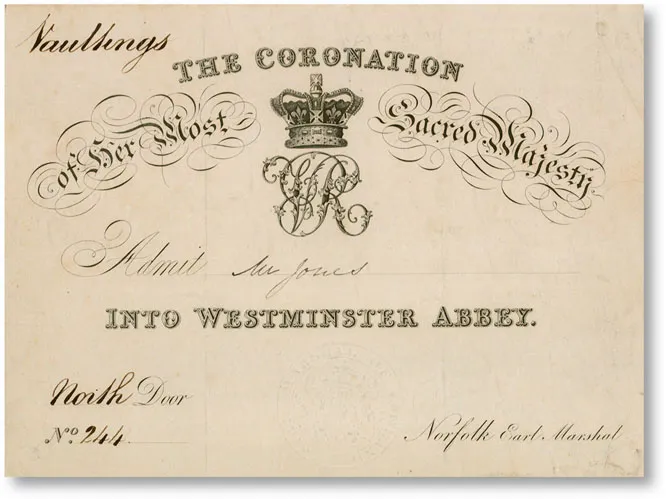
An invitation to Victoria’s Coronation at Westminster Abbey.
Script quote:
Conroy:
I suppose the first thing to decide is how you will style yourself. ‘Alexandrina’ is too foreign and ‘Victoria’ is hardly a name for a queen. You need something traditional like Elizabeth perhaps, or Anne. Elizabeth the Second sounds very well.
THE SECOND, AND INCREASINGLY URGENT, problem was a much more delicate one. Despite settling into Buckingham Palace with great confidence and spreading her wings, alone, in her own apartments, Victoria had a continuing preoccupation: what to do with Mother?
Her most trusted confidant during this time was her prime minister, William Lamb, 2nd Viscount Melbourne, and she remarked to him, ‘How dreadful it was to have the prospect of torment for many years by Mama’s living here.’ She and the Duchess were not getting on at all. Mama’s humour was ‘so variable’, Victoria complained to him; she was ‘touchy and jealous’. She knew that the situation would not change until she married.
‘Well then,’ replied Lord Melbourne, ‘there’s that way of settling it.’ Victoria was appalled. She had absolutely no intention of getting married yet. Here she was, free at last, enjoying the attention and the indulgence that her position brought, and – had she but admitted it – the power too. Why burden herself with all that marriage entailed?
I said to him (Lord M) that I had had a great set to, with Ma. (…) that Ma and I had quarrelled about him; that she said Lord M came too often to me; upon which Lord M said: The Duke of Wellington said that was right; and that if he was me, he would establish himself in the Palace,’ which I said I wished he would. Then I said, Ma said that Lord Ms manners towards me were not good (for they happen to be the admiration of every one – so respectful, yet so fatherly) – which greatly shocked Lord M. ‘How can she say that?’ he said. I told him that we had also quarrelled about J.C. (John Conroy), and that I had told her that if I ever told her anything, she always repeated it again.
VICTORIA’S JOURNAL, 12 MAY 1839
Script quote:
Lehzen:
How are you finding the north wing, your Royal Highness?
Duchess:
Where are my daughter’s rooms?
Lehzen:
In the south wing, Ma’am.
Duchess:
And where do you sleep, Baroness?
Lehzen:
I have a room next to the Queen, with an interconnecting door.
SINCE COMING TO THE THRONE Victoria had quickly made up for the years of seclusion and oppression at Kensington. As Queen, she now had a daily routine that suited herself, and not one dictated by Conroy and her mother. After breakfast at 8 a.m., she received Lord Melbourne in her private boudoir to read and discuss the day’s dispatches and deal with other state business. Later in the morning she would receive other cabinet ministers.
After lunch she regularly went out for a vigorous ride attended by her suite and, of course, Lord M. If there was time, she would continue to work on her dispatches. Dinner, at which her mother joined her by invitation, was at 8 p.m., followed by music, card games and conversation with Lord M.
Victoria also held a succession of dinner parties, ball...