1 Knowing the basics
With our 21st-century lifestyles and the everincreasing need to juggle work and family commitments, getting a good night’s sleep has never seemed more important, yet although we spend a third of our lives asleep, research in this area is still relatively new. What really happens when we are asleep? And why is sleep so important? Although much of this fascinating and complex subject remains a mystery, scientists now have some of the answers to these all-important questions.
Understanding sleep
Sleep is essential for our survival and wellbeing. We all know it makes us feel good, alert and able to cope with our waking lives. But why is it so important? What are the benefits of sleep and what happens when we don’t get enough?
Why sleep?
Sleep is not an optional extra. Like the food we eat and the air we breathe, it is a fundamental need. Sleep is essential for all living beings. Studies on animals have shown that sleep provides a period of enforced quietness in which they can hide from predators, and that sleep exists in all varieties of mammal, irrespective of their size, temperament and habitat.
The generally held view is that sleep energizes and revives, providing us with an enforced time of rest that allows us to recharge our batteries to cope with the everyday business of living. But many scientists argue that to think of sleep entirely in terms of rest is misleading, because it is also an active period when the restoration and repair of body tissue takes place. It is during sleep, for example, that growth hormones are released in developing babies and children.
There is also evidence to suggest that sleep plays a significant role in brain development, and that learning may improve after sleep. In experiments carried out in the UK and USA, subjects who were allowed to sleep after learning new information were found to have a better recall of the data they had learned than those who had not slept.
To most of us, the benefits of sleep are evident from the way we feel after a good night’s rest. But perhaps a better way to understand the role of sleep is to look at what happens when we don’t sleep.
Effects of sleep deprivation
Classic sleep deprivation experiments consist of depriving subjects of one night’s sleep, then asking them to listen to about 1800 bleeps for an hour or so. About 40 of the bleeps are a second shorter than the others, and these are the ones the subjects have to react to. (Most errors of detection generally occur in the last 15 minutes of the task.) Experiments such as this have proved useful to scientists’ understanding of the consequences of lack of sleep. Findings have shown the main short-term effects to be as follows:
• General lack of wellbeing. Lack of sleep can cause fatigue and grogginess.
• Concentration and vigilance. Experiments have invariably shown damaging effects in these areas. People who have been sleep-deprived are more likely to have difficulty taking in information and to make mistakes at work. In real-life situations requiring constant vigilance, such as driving, the dangers are obvious. Statistics show that 20 per cent of all road accidents are caused by fatigue and that many of these accidents will lead to fatalities.
• Memory. Many people complain that they are more forgetful when they do not get enough sleep. This could be down to a concentration problem but it may also be that sleep deprivation makes it more difficult to retrieve information from the brain’s memory store.
• Mood. Lack of sleep can lead to irritability and over-anxiety, which can have damaging effects on your social life, family and other relationships.
• Immunity. Evidence suggests that lack of sleep may affect the immune system. After vaccination, subjects who may have been sleep-deprived have 50 per cent fewer antibodies than those who have slept adequately. Sleep and the immune system are strongly linked; bacterial cell walls can stimulate the sleep centres directly.
• Rational decision-making. Studies show that sleep deprivation can affect general judgement and decision-making abilities, and that people who are sleep-deprived have difficulty in responding to rapidly changing situations. The real-life consequences can be grave. Fatigue is now known to have been a contributory factor in many international disasters such as the nuclear explosion at Chernobyl, the Exxon Valdez oil spill and the Challenger shuttle explosion.
Apart from these common short-term effects of sleep deprivation, there are also long-term consequences. American research suggests that long-term sleep deprivation (defined as interrupted sleep over a period of about a year) may be linked with obesity. Studies carried out at Colombia University have shown that 73 per cent of people who sleep only 2-4 hours a night are more likely to be obese than those who sleep for seven hours. The reason is unclear but it may be because chemicals that play a key role in appetite and weight gain are released during sleep. Other long-term consequences include extreme anxiety, depression, specific sleep-related disorders and even psychosis.
Key turning points in sleep research
Progress in sleep studies changed significantly when it was found that the brain’s activity could be measured objectively. Here is a summary of the main findings that led to this discovery.
• In the 19th century, British researcher Richard Caton measured the brain’s electrical activity by placing sensors on to the scalp’s surface. He noted that the activity was not constant but increases and decreases over time.
• In the late 1920s, German psychiatrist Hans Berger measured brain activity in the belief that it would help him to calculate psychical energy. Largely discredited, he tragically committed suicide. However, his work on measuring the electrical activity of the brain was pivotal in the development of sleep research.
• In 1939, while working at Chicago University, Nathaniel Kleitman – often called ‘the father of sleep’ – published the first major book on sleep, Sleep and Wakefulness (1939). The generally held view of the scientific and medical establishment was that sleep is a passive condition. Kleitman was one of the few people in the world working on sleep at the time.
• In 1953, PhD student Eugene Aserinsky, while working with Kleitman, noted that the eyes move rapidly during sleep, eventually leading to the name of this state as Rapid Eye Movement (REM) sleep. Around this time, William (Bill) Dement joined them and all three were involved in the discovery that subjects awoken out of REM sleep often report dreaming – a turning point in knowing, as opposed to inferring, what goes on in the mind.
How sleep works
Sleep is a highly complicated but ordered process that is controlled by special wakefulness and sleep centres in the brain that work in tandem with hormones and our own internal body clock. The main players in this fascinating process are described below.
Clocks, cycles and rhythms
We are all governed by a 24-hour cycle called a ‘circadian rhythm’, taken from the Latin words circa, meaning ‘around’, and die, meaning ‘day’. Circadian rhythms underpin everything, from hormone production to when we feel like getting up or going to bed. Our body temperature has a 24-hour rhythm too; minimum body temperature usually occurs around 4 a.m., maximum body temperature around 10-11 p.m. Sleep also roughly follows a 24-hour rhythm.
For most of us, a typical cycle means falling asleep between around 11 p.m. and midnight, and waking up between 6 a.m. and 8 a.m., indicating that we are biologically programmed to be able to fall asleep and wake up at around those times. However, not all clocks keep the correct time, and the biological clock is no exception. It generally runs a little ‘slow’ but is kept to the right time relative to light and darkness by ‘synchronizing’ cues called ‘zeitgebers’. Dawn light is one of the most important and well-understood cues that our body responds to, but the onset of darkness (which stimulates the production of melatonin from the pineal gland) also has a role to play. Other zeitgebers are exercise, mealtimes, social interactions, sounds, and possibly changes in temperature. Sleep itself may be a weak zeitgeber.
Sleep and wakefulness
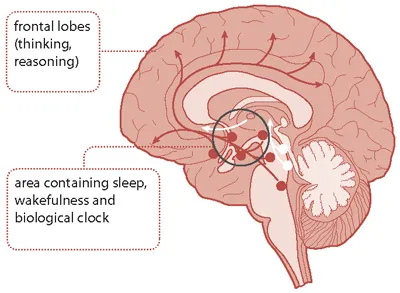
Working with the ebb and flow of the circadian rhythm are special sleep and wakefulness centres, which are located in a part of the brain called the hypothalamus. The sleep centre is in the same region of the brain that controls temperature (which may be why you sometimes can’t sleep if you are too hot) and the wakefulness centre is near the part that is associated with activity. In an ideal world, the sleep centre will shut down during the day, when the wakefulness centre opens, and open at night, when the wakefulness centre closes. Not surprisingly, good sleepers have strong day-time wakefulness and night-time sleep systems. But if these centres have been damaged (through, say, over-use of caffeine, alcohol or drugs, or due to illness or age), you are likely to have sleeping problems.
The brain’s sleep centres
The brain’s metronome
The suprachiasmatic nucleus...