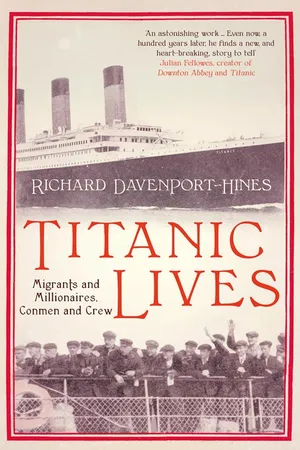
In 1901, H. G. Wells likened the urban poor to an iceberg with much of its rock-hard bulk lurking under the surface: ‘the “submerged” portion of the social body, a leaderless, aimless multitude of people drifting down towards the abyss’.1 This submerged mass of the poor had accumulated from across the world: their recruitment accelerating as spreading railway and steamship routes more easily carried migrants from remote fastnesses to great cities. If the iceberg was a metaphor, the great modern liner was a paradigm of Western society – ‘a monstrous floating Babylon’, wrote one of the Titanic passengers during its maiden voyage.2 G. K. Chesterton made a similar analogy between modern liners and the society that built them. ‘Our whole civilization is indeed very like the Titanic; alike in its power and its impotence, its security and its insecurity,’ he wrote after the ship’s loss. ‘There was no sort of sane proportion between the extent of the provision for luxury and levity, and the extent of the provision for need and desperation. The scheme did far too much for prosperity and far too little for distress – just like the modern State.’3
Over eighty years later the paradigm was sharpened into class war. James Cameron’s film Titanic diabolized rich Americans and educated English, anathematizing their emotional restraint, good tailoring, punctilious manners and grammatical training, while it made romantic heroes of the poor Irish and the unlettered. If Cameron’s film had caricatured the poor as it did the rich there would have been an outcry. Instead Jiang Zemin, the President of China, hailed the film as a parable of class warfare, in which ‘the third-class passengers (the proletariat) struggle valiantly against the ship’s crew (craven capitalist lapdogs and stooges)’. He urged fellow Marxists to see the film and study its depiction of money and class. Similarly, Serge July, editor of Libération, told his fellow French Marxisants that the film represented the suicide in mid-Atlantic of a society divided by class rather than a sinking ship.4
Class demarcations on ocean steamers were based on hard money rather than notions of social justice. The German-American Edward Steiner described how, after a mid-ocean storm in 1906, seasick third-class Atlantic passengers sidled from the hold looking shaken, pale and unkempt. On deck they made a diverting spectacle for richer voyagers who, from their spacious upper deck, looked down on them ‘in pity and dismay, getting some sport from throwing sweetmeats and pennies among the hopeless-looking mass’ of emigrants who wanted to be accepted as Americans. ‘This practice of looking down into the steerage holds all the pleasures of a slumming expedition with none of its hazards of contamination,’ Steiner continued, ‘for the barriers which keep the classes apart on a modern ocean liner are as rigid as in the most stratified society, and nowhere else are they more artificial or more obtrusive. A matter of twenty dollars lifts a man into a cabin passenger or condemns him to the steerage; gives him the chance to be clean, to breathe pure air, to sleep on spotless linen and to be served courteously; or to be pushed into a dark hold where soap and water are luxuries, where bread is heavy and soggy, meat without savour and service without courtesy. The matter of twenty dollars makes one man a menace to be examined every day, driven up and down slippery stairs and exposed to the winds and waves; but makes of the other man a pet, to be coddled, fed on delicacies, guarded against draughts, lifted from deck to deck, and nursed with gentle care.’5
For the millionaires on board, but also for surprising numbers of the poorest passengers, an Atlantic crossing was a regular round-trip which they made twice or more a year. For many others, though, it was momentous. An ocean voyage separates and estranges. People are parted, sorrowfully or cheerily, as it may be, with hope, regret or relief. At departure some think only of their next reunion, and others are set on a lifelong repudiation. There are times when leave-takings open chasms. US immigration laws stipulated that passengers of different classes must be separated on liners by locked metal barriers to limit their supposed power to spread contagion, but some obstacles between the classes were more insurmountable even than barred gates. Money made the difference. Contrast the contents of the pockets of two Titanic corpses recovered from the ocean: John Jacob Astor IV (‘Colonel Jack’), the richest man on board, had $4,000 in sodden notes in his pockets; but the jacket of Vassilios Katavelas, a nineteen-year-old Greek farm worker, had more meagre treasures: a pocket mirror, a comb, a purse containing 10 cents and a train ticket to Milwaukee.
The White Star Line, which operated the liner, promoted its leviathans as expressions of racial supremacy, for this was an epoch when Africans and Asians were customarily described as ‘subject races’. ‘The Olympic and Titanic,’ declared the owners, ‘are not only the largest vessels in the World; they represent the highest attainments in Naval Architecture and Marine Engineering; they stand for the pre-eminence of the Anglo-Saxon race on the Ocean.’ Both liners ‘will rank high in the achievements of the twentieth century’.6 Such clamorous confidence was soon to seem like deadly hubris.
Southampton, on England’s south coast, was White Star Line’s new port for its New York service. When Alfred the Great was king of the Anglo-Saxons in the ninth century, Southampton was his harbour. After the Norman Conquest in 1066, Southampton became a vital port between the duchy of Normandy and the kingdom of England. Roman barges, plague ships, merchant vessels, troop ships, Sir Francis Drake’s Golden Hind bringing Spanish gold to Queen Elizabeth – they all used Southampton harbour. After 1750, Southampton was developed as a smart spa town: spacious Georgian stucco terraces were built, and pretty villas studded the surrounding countryside. In 1815 the first steamship came to Southampton, and in 1839 the railway to London was opened.
It was not until 1892, when the London & South Western Railway (L&SWR) bought the Southampton Dock Company for £1,360,000, that the port mounted its challenge on Liverpool. Southampton held an advantage with which Liverpool could not vie: a double tide caused by the way that the Isle of Wight juts into the English Channel and diverts ebb tides. Norddeutscher-Lloyd and Hamburg-Amerika steamships already stopped at Southampton, as they plied the emigrant traffic between Germany and the United States, but it was an auspicious day when, in 1893, the liner New York, owned by the American financier John Pierpont Morgan, docked at Southampton, where its passengers were carried away on the South Western Railway. By 1895 the railway company had invested £2 million in the port, through which passenger traffic had risen by 71 per cent. Norddeutscher-Lloyd then built three ocean greyhounds, Kaiser Wilhelm der Grosse (1897), Kronprinz Wilhelm (1901) and Kaiser Wilhelm II (1903), while Hamburg-Amerika’s Deutschland (1900) held the Blue Riband, for the swiftest North Atlantic crossings in three consecutive years (at an average speed exceeding 23 knots). First-class passengers, especially rich Americans, became disinclined to make the railway journey to Liverpool, for embarkation on Cunard or White Star liners, when from London they could reach more readily the swift German steamships halting at Southampton.
In 1907 White Star withdrew its Atlantic liner service from Liverpool and inaugurated a new outward service from Southampton to New York, via Cherbourg in Normandy and Queenstown, Ireland, with a return service calling at Plymouth rather than Queenstown. A director of White Star, Lord Pirrie, became a director of L&SWR to ensure that relations between the two companies were lubricated by trusty cooperation. To meet White Star’s needs, the railwaymen erected a passenger and cargo shed at Southampton, 700 feet long, with passenger gantries for passengers to embark on Olympic and Titanic. It was said that ‘what Brighton is to London for pleasure, Southampton will be to London for business’. Other railwaymen called it ‘London-super-Mare’.7
But by 1911–12, Southampton’s prosperity was faltering. Seamen and ships’ firemen had long been pitied by trade unionists as the most downtrodden of workers. In 1911 they struck for higher wages, and after tense weeks in which money was short in Southampton, the shipowners yielded to the strikers’ demands. This outcome encouraged dockers to strike several weeks later, and in August two men were shot dead when the army was used to quell riots in Liverpool docks. Later that month, during the first ever national railway strike, two further men were shot dead by soldiers during rioting. On 1 March 1912, continuing the unrest, 850,000 coal miners struck for a minimum wage. Once the mines shut, another 1,300,000 iron and steel workers, seamen and others were thrown out of work. Despite the government introducing minimum-wage legislation, the strike had its own stubborn impetus and was not settled until 6 April. This left insufficient time for newly mined coal to reach Southampton and be loaded into Titanic’s bunkers, and 4,427 tons of coal had to be transferred from other liners lying at the quayside.
The gross tonnage of the Titanic was 46,328 tons. It measured 882 feet long and 92 feet wide. Its eight decks reached the height of eleven storeys. The top of the captain’s quarters was 105 feet above the bottom of the keel. Three million rivets held its hull together. The ship’s three propellers were each the size of windmills. Its steel rudder, weighing 101 tons, was 78¾ feet high. Its three anchors weighed a total of 31 tons. Its four funnels (one of them a dummy, added for aesthetic balance) were 22 feet in diameter and rose 81 feet above the boat deck. With such proportions a high crane, movable along the side of the liner on rails set into the concrete quay, was needed to lower cargo into the ship’s hold long before passengers arrived.
The freight laden into Titanic’s holds resembled the twentieth-century equivalent of the luxuries pictured in John Masefield’s poem ‘Cargoes’, with its Spanish galleon carrying rare gems and tropical spices and its quinquireme from Nineveh rowing across the Mediterranean bearing its treasure of ivory and peacocks. Precious stones sent from Antwerp alone were insured for nearly £50,000. One diamond merchant lost stock insured for £18,000 when the ship went down: ‘a North Atlantic liner, freighted with millionaires and their wives, is a little diamond mine in itself’.8 A consignment of ostrich plumes valued at £10,000 was also carried.9 There was a red 25-horsepower Renault motor car, and high-class package freight such as velvet, cognac and other liqueurs, cartons of books, as well as fine foods such as shelled walnuts, olive oil, anchovies, cheese, vinegar, jam, mushrooms, and goods like goat skins and jute bagging. Some 3,435 bags of mail were loaded at Southampton: business letters, of course, but equally precious to the recipients, letters going to migrants’ homes and boarding houses, from Finland, Sweden, Italy, Greece, Lebanon and the rest, bringing their treasures of memory and love from the old country. There were thousands of registered packets. Joseph Conrad has posted the manuscript of his story ‘Karain’ to his New York admirer John Quinn, one of those American collectors who rifled Europe for rarities to hoard in their private troves. ‘Karain’ was lost in the sinking, together with a seal ring belonging to the Irish dramatist Lady Gregory. Fortunately, Conrad had sent the manuscript of ‘The Secret Agent’ to Quinn by an earlier ship. Titanic was also carrying a rare copy of the Rubáiyát of Omar Khayyám in a unique jewel-studded binding by the English binders Sangorski and Sutcliffe. A Colorado mining millionairess, Margaret Brown, who made a late booking on Titanic, travelled with three crates containing architectural models of the ruins of ancient Rome, which she intended to give to Denver Art Museum.
It was providential that there were not more grievous, irreplaceable losses. When Titanic sailed, many European art rarities were in packing cases awaiting their final far migration to a New York millionaire’s show place on Madison Avenue. The US Revenue Act of 1897 had imposed a 20 per cent tariff on imported works of art destined for private homes. As a result, collectors like Pierpont Morgan had for fifteen years kept their acquisitions in London or Paris. But the balance of tax advantages had recently shifted. In the United States, partly at Quinn’s instigation, the Payne-Aldrich tariff act of 1909 repealed the import duty on art works; while in Britain, Lloyd George’s ‘People’s Budget’ raised the level of death duties. Morgan’s aversion to paying tax spurred him to order the transfer of his London collection to New York – despite Lloyd George issuing an official statement in January 1912: ‘Mr Pierpont Morgan’s art treasures would not be liable to death duties in England unless they were to be sold.’10 That January, to the consternation of English cognoscenti, Morgan’s paintings, furniture, miniatures, silver, sculpture, bronzes, ivories, majolica, enamels, porcelain and jewellery began to be packed for transatlantic shipment. The princely house in Kensington which served as a show case for his collection – ‘it looks like a pawnbroker’s shop for Croesuses’,11 the connoisseur Bernard Berenson observed – was given over to packers, hammerers and carters. Pierpont Morgan felt that the ships of the White Star Line, which he owned, had an inviolable safety record, and insisted that his precious rarities were carried on its vessels. White Star liners conveyed Morgan’s first packing cases across the Atlantic in February, but in March shipments had to be suspended for lack of an official who was required by pettifogging US customs regulations to monitor the packing. By this chance not a particle of Morgan’s collection was shipped on Titanic.
Most Titanic passengers reached Southampton from Waterloo station in London. Cart-horses were still used for haulage in the capital, and society women maintained carriages for the fashionable throng in Hyde Park, but a whirligig of motor cars, taxis, vans and buses had set about exterminating the old, slow horse-drawn traffic. The stench of exhaust fumes stifled passers-by, reverberations from motors cracked ceilings in the best districts, the sound of engines quelled conversation, chauffeurs with goggles and peaked caps were superseding liveried coachmen in cockades. There had been many types of horse-drawn vehicles – the brougham, cabriolet, landau and phaeton among others – and now there were new brand names to be mouthed by votaries of the cult of speed: De Dion-Bouton, Panhard-Levassor, Delaunay-Belleville, Lozier, Winton Bullet, Stoddard-Dayton, Pierce-Arrow, Pope-Toledo, Hispano-Suiza, Siddeley-Deasy. Such were the steeds carrying Titanic passengers to Waterloo.
E. M. Forster wrote in 1910 of ‘the poised chaos of Waterloo’.12 The station was being rebuilt so as to provide one of the world’s largest passenger concourses. A wide roof of glass and steel – soaring high so that the smoke from the engines might disperse – would protect passengers from rain, wind and cold. From the concourse, which would provide twenty-three gated platforms, strange new-fangled moving stairways called escalators were to take travellers down to the infernal tunnels of the underground railway system. The rebuilding was incomplete in 1912, and the new glazed roof stopped short: high girders jutted into mid-air; a jumble of smutty old office buildings awaited demolition; travellers could see timber roof beams and blackened smoke troughs in the remains of the old Victorian station. The station buffet still disappointed famished travellers with its dusty cakes and fossilized sandwiches. The ticket office remained a place where during busy rushes one could lose precious minutes as well as shillings. Porters’ trolleys piled with trunks weaved between the crowds. The station, recalled a railway historian, had a pervasive odour compounded of ‘empty loose-lid milk-churns, horses, Welsh coal and oil lamps, the London and South-Western smell’.13 It was a distinctive sooty smell which stretched halfway to Southampton, said Sinclair Lewis.14 Before the departure of the Titanic train, there was an extra ingredient in the Waterloo medley: ‘camera fiends’, as one of the first-class passengers had called them, paparazzi as they are called now, edging up the platform to take ‘snapshots’ of eminent men like John Jacob Astor.15
The design, compartmentalization and pricing of British railways were permeated by class demarcations. Class-feeling was innate and inexorable, as an Anglican clergyman demonstrated in 1912 when he protested at the Great Western Railway’s proposal to abolish first-class carriages on short runs: ‘this forcing [of] passengers accustomed to live in sweet and wholesome surroundings to herd with the unwashed and, very often, strongly malodorous things that one meets in a third-class compartment, is nothing less than ...