Wednesday 27 August 1930 was overcast for most of the day on St Kilda. Shortly after dawn a raw mist slowly rolled over the Atlantic from the nearby island of Boreray and spilled over the cliffs on Conachair like a waterfall. By the afternoon a thick, grey blanket hung low over the village. It was cold and damp – so unlike the summer days of the previous week. Few on the island, however, had time to notice that the weather had changed. The St Kildans had much to do if in two days’ time they were to leave the island forever.
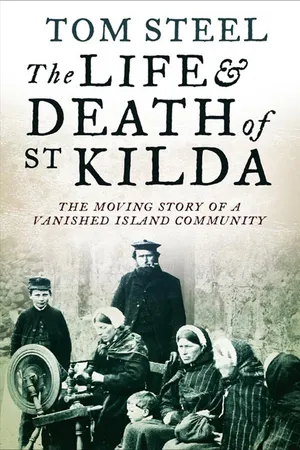
In House no 5, Main Street, St Kilda, Annie Ferguson was busy at her spinning wheel. She was preparing yarn for a length of cloth that a tourist from the mainland had asked her to make. She would not finish the work, that she knew; but she would take the yarn to the mainland with her and in the coming winter months her husband would weave the tweed on the old loom they were taking with them.
In the other room of the house a young newspaperman was finding it difficult to pen his copy. Alasdair Alpin MacGregor, then thirty-one, had been sent all the way from London by The Times to report on the evacuation. As he sat close to the small window to catch the falling light, the paper he was writing on became wet in the heavy atmosphere. He struggled on, knowing he would have to wire his story as soon as he boarded the SS Dunara Castle.
On the advice of Nurse Williamina Barclay, the St Kildans had decided to take with them only those few possessions that could be of use to them in their new life. All through the day, heavy bundles were carried from the houses to the jetty. The women were busy packing kists with the few clothes and heirlooms each family possessed. They were also packing the wool taken that summer from the island sheep. It would be a waste to leave it behind; it could prove to be a useful source of income. Even in their new homes the St Kildans could knit and weave as they had done for generations to help supplement the new reward for their labour called wages.
Down by the old storehouse, used for over a century by the St Kildans to lay aside the produce they had bartered with those on the mainland, a few of the men were busy sawing up bits of wood. They were concerned to protect the few pieces of furniture being taken away from becoming damaged in transit. With battens and rope they made safe the tables and chairs that were to be transported to Lochaline in Argyll. Others were occupied at the back of the manse, sifting through the driftwood that had been cast ashore over the years. Much of the wood was the cargo of a freighter torpedoed off St Kilda in 1917. The big planks of timber, the men agreed, might be of use; they too would be loaded onto the Dunara Castle, due to arrive at St Kilda that day.
To the right of the schoolhouse, about a hundred yards from the jetty, the remainder of the St Kildans’ sheep were bleating in the calm air. Six hundred and sixty-seven sheep had already been transported by the SS Hebrides to the marts of Oban on 6 August. In July the Scottish Department of Agriculture had sent out an official and two shepherds from Uist along with their dogs to help the islanders round up their sheep. The task had not been an easy one. Many sheep had gone over the steep cliffs rather than be captured; many like those on Boreray had to be left undisturbed because taking them off proved impossible, given the time and manpower resources available.
To begin with, the St Kildans had stubbornly refused to help gather their scattered flocks. It had been suggested that the money obtained from their sale should go towards paying for the evacuation of the community. The islanders felt that if the government wanted to remove the sheep, they could do the work. One islander, old Finlay Gillies, had gone as far as to take to his bed the day before the rounding-up was due to begin, claiming that he was too sick to get up. The missionary Dugald Munro suggested to Macaulay, the Department’s representative, that the situation might be eased if the government offered the St Kildans money in exchange for their help. When the islanders heard that they would be paid a pound a day, even Finlay Gillies was seen catching sheep along with the rest of the men among the cliffs. Removing the sheep from St Kilda proved a costly business. It cost the government over £240 to transport twelve hundred sheep to the mainland, plus £143 in wages and expenses for the shepherds. By the time the sheep had been dipped and penned at Oban until their sale on 3 September, the total cost was £506 os 4½d.
At five o’clock in the afternoon the island dogs announced the arrival of the SS Dunara Castle. As she steamed like a ghost ship through the heavy mist into the bay, the islanders dragged their boats down the slipway into the water to go out and meet her. There was the hope of a last letter from friends on the mainland, eager to wish them well, and the chance to sell to the thirty or so visitors on board the few remaining socks and scarves the women had knitted. The last tourists to visit the island inhabited hoped to buy a spinning wheel or some other relic of life on St Kilda from a people only too eager to be rid of them. They were to be unlucky. The island had been stripped of most souvenirs in the few weeks since the world had got to know that St Kilda was to be abandoned. When the visitors had been rowed ashore, the St Kildans returned to the most pressing business of the day – the transfer of the sheep.
They had arranged the sheep in groups so that they could be loaded more easily into the boats that would take them out to the Dunara Castle. There were over five hundred sheep to put on board. It was a slow, tiring business; to and from the steamer, the islanders plied boats that could hold no more than a dozen sheep at a time. It was not until after nine o’clock in the evening that the majority of the sheep were safely on board. By then it was getting dark and dangerous to do much more; the few lanterns cast little light on the operation and the jetty was crowded with tea chests and bits of furniture. But work continued, and it was not until one o’clock in the morning that the nine fit men on the island struggled for over an hour to pull the boats up the slipway clear of the high-water mark.
At approximately three o’clock in the morning ‘The Books’ were brought out, and in the house of the Fergusons, Alasdair Alpin MacGregor joined in the day’s last act of reverence to the Almighty. After a few verses of a psalm to the tune ‘Wiltshire’, ‘The household’, wrote the man from The Times, ‘was so tired that we contented ourselves with a short reading and a shorter prayer. In the small hours we dragged ourselves to bed knowing that at daybreak we had to resume the shipping of the sheep.’
At first light the St Kildans were awakened by the siren of the SS Dunara Castle. The crew were anxious to complete the work and return to the mainland. After breakfast and family prayers, the St Kildans once again pushed their little boats into the water and took the last of the sheep on board. Then came the turn of the cattle, which had to be enticed down to the jetty with handfuls of soda scone. The four young calves were rowed over to the waiting ship in one boat, whilst the cows, tethered to the tail of the small craft in case they drowned, had to swim. The last ten cows of St Kilda were taken over to the Dunara Castle and hoisted aboard.
At approximately seven o’clock in the morning of 28 August, HMS Harebell, under the command of Captain Barrow, steamed into the bay. She had been sent by His Majesty’s Government to carry out the evacuation of the islanders. The Harebell, the senior ship of the Fishery Protection Squadron, had spent the summer months touring the fishing ports of the British Isles. The ship had left Oban and crossed to St Kilda during the night. ‘We knew we were due for this,’ recalls Commander Pomfret, then medical officer on board, ‘so we had fitted it in.’
In the corrugated iron shack that served as a post office, Neil Ferguson was busy getting ready the last mailbags to leave St Kilda. It was the largest mail ever to leave the island. Many on the mainland whose interest had recently been aroused by the publicity given to the evacuation in the newspapers were eager to obtain a St Kilda postmark by way of the passengers on board the steamer. As the tourists crowded the small office they complained bitterly when Neil ran out of penny stamps and demanded that he supply them with two halfpenny stamps instead. When there were no more halfpenny stamps Neil could only offer them three-halfpenny ones. Tempers became frayed.
The mailbags taken aboard the Dunara Castle that day were not the only mail sent from St Kilda. Three days earlier. Alasdair Alpin MacGregor and Neil Ferguson had despatched the last traditional St Kildan mailboat. Within its wooden hold was placed a solitary postcard addressed to the island’s owner at Dunvegan, in the Isle of Skye. The wooden vessel, attached to an inflated stomach of a sheep, had been cast into the sea. ‘This’, read the postcard, ‘is the last mail from St Kilda.’
Meanwhile, the Master of Reay was being persuaded at great length by Alasdair Alpin MacGregor not to try to remain on the island. The Master, heir to the Chief of Clan Mackay, had come ashore from the Dunara Castle with the intention of remaining on St Kilda for a few weeks to do some exploring. He had even gone as far as to bring a load of provisions with him to last him throughout his period of isolation. The Dunara Castle’s sister ship Hebrides, he thought, was to make yet another trip that summer and he was relying on that to take him off before the winter. But Dr Shearer, sent by the Department of Health to carry out the evacuation, put an end to the young Robinson Crusoe’s plans by saying no.
The Scottish Office and the proprietor of the island had already turned down hundreds of requests from people wanting to live on St Kilda. The government received more than four hundred enquiries and pleadings from those eager to accept that which the St Kildans were abandoning.
Sir Reginald MacLeod of MacLeod, the proprietor of the island, had told the Glasgow Herald in an interview, ‘I am sorry to lose a population that has down its generations been tenants of my family for a thousand years. But they themselves have elected to go, and I cannot blame them. The life is one of hardship and inconvenience.’ Sir Reginald played a minor role in the decisions that had to be made at the evacuation but was determined, as was the government, that no one should live on St Kilda after 29 August 1930. ‘At all events,’ he told the Herald’s correspondent, ‘I am strongly opposed to the idea of new settlers. The present population have signed and sent a petition for removal which, at great trouble and expense, is now being carried out. In these circumstances it would be folly to remove one lot of people who know the island, and replace them with a group of strangers.’
The last thirty-six St Kildans on the island were sad but not sorry they were leaving. They had been convinced by the nurse and the missionary that they were leaving for a better land. The experience of living on St Kilda in the last few years had shown them they could not be leaving for a more inhospitable world.
The Dunara Castle had brought not only tourists and journalists, but also various officials who had work to do on St Kilda. The Examiner of Registration Records came ashore to check the island’s entries of births, deaths and marriages with the missionary, Dugald Munro, who had been responsible for keeping them. Nurse Williamina Barclay told the Examiner that she had not had to assist with the birth of a single child since she came to St Kilda over two years before. No one had been born on St Kilda since 1927, when the youngest of the Mackinnons, Neil, was born. The books duly checked and signed by the Examiner were transferred to the vaults of Register House in Edinburgh. No further entries would be made.
At noon the Dunara Castle sailed for Oban. The journey would take seventeen hours and the skipper was anxious to be safely through the dangerous Sound of Harris in daylight. Together with the beasts and belongings went the last outsiders – the journalists, photographers, and visitors. No one but a few government officials was to be allowed to remain on the island until the end. Alasdair Alpin MacGregor had gone as far as to petition the Prime Minister to allow him to stay and witness the evacuation, but the reply from the Scottish Office had been definite: ‘The Admiralty are naturally hostile to the idea of publicity and Mr Johnston himself is strongly of the opinion that the utmost effort should be made to avoid the miseries of the poor people being turned into a show…The Scottish Office are endeavouring to carry out the evacuation with as little publicity as possible out of consideration for the feelings of the St Kildans themselves.’ Tom Johnston, then Under-Secretary of State for Scotland, had decided there would be no cinema newsreel cameras present, no press photographers to capture for publication the first tears of sadness, no witness of any description to the emotions that were felt by the St Kildans between noon on 28 August and eight o’clock on the morning of the 29th. The officials even rejected a request from a former islander, Donald MacQueen, who wished to see for himself the removal, as he put it, ‘of the last remnants of my race’. He had asked if the Department could help him get to St Kilda because, he wrote, ‘owing to having to exist on seventeen shillings a week, I could not manage home to my people’.
One of the first tasks that had to be carried out once the sheep had been taken off was to deal with the island’s numerous dogs. They were no longer of use to the St Kildans, and despite the pleadings of the National Canine Defence League and numerous offers from people on the mainland to adopt them, the dogs were put to death. Dr Shearer, assisted by Commander Pomfret of the Harebell, was able to destroy only two dogs with hydrocyanic acid in a room in one of the empty houses. The St Kildans stubbornly demanded that they drown the rest. A stone was tied round the neck of each dog and they were thrown off the end of the jetty. Weeks later, when the Hebrides paid a visit to the island, the bay was still full of dead dogs.
It seemed to the St Kildans that everyone had been interested in their island during the past few weeks. But it was their home and they would not be badgered, bribed, or bullied into doing things they did not want to do. Offers of help were made, but few were taken up. The afternoon of the 28th was spent ferrying out the islanders’ belongings to the Harebell, and the work went on well into the night. As the women carried the last few bundles down to the pier, the men of the British Navy looked on. They were prepared to help, but the St Kildans did not want to be assisted in these last hours by representatives of a society that had ignored them for centuries. The sailors could only stand and watch, and the islanders were heard to murmur to one another that they would not be rushed should the entire Navy come out for them.
By seven o’clock next morning, there was little left for the St Kildans to do save board the Harebell. The islanders put on their best clothes. If they did not feel a desire to impress their new neighbours on the mainland upon arrival, they were certainly determined that they would not be the subject of ridicule. The family prayers were said for the last time and, as was the custom among Gaelic people, a Bible was left open in each house, along with a small heap of oats. In one house the exposed text was Exodus.
In each of the eleven inhabited cottages, the fire was built up with fresh coal and turf. When they were burnt out some hours later, it was probably the first time there had not been a fire on St Kilda for a thousand years. Lachlan Macdonald, then a young man just turned twenty-four, recalls: ‘I mind of everyone closing the door of his house and some of them read a chapter of the Bible before they left, and put up a prayer.’
Neil Ferguson, son of the postmaster, and the last male islander to marry and set up a home of his own on St Kilda, remembers those last hours well. ‘You had a bed and chairs and them old-fashioned chests and all that stuff. All that stuff was left on the island when we left. Most of the furniture was left in the houses – dressers, and even pots and pans and stuff like that – all left. And all them pots they used to have in the old days with three legs, they were all left. And all the fishing gear was left, lines and boats. Oh, we never took much away, we were just running away and leaving everything.’
His father took a last walk round the village. In many respects he had been the most important man on the island. Not only had he been sub-postmaster for many years but he had also been the factor’s representative. If the St Kildans had ever allowed one of their number authority over the rest, Neil Ferguson Senior was that man. He was the one who had called the men together when important decisions had had to be made. He had taken the Church services when the missionary was absent from the island. He was the only islander to have planted as much as a plot of potatoes that year, and was leaving the island with a heavy heart.
The corrugated iron shack bearing the crudely lettered notice ‘St Kilda Post Office’ was Ferguson’s first port of call. The target of visitors to the island eager to prove to their friends they had been to St Kilda would no longer sell the famous St Kilda postcards. Inside, papers and postcards lay strewn over the floor. On one wall was pinned a notice headed ‘What the disabled soldier wants to know’ and dated ‘War Office, August 1915’. Ferguson had often wondered why he had been sent the notice. The men of St Kilda had never in recorded history taken up arms against anyone. On 10 September 1930 the Post Office Circular announced: ‘The St Kilda Post Office was closed on 29 August, the date of the evacuation of the island. Official Records should be amended where necessary. Any letters or parcels which may come to hand for St Kilda should circulate as for Oban, where arrangements have been made for their redirection to the addressees.’
In the little schoolroom where Ferguson had received an education forty years before, a piece of linoleum still served as a blackboard. The walls were of unvarnished matchboarding. There were two school pews that could seat fifteen scholars. In each pew were mountings for inkpots. On the wall was a map of Great Britain – a map which included England at the expense of Scotland. It did not even show where St Kilda was. On the same wall was a notice that proclaimed: ‘Any scholars between the ages of three and fifteen will be exempted from payment of school fees, Harris, 14 October 1904.’ The scho...