![]()
![]()
HILARY MANTEL
WOLF HALL
![]()
Dedication
To my singular friend
Mary Robertson this be given.
![]()
Epigraph
‘There are three kinds of scenes, one called the tragic, second the comic, third the satyric. Their decorations are different and unalike each other in scheme. Tragic scenes are delineated with columns, pediments, statues and other objects suited to kings; comic scenes exhibit private dwellings, with balconies and views representing rows of windows, after the manner of ordinary dwellings; satyric scenes are decorated with trees, caverns, mountains and other rustic objects delineated in landscape style.’
VITRUVIUS, De Architectura, on the theatre, c.27BC
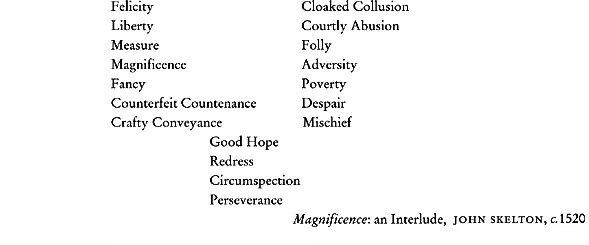
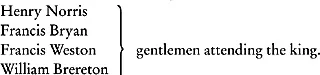
These be the names of the players:
![]()
Contents
Cover
Title Page
Dedication
Cast of Characters
Family Trees
Epigraph
PART ONE
I - Across the Narrow Sea. 1500
II - Paternity. 1527
III - At Austin Friars. 1527
PART TWO
I - Visitation. 1529
II - An Occult History of Britain. 1521–1529
III - Make or Mar. All Hallows 1529
PART THREE
I - Three-Card Trick. Winter 1529–Spring 1530
II - Entirely Beloved Cromwell. Spring–December 1530
III - The Dead Complain of Their Burial. Christmastide 1530
PART FOUR
I - Arrange Your Face. 1531
II - ‘Alas, What Shall I Do For Love?’ Spring 1532
III - Early Mass. November 1532
PART FIVE
I - Anna Regina. 1533
II - Devil’s Spit. Autumn and winter 1533
III - A Painter’s Eye. 1534
PART SIX
I - Supremacy. 1534
II - The Map of Christendom. 1534–1535
III - To Wolf Hall. July 1535
Author’s Note
Acknowledgements
![]()
Cast of Characters
In Putney, 1500
Walter Cromwell, a blacksmith and brewer.
Thomas, his son.
Bet, his daughter.
Kat, his daughter.
Morgan Williams, Kat’s husband.
Thomas Cromwell, a lawyer.
Liz Wykys, his wife.
Gregory, their son.
Anne, their daughter.
Grace, their daughter.
Henry Wykys, Liz’s father, a wool trader.
Mercy, his wife.
Johane Williamson, Liz’s sister.
John Williamson, her husband.
Johane (Jo), their daughter.
Alice Wellyfed, Cromwell’s niece, daughter of Bet Cromwell.
Richard Williams, later called Cromwell, son of Kat and Morgan.
Rafe Sadler, Cromwell’s chief clerk, brought up at Austin Friars.
Thomas Avery, the household accountant.
Helen Barre, a poor woman taken in by the household.
Thurston, the cook.
Christophe, a servant.
Dick Purser, keeper of the guard dogs.
Thomas Wolsey, Archbishop of York, cardinal, papal legate, Lord Chancellor: Thomas Cromwell’s patron.
George Cavendish, Wolsey’s gentleman usher and later biographer.
Stephen Gardiner, Master of Trinity Hall, the cardinal’s secretary, later Master Secretary to Henry VIII: Cromwell’s most devoted enemy.
Thomas Wriothesley, Clerk of the Signet, diplomat, protégé of both Cromwell and Gardiner.
Richard Riche, lawyer, later Solicitor General.
Thomas Audley, lawyer, Speaker of the House of Commons, Lord Chancellor after Thomas More’s resignation.
Thomas More, lawyer and scholar, Lord Chancellor after Wolsey’s fall. Alice, his wife.
Sir John More, his aged father.
Margaret Roper, his eldest daughter, married to Will Roper.
Anne Cresacre, his daughter-in-law.
Henry Pattinson, a servant.
Humphrey Monmouth, merchant, imprisoned for sheltering William Tyndale, translator of the Bible into English.
John Petyt, merchant, imprisoned on suspicion of heresy.
Lucy, his wife.
John Parnell, merchant, embroiled in long-running legal dispute with Thomas More.
Little Bilney, scholar burned for heresy.
John Frith, scholar burned for heresy.
Antonio Bonvisi, merchant, from Lucca.
Stephen Vaughan, merchant at Antwerp, friend of Cromwell.
Henry VIII.
Katherine of Aragon, his first wife, later known as Dowager Princess of Wales.
Mary, their daughter.
Anne Boleyn, his second wife.
Mary, her sister, widow of William Carey and Henry’s ex-mistress.
Thomas Boleyn, her father, later Earl of Wiltshire and Lord Privy Seal: likes to be known as ‘Monseigneur’.
George, her brother, later Lord Rochford.
Jane Rochford, George’s wife.
Thomas Howard, Duke of Norfolk, Anne’s uncle.
Mary Howard, his daughter.
Charles Brandon, Duke of Suffolk, old friend of Henry, married to his sister Mary.
Mark Smeaton, a musician.
Henry Wyatt, a courtier.
Thomas Wyatt, his son.
Henry Fitzroy, Duke of Richmond, the king’s illegitimate son.
Henry Percy, Earl of Northumberland.
William Warham, aged Archbishop of Canterbury.
Cardinal Campeggio, papal envoy.
John Fisher, Bishop of Rochester, legal adviser to Katherine of Aragon.
Thomas Cranmer, Cambridge scholar, reforming Archbishop of Canterbury, succeeding Warham.
Hugh Latimer, reforming priest, later Bishop of Worcester.
Rowland Lee, friend of Cromwell, later Bishop of Coventry and Lichfield.
Lord Berners, the Governor, a scholar and translator.
Lord Lisle, the incoming Governor.
Honor, his wife.
William Stafford, attached to the garrison.
Lady Bryan, mother of Francis, in charge of the infant princess, Elizabeth.
Lady Anne Shelton, Anne Boleyn’s aunt, in charge of the former princess, Mary.
Eustache Chapuys, career diplomat from Savoy, London ambassador of Emperor Charles V.
Jean de Dinteville, an ambassador from Francis I.
Henry Courtenay, Marquis of Exeter, descended from a daughter of Edward IV.
Gertrude, his wife.
Margaret Pole, Countess of Salisbury, niece of Edward IV.
Lord Montague, her son.
Geoffrey Pole, her son.
Reginald Pole, her son.
Old Sir John, who has an affair with the wife of his eldest son Edward.
Edward Seymour, his son.
Thomas Seymour, his son.
Jane, his daughter: at court.
Lizzie, his daughter, married to the Governor of Jersey.
Nikolaus Kratzer, an astronomer.
Hans Holbein, an artist.
Sexton, Wolsey’s fool.
Elizabeth Barton, a prophetess.
![]()
Family Trees
![]()
PART ONE
![]()
I
Across the Narrow Sea
Putney, 1500
‘So now get up.’
Felled, dazed, silent, he has fallen; knocked full length on the cobbles of the yard. His head turns sideways; his eyes are turned towards the gate, as if someone might arrive to help him out. One blow, properly placed, could kill him now.
Blood from the gash on his head – which was his father’s first effort – is trickling across his face. Add to this, his left eye is blinded; but if he squints sideways, with his right eye he can see that the stitching of his father’s boot is unravelling. The twine has sprung clear of the leather, and a hard knot in it has caught his eyebrow and opened another cut.
‘So now get up!’ Walter is roaring down at him, working out where to kick him next. He lifts his head an inch or two, and moves forward, on his belly, trying to do it without exposing his hands, on which Walter enjoys stamping. ‘What are you, an eel?’ his parent asks. He trots backwards, gathers pace, and aims another kick.
It knocks the last breath out of him; he thinks it may be his last. His forehead returns to the ground; he lies waiting, for Walter to jump on him. The dog, Bella, is barking, shut away in an outhouse. I’ll miss my dog, he thinks. The yard smells of beer and blood. Someone is shouting, down on the riverbank. Nothing hurts, or perhaps it’s that everything hurts, because there is no separate pain that he can pick out. But the cold strikes him, just in one place: just through his cheekbone as it rests on the cobbles.
‘Look now, look now,’ Walter bellows. He hops on one foot, as if he’s dancing. ‘Look what I’ve done. Burst my boot, kicking your head.’
Inch by inch. Inch by inch forward. Never mind if he calls you an eel or a worm or a snake. Head down, don’t provoke him. His nose is clotted with blood and he has to open his mouth to breathe. His father’s momentary distraction at the loss of his good boot allows him the leisure to vomit. ‘That’s right,’ Walter yells. ‘Spew everywhere.’ Spew everywhere, on my good cobbles. ‘Come on, boy, get up. Let’s see you get up. By the blood of creeping Christ, stand on your feet.’
Creeping Christ? he thinks. What does he mean? His head turns sideways, his hair rests in his own vomit, the dog barks, Walter roars, and bells peal out across the water. He feels a sensation of movement, as if the filthy ground has become the Thames. It gives and sways beneath him; he lets out his breath, one great final gasp. You’ve done it this time, a voice tells Walter. But he closes his ears, or God closes them for him. He is pulled downstream, on a deep black tide.
‘Kat, don’t shout, it hurts me.’
She bawls for her husband: ‘Morgan Williams!’ She rotates on the spot, eyes wild, face flushed from the oven’s heat. ‘Take this tray, body of God, where are you all?’
He is shivering from head to foot, exactly like Bella did when she fell off the boat that time.
A girl runs in. ‘The master’s gone to town.’
‘I know that, fool.’ The sight of her brother had panicked the knowledge out of her. She thrusts the tray at the girl. ‘If you leave them where the cats can get at them, I’ll box your ears till you see stars.’ Her hands empty, she clasps them for a moment in violent prayer. ‘Fighting again, or was it your father?’
Yes, he says, vigorously nodding, making his nose drop gouts of blood: yes, he indicates himself, as if to say, Walter was here. Kat calls for a basin, for water, for water in a basin, for a cloth, for the devil to rise up, right now, and take away Walter his servant. ‘Sit down before you fall down.’ He tries to explain that he has just got up. Out of the yard. It could be an hour ago, it could even be a day, and for all he knows, today might be tomorrow; except that if he had lain there for a day, surely either Walter would have come and killed him, for being in the way, or his wounds would have clotted a bit, and by now he would be hurting all over and almost too stiff to move; from deep experience of Walter’s fists and boots, he knows that the second day can be worse than the first. ‘Sit. Don’t talk,’ Kat says.
When the basin comes, she stands over him and works away, dabbing at his closed eye, working in small circles round and round at his hairline. Her breathing is ragged and her free hand rests on his shoulder. She swears under her breath, and sometimes she cries, and rubs the back of his neck, whispering, ‘There, hush, there,’ as if it were he who were crying, though he isn’t. He feels as if he is floating, and she is weighting him to earth; he would like to put his arms around her and his face in her apron, and rest there listening to her heartbeat. But he doesn’t want to mess her up, get blood all down the front of her.
When Morgan Williams comes in, he is wearing his good town coat. He looks Welsh and pugnacious; it’s clear he’s heard the news. He stands by Kat, staring down, temporarily out of words; till he says, ‘See!’ He makes a fist, and jerks it three times in the air. ‘That!’ he says. ‘That’s what he’d get. Walter. That’s what he’d get. From me.’
‘Just stand back,’ Kat advises. ‘You don’t want bits of Thomas on your London jacket.’
No more does he. He backs off. ‘I wouldn’t care, but look at you, boy. You could cripple the brute in a fair fight.’
‘It never is a fair fight,’ Kat says. ‘He comes up behind you, right, Thomas? With something in his hand.’
‘Looks like a glass bottle, in this case,’ Morgan Williams says. ‘Was it a bottle?’
He shakes his head. His nose bleeds again.
‘Don’t do that, brother,’ Kat says. It’s all over her hand; she wipes the blood clots down herself. What a mess, on her apron; he might as well have put his head there after all.
‘I don’t suppose you saw?’ Morgan says. ‘What he was wielding, exactly?’
‘That’s the value,’ says Kat, ‘of an approach from behind – you sorry loss to the magistrates’ bench. Listen, Morgan, shall I tell you about my father? He’ll pick up whatever’s to hand. Which is sometimes a bottle, true. I’ve seen him do it to my mother. Even our little Bet, I’ve seen him hit her over the head. Also I’ve not seen him do it, which was worse, and that was because it was me about to be felled.’
‘I wonder what I’ve married into,’ Morgan Williams says.
But really, this is just something Morgan says; some men have a habitual sniffle, some women have a headache, and Morgan has this wonder. The boy doesn’t listen to him; he thinks, if my father did that to my mother, so long dead, then maybe he killed her? No, surely he’d have been taken up for it; Putney’s lawless, but you don’t get away with murder. Kat’s what he’s got for a mother: crying for him, rubbing the back of his neck.
He shuts his eyes, to make the left eye equal with the right; he tries to open both. ‘Kat,’ he says, ‘I have got an eye under there, have I? Because it can’t see anything.’ Yes, yes, yes, she says, while Morgan Williams continues his interrogation of the facts; settles on a hard, moderately heavy, sharp object, but possibly not a broken bottle, otherwise Thomas would have seen its jagged edge, prior to Walter splitting his eyebrow open and aiming to blind hi...