This book analyzes modern conceptual
models of information economies, highlighting and examining their systemic
contradictions and failings. It explores the disconnection between the readiness of the technical infrastructure for forming and developing the information economy, and an unprepared institutional and societal structure that is therefore unable to implement these processes and models. The editors present different approaches to solving these methodological and practical
contradictions and lay out future models across different international
contexts. They also provide recommendations for optimizing their theoretical model and improving its implementation in modern economic systems.
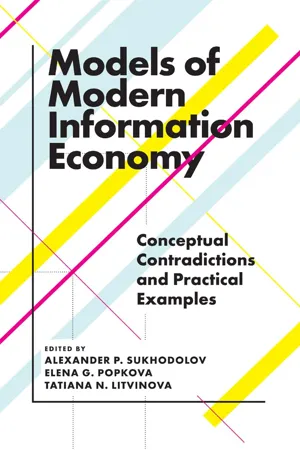
eBook - ePub
Models of Modern Information Economy
Conceptual Contradictions and Practical Examples
- 360 pages
- English
- ePUB (mobile friendly)
- Available on iOS & Android
eBook - ePub
Models of Modern Information Economy
Conceptual Contradictions and Practical Examples
About this book
The concept of an information economy is considered by some to be a new branch of economic theory, and by others as the next stage of development for an economy post-industrialization. Leading and developing economies are seeking to quickly develop a functional information economy in order to help overcome the consequences of the global financial crisis and ensure high global economic competitiveness.
Trusted by 375,005 students
Access to over 1.5 million titles for a fair monthly price.
Study more efficiently using our study tools.
Information
Topic
EconomíaSubtopic
Teoría económicaTHEORETICAL MODEL OF
MODERN INFORMATION
ECONOMY
Chapter 1
The Notion and Essence of Information Economy
Abstract
Purpose – The purpose of this chapter is to study the conceptual provisions of the theory of information economy and to determine its notion and essence.
Methodology – The research methodology is based on the application of traditional methods of economic science, including the methods of systemic, problem, and comparative analysis, method of analysis of causal connections, systematization, classification, and formalization of scientific data.
Results – The authors systematize the existing conceptual provisions of the theory of information economy and classify the conceptual approaches to its study as process approach, resulting approach, and combined approach; a comparative analysis of these approaches is also conducted.
Recommendations – The authors conclude that the evolutional development of modern socio-economic systems is dominated by the information economy concept, which should be the basis of the future developmental model of the global economic system. This concept develops within the combined approach, based on the previous concepts of digital economy and internet economy, which is a part of the process approach proclaiming technological capital, the key factor of reproduction, by focusing on the development of socio-economic systems and the concept of knowledge economy, which is a part of the resulting approach that emphasizes human capital and innovations as a target result of the development of economic systems. The information economy concept includes the features of previous concepts, emphasizes the importance of technological and human capital, applies information and communication technologies, and achieves results that are connected to highly effective creation, storage, distribution, and usage of information. It also supplemented them with a new sense of proclaiming information on the most valuable resources as well as provision of free and continuous interaction of economic subjects – the highest priority of socio-economic systems.
Keywords: Digital economy; internet economy; knowledge economy; socio-economic development; information economy; socio-economic system
JEL classifications: B52; L86; M15; O11; O32; P52
Introduction
Socio-economic systems are the most complex study objects in modern science as they are subject to constant changes and include several connections of elements possessing unique characteristics. Economic science distinguished the common features and qualities of these elements, modeled statistical states of socio-economic systems, and determined the tendencies and regularities of their development, suggesting their dynamic models.
At present, it is proven that socio-economic systems not only develop but also evolve and become more complicated. This process is described differently by different scholars such as change of economic formations, transition to new technological modes, formation of new and more complex social systems. The modern global economic system is in a transitional state in which the previous model of its development, which envisaged foundation on a society of consumption, postindustrial economy, and almost absolute market freedom, depleted its potential of stimulation of economic growth and social progress.
The duration of overcoming the consequences of the global depression of the early twenty-first century, which was accompanied by cardinally opposite measures applied by governments of different countries for restoration of the economy after the crisis, shows the global society’s lack of an understanding of a new model of socio-economic development. Certain features of this model, which correspond to the key global tendencies of modernization of economic systems are noted by different scholars and are set in the foundation of their visions of the future that outline the global economy as prospective vectors of its development.
All things considered, the problem of inconsistency of scientific knowledge and its contradictions arises. This problem is caused by different treatments of the same socio-economic phenomena and processes or applications of various notions for denoting them. This does not allow for compilation of a comprehensive model and a precise new course of socio-economic development of the modern global economic system, which hinders a successful struggle with crisis phenomena in this system.
In this chapter, the authors offer a hypothesis that furthers the development perspectives of the global economy that are related to the formation of information economy. The purpose of this chapter is to study the conceptual provisions of the theory of information economy and to determine its notion and essence.
Materials and Method
A theoretical overview of the selected topic showed that there are four scientific schools that study the information economy and come to an agreement that it is the highest stage of socio-economic system development; however, it is assigned various features. The first one formulates the object of study as the digital economy which emerged at the end of the twentieth century; its key scientific provisions are described in the works of the following authors: Chakpitak, Maneejuk, Chanaim, and Sriboonchitta (2018); Cheng and Foley (2018); Goldstein (2017); and Teoh and Mahmood (2017).
The second scientific school, which appeared at the same time, studies the internet economy. Its representatives are described in Sukhodolov, Popkova, and Kuzlaeva (2018a, 2018b). The similarity of the conceptual settings allows for the definition of this scientific school as a component (subsystem) of the first scientific school, which studies the digital economy. However, these schools are divided for the vividness of differences in the categorical tools used.
The third scientific school treats the pinnacle of evaluation of socio-economic systems as the knowledge economy and defines it as the object of its research. This school appeared at the beginning of the twenty-first century and includes many scholars (Arsenyev, Litvinova, Parakhina, Kozenko, & Denisov, 2016; Goryainova, Krishtal, & Kuznetsova, 2017; Kravets, Gurtjakov, & Darmanian, 2013; Kuleshov, Untura, & Markova, 2017; Kuznetsov, Tereliansky, Shuvaev, Natsubize, & Vasilyev, 2016; Popova, Litvinova, Ioda, Suleimanova, & Chirkina, 2015; Przhedetskaya & Akopova, 2016; Sibirskaya & Shestaeva, 2016).
The fourth scientific school, which appeared in the early 2010s, offered the term “information economy” and selected it as the object of research. The main scientific provisions of this school are described in the works of the following authors: Aliyev, Shahverdiyeva, and Abbasova (2017); Azuero Zúñiga, Guzmán Vás Quez, and Trujillo Dávila (2017); Bogoviz, Ragulina, Komarova, Bolotin, and Lobova (2017); Boukouras and Koufopoulos (2017); Chen, Wang, Nevo, Benitez, and Kou (2017); Keszey (2017); Öhman and Floridi (2017); Tan and Hew (2017); and Timofeev, Bayandin, and Kulikova (2018).
Meanwhile, it should be noted that the representatives of the above scientific schools do not show their connection to these or other schools. Further, the modern scientific economic literature is peculiar for the phenomenon of substitution of notions, at which the research object is assigned, with characteristics that are not peculiar to them, or, in other words, the research uses various scientific terms to denote the same idea (research objects of different schools).
This shows the weakness of the fundamental platform of studying information economy and imprecision of the categorical tools of this modern scientific economic theory, which reflects the necessity for further research aimed at the specification of its theoretical provisions. The methodology of the research conducted in this chapter is based on the application of traditional methods of economic science, including the method of systemic, problem, and comparative analysis, analysis of causal connections, method of systematization and classification, and formalization of scientific data.
Results
As a result of content analysis, systematization, and classification of the existing studies and publications on the studied topic, we distinguished three main conceptual approaches to determine the notion and essence of information economy. Their comparative analysis is shown in Table 1. Representatives of these approaches are specified in the description of scientific schools that correspond to the names of economies that are research objects of these approaches.
Table 1. Comparative Analysis of Conceptual Approaches to Defining the Notion and Essence of Information Economy.

In Table 1, approaches are named depending on the essence and role of the research objects in socio-economic systems. The technological approach studies digital and internet economies, which show technological peculiarities of the development of modern economic systems, related to the application of digital and, in particular, internet technologies.
This approach helped the formation of digital society in leading developed countries of the world and the process of formation of digital society in developing countries. The leading developed countries are countries that achieved the highest success in the informatization of their socio-economic systems. The ranking of all countries as per the development of information and communication technologies (ICT Development Index, which is measured in points from 1 to 10) is compiled annually by the International Telecommunication Union (2018). The leading developed countries that achieved the largest success in the informatization of their socio-economic systems in 2017 include the following countries (International Telecommunication Union, 2018):
- Ireland (ICT Development Index constitutes 8.98 points, first position in the ranking of countries as per this index);
- South Korea (ICT Development Index constitutes 8.85 points, second position in the ranking of countries as per this index);
- United Kingdom (ICT Development Index constitutes 8.65 points, fifth position in the ranking of countries as per this index);
- Japan (ICT Development Index constitutes 8.43 points, 10th position in the ranking of countries as per this index);
- Germany (ICT Development Index constitutes 8.39 points, 12th position in the ranking of countries as per this index); and
- USA (ICT Development Index constitutes 8.18 points, 16th position in the ranking of countries as per this index), etc.
We think that countries that occupy the top 20 positions in this ranking could be considered to be leading in the aspect of information economy development. Russia occupies 45th position in this ranking (7.07 points) (International Telecommunication Union, 2018), which shows the success of the Russian socio-economic system in the formation of information economy and certain perspectives of its success in entering the group of leading developed countries.
In this society, digital technologies are used, they are widely available to masses, and most people possess the competences of using them. Digital society is the basis for the formation of digital economy, in which digital technologies are included in business processes. One of its forms is internet economy, which is based on internet technologies.
Due to the application of digital technologies, including the internet, it becomes possible to produce and distribute electronic goods and services. Almost all socio-economic phenomena and processes acquire electronic form. Thus, the system of electronic payments is formed in which financial operations are performed remotely; the system of e-governance, which provides consumers with remote access to the state, survives; the system of electronic entrepreneurship, which eliminates direct (personal) interaction between buyers and sellers, and other new systems exist. Moreover, the existing systems are transformed into an electronic format.
The resulting approach studies the knowledge economy, which reflects the result of socio-economic development of modern economic systems, related to the creation, distribution, and usage of new knowledge. According to this approach, modern socio-economic systems are peculiar for knowledge society or innovational society, in which the highest value belongs to new knowledge – innovations.
In this society, establishment of knowledge economy – innovational economy – takes place. The most valuable production factor is human capital, which includes labor (one that ensures execution of routine business operations) and intellectual (one that determines the capability for innovational activity) competences of employees that lead to the creation of formalized (separated from their creator and/or bearer and, as a rule, protected by the right for objects of intellectual property – patents, useful models, etc.) and nonformalized (inseparable from their creation and/or bearer and, as a rule, not protected by the right for objects of intellectual property – new ideas, know how, etc.) new knowledge and technologies.
Due to public support for innovational activity of economic subjects, constant innovational development of economic systems takes place, determined within the resulting approach as a key landmark and the main purpose of knowledge economy. For that, high-tech spheres of economy are created that are peculiar to high knowledge-intensity, are based on new technologies, and that ensure creation of leading knowledge.
Simultaneous existence of the process and resulting approaches – despite their different treatments of the essence of the future direction for d...
Table of contents
- Cover
- Copyright Page
- Introduction
- Part I: Theoretical Model of Modern Information Economy
- Part II: Practical Experience of Formation of Information Economy’s Model
- Part III: Peculiarities of Information Economy in Modern Russia
- Part IV: Logical Disparities of the Model of Information Economy
- Part V: Recommendations for Optimization of the Model of Information Economy
- Part VI: The Key Characteristics of the Optimization Model of Well-Balanced Information Economy
- Part VII: Methodological Provision of Monitoring and Control Over Implementation of the Optimization Model of Information Economy
- Part VIII: Adaptation of the Optimization Model to the Modern Russia’s Economy
- Index
Frequently asked questions
Yes, you can cancel anytime from the Subscription tab in your account settings on the Perlego website. Your subscription will stay active until the end of your current billing period. Learn how to cancel your subscription
No, books cannot be downloaded as external files, such as PDFs, for use outside of Perlego. However, you can download books within the Perlego app for offline reading on mobile or tablet. Learn how to download books offline
Perlego offers two plans: Essential and Complete
- Essential is ideal for learners and professionals who enjoy exploring a wide range of subjects. Access the Essential Library with 800,000+ trusted titles and best-sellers across business, personal growth, and the humanities. Includes unlimited reading time and Standard Read Aloud voice.
- Complete: Perfect for advanced learners and researchers needing full, unrestricted access. Unlock 1.5M+ books across hundreds of subjects, including academic and specialized titles. The Complete Plan also includes advanced features like Premium Read Aloud and Research Assistant.
We are an online textbook subscription service, where you can get access to an entire online library for less than the price of a single book per month. With over 1.5 million books across 990+ topics, we’ve got you covered! Learn about our mission
Look out for the read-aloud symbol on your next book to see if you can listen to it. The read-aloud tool reads text aloud for you, highlighting the text as it is being read. You can pause it, speed it up and slow it down. Learn more about Read Aloud
Yes! You can use the Perlego app on both iOS and Android devices to read anytime, anywhere — even offline. Perfect for commutes or when you’re on the go.
Please note we cannot support devices running on iOS 13 and Android 7 or earlier. Learn more about using the app
Please note we cannot support devices running on iOS 13 and Android 7 or earlier. Learn more about using the app
Yes, you can access Models of Modern Information Economy by Alexander P. Sukhodolov, Elena G. Popkova, Tatiana N. Litvinova, Alexander P. Sukhodolov,Elena G. Popkova,Tatiana N. Litvinova in PDF and/or ePUB format, as well as other popular books in Economía & Teoría económica. We have over 1.5 million books available in our catalogue for you to explore.